NAll news

Saturday28 items

  1. QbitAIProduct release
    AI score73

    Dawa Technology's Scenes AI real-time world model runs a 34B-parameter model on a single RTX GPU

    Dawa Technology's real-time world model Scenes AI won the "Halfway Showcase Outstanding Enterprise Award" at the 2026 NVIDIA Startup Showcase halfway showcase. The model has 34B total parameters, activates only about 4B per step, and achieves 720P, 25 fps real-time output on a single NVIDIA GeForce RTX consumer-grade GPU. It does not redraw the frame pixel by pixel; instead, it maintains separately readable and writable world state variables such as scenes, characters, cameras, lighting, objects, and physics, and updates only the local parts that change. Compared with traditional video diffusion approaches, GPU consumption is reduced by 40%–60% and inference speed is increased by 3–5 times. The team says its data comes from about 180TB of structured world state data accumulated from the 84,000-square-meter studio in Yongchuan, Chongqing, and more than 300 real commercial projects.

    #Product updates#Video#English text is being prepared.
  2. Analytics India MagazineProduct release
    AI score81

    Anthropic opens Claude Duet agent preview to Pro and Max subscribers in the US

    Anthropic is opening a research preview of the Claude Duet agent to Pro and Max subscribers in the US, offering standalone iOS and Android apps and a claude.ai entry point, based on the Claude Opus 5.5 model. The agent can schedule meetings, draft emails, build dashboards, generate financial and sales forecasts, develop prototypes and web apps, and connect to more than 6,000 tools including Gmail, Slack, QuickBooks, and HubSpot through Claude Marketplace. It runs in a virtual machine with its own browser, checks linked accounts every few hours, and requires user approval before sending messages, making payments, signing documents, or deleting information; securities trading and transfers between accounts are not permitted even with approval.

    Same story · 44 reports

    #Product updates#Agents#Anthropic

  3. Testing CatalogProduct release
    AI score54

    Mubit launches a platform for teams to train their own small models, and releases an open-source model and a new benchmark

    Mubit launches a platform that lets teams train their own AI models for repetitive tasks, while also releasing an open-source model and a new benchmark. The platform sits as an agent base URL in front of OpenAI, Anthropic, or Gemini APIs, trains small models based on agent tasks, and in Mubit's tests can take over tasks once it catches up to frontier models. The platform can also learn from historical calls imported from Langfuse, Braintrust, or Pydantic Logfire.

    We started Mubit in Aberdeen. No network, no lab, nobody knew us. We just wanted AI systems that actually work. Today we work with some of the best companies and engineers in the world. And the thing we kept seeing: you and your competitor run the same AI. It should be yours. 🧵 Comment "SAPLING" in the next 48 hours for $100 free credits. Enterprises get the first month free.

    Same story · 2 reports

    #Product updates#Agents#English text is being prepared.

  4. MiniMaxFirst-partyProduct release
    AI score58

    MiniMax M3.1 Flash Launches on Fireworks Serverless Preview

    MiniMax officially stated that Fireworks integrated M3.1 Flash into its serverless platform on the same day the open weights were released, offering it in preview form for two weeks. The model is designed for long-running, multi-step agent workflows. Fireworks' reported figures include 62.8 on AutomationBench-AA, 73.7% on DeepSWE v1.1, and 91 on BabyVision, with pricing at $0.15 per 1M input tokens, $0.60 per 1M output tokens, and $0.015 per 1M cached tokens—half the price of M3.

    We have another release you don’t want to miss. @MiniMax_AI M3.1 Flash is now live on Fireworks, day 0 with the open-weights release. Built for agents that run long, multi-step work: → Cowork automation: 62.8 on AutomationBench-AA → Coding: 73.7% on DeepSWE v1.1 → Visual reasoning: 91 on BabyVision → $0.15 input / $0.60 output / $0.015 cached per 1M tokens, half the price of M3 We've heard your feedback that you want more models on serverless. So we're launching more models in preview mode, starting today with M3.1 Flash, available for two weeks. We'll be watching demand, and if the community likes it, we'll keep it around. Try it now → https://t.co/RVwd3ETz9d

    #Product updates#English text is being prepared.#Agents

  5. Aravind SrinivasProduct release
    AI score62

    Perplexity Computer autonomously turns a Raspberry Pi 5 into a game console via SSH

    Perplexity CEO Aravind Srinivas shared that a user granted Perplexity Computer SSH access to a Raspberry Pi 5 via Tailscale, and it autonomously turned the device overnight into a game console with an arcade UI, toolchain, and MCP integration. The console can generate GBA, C, Rust, and terminal games, and automatically completes compilation, playtesting, and bug fixing; Computer also built a USB gamepad service supporting button remapping, turbo, vibration, and per-game profiles, as well as a Minecraft-style multiplayer voxel game written in C (141 KB binary), where users can play together with an AI bot played by Computer, commanded via in-game chat through MCP.

    #English text is being prepared.#Agents#English text is being prepared.

  6. Rohan PaulProduct release
    AI score58

    Mubit launches a service that trains your own small model using agent API calls

    Mubit reads the API calls that agents have already sent to OpenAI or Anthropic, identifies repetitive tasks, and trains a user's own small model so that this portion of the work costs less and has shorter wait times, while the remaining tasks are still handled by frontier models. Integration only requires replacing the base URL and keeping the existing client code; it can also connect directly to traces that have already been collected. The company says the model refreshes every few minutes. The author believes the idea is to write experience into weights rather than prompts, so agents from different companies will train different small models.

    We started Mubit in Aberdeen. No network, no lab, nobody knew us. We just wanted AI systems that actually work. Today we work with some of the best companies and engineers in the world. And the thing we kept seeing: you and your competitor run the same AI. It should be yours. 🧵 Comment "SAPLING" in the next 48 hours for $100 free credits. Enterprises get the first month free.

    Same story · 2 reports

    #Product updates#Agents#English text is being prepared.

  7. ZhidongxiProduct release
    AI score72

    OpenAI opens the Decisions API to all customers, using GPT-6 Luna to cut decision responses to 100 milliseconds

    On October 22, OpenAI officially opened the Decisions API to all customers. This interface is based on the reasoning model GPT-6 Luna to optimize reasoning speed and cost, and in some scenarios reduces response time from 1 to 3 seconds to 100 to 180 milliseconds. The interface is aimed at tasks with a clear range of answers. Developers can preset questions and selectable answers, and the model outputs probabilities, options, or scores, for use in content classification, request routing, and deciding the next action of AI agents, processing up to 400 questions per request. Datadog uses it to assess the risk of commands generated by agents, with P95 latency about 40 times faster than available frontier models; Ramp improves processing speed by 4 times and reduces cost by 30%; Speak reduces the waiting time between user actions from 1.4 seconds to 0.13 seconds.

    Same story · 7 reports

    #Product updates#Agents#OpenAI

  8. ZhidongxiProduct release
    AI score61

    StartLux open-sources the Prism inference engine for decision models, delivering up to 5.3x faster single-card inference

    StartLux (Yuandian Xinghui) has open-sourced its self-developed inference engine Prism, designed specifically for decision models. On a single H200, it processes a single short question 2.8x faster than the original vLLM solution, and when asking three questions in a row on the same material, it achieves up to 5.3x speedup. Prism restructures the inference pipeline around four changes: narrowing the output computation range, forest-style computation, int8 integer arithmetic, and mixed-batch scheduling. In a 231-question cross-engine comparison, its average per-question latency was 41 milliseconds, lower than SGLang's 75.6 milliseconds and vLLM's 112.7 milliseconds. The team also released the complete engine code and optimization logic. Its decision model StartLux-Decision-v1.1 previously topped the Hugging Face Decision Index 0.3.2 with a score of 69.1.

    Same story · 2 reports

    #English text is being prepared.#Reasoning#English text is being prepared.

  9. NumeramaProduct release
    AI score65

    1Password Launches 1Password for Agents, Letting AI Agents Sign In to Accounts Without Touching Passwords

    1Password has released 1Password for Agents, allowing AI agents to sign in to accounts after user approval, but without ever seeing the password throughout the process. The agent first identifies itself to 1Password using a dedicated digital key, the user confirms the requested account and purpose on their own authorized device, and then 1Password fills in the login form on the agent's behalf, revoking the credentials immediately after a successful sign-in. The first batch of integrations are Meta's Muse and SpaceXSI's Grok Bot, to be deployed over the coming days; partners such as Anthropic's Claude Duet, OpenAI's ChatGPT Work and dots, and Perplexity have not yet given a timeline. The service is included in personal and family subscriptions at no extra charge, and currently only supports accounts hosted on 1Password.com; 1Password.eu and 1Password.ca accounts are not yet supported.

    Same story · 13 reports

    #Product updates#Agents#English text is being prepared.

  10. ComputerworldProduct release
    AI score66

    Anthropic launches AI agent Claude Duet, targeting Meta Muse and OpenAI Dots

    Anthropic on Wednesday released AI agent Claude Duet, based on the Claude Opus 5.5 model, mainly aimed at small business owners and professionals for tasks such as planning, meetings, and building web apps. The agent comes with a virtual machine featuring a built-in browser. The report mentions that Anthropic last month also launched Claude Docs and Slides, targeting Microsoft Word and PowerPoint.

    Same story · 44 reports

    #Product updates#Agents#Anthropic

  11. Fortune AIProduct release
    AI score71

    Anthropic launches personal AI assistant Claude Duet

    Anthropic releases Claude Duet as a research preview; this app is aimed at professionals and small business owners, and can check email and calendar, draft replies, and follow up on unfinished items. Duet reuses the memory, skills, and app connections users have already set up in Claude, sends morning briefings, checks connected accounts throughout the day, and notifies users when tasks are completed or decisions are needed. Duet shares usage quota with regular Claude conversations, and background checks consume quota, so Anthropic says it checks connected accounts only every few hours; Team and Enterprise customers must wait for availability.

    Same story · 44 reports

    #Product updates#Agents#Anthropic

  12. Claude BlogFirst-partyProduct release
    AI score62

    Anthropic releases Claude Duet research preview and discloses its safety, privacy, and security design

    Anthropic releases the research preview of Claude Duet, a proactive agent that runs continuously on a cloud computer, can read the inbox, draft replies, book appointments, and execute routines after you leave. Before sending sensitive messages, making payments, or deleting content, it displays the action, target, and content and waits for approval; operations such as securities trading and transfers between accounts are not permitted even with approval. A newly added safety classifier divides information into two levels: never share and share with consent; passwords, browser cookies, and login tokens do not pass through the model, and the browser runs in a separate virtual machine.

    Same story · 44 reports

    #Safety / alignment#Agents#Anthropic

  13. Claude BlogFirst-partyProduct release
    AI score58

    Claude Enterprise merges chat and Cowork into a unified experience

    Anthropic announced that the Claude Enterprise plan officially launches a unified Claude experience, merging chat and Cowork across web, desktop, and mobile, so teams can ask questions or deliver complete projects within the same conversation. Agent tasks run in Anthropic-hosted cloud environments, with each session using a separate virtual machine, network egress disabled by default, and connector credentials stored outside the sandbox. Administrators can control access by role and use the new Efficient mode to limit the experience to Sonnet and Haiku models, while also supporting spending limits at the organization, group, and member levels.

    #Product updates#Anthropic#Agents

  14. Google ResearchFirst-partyProduct release
    AI score63

    Google Research uses open models such as MedGemma to advance tuberculosis screening implementation

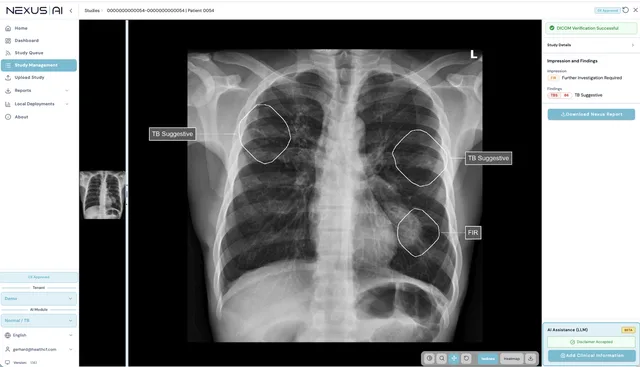
    Google Research and Google for Health presented progress in bringing health AI research into clinical practice at IDWeek 2026, including open-source chest X-ray embeddings and MedSigLIP, as well as open-weight multimodal models MedGemma at 4B and 27B parameter scales; the latter can run locally offline and has accumulated over 10 million downloads. Tools developed by partner Nexus AI based on these algorithms have obtained EU CE MDR class IIb certification and ISO 13485 certification, and have been deployed in about 40 medical institutions across six countries including South Africa, Sierra Leone, and Côte d'Ivoire; more than 90 clinicians have evaluated over 25,000 chest X-rays, reducing turnaround time from weeks to under 45 seconds. Indonesia's Ministry of Health is fine-tuning MedGemma and MedSigLIP with domestic chest X-rays to support a screening target of 50 million people per year on local infrastructure.

    A Nexus AI software interface displaying a chest X-ray with three circled lung areas marked as "TB Suggestive" and "FIR".

    #Industry news#Multimodal#Open-source ecosystem

  15. Figma AI / Agent / MakeFirst-partyProduct release
    AI score55

    Figma code layers enter public beta, six teams share how they use it

    Figma announced that code layers have entered public beta, allowing teams to explore and build code-backed prototypes on the canvas. The article lists how six teams—Superside, Dell, Cox Automotive, Rocket Money, Merkle, and Checkout.com—use it, including using the Figma agent to turn static designs into code layers, comparing multiple versions side by side, and iterating in stages with precise values and reference screenshots. Merkle says iteration and feature development speed increased by 30%, and documentation creation time was reduced by up to 50%; a product manager at Cox Automotive says 19 versions took only about an hour of manual operation time. Code layers will consume AI credits; creating and editing will be free on paid plans until November 4, 2026.

    Pickup App preview showing a wall clock listing beside its App.tsx code.

    #Product updates#English text is being prepared.#Agents

Friday74 items

  1. Phoenix TechnologyProduct release
    AI score55

    StartLux open-sources decision model inference engine Prism, up to 5.3x faster inference on a single card

    StartLux Origin Star open-sources its self-developed inference engine Prism, claiming it is the first inference engine built specifically for decision models and open-sourced. On a single H200, Prism processes a single short question 2.8x faster than the original vLLM 0.31 solution, and asking three questions in a row about the same material is up to 5.3x faster. The team says it achieves the speedup through four optimizations: narrowing the output layer computation range, forest-style computation, int8 integer arithmetic, and mixed scheduling; in a 231-question cross-engine comparison, the average per-question latency is 41 milliseconds.

    #English text is being prepared.#Reasoning#English text is being prepared.

  2. Shao MengProduct release
    AI score60

    The Grok Bot team launches Team Bots, which can share personal workflows as internal team tools

    The Grok Bot team shares the Team Bots feature, which can package a personal Grok Bot's judgment, processes, and tools into internal tools usable by the team; it is currently open to Teams and Enterprise customers. Team Bot supports layered permissions: collaborators can be invited to change rules or be granted usage-only access, and it can connect to Slack and Teams so colleagues can directly @ mention and invoke it. The Marketing Review Bot in the demo outputs Before / After / Why according to marketing copy preferences, while the complex example uses the Typefully API, Skills, and a routine about once every 30 minutes to complete review, scheduling, and posting.

    Team Bots - Grok Bots for your whole team 1:18 A simple example 1:51 Why they're powerful 2:32 Connecting your tools 3:11 How to make one 3:52 A complex example 5:48 When to make one 7:21 Under the hood 7:55 Recap Currently available to Teams & Enterprise customers - more soon! https://t.co/0HrNArSmWC

    #Product updates#Agents#English text is being prepared.

  3. Aravind SrinivasProduct release
    AI score51

    Perplexity Computer integrates LexnLin's open-source Taste Skill

    Perplexity CEO Aravind Srinivas said that Computer has integrated @LexnLin's open-source skill, giving it better aesthetics when building sites, and is offering every user 5000 credits to try it. The cited official Computer account explained that Taste Skill has entered the Computer skills marketplace and sets the artistic direction before building a site, with layout and typography referencing 247 websites from Awwwards and One Page Love; tasks using /taste-skill are free until October 31, with up to 5000 credits per user.

    The Taste Skill by @LexnLin, now in Computer's skills marketplace, sets an art direction before Computer builds a website. Layout and type draw on 247 sites from Awwwards and One Page Love. Tasks that use /taste-skill are free through October 31, up to 5,000 credits per user. https://t.co/XWIgQZavHo

    #Product updates#Agents#Open-source ecosystem