 AI Trends
- Customers can access the same copy of data from either BigQuery or Databricks without duplication.
- Google and Databricks are committed to a long-term vision of shared catalog metadata.
The Lakehouse architecture is becoming more open than ever. What started with open table formats – Delta Lake and Iceberg – has evolved into catalog federation for zero-copy access across multiple platforms. Through our partnership and Open Source contributions, Databricks and Google Cloud continue to drive advancements in the Open Lakehouse community.
Today, we're proud to announce a significant milestone in catalog interoperability in collaboration with Google: customers can now access a single copy of data from both Unity Catalog and Google Cloud's borderless Lakehouse. The Databricks and Google Cloud partnership continues to thrive, and we're committed to making bi-directional interoperability seamless.
Unity Catalog and Google Cloud's Lakehouse: Bi-Directional Federation
Bringing data from Google Cloud into Databricks is simple. With Lakehouse Federation to Google Cloud, customers can mount Iceberg tables managed by Google Cloud's Lakehouse runtime catalog in Unity Catalog for analysis in Databricks.
These Iceberg tables from Google's Lakehouse runtime catalog can then be queried by Databricks Lakehouse, our serverless data warehouse, or analyzed via Genie, which intelligently answers data questions from natural language – no code or SQL required.
Interoperability works in the other direction as well. Data from Databricks can also be brought into Google Cloud's Lakehouse (learn more). This allows customers using engines like BigQuery to read Unity Catalog managed tables without data copy.
The Next Frontier: Making Catalog Metadata Interoperable
Databricks and Google Cloud are taking major strides to strengthen interoperability by making catalog metadata open. Our belief is that business and governance semantics should be accessible rather than tied to a specific vendor. In the Iceberg community, we helped drive and land catalog labels - a proposal that enables catalogs to share metadata through key-value pairs (a.k.a labels). That way, a table tagged as "domain=finance" and "status=certified" with a column tagged as "pii=ssn" continues to be tagged even as the table is federated from one catalog to another (learn more).
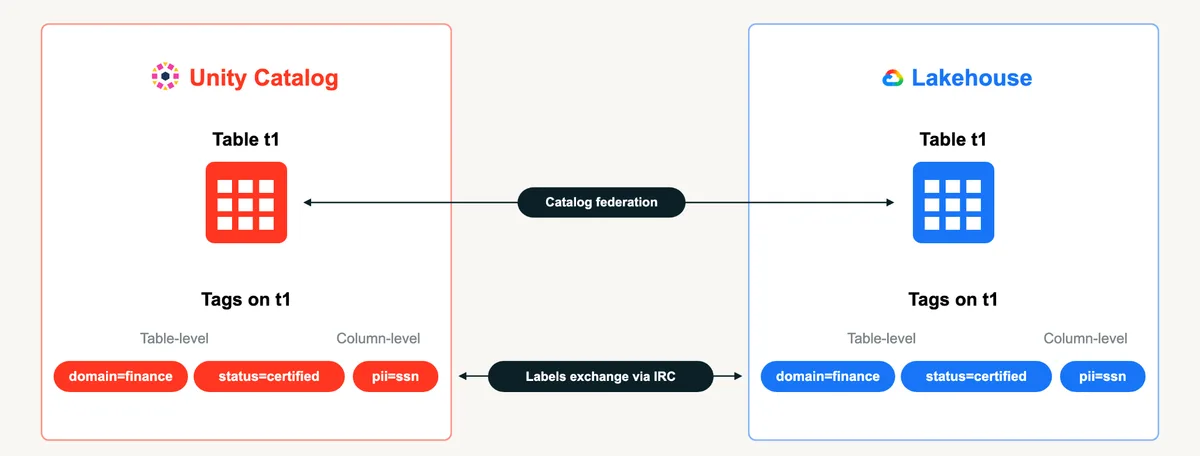
Shared labels are critical for governance in the era of agents as catalog metadata can be used to flag sensitive data for masking and provide context to agents searching for assets to answer data questions. Through our partnership, Databricks and Google Cloud are committed to advancing the vision of open governance. As data estates grow and AI agents become more embedded in enterprise workflows, that shared commitment becomes increasingly important. We're headed towards a future where governance and business context can travel with data without requiring enterprises to redefine them in every system.
Get Started Today
Get started with Catalog Federation between Unity Catalog and Google Cloud's borderless Lakehouse by reading our documentation. You can also learn more about Google's catalog federation to Unity Catalog here.
If you're interested in sharing your interoperability needs or learning more about our vision for interoperability, please reach out to your Databricks account team.
Related tags:Get the latest posts in your inbox
Subscribe to our blog and get the latest posts delivered to your inbox.