 En
- Research Outputs Think Tank Reports Academic Papers Current Affairs Commentary Research References Academic Books
- Academic Exchange International Conferences Domestic Conferences Domestic and International Exchange
- External Engagement Podcasts Newsletters Media Interviews Communication References
- Center Team Academic Committee Research Team Special Experts Visiting Scholars Administrative Team
- Talent Development International Youth Exchange Strategic Youth Tsinghua University Student Association for Global Strategy Studies Tsinghua University Student Association for China-US Cultural Exchange Overseas Practical Activities Doctoral Researchers
 Research Outputs
Current Affairs Commentary
Lu Chuanying: The Diffusion of Issues, Institutional Framework, and China's Role in Global AI Governance
 2026-11-03
Lu Chuanying Special Expert of the Center for Strategic and Security Studies at Tsinghua University; Professor at the School of Political Science and International Relations, Tongji University; and Executive Deputy Director of the Institute of International Cyberspace Governance
Summary
Issue diffusion and institution building are the core issues in current global AI governance. Global AI governance issues show a trend of extending from behavioral norms toward both the technological and industrial ends. Issue diffusion is manifested not only in the increase in the number of issues but also in a cross-domain and cross-level diffuse pattern. Issue diffusion is not a natural expansion of the scope of governance; rather, it is jointly driven by the consensus dilemma of behavioral norms, the endogeneity of technological risks, and the strategicization of the conditions for the formation of technological capabilities. Along with issue diffusion, a governance framework composed of existing multilateral mechanisms, specialized emerging mechanisms, and comprehensive governance mechanisms is gradually taking shape worldwide. China's approach, which is based on the concept of attaching equal importance to development and security, takes multilateral institutional coordination as its implementation path, and takes capacity building in the Global South as its practical support, makes important contributions to promoting the development of global AI governance in the direction of equal co-governance, openness and inclusiveness, and coordinated cooperation.
Keywords
Global AI Governance Issue Diffusion Institutional Framework China's Role
Since the Dartmouth Conference in 1956, AI technology has achieved multiple rounds of development, but the process of global AI governance has not advanced in tandem. In 2014, the first informal meeting of experts on "lethal autonomous weapons systems" (LAWS) under the framework of the Convention on Certain Conventional Weapons (CCW) was held, and AI-related issues began to enter the intergovernmental security governance agenda in a relatively systematic way. In 2022, the official release of ChatGPT accelerated the process of global AI governance, and various global and regional multilateral organizations and specialized agencies successively issued AI governance initiatives, principles, and action arrangements. As of October 2026, the "AI Policy Navigator" under the framework of the Organisation for Economic Co-operation and Development (OECD) had recorded 2,568 policy initiatives. However, the proposal of numerous governance initiatives has not, as expected, promoted global AI cooperation; instead, it has led to a fragmented situation in which governance issues continue to diffuse and institutional arrangements overlap. Against this background, issue diffusion and institution building have become the core issues in current global AI governance.

July 17, 2026, Shanghai: At the Enterprise AI High-Quality Development Forum of the 2026 World Artificial Intelligence Conference, a promotional poster for AI humanoid robots attracts attention. (China News Service photo)
The Diffusion of Issues in Global AI Governance
As a general-purpose technology, AI is intertwined with issues in different fields such as security, development, economy, and society, forming a composite governance agenda. AI has become one of the global governance fields with the fastest growth in the number of issues and the most obvious expansion of governance boundaries. Understanding the basic paths, internal drivers, and morphological evolution of the diffusion of AI governance issues is an important prerequisite for analyzing changes in AI governance institutions.
I. The Basic Paths of Issue Diffusion
Global AI governance issues generally show a trend of extending from behavioral norms toward both the technological and industrial ends. Traditional governance focuses on the behavioral norms of states and other actors in specific fields and advocates reducing risks by regulating behavior. Early AI governance followed this approach, focusing on issues such as fairness, transparency, accountability, human oversight, and responsible use, with the core being to regulate how developers, enterprises, governments, and other actors develop, deploy, and use AI. Although the international community generally accepts basic principles such as "human-centered" and "responsible use" and "maintaining human oversight," there are obvious differences at the level of specific rules.
At the same time, AI governance issues are extending toward the technological front end, that is, from "how to use AI responsibly" to "whether AI itself is safe." The safety, reliability, trustworthiness, and controllability of AI systems have become important issues in global governance. Compared with early governance issues, current governance issues are more professional and technical and rely on tools such as risk assessment, safety testing, technical verification, and standard setting. The Bletchley AI Safety Summit and the International Organization for Standardization, among others, have advanced global governance of AI system safety from the dimensions of international policy consensus and technical standards, respectively; multilateral mechanisms such as the United Nations, the Group of Twenty (G20), and the Asia-Pacific Economic Cooperation (APEC) have also incorporated principles such as safety, trustworthiness, transparency, and explainability into AI governance frameworks.
AI governance issues are also extending toward the other end, that is, from technology application to the industrial system and technological ecosystem that support AI capabilities. The development of AI technology is highly dependent on basic conditions such as advanced semiconductors, computing power, energy, critical minerals, and data centers. Technology access, capability diffusion, and supply chain security have become new governance issues. Technologically leading countries mainly focus on the protection of key technologies, supply chain resilience, and the risks of advanced capability diffusion, while technologically lagging countries focus more on technology accessibility, access to computing power, the digital divide, and capacity building. Because of differences in their positions in the industrial chain, technological capabilities, and stages of development, countries' governance demands differ markedly, and the technology industry and strategic security have become issue areas with relatively large disagreements in current global AI governance.
II. The Internal Drivers of Issue Diffusion
The diffusion of global AI governance issues is not a natural expansion of the scope of governance; rather, it is jointly driven by the consensus dilemma of behavioral norms, the endogeneity of technological risks, and the strategicization of the conditions for the formation of technological capabilities.
First, the consensus dilemma over behavioral norms drives the diffusion of governance issues into the technological domain. Establishing behavioral norms such as "responsible use of artificial intelligence" was originally the primary goal of global AI governance, but technological uncertainty, the complexity of application consequences, and differences in national development levels and interest demands make it very difficult for countries to reach consensus on the question of "how to use artificial intelligence." For example, on the governance of lethal autonomous weapons systems, technologically leading countries and some Global South countries have clear disagreements over the boundaries of military applications of AI: the former tend to preserve space for technological use under certain normative constraints, while the latter advocate imposing strict limits on military applications. Such disagreements mean that the establishment of norms may take a long time, yet the risks are imminent. This drives global AI governance issues from behavioral norms toward areas such as technical safety and technical capabilities, where consensus is easier to reach.
Second, the endogeneity of technological risks drives the expansion of governance issues toward technical safety. The technological risks of AI are endogenous to model training, algorithm operation, and system interaction. Model hallucination, algorithmic bias, inexplicability, and unpredictable behavior in complex environments mean that even if users follow established rules, the technical system itself may still generate risks. As the capabilities of large models improve and the scope of applications expands, related risks may also cross industries and national borders, affecting the operation of society and even producing systemic consequences. AI safety is no longer merely a technical responsibility within enterprises, but a public governance matter requiring transnational coordination. This risk attribute determines that governance must reach the technology itself and cannot remain at the external level of regulating technology use behavior. Technical safety governance can effectively reduce the endogenous risks of AI, improve safety levels, and maintain application order.
Third, the strategicization of the conditions for forming technological capabilities drives the extension of governance issues toward production and supply chains. AI technological capabilities are not determined by a single model or algorithm, but are built on a series of interrelated factors such as technology, industry, and infrastructure. Different factors are highly coupled, and a change at one key node can affect the formation and diffusion of overall technological capabilities. As AI becomes an important foundation of national competition, technological dependence in industry and market domains is given strategic significance, supply chain disruptions are regarded as national security risks, and key technological advantages are transformed into resources for international competition. The strategicization of the conditions for forming technological capabilities drives AI governance to extend from technology use to issues such as technology acquisition, supply chain security, and capability diffusion, and the interest divergences among countries over technology openness and capability enhancement are becoming increasingly evident.
III. The Morphological Evolution of Issue Diffusion
The issue diffusion of global AI governance is manifested not only in the increase in the number of issues, but also in cross-domain and cross-level diffusion patterns. This means that AI is changing the boundaries between global governance issues and also laying the groundwork for institutional differentiation and competition.
AI governance issues have cross-domain characteristics. As a general-purpose technology, AI is widely embedded in fields such as the economy, society, security, and development, and issues in different fields intersect and integrate with AI. For example, the application of AI in healthcare, education, finance, public governance, and other fields gives new technological connotations to issues such as privacy protection, intellectual property, employment, and public services; the combination of AI with the military, security, and critical infrastructure deeply integrates technology governance with international security, arms control, and strategic stability; and the development of AI technology is highly dependent on factors such as industry and infrastructure, driving technology governance to become interrelated with trade, investment, and industrial policy. AI governance is constantly breaking through the original issue boundaries of science and technology governance and has become an important cross-cutting issue connecting multiple governance domains.
AI governance issues cover multiple security levels. The issue diffusion of global AI governance drives technological risks to rise into social risks, national security risks, and even international strategic risks. For example, model capabilities were initially only a matter of product performance and technical safety, but when they are applied on a large scale to socioeconomic activities, they generate responsibility, ethical, and regulatory issues; when they enter the military, security, and critical infrastructure domains, they rise to issues of strategic stability and national security. Issues at different levels—technical security, social security, national security, and international security—have different governance objects, risk natures, policy tools, and international consensus, and the interest divergences among actors are significant, increasing the difficulty of global AI governance.
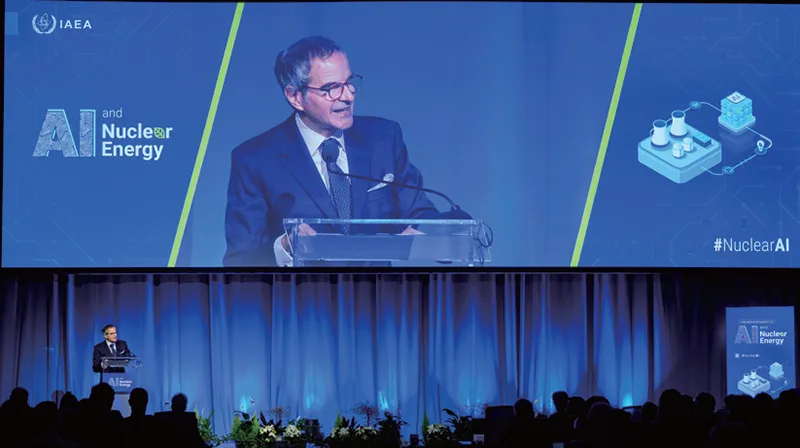
On December 3, 2025, in Vienna, Austria, the International Atomic Energy Agency held the first International Symposium on AI and Nuclear Energy, focusing on how nuclear energy can meet the growing electricity demand of AI data centers and how AI can support the development of nuclear technology. (epa/IC photo)
The Institutional Framework of Global AI Governance
Issue diffusion is constantly impacting the boundaries of existing governance institutions and driving the creation and reorganization of governance institutions. The current global AI governance framework is jointly constituted by existing multilateral mechanisms such as the United Nations, the G20, and APEC, specialized emerging mechanisms such as the Bletchley AI Safety Summit and the "Responsible Use of AI in the Military Domain" summit, and comprehensive governance mechanisms such as "Silicon Peace" and the World AI Cooperation Organization.
I. AI Governance under Existing Global Governance Frameworks
In recent years, existing global governance frameworks such as the United Nations, the G20, and APEC have gradually incorporated AI into their governance scope, establishing new AI-specific governance mechanisms within their institutions or embedding AI into existing governance domains, thereby promoting the integration of AI governance with existing institutions.
The United Nations, as the most universal multilateral governance platform, has systematically incorporated AI into its existing governance system. On the one hand, the United Nations has created new specialized mechanisms around AI. The Global Digital Compact incorporates AI governance into the UN digital cooperation framework; in 2025, the UN General Assembly established the "Global Dialogue on AI Governance" and the "Independent International Scientific Panel on AI," the former providing a platform for countries to conduct dialogue on AI governance and the latter providing a knowledge base for AI governance through scientific assessment. On the other hand, the United Nations actively promotes the integration of AI with traditional governance issues. In 2016, the Fifth Review Conference of the Convention on Certain Conventional Weapons decided to establish a Group of Governmental Experts on Lethal Autonomous Weapons Systems. In recent years, the First Committee of the UN General Assembly has discussed military applications of AI from the perspective of international peace and security; UNESCO focuses on AI ethics, human rights, and education; the International Telecommunication Union focuses on technical standards, communications infrastructure, and capacity building; and the World Intellectual Property Organization has incorporated generative AI into intellectual property discussions.
Multilateral governance mechanisms such as the G20 and APEC are gradually incorporating artificial intelligence into their existing governance frameworks. The G20 Digital Economy Ministers' Meeting treats AI governance as one of its core topics and has established mechanisms such as the "Special Task Force on AI, Data Governance and Innovation for Sustainable Development" to align AI issues with the Sustainable Development Goals. APEC, for its part, advances AI cooperation through existing mechanisms such as the Digital Economy Steering Group and the Telecommunications Working Group, and in 2025 adopted the APEC AI Initiative, bringing AI infrastructure, innovative applications and capacity building into the regional cooperation agenda. In 2026, the APEC Digital and AI Ministers' Meeting issued the 2026 APEC Digital and AI Ministerial Statement, and the APEC High-Level Forum on AI issued the APEC High-Level Forum on AI Statement on Promoting AI Development in the Asia-Pacific Region; these are important outcomes of AI policy dialogue and governance collaboration in the Asia-Pacific region.
While AI governance is being rapidly embedded in existing multilateral governance mechanisms, it has also given rise to a certain degree of institutional contestation. The United States, the European Union and others seek to bring their own concerns into the UN agenda and to elevate their governance concepts into universal global governance norms. The Biden administration in the United States, relying on the Executive Order on the Safe, Secure, and Trustworthy Development and Use of Artificial Intelligence, pushed the UN General Assembly to adopt the resolution initiated by the United States, "Seizing the Opportunities of Safe, Secure and Trustworthy Artificial Intelligence Systems for Sustainable Development." The European Union, in turn, seeks to promote its positions on human rights and risk governance from its AI Act within the UN framework. At the same time, the vast number of developing countries focus on the accessibility of AI technology, infrastructure and capacity building. The entry of diverse governance demands into the UN agenda has broadened the representativeness of global AI governance, but it has also made consensus among all parties more difficult to reach. Some countries, on the one hand, contend for leadership over the global governance agenda within the UN framework; on the other hand, when their own demands are difficult to fully accommodate, they turn to more favorable governance platforms outside the United Nations. Some countries are no longer confined to agenda-setting contests within existing mechanisms, but have expanded to contests over the creation of new mechanisms and the making of rules.
II. Specialized governance mechanisms focused on specific domains
The professionalism and complexity of AI security governance have opened space for the development of specialized governance mechanisms. Compared with comprehensive multilateral organizations such as the United Nations, emerging mechanisms focus on specific risks, application scenarios or governance concepts, have a limited range of participants and topics, are more highly specialized, and allow more flexible institutional adjustment. For example, the Bletchley AI Safety Summit focuses on frontier AI safety, separating issues such as model capabilities, systemic risks and safety evaluation from the broad AI governance agenda; the Summit on Responsible Use of AI in the Military Domain treats military applications of AI as a relatively independent governance domain, with discussions centered on human control, attribution of responsibility and application principles. In 2024, the United States initiated the establishment of the International Network of AI Safety Institutes (INASI), which takes foundation model testing, risk assessment and AI safety science cooperation as its main topics, aiming to advance cross-national AI safety evaluation cooperation through government-backed technical institutions.
Enterprises and research institutions have also built numerous governance networks. The Frontier Model Forum, initiated by companies such as OpenAI, Anthropic, Google and Microsoft, focuses its cooperation on frontier model safety research, risk assessment, best practices and threat information sharing among enterprises; the International Dialogue on AI Safety (IDAIS), initiated by the U.S. nonprofit AI Safety Forum (SAIF), relies on a network of scientists and experts and focuses on issues such as extreme AI risks, safety research, testing and evaluation, and international governance. The creation of these mechanisms shows that global AI governance has differentiated into specialized institutional spaces such as frontier model safety, military applications, technology evaluation, industry self-regulation and expert coordination.
Specialized governance mechanisms significantly raise the level of governance specialization, but they also bring a series of problems. On the one hand, specialized governance mechanisms improve the targeting of institutional supply and fill the gaps of comprehensive international organizations in areas such as frontier model safety and military AI, where responses are slow and professional capacity is insufficient. On the other hand, different actors establish mechanisms based on their core concerns and governance concepts, which may lead to institutional overlap, rule fragmentation and the division of membership systems. States and enterprises will face a situation in which multiple standards and rules coexist, and all parties will have more room for institutional choice. Institution-building itself has become an important source of international influence; being the first to institutionalize governance concepts and spread them internationally will give actors a greater rule-making advantage in global AI governance.
III. Comprehensive mechanisms created around artificial intelligence
As AI competition expands from model research and development and scenario applications to areas such as chips, computing power, data centers, energy and supply chains, some emerging governance mechanisms have broken through the scope of a single topic and cover multiple dimensions such as technological cooperation, industrial policy, supply chain security, development capacity and political trust. This trend reflects the accelerating interweaving of AI governance with geoeconomic competition; the fragmentation of AI governance institutions is extending from the level of rules to the level of technological conditions and cooperation networks.
Since Trump returned to power, major changes have taken place in the institutional choices of U.S. AI governance. Compared with the Biden administration's governance orientation, which emphasized AI safety and multilateral coordination, the Trump administration is skeptical about whether the United Nations can achieve effective governance in the field of AI, where national interests are highly fragmented. In December 2025, U.S. Deputy Secretary of State for Economic Affairs Jacob Helberg announced the launch of the "Pax Silica" mechanism. The "Pax Silica" mechanism organizes specific partners around technology and production and supply chains, combines technological cooperation with security relations, industrial interests and political trust, and attempts to establish outside the United Nations a new global AI governance framework serving U.S. interests. The "Pax Silica" mechanism extends governance power from "making rules" to "controlling technological conditions," both setting AI development standards and determining countries' qualifications, conditions and accessible technological ecosystems for obtaining key technologies. This gives the United States more leadership at the level of rule-making, but intensifies the bloc-based division of global AI governance. The hegemonic concept behind the "Pax Silica" mechanism is fundamentally at odds with the basic principles of global governance; under this mechanism, the designation of participants is no longer based on the principle of universal participation, but depends on whether they belong to a "trusted technology ecosystem."
Compared with a closed governance mechanism like "Pax Silica" that carries hegemonic thinking, the World Artificial Intelligence Cooperation Organization, established in 2026 under China's initiative, follows the purposes of the UN Charter, upholds the concept of extensive consultation, joint contribution and shared benefits, adheres to the people-centered principle, and aims to promote international cooperation and global governance of artificial intelligence and ensure that AI develops in a healthy and orderly manner in a beneficial, safe and fair direction. The institutional significance of the World Artificial Intelligence Cooperation Organization lies in how it positions its relationship with the United Nations and the existing governance system. The organization supports the United Nations in playing the main-channel role in governance and provides a professional, regular and open institutional platform for AI development cooperation, capacity building and policy coordination. The organization places Global South capacity building and participation in governance in an important position, responding to the highly asymmetric problem between technological power and institutional power in current AI governance. Most developing countries not only lack institutional channels for expressing their demands, but also lack the practical capacity to participate in AI development and governance. Therefore, the World Artificial Intelligence Cooperation Organization both undertakes the function of rule discussion and emphasizes technical exchange, industrial cooperation, capacity building and narrowing the intelligence divide.

On July 22, 2026, diplomatic envoys of ASEAN countries in China visited the China-ASEAN Countries Artificial Intelligence Application Cooperation Center in Nanning, Guangxi. (China News Service photo)
China's Role in Global AI Governance
While making important progress in the field of artificial intelligence technology, China has gradually formed a governance plan based on the concept of attaching equal importance to development and security, with multilateral institutional coordination as the organizational path and Global South capacity building as practical support, promoting global AI governance to develop in the direction of equal co-governance, openness and inclusiveness, and coordinated cooperation.
I. Leading Global AI Governance with Conceptual Innovation
Some technologically leading countries use global AI governance mechanisms to expand their own influence, and their governance plans have obvious limitations. The United States possesses the world's leading AI technological capabilities, but the core goal of its global governance is to maintain its own technological level and national competitive advantage. Since Trump took office again, the United States has placed greater emphasis on expanding the global application of its own AI technology stack and strengthening supply chain security and technology protection through alliances and partner systems. The European Union, meanwhile, provides rule-based public goods through institutional arrangements such as the Artificial Intelligence Act, highlighting value orientations such as risk classification, protection of fundamental rights, and safety and trustworthiness. Although the EU supports digital infrastructure and international development cooperation through programs such as "Global Gateway," AI capacity building and technological accessibility for developing countries are not its core agenda.
By contrast, China advocates combining rule supply with development supply, focusing not only on "how to regulate artificial intelligence" but also emphasizing "how to enable more countries to have the capacity to develop and govern artificial intelligence." In 2023, China released the Global AI Governance Initiative, emphasizing a people-centered approach and AI for good, respecting the sovereignty of all countries, adhering to the equal importance of development and security, and advocating enhancing the representativeness and voice of developing countries in global AI governance. For the vast number of developing countries, how to obtain AI technology, infrastructure and development opportunities is an important demand. If governance only emphasizes security standards and behavioral constraints while ignoring the huge gaps in countries' development capabilities and technological accessibility, a governance imbalance will emerge in which a few countries develop technology and most countries accept rules. Therefore, China's plan values inclusive participation on the basis of sovereign equality. China advocates enhancing the representativeness and voice of developing countries in global AI governance and opposes drawing ideological lines and using technological monopolies and unilateral coercive measures to create development barriers. Its basic logic is to relatively separate technological capability from governance power, avoiding the direct conversion of technological advantages into rule-making advantages.
II. Improving the Global AI Governance Framework through Institutional Coordination
China embeds its own governance concepts and cooperative actions into the existing multilateral institutional system. From the Global AI Governance Initiative to subsequent policy documents, China firmly supports the United Nations in playing the main-channel role in governance. The chair's statement of the 2026 World Artificial Intelligence Conference and High-Level Meeting on Global AI Governance further clarified that it "supports the role of the two mechanisms of the UN Global Dialogue on AI Governance and the International Scientific Panel on AI." Although the United Nations has shortcomings such as insufficient adaptability and limited institutional supply capacity, its authority and representativeness remain irreplaceable.
The establishment of the World Artificial Intelligence Cooperation Organization reflects China's approach of building on the existing multilateral system and promoting global AI governance through institutional coordination. First, the World Artificial Intelligence Cooperation Organization helps make up for shortcomings in the supply of public goods, enhance developing countries' practical capacity to participate in AI development, and narrow the North-South digital and intelligence divide. Second, by cooperating with the United Nations and related mechanisms, the World Artificial Intelligence Cooperation Organization strengthens the United Nations' main-channel role in governance while enhancing its own openness and normativity. Third, as a professional and regular cooperation platform, the World Artificial Intelligence Cooperation Organization will establish coordinated relations with the G20, APEC, BRICS, the Shanghai Cooperation Organization and other AI governance mechanisms, forming a division of labor and complementarity among governance mechanisms at different levels and with different functions.
China advocates fully leveraging the comparative advantages of different international mechanisms. China actively promotes existing international mechanisms such as the G20, APEC, BRICS and the Shanghai Cooperation Organization to perform their respective functions. In 2026, China established "APEC Digital Week" to promote concentrated discussion of issues such as artificial intelligence, the digital economy and data governance under the APEC framework. During Digital Week, APEC held the Digital and AI Ministerial Meeting, the High-Level Forum on Artificial Intelligence and other high-level meetings, and released important documents such as the 2026 APEC Digital and AI Ministerial Statement and the APEC High-Level Forum on Artificial Intelligence Statement on Promoting AI Development in the Asia-Pacific Region, promoting the elevation of artificial intelligence from a general digital issue to an important governance agenda for APEC regional cooperation. At the regional level, BRICS and the Shanghai Cooperation Organization have become important platforms for emerging economies and the Global South to strengthen coordination on the right to AI development, capacity building and governance rules.
III. Safeguarding Global South Participation in Governance through Capacity Building
From the perspective of global governance, capacity building concerns the power foundation of AI governance. If developing countries lack AI infrastructure, technological capabilities and talent resources for a long time, even if they formally participate in multilateral governance, their ability to shape rules will still be constrained. Therefore, the significance of capacity building lies not only in bridging the intelligence divide, but also in narrowing the governance capacity gap generated by the technological capability gap. Capacity building has become an important link connecting the right to development and the right to governance, and is key to the Global South's participation in AI development and governance.
China incorporates capacity building into the global AI governance framework. In 2024, China proposed the "Inclusive Plan for AI Capacity Building," which integrates infrastructure development, talent training and security governance into international cooperation, emphasizing enhancing developing countries' AI capabilities through capacity building. The 2025 "Action Plan for Global AI Governance" further translates principled propositions into concrete actions covering areas such as AI infrastructure, capacity building and international cooperation. The "Chair's Statement of the 2026 World AI Conference and High-Level Meeting on Global AI Governance" points out that it is necessary to "place international cooperation on AI capacity building in a prominent position in global AI governance" and "help Global South countries benefit equally in the process of AI development." At this point, capacity building is no longer merely development assistance outside AI governance, but has been incorporated into the global AI governance agenda.
Unlike traditional development cooperation, which focuses on funding and project inputs, AI capacity building emphasizes infrastructure development, technology application and talent training. China actively promotes connectivity in AI and digital infrastructure, carries out cooperation on AI model research and development and empowerment, and enhances developing countries' AI capabilities through technical training and exchanges. China is building international AI application cooperation centers for ASEAN, the Arab League, the African Union, CELAC, the Shanghai Cooperation Organization and BRICS, using practical cooperation to bridge the intelligence divide between regions. At the same time, China's industrial development and application capacity improvements in areas such as digital infrastructure, data centers, cloud computing and AI have also laid a solid foundation for carrying out technical cooperation with the Global South.
This article is a phased result of a major special project of the National Social Science Fund of China (project approval number: 26ZDA123).
The article was originally published in Contemporary World, Issue 10, 2026; notes omitted.
More recommendations Sun Chenghao: The NATO dilemma behind the anxiety of America's "strategic retreat"
 Jiang Feng: Backpedaling on emissions reduction, Europe will fall into double passivity
 Wen Jing: Before the midterm elections, will Trump use force against Iran?
 Zhao Minghao: China and the United States should jointly manage AI risks

 Substack
Copyright ©2019 Center for Strategic and Security Studies, Tsinghua University All rights reserved


Email: ciss@mail.tsinghua.edu.cn

Postal code: 100084

Address: Room 428A, Mingli Building, Tsinghua University, Haidian District, Beijing