 AI Trends
Programming note: Given my conflicts here, I sat out the writing for this one. But I did edit it. — Casey
And now, from the company that has promised to soon replace us, comes the biggest IPO in history.
Anthropic raised $81.3 billion on Thursday in its Nasdaq debut, the largest-ever haul from an initial public offering. At close, Anthropic was valued at $1.76 trillion, making the AI lab both the world’s largest public benefit corporation and one of its largest public companies, period.
On paper, today should feel like a big win for the AI industry: a darling of the AI boom just successfully went public, affirming the massive demand for frontier-level intelligence while returning hundreds of billions of dollars to the tech ecosystem. Amid ongoing concerns about the AI bubble, from the industry’s circular-financing arrangements to the geopolitical consequences of Jensen Huang’s affairs, investors still proved eager to bet big on Anthropic.
On the other hand, Anthropic’s mission is to build AI systems that are smarter than humans — systems that its founders have repeatedly warned could kill everyone. Which makes this moment … bittersweet? Crazy-making? Infuriating?
It depends on who you ask.
In a speech at the Nasdaq, Anthropic CEO Dario Amodei tried to walk his now-familiar line, talking up AI’s potential for scientific breakthroughs while also warning of its potential for misuse. “My company’s co-founders and I started Anthropic because we believe that the most powerful technology of our time should be built for the benefit of humankind,” he said.
Not everyone is buying it. While the founders popped (we assume) ethically sourced non-alcoholic champagne on Wall Street, more than 100 protesters gathered outside the AI company’s San Francisco headquarters holding signs saying “Stop the AI race,” “Earth is in danger,” and “Please stop.” Among them was Jacob Coxon, whose viral tweet about quitting Anthropic drew fresh attention to the AI safety movement, and who spoke at the protest. Four people were arrested for allegedly blocking the entrance to the company’s office.
Elsewhere, a diverse cast of characters, ranging from perpetual AI skeptic Gary Marcus to wild-eyed AI accelerationist Guillaume Verdon (aka Beff Jezos), signed “The MisAnthropic Statement.”
The statement reads:
“Anthropic warns that recursively self-improving AI could concentrate power and escape human control, yet races to build it first. The company uses safety branding to court investors, employees, and the public — even as it has quietly weakened its safety pledges and lobbied for self-serving regulation. Anthropic is not a safe AI company, and we must reject its reckless attempt to amass power in the name of the greater good.”
Futurists have long theorized about the dangers of “recursive self-improvement,” a state in which sufficiently advanced AI builds next-generation versions of itself in ever-tighter loops. The process risks spiraling out of control, given that humans will become less and less able to understand or stop the system when it misbehaves.
A recent report from AI auditor METR concluded that Anthropic’s rate of AI R&D progress had roughly doubled due to AI’s research ability. Notably, doubling the rate of research progress would indicate that the company had surpassed its own risk threshold for “Automated R&D” in its “Responsible Scaling Policy.”
According to that policy, Anthropic should now be taking on new safety auditing, security policies, and transparent reporting to meet its commitments. But Anthropic’s Responsible Scaling Policy isn’t binding. Anthropic endorsed California law SB 53, which asks companies to publish safety policies that they are legally required to follow. But after the law passed, Anthropic submitted a weaker framework under SB 53, recasting its more ambitious safety commitments as voluntary ones.
During his speech at the Nasdaq, Amodei promised to “pace the training and deployment of AI systems, taking as long as is necessary” to ensure they are safe. Amodei added, “We will not bend to either business nor political pressure.”
Anthropic will continue to face business pressure to keep building the most capable AI systems, though, both to retain customers and to appease its investors. (The Financial Times’ Robert Armstrong estimated the company will need to generate more than $600 billion in annual revenue to return the 20 percent on invested capital that its peers do; Apple generates a mere $478 billion in revenue. So!) In a conversation with CNBC, Amodei said Anthropic aspires to be “investment grade” — to earn a high credit rating — and plans to issue more debt.
Raising billions of dollars of capital and additional debt to acquire ever more compute strikes some people as an odd way to “pace the frontier.” Amodei has justified the company’s practices as being necessary to trigger a “race to the top,” in which Anthropic’s financial success and safety commitments inspire its competitors to adopt similar practices in hopes of catching up.
Jasmine Sun, writing for the New York Times, reported hearing a striking version of this vision from an anonymous ex-employee:
“One former Ant referenced J.R.R. Tolkien’s parable in trying to explain Anthropic’s mind-set: Whoever builds superintelligence first will get Sauron’s ring. That person or company will possess the most dangerous cyberweapons in the world, the cures and recipes for every disease, and an army of tireless digital geniuses to do its bidding. The most load-bearing question, then, is the morality of the one who wields the ring.”
Many readers may remember that the One Ring from The Lord of the Rings famously corrupts the minds of all who wear it, slowly bending them towards evil.
Just as Frodo Baggins eventually grew to despise the Ring, one of Anthropic’s earliest investors seems to rue the day he first invested in Anthropic (and before it, in OpenAI). In a statement to the New York Times, Facebook co-founder Dustin Moskovitz wrote: “Cari and I invested in Anthropic to promote safety, not racing.” (Moskovitz invested along with his wife, Cari Tuna.) The statement continued, “A.I. is moving too fast. Anthropic and everyone else on the frontier should slow down and stop racing.”
A spokesman for Moskovitz and Tuna said they donated their Anthropic stock to a nonprofit in 2025, preventing the couple from profiting personally.
No one can say for certain what the future will bring. Amodei is clearly quite confident in his vision — and to Anthropic’s credit, the company’s all-in bet on the scaling laws while its competitors dithered with robotics, world models, and other baubles looks incredibly shrewd in retrospect.
At the same time, while the IPO may give retail investors a chance to share in whatever upside AI may have, it has also drawn necessary attention to the reckless bet that all frontier labs are making: that they can build ever-smarter systems with minimal government oversight, despite themselves believing that the technology puts everyone at risk.
Many aspects of Anthropic’s story strain credulity. The way a ragtag band of OpenAI apostates who seemingly cared nothing about business went on to mount the biggest IPO in history will be studied long into the future.
To the protesters, though, the most unbelievable thing about Anthropic’s story in this moment is how little governments have so far done to stop it. Perhaps in the end AI really will usher in an age of wonders. But polls say the public doesn’t buy it — and that, for now, Anthropic has yet to convince the world that the risks are worth the rewards.

Sponsored
Child sexual abuse material (CSAM) can appear in training datasets, AI-generated outputs, or content hosted on your platform. Understanding where these risks arise is the first step toward protecting children and your brand.
Thorn’s child safety checklist gives safety and governance teams practical safeguards to consider across AI development, deployment, and maintenance.
Explore measures for screening training data, detecting harmful inputs and outputs, evaluating hosted models, and establishing reporting procedures. Use the checklist to identify potential gaps, prioritize safeguards, and guide discussions with product, engineering, and safety leaders.
Whether your company develops models, offers AI creation tools, or hosts content, use it to bring child safety considerations into decisions about your products, policies, and ongoing oversight.
Get Thorn’s child safety checklist.
On Friday's episode: Kevin I compare notes on three years of reporting about Anthropic. Will the company maintain its commitment to safety in the face of pressure from investors? Then, it's time once again to re-open Pandora's Box.
YouTube | Apple | Spotify | RSS
Those good posts
For more good posts every day, follow Casey’s Instagram stories.
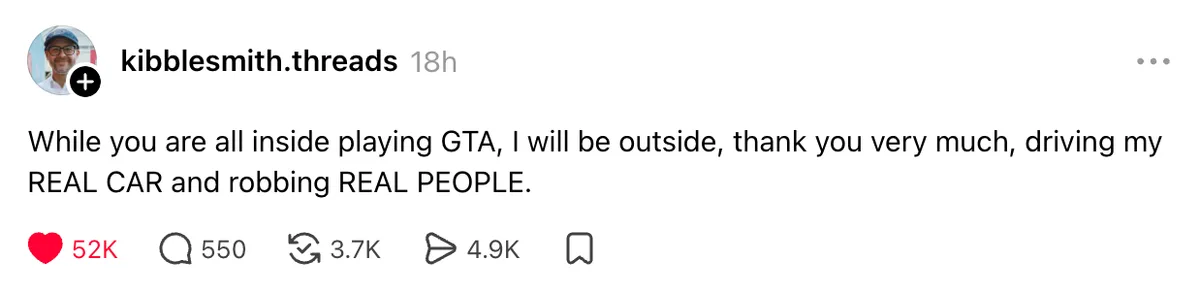
(Link)

(Link)

(Link)
Talk to us
Send us tips, comments, questions, and Anthropic takes: casey@platformer.news. Read our ethics policy here.
Sponsor a Newsletter