- Databricks' position as a Leader in the 2026 Gartner Magic Quadrant for Data Lakehouse Platforms validates that we pioneered and established the lakehouse market category.
- Databricks is named as the only Visionary in the Gartner Magic Quadrant for Cloud Operational Database Management Systems, a strong competitive placement that highlights our strategic vision for the future of operational databases.
- A lakebase is a transactional database that keeps its data on the lake, in an open format, so agents can create and discard databases on demand and other engines can work with the same data. Databricks Lakebase Postgres is the first commercial implementation of this new database, and is used as the system of record for all applications: new agentic workloads, modern applications, as well as traditional transactional systems.
AI is pulling analytical and operational data together
For decades, enterprises have run their data in two separate worlds. A warehouse or lakehouse handles analytics. Traditional OLTP databases run applications. Pipelines move data between them, creating copies, delay, and separate governance along the way.
That setup worked while dashboards and applications lived apart. AI changes that. An agent that answers a customer question, approves a transaction, or updates a forecast needs fresh operational data and deep analytical context at the same time, and it often needs to write back. Each extra pipeline adds latency, cost, and risk, so the boundary between the two systems has become a bottleneck.
These markets are evaluated largely independently. Gartner just published a Magic Quadrant for Data Lakehouse Platforms and a Magic Quadrant for Cloud Operational Database Management Systems. We see that customers, though, increasingly need the two systems to work as one.
The Lakehouse: a category we pioneered, now recognized by the industry
When we introduced the lakehouse, the idea was simple. Give every data workload one open, governed foundation, instead of keeping data lakes and data warehouses as separate systems. Today thousands of organizations run data engineering, data warehousing, streaming, BI, and AI on that foundation.
We believe our position as a Leader in Gartner's first Magic Quadrant for Data Lakehouse Platforms, with the highest scores in execution, reflects what customers rely on every day:
- AI-native. Genie lets anyone ask questions of their data in natural language, grounded in governed business semantics defined once in Unity Catalog. AI Functions run inference directly on governed data, and AI optimizes the lakehouse automatically.
- Open by design. Data lives in open formats (Delta Lake and Apache Iceberg), so customers aren't locked into a proprietary engine.
- Unified governance. Unity Catalog applies one set of permissions, lineage, and quality controls across data and AI.
- Performance and cost. Serverless compute and continued engine improvements bring warehouse-class price-performance to the lakehouse.
- Real time. Lakehouse//RT brings low-latency, high-concurrency analytics directly to lakehouse data.
We’ve seen the impact with our customers. Airwallex and Volkswagen Brasil both consolidated from Google BigQuery to Databricks Lakehouse, and have seen 3-4x faster time to insight and 25% reduced TCO respectively. Nubank, for example, runs more than 50 million queries a month with 7x better P90 query performance and more than 40% lower costs.
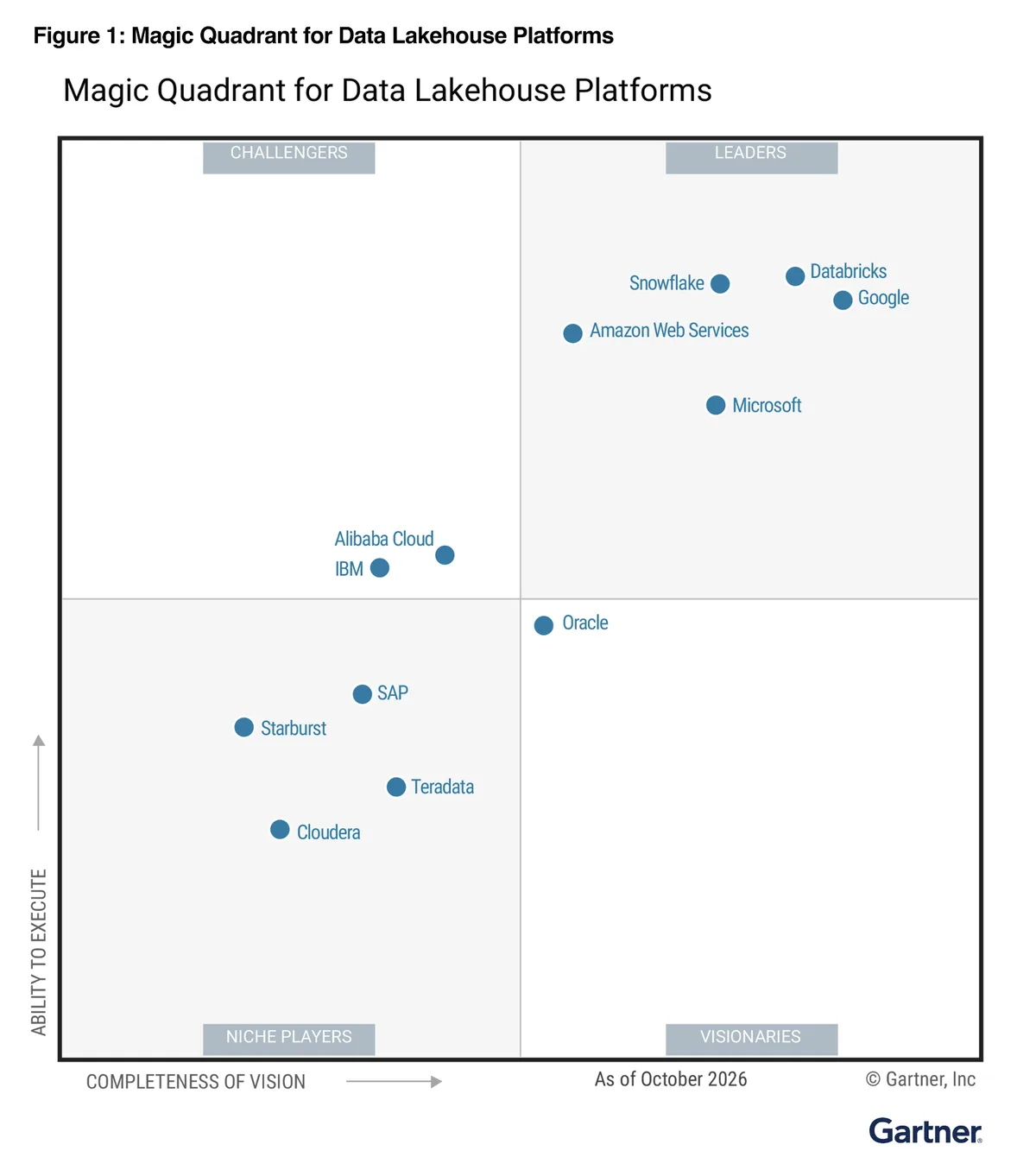
The lakehouse didn't begin as a category, but as a different way to build. Customers adopted it, the ecosystem built around it, and the market followed. That's the path we're on again.
The lakebase: Redefining operational databases on the lake
The lakehouse rebuilt analytics on open, low-cost cloud storage. A lakebase does the same for operational databases. We believe it will serve as the system of record for all applications: new agentic workloads, modern applications, as well as traditional transactional systems.
In the 2026 Gartner Magic Quadrant for Cloud Operational Database Management Systems, Databricks is the only vendor named a Visionary, less than a year after Lakebase Postgres became generally available. We see that as a signal of where the category is going.
Most operational databases in use today were designed for a different era. Storage and compute are tightly coupled, so capacity is paid for at peak. Databases are heavy assets that teams seldom duplicate, and getting data to analytics or AI means building and maintaining pipelines. They weren't designed for software that agents write and run.
Lakebase Postgres starts from different assumptions. It's Postgres, so developers keep the tools they already know, but compute is separated from storage and data lives on cloud object storage, the same foundation as the lakehouse. Compute is serverless and scales to zero. Databases branch instantly, like code, so developers and agents can spin up isolated copies in seconds. And because Lakebase Postgres is native to the Databricks Data + AI Platform, its data is governed in Unity Catalog alongside everything else.
Customers are already running production workloads on a lakebase. PRADA Group uses it to serve thousands of trusted KPIs across its brands as low-latency APIs, delivering them about 130x faster (from roughly 2 seconds to 15 milliseconds) while cutting infrastructure costs by about 50%.
“Lakebase allowed us to move from traditional query-based KPI delivery to a low-latency serving layer where every metric is exposed as an API in milliseconds.”- Michele Piunti, Data Platform Manager, PRADA Group
LTAP: a unified agentic data foundation for operations and analytics
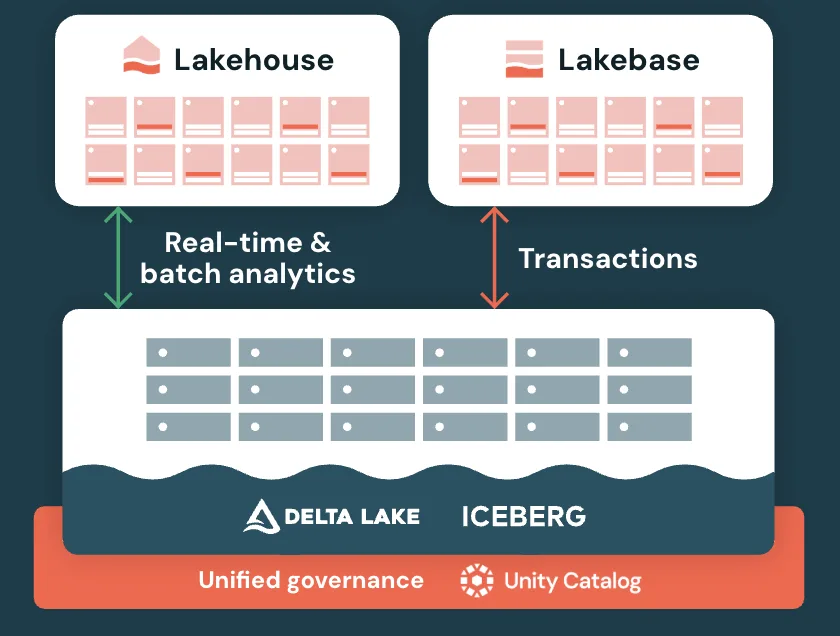
Getting operational data into analytics has always meant copying it. A heavy analytical query can't run on the same machine as latency-sensitive transactions without causing disruptions, so teams add read replicas or build CDC pipelines into a warehouse. They pay for extra copies, wait on brittle pipelines, and end up governing two versions of the same data whose permissions drift apart. That's a big reason operational databases and analytics platforms have long been bought, run, and evaluated as separate markets.
The Lake Transactional/Analytical Processing (LTAP) architecture, enabled by the lakebase, unifies the two at the storage layer instead of forcing one engine to do both jobs. Lakebase Postgres handles transactions with full ACID guarantees, and lakehouse engines handle analytics. Both read a single durable copy of the data in open formats like Delta Lake and Apache Iceberg, governed in Unity Catalog. There's no pipeline to build and no tables to mirror, and analytical queries never slow down the application. Analytics reads instantly fresh data the application just wrote, with no delays. That's how operational and analytical data work on one foundation.
We’re already seeing customers achieving value from this unification. Posti already runs its analytics on Databricks Lakehouse, and plans to use Lakebase Postgres to power GIS and operational planning on the same governed platform, so operational applications and analytics no longer live in separate stacks.
For a deeper look at how LTAP works, read our blog post.
What's next
A few years ago, the lakehouse was an idea we had to explain. Today it's a market category, and we think the lakebase is at the start of the same shift. Applications aren't the only thing writing to databases anymore. Agents now create, branch, and query databases at a speed and scale traditional systems weren't designed for, and they need the analytical context that lives in the lakehouse.
We're building toward an open, governed foundation where every workload, operational or analytical, built by people or by agents, runs on the same data. We built the Lakehouse together with our customers, and we're building the Lakebase the same way.
Get started
Gartner, Magic Quadrant for Data Lakehouse Platforms, Aaron Rosenbaum, Michael Gonzales, Masud Miraz, Ramke Ramakrishan, Xingyu Gu, Robin Schumacher, Prasad Pore, November 4, 2026.
Gartner, Magic Quadrant for Cloud Operational Database Management Systems, Masud Miraz, Aaron Rosenbaum, Ramke Ramakrishan, Xingyu Gu, Michael Gonzales, Prasad Pore, Robin Schumacher, November 12 2026.
Gartner does not endorse any vendor, product or service depicted in its research publications, and does not advise technology users to select only those vendors with the highest ratings or other designation. Gartner research publications consist of the opinions of Gartner's Research & Advisory organization and should not be construed as statements of fact. Gartner disclaims all warranties, express or implied, with respect to this research, including any warranties of merchantability or fitness for a particular purpose.
GARTNER and MAGIC QUADRANT are registered trademarks of Gartner, Inc. and/or its affiliates in the U.S. and internationally and are used herein with permission. All rights reserved.
This graphic was published by Gartner, Inc. as part of a larger research document and should be evaluated in the context of the entire document. The Gartner document is available upon request from Databricks.
Related tags:Lakebase, LTAP and Lakehouse Architecture
Get the latest posts in your inbox
Subscribe to our blog and get the latest posts delivered to your inbox.