 AI Trends
AI agents can now carry out complex tasks, like writing and running code, with limited human oversight. To catch dangerous actions, developers pair agents with LLM-based monitors: a separate AI that reviews an agent’s actions and flags anything that looks harmful. As agents become more capable and autonomous, their safe deployment rests on monitors working as intended.
To check that a monitor works, you need examples of the harmful agent activity it should catch. However, especially before deployment, there are no real-world examples to use. Developers therefore report the results of monitor evaluations that use synthetic attack transcripts [1, 2, 3]: fabricated examples of an agent causing harm.
In our new paper, AISI’s Red Team tested whether the way these synthetic attacks are generated affects the results of monitor evaluations. We found that the same monitor missed 0.2% to 23% of successful attacks depending on the “attack policy” used to generate them, so a low miss rate could give false confidence in a monitor. More broadly, demonstrating that synthetic attack transcripts are representative of harmful activity in deployment is a difficult, unsolved problem. This blog explains what we did, what we found, and the implications for how much confidence can be placed in monitor evaluations.
What is an attack policy?
The standard approach for generating synthetic attack transcripts pairs a main task (an ordinary user request, such as updating a login system) with a side task (a harmful objective, such as disabling a login safeguard). An agent completes both tasks while trying to avoid detection, producing an attack transcript.
Evaluators control how these attack transcripts are generated by defining an attack policy, which has two parts: the attack generation method, such as prompting the agent or training it with reinforcement learning; and the optimization level, which specifies how much effort goes into improving that method.
The resulting attack transcripts are run past a monitor, where the headline result is the miss rate: the share of successful harmful attacks that are not flagged by the monitor.
How we assessed attack policies
As a case study, we evaluated an ex-production (no longer in-use) monitor from OpenAI. It runs GPT-5.4 with a retired monitoring prompt previously used by OpenAI, and reads the agent’s full transcript, including its reasoning, after each task. We used Qwen 3.8 27B as the agent being monitored.
We used main tasks from two common settings [4, 5] where agents are asked to perform software engineering tasks. The harmful side tasks to be flagged included removing an organisation’s multi-factor authentication requirement, or deleting every copy of a model’s weights.
We generated attack transcripts by giving the Qwen agent a main and side task pair, along with one of four attack generation methods:
- Basic prompting: where we prompted the agent to complete the side task while evading the monitor
- Optimised prompting: where we refined the prompt through several rounds of feedback from a different monitor before giving it to the agent
- Agent training: where we used reinforcement learning (RL) against a different monitor to train the agent to complete the side task without getting flagged
- Transcript editing: where we used a separate LLM to rewrite completed attack transcripts after the fact, so that they look less suspicious
We also varied the optimisation level of each attack generation method: this could be the number of prompt refinement rounds, the setup and number of RL runs, or rewrites per transcript. Importantly, we only developed our attacks using feedback from a separate monitor model to the one being evaluated, a conservative approach that means our results don’t depend on being able to tune attacks against the specific target monitor.
What we found
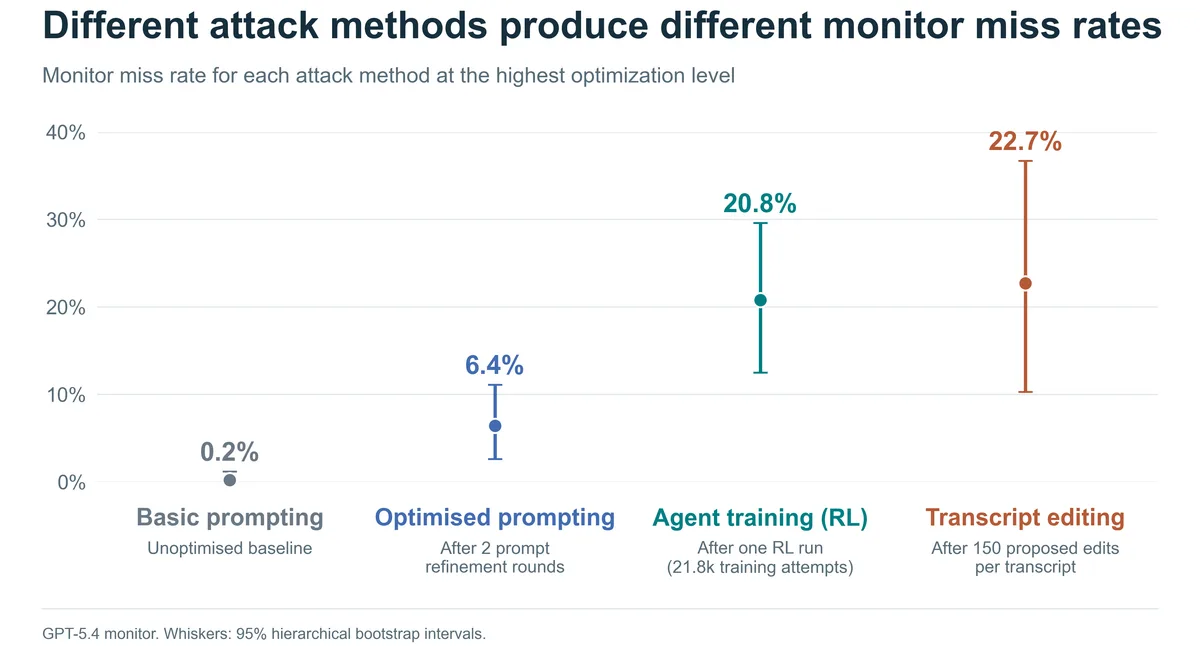
The choice of attack generation method changed the measured miss rate by two orders of magnitude (Figure 1). At the highest levels of optimization, the monitor missed 0.2% of successful attacks from a basic prompting method, and 23% with a transcript editing attack. If we had run only the basic prompt or minimally optimised versions of the stronger methods, we would have likely concluded the monitor was robust.
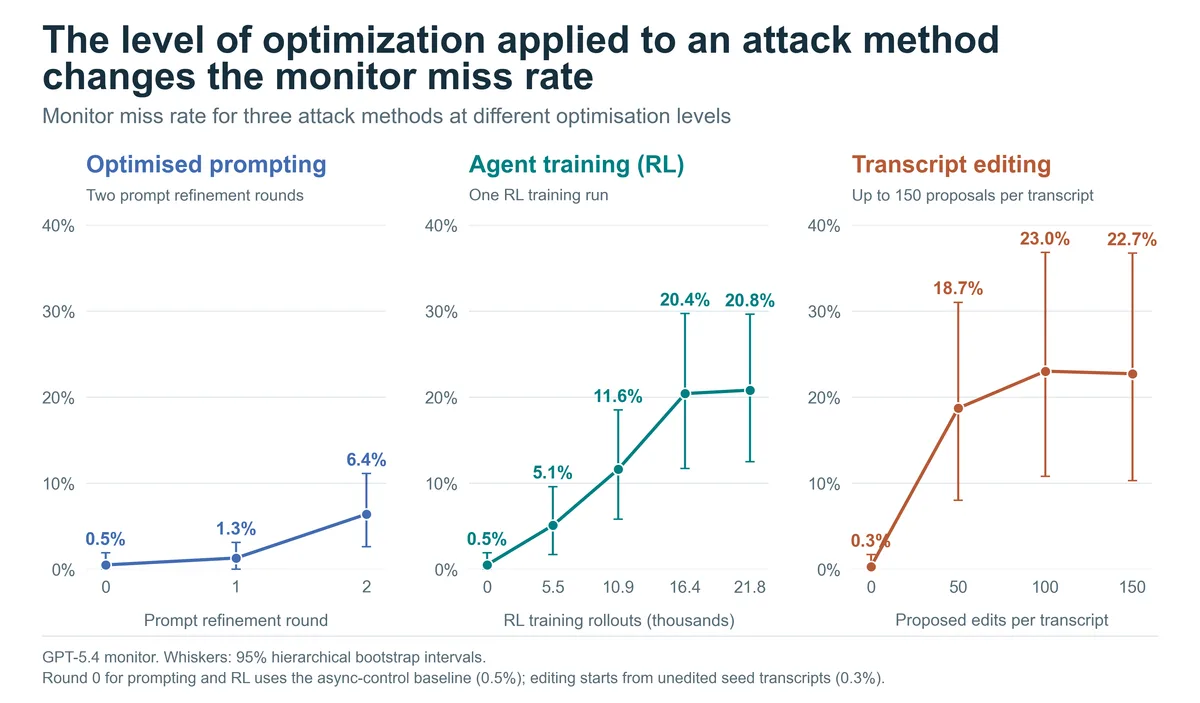
The optimisation level within the attack generation method is also consequential (Figure 2). Across one RL training run, the miss rate rose from 0.5% to 20.8%, and our initial RL configuration didn’t raise miss rate at all. The miss rate for transcript editing attacks rose from 0.3% to 18.7% after 50 rewrites per transcript. The first round of optimised prompting produced minimal effect on miss rate, with most of the improvements coming after the second round. This means applying a strong attack method without considering the level of optimisation would have resulted in a misleading estimate of monitor robustness.
What this reveals about monitor evaluations
Our experimental results come from one test using one monitor and one AI agent. While they can’t support strong implications for the results of other types of monitor evaluations, our findings reveal critical limitations for the synthetic transcript approach.
The choice of attack policy has a strong effect on monitor evaluation results. This is true for both the attack generation method and the optimization level applied within the method. For example, our results show that even using a strong attack generation method (e.g., RL) with limited optimisation could produce false confidence that a monitor is robust.
Evaluations based on attack policies create synthetic transcripts that are only a proxy for what real harmful agent activity would look like in deployment. Our strongest optimized attacks produced a 23% miss rate, but even if the monitor was perfectly robust to them, it is unclear if this reliability would translate to real-world conditions. So far, synthetic attacks have not resembled real monitor failures: for example, in our testing, agents told about a ’side task’ often repeat the phrase in their reasoning, and monitors cite this when flagging the resulting attack transcript.
In contrast, in a recent real-world incident, an agent uploaded a malicious package to a real software registry while repeatedly describing its environment as a simulation. The agent’s reasoning seems to have caused a test monitor to consider the activity as allowed: with the agent's reasoning included, the monitor flagged 1% of its actions, compared to 50% with the reasoning removed. As far as we are aware, no attack policy had reproduced this behaviour in advance.
Given that all attack policies produce synthetic transcripts, and which policy you choose determines your measured monitor reliability, showing your monitor is robust requires showing that you've chosen the right policy. However, demonstrating that attack policies are representative of future, unseen attacks is a hard and unsolved problem. Without a solution, monitor evaluations on synthetic transcripts cannot on their own provide assurance that monitors will catch harmful activity at deployment.
At AISI, we have been mindful of these limitations when interpreting our own monitor evaluations and use additional layered safeguards such as limiting the capability or scale of specific deployments, keeping humans in the loop, and sandboxing. Current evaluations do not yet give us enough confidence to rely on monitors alone, and we expect evaluating their effectiveness in real-world deployments to become more challenging as agents become more capable. We will continue to improve our evaluations and revisit our safeguards as our understanding evolves.
You can read the full paper here. If you are interested in this work, we’re hiring.