←Search results

By relevance · Total 1528 results Clear search

Thursday

  1. Wired AI

    AI Drives a Wave of Formal Verification Startups as &Truth Raises $70 Million

    WIRED reports that generative AI is pushing formal verification toward commercialization. &Truth has raised $70 million and launched publicly, while Harmonic has raised a cumulative $295 million, and its math AI agent Aristotle supports verification of C code and Verilog hardware designs. Stanford researcher Chuyue Sun used AI tools to complete an engineering project in less than half a day at a cost of under $500, whereas three experts working by hand took five months to complete the same work. The report also notes that the technology is still at the prototype stage, that customers' willingness to pay and adoption methods remain unclear, and that Antithesis's Will Wilson calls formal verification a "trap" that can only provide partial guarantees.

    WIRED reports that generative AI is pushing formal verification toward commercialization. &Truth has raised $70 million and launched publicly, while Harmonic has raised a cumulative $295 million, and its math AI agent Aristotle supports verification of C code and Verilog hardware designs. Stanford researcher Chuyue Sun used AI tools to complete an engineering project in less than half a day at a cost of under $500, whereas three experts working by hand took five months to complete the same work.

    Matched fieldsBody
  2. Databricks Blog

    Databricks introduces finer-grained cost controls for serverless

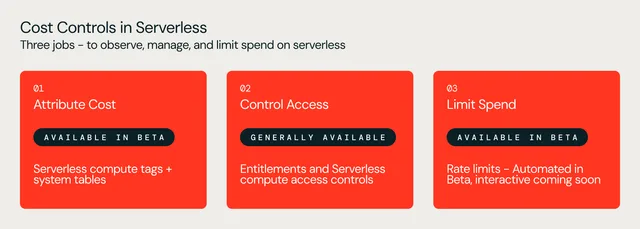
    Databricks has introduced cost control capabilities for serverless compute, shifting the object of control from machines to people and workloads: Serverless Compute Tags is in Beta and can attribute DBU costs by team and project; Serverless Compute Access Controls is now GA, using Can Use/Can Manage permissions to determine who can run serverless. Rate limits are now available, and shared budgets are coming soon, to prevent runaway workloads and cap team spending. Over the past year, Databricks' serverless usage has grown more than 3x.

    image1.png

    Databricks has introduced cost control capabilities for serverless compute, shifting the object of control from machines to people and workloads: Serverless Compute Tags is in Beta and can attribute DBU costs by team and project; Serverless Compute Access Controls is now GA, using Can Use/Can Manage permissions to determine who can run serverless. Rate limits are now available, and shared budgets are coming soon, to prevent runaway workloads and cap team spending. Over the past year, Databricks'

    Matched fieldsBody

  3. TechCrunch AI

    Microsoft reports record revenue for the 10th consecutive quarter, with quarterly revenue reaching $92.3 billion

    Microsoft announced quarterly revenue of $92.3 billion, up 19% year-over-year, marking the 10th consecutive quarter of record revenue, with net income of $36.6 billion, up 32% year-over-year. Microsoft Cloud revenue was $63.9 billion, up 30% year-over-year, of which Azure contributed $33.2 billion, and revenue from OpenAI was $10 billion. Microsoft's capital expenditure this quarter reached $45.2 billion, also a new single-quarter high.

    Matched fieldsBody

Wednesday

  1. Latent Space

    Anthropic Abolishes Coding Interviews: Felix Reiseberg Says "Hunger beats tenure"

    Anthropic hiring manager Felix Reiseberg announced that the company will no longer use traditional coding interviews to evaluate candidates, citing the fact that Claude is already stronger than humans at both React challenges and assembly problems, and that truly impactful builders do not win through such tests. He advises junior engineers to pick an idea that can drive business impact, build a working prototype over the weekend, focus on just one good idea, and leverage their fresh perspective on users. On the same day, Google DeepMind released the Genie 4 world model, and Claude Opus 5.5 (58 points) topped the Artificial Analysis Intelligence Index v5.

    Anthropic hiring manager Felix Reiseberg announced that the company will no longer use traditional coding interviews to evaluate candidates, citing the fact that Claude is already stronger than humans at both React challenges and assembly problems, and that truly impactful builders do not win through such tests. He advises junior engineers to pick an idea that can drive business impact, build a working prototype over the weekend, focus on just one good idea, and leverage their fresh perspective

    Matched fieldsBody

  2. Unite.AI

    Perplexity Publishes LLM Gateway Best Practices Guide, Outlining Request Flow and Production Risks

    On October 27, 2026, Perplexity published an LLM gateway best practices guide explaining how this middleware layer routes, authenticates, caches, and logs model calls, and distinguishing four categories: API gateways, LLM gateways, MCP gateways, and AI gateways. The guide breaks down the mechanism through a six-step request lifecycle, while warning that the gateway centralizes credentials from various providers, and cites the LiteLLM gateway breach disclosed by Microsoft and two high-severity vulnerabilities, CVE-2026-35029 and CVE-2026-59823, reported by Check Point (already fixed in LiteLLM 1.83.9). The article also lists postmortems of Cloudflare AI Gateway and OpenRouter outages, four deployment paths, and paid plans starting at about $50 per month.

    On October 27, 2026, Perplexity published an LLM gateway best practices guide explaining how this middleware layer routes, authenticates, caches, and logs model calls, and distinguishing four categories: API gateways, LLM gateways, MCP gateways, and AI gateways. The guide breaks down the mechanism through a six-step request lifecycle, while warning that the gateway centralizes credentials from various providers, and cites the LiteLLM gateway breach disclosed by Microsoft and two high-severity vu

    Matched fieldsBody

  3. Unite.AI

    Aviatrix Launches Clearance to Limit Lateral Spread of Compromised Cloud and AI Workloads

    Aviatrix has released the cloud security product Clearance, which uses default-deny egress and lateral isolation to limit the targets that compromised workloads can reach, and supports first previewing policy impact in monitoring mode with a Shadow Rule Set before enabling it with one click. Clearance is built on the Aviatrix Containment Platform and controls communications of containers, serverless, databases and AI agents by domain and identity; the Aviatrix Active Defense automated policy layer is currently available for free early access to Aviatrix Enterprise design partners. The company will also offer a temporary response program with no limit on the number of workloads from November 1, 2026 to May 1, 2027.

    Aviatrix has released the cloud security product Clearance, which uses default-deny egress and lateral isolation to limit the targets that compromised workloads can reach, and supports first previewing policy impact in monitoring mode with a Shadow Rule Set before enabling it with one click. Clearance is built on the Aviatrix Containment Platform and controls communications of containers, serverless, databases and AI agents by domain and identity; the Aviatrix Active Defense automated policy lay

    Matched fieldsBody

  4. Unite.AI

    GSA Expands OneGov Agreement with Anthropic, Raising Claude Procurement Discount to 40%

    The U.S. General Services Administration (GSA) and Anthropic announced on October 27, 2026 the expansion of the OneGov agreement, under which government buyers receive a 40% usage-based discount on Claude Enterprise, Claude for Government, and the Claude API, with the scope extended from the federal government to state, local, tribal, and territorial governments. The agreement sets no minimum purchase volume; agencies pay based on actual usage and can place orders through direct sales, resellers, and major cloud platforms. Anthropic says about 500 U.S. federal, state, and local government agencies are using Claude, and weekly active users of Claude for Government have grown about eightfold since February 2026.

    The U.S. General Services Administration (GSA) and Anthropic announced on October 27, 2026 the expansion of the OneGov agreement, under which government buyers receive a 40% usage-based discount on Claude Enterprise, Claude for Government, and the Claude API, with the scope extended from the federal government to state, local, tribal, and territorial governments. The agreement sets no minimum purchase volume; agencies pay based on actual usage and can place orders through direct sales, resellers

    Matched fieldsBody

  5. Publickey

    Oracle Cloud announces the introduction of Google TPU, with services to begin in 2027

    At the Oracle AI World 2026 keynote, Oracle announced that it will bring Google's self-developed AI chip, Google TPU, into Oracle Cloud Infrastructure, and plans to begin offering Google TPU services in 2027. Oracle said it will provide supporting infrastructure such as power, cooling, and intra-data-center networking for large-scale deployments. The article also mentioned that Google Cloud last week open-sourced TorchTPU, which enables native PyTorch support for TPU.

    Matched fieldsBody

  6. Codex:GitHub Releases

    OpenAI Codex 0.165.0 Released: Adds Google Cloud Vertex AI Provider and…

    OpenAI Codex 0.165.0 adds a built-in Google Cloud Vertex AI provider (configured via model_provider = "gcp") and adds GPT-6.1 Terra to the model catalog. This version also enables memory v2 by default and supports importing external agent memory, while allowing reasoning effort to be adjusted during conversations by default. The session selector adds repository filtering, and the agent command center supports grouping by directory.

    OpenAI Codex 0.165.0 adds a built-in Google Cloud Vertex AI provider (configured via model provider = "gcp") and adds GPT-6.1 Terra to the model catalog. This version also enables memory v2 by default and supports importing external agent memory, while allowing reasoning effort to be adjusted during conversations by default. The session selector adds repository filtering, and the agent command center supports grouping by directory.

    Matched fieldsBody

  7. Latent SpaceSelected

    Anthropic's Engineering and Product Leads Discuss the Opus 5.5 Release and Claude's Agent Architecture

    In a Latent Space podcast interview, Anthropic engineering lead Katelyn Lesse and product lead Angela Jiang discussed the Opus 5.5 release, covering adjustments to the model's writing style, pricing based on intelligence per dollar, and API changes such as requiring thinking blocks to be retained across turns to prevent distillation. The interview also described Claude Managed Agents' approach of separating sessions and the harness from the sandbox that executes code, with credentials mounted separately through a proxy so that a sandbox failure does not take down the entire session; Dreaming, meanwhile, is implemented as one managed agent inspecting another agent's history and writing back to memory. The team said that as safety work for model releases has grown heavier, recent efforts have shifted more toward safety, with progress on features such as skills and memory slowing relatively.

    In a Latent Space podcast interview, Anthropic engineering lead Katelyn Lesse and product lead Angela Jiang discussed the Opus 5.5 release, covering adjustments to the model's writing style, pricing based on intelligence per dollar, and API changes such as requiring thinking blocks to be retained across turns to prevent distillation. The interview also described Claude Managed Agents' approach of separating sessions and the harness from the sandbox that executes code, with credentials mounted se

    Matched fieldsBody

  8. AWS Machine Learning

    Exowatt Beats Frontier Models in Accuracy with SageMaker Serverless Model Customization

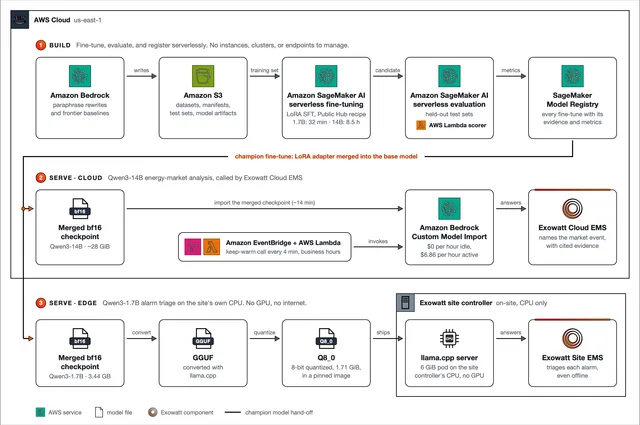
    Using Amazon SageMaker AI serverless model customization, Exowatt fine-tuned Qwen3-1.7B for edge alert triage and Qwen3-14B for cloud-based energy market analysis, surpassing frontier models in accuracy while cutting costs by up to 49 times. The pipeline combines LoRA and SFT, and uses SageMaker serverless evaluation to score 2,000 answers for each candidate model; the fine-tuned Qwen3-14B is hosted through Amazon Bedrock Custom Model Import. Exowatt says this repeatable path from raw operational data to evaluated deployment artifacts can now be completed in days rather than months.

    Exowatt fine-tuning and deployment architecture across build, cloud-serve, and edge-serve stages

    Using Amazon SageMaker AI serverless model customization, Exowatt fine-tuned Qwen3-1.7B for edge alert triage and Qwen3-14B for cloud-based energy market analysis, surpassing frontier models in accuracy while cutting costs by up to 49 times. The pipeline combines LoRA and SFT, and uses SageMaker serverless evaluation to score 2,000 answers for each candidate model; the fine-tuned Qwen3-14B is hosted through Amazon Bedrock Custom Model Import. Exowatt says this repeatable path from raw operationa

    Matched fieldsBody

  9. AWS Machine Learning

    Fixing evaluation bias to select a better model on Amazon Bedrock

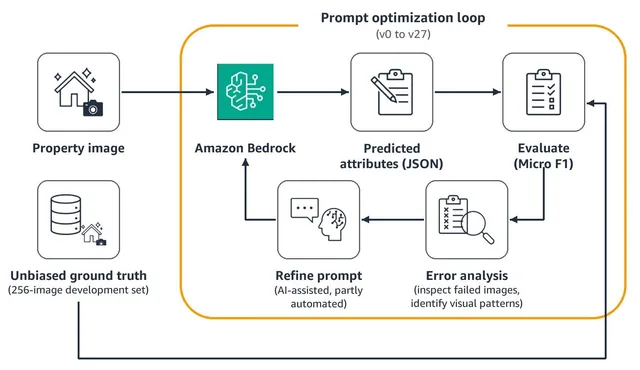
    Property Finder found that 96.8% of its evaluation labels came directly from predictions of an existing vision-language model rather than human verification, causing any alternative model to be structurally disadvantaged in comparisons. The team re-annotated 356 UAE images by hand and switched to multi-label classification, then iterated and optimized prompts from v0 to v27 to select a model on Amazon Bedrock, ultimately achieving higher accuracy and an 86% cost reduction.

    Diagram of the prompt optimization loop: a property image goes to Amazon Bedrock, the predicted attributes are scored with Micro F1 against the expert-annotated development set, error analysis informs the next prompt version, and the loop repeats from v0 to v27.

    Matched fieldsBody

Friday

  1. Wallstreetcn

    Amazon, Intel, and Alphabet earnings miss expectations, global tech stocks fall collectively

    Earnings from Amazon, Intel, and Alphabet successively missed expectations, triggering a collective slump in global tech stocks. Nasdaq 100 index futures extended losses to 2%, and South Korea's KOSPI index fell 4.5% and triggered the SIDECAR mechanism to suspend program selling. Intel plunged 23% after hours, Amazon fell about 7.3% after hours, and Alphabet tumbled 13% in the previous trading session, its largest single-day drop. Market attention is focused on capital expenditures: Amazon's third-quarter spending on equipment and property exceeded $77 billion, and free cash flow over the past 12 months was negative $42.4 billion. CEO Andy Jassy said capital expenditures will increase significantly in 2027.

    Earnings from Amazon, Intel, and Alphabet successively missed expectations, triggering a collective slump in global tech stocks. Nasdaq 100 index futures extended losses to 2%, and South Korea's KOSPI index fell 4.5% and triggered the SIDECAR mechanism to suspend program selling. Intel plunged 23% after hours, Amazon fell about 7.3% after hours, and Alphabet tumbled 13% in the previous trading session, its largest single-day drop. Market attention is focused on capital expenditures: Amazon's thi

    Matched fieldsBody

  2. Cailian Press

    Oracle and Google Share Prices Diverge: Capital Expenditure Expectations Move in Opposite Directions

    On October 28, Oracle's share price surged 10.73%, while Google's parent company Alphabet plunged more than 10% in premarket trading on October 29. Oracle expects capital expenditure to peak in fiscal years 2027 to 2028 and decline in fiscal year 2029, with free cash flow turning positive in the second half of fiscal year 2028 and exceeding $30 billion in fiscal year 2029; Google's third-quarter revenue and profit both fell short of expectations, recording negative free cash flow for two consecutive quarters. Oracle also said it needs to raise up to an additional $20 billion over the remainder of fiscal year 2027, split evenly between debt financing and equity financing.

    On October 28, Oracle's share price surged 10.73%, while Google's parent company Alphabet plunged more than 10% in premarket trading on October 29. Oracle expects capital expenditure to peak in fiscal years 2027 to 2028 and decline in fiscal year 2029, with free cash flow turning positive in the second half of fiscal year 2028 and exceeding $30 billion in fiscal year 2029; Google's third-quarter revenue and profit both fell short of expectations, recording negative free cash flow for two consecu

    Matched fieldsBody

  3. Phoenix Technology

    TSMC, a major water consumer, draws no criticism, while AI data centers that use less water provoke outrage among Americans?

    The Verge reports that Project Blue, a planned 600-megawatt data center on the outskirts of Tucson, Arizona, has faced resident opposition over groundwater extraction, with the advocacy group "No Desert Data Center Coalition" chanting "not one drop of water for data." By contrast, TSMC's Phoenix campus uses about 4.75 million gallons of water per day, yet is more welcomed locally due to its 3,500-plus employees and industry spillover, and about 60% to 65% of the water at its first fab is recycled.

    The Verge reports that Project Blue, a planned 600-megawatt data center on the outskirts of Tucson, Arizona, has faced resident opposition over groundwater extraction, with the advocacy group "No Desert Data Center Coalition" chanting "not one drop of water for data." By contrast, TSMC's Phoenix campus uses about 4.75 million gallons of water per day, yet is more welcomed locally due to its 3,500-plus employees and industry spillover, and about 60% to 65% of the water at its first fab is recycle

    Matched fieldsBody

  4. AWS Machine Learning

    How the UK Amazon Quick User Group Grew in 2026

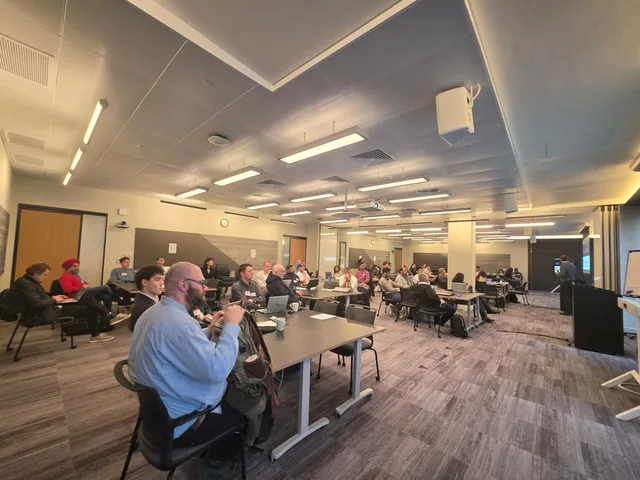
    The UK Amazon Quick User Group held three quarterly meetups in 2026, drawing more than 150 attendees in total. The events took place at Amazon's UK office in Shoreditch, London, where attendees built custom chat agents with Amazon Quick, tried out Amazon Quick Desktop and Amazon Quick Apps, and practiced automation and research through Quick Flows, Quick Automate, and Quick Research. Customers such as Arriva UK Trains and Carsa shared their experiences implementing role-based dashboards and a unified governed data layer.

    Attendees at a UK Amazon Quick User Group meetup in Shoreditch, London

    The UK Amazon Quick User Group held three quarterly meetups in 2026, drawing more than 150 attendees in total. The events took place at Amazon's UK office in Shoreditch, London, where attendees built custom chat agents with Amazon Quick, tried out Amazon Quick Desktop and Amazon Quick Apps, and practiced automation and research through Quick Flows, Quick Automate, and Quick Research. Customers such as Arriva UK Trains and Carsa shared their experiences implementing role-based dashboards and a un

    Matched fieldsBody

Tuesday

  1. The Rundown AI

    Apple unveils new iPad mini: 8.5-inch OLED display, A20 Pro chip, starting at $699

    Apple launched the new iPad mini ahead of its Mac event, featuring an 8.5-inch OLED display and A20 Pro chip, starting at $699, $100 more than the previous generation. Apple says the A20 Pro is 60% faster at multitasking and delivers 4.5x better AI performance, used to run Siri AI; the body is 5.4mm thick and weighs 255g, about 13% lighter than the previous generation. According to Bloomberg, Apple will also release its first touchscreen OLED MacBook Pro this week, equipped with M5 Pro and M5 Max chips.

    Apple launched the new iPad mini ahead of its Mac event, featuring an 8.5-inch OLED display and A20 Pro chip, starting at $699, $100 more than the previous generation. Apple says the A20 Pro is 60% faster at multitasking and delivers 4.5x better AI performance, used to run Siri AI; the body is 5.4mm thick and weighs 255g, about 13% lighter than the previous generation. According to Bloomberg, Apple will also release its first touchscreen OLED MacBook Pro this week, equipped with M5 Pro and M5 Ma

    Matched fieldsBody

Monday

  1. SiliconANGLE

    Musk says SpaceX has secured $40 billion in debt financing to buy GPUs, and predicts consolidation among neoclouds

    Musk said on X that SpaceX has secured $40 billion in debt financing to purchase GPUs from suppliers such as Nvidia, and that these GPUs will be delivered in the first and second quarters of 2027. He said SpaceX has an investment-grade credit rating and that Starlink and the launch business generate revenue independent of AI data centers, which is why it was able to obtain this funding; over the past few weeks, the debt market has been nearly closed to companies without independent revenue. Musk also predicted that there will be consolidation among more than 200 neoclouds, with only a few able to survive.

    Musk said on X that SpaceX has secured $40 billion in debt financing to purchase GPUs from suppliers such as Nvidia, and that these GPUs will be delivered in the first and second quarters of 2027. He said SpaceX has an investment-grade credit rating and that Starlink and the launch business generate revenue independent of AI data centers, which is why it was able to obtain this funding; over the past few weeks, the debt market has been nearly closed to companies without independent revenue. Musk

    Matched fieldsBody

Saturday

  1. Cailianshe

    AI-driven cyberattacks erupt intensively; industry insiders call October a "Black October" for cybersecurity

    Cailianshe reported that in recent weeks hackers have massively deployed AI agents and automated tools to launch attacks, and industry insiders describe this month as Black October in the cybersecurity world. A major vulnerability was exposed in PHP, and as many as 70% of websites worldwide may face the risk of being hacked. The U.S. National Security Agency and the FBI warned enterprises to shut down their websites if they cannot patch immediately, and some government websites in Canada, Belgium, France and the Netherlands have proactively gone offline. Shane Fry, chief technology officer of security firm RunSafe Security, said AI can weaponize a vulnerability into attack code within hours, whereas in the past this took weeks or even months.

    Cailianshe reported that in recent weeks hackers have massively deployed AI agents and automated tools to launch attacks, and industry insiders describe this month as Black October in the cybersecurity world. A major vulnerability was exposed in PHP, and as many as 70% of websites worldwide may face the risk of being hacked. The U.S. National Security Agency and the FBI warned enterprises to shut down their websites if they cannot patch immediately, and some government websites in Canada, Belgiu

    Matched fieldsBody

  2. MarkTechPost

    Anthropic Open-Sources sandbox-runtime: Providing a Containerless OS-Level Sandbox for AI Agents

    Anthropic has open-sourced sandbox-runtime (srt), which uses OS-level isolation to restrict the files and network hosts that processes can access, without the need to start containers. The npm package @anthropic-ai/sandbox-runtime v0.0.81 is licensed under Apache-2.0 and requires Node.js 22.12+. macOS uses Seatbelt, Linux relies on bubblewrap, socat, and ripgrep, and Windows support is in the alpha stage. Anthropic says permission prompts dropped by 84% during internal use of Claude Code, though this figure is self-reported data; network access is denied by default, and traffic is allowed through a host-side proxy based on a domain allowlist.

    Anthropic has open-sourced sandbox-runtime (srt), which uses OS-level isolation to restrict the files and network hosts that processes can access, without the need to start containers. The npm package @anthropic-ai/sandbox-runtime v0.0.81 is licensed under Apache-2.0 and requires Node.js 22.12+. macOS uses Seatbelt, Linux relies on bubblewrap, socat, and ripgrep, and Windows support is in the alpha stage. Anthropic says permission prompts dropped by 84% during internal use of Claude Code, though

    Matched fieldsBody