English translation is being prepared.
Matched fieldsSummary
Matched fieldsSummary
Matched fieldsSummary
Matched fieldsSummary
Matched fieldsSummary
Matched fieldsSummary
Matched fieldsSummary
Matched fieldsSummary
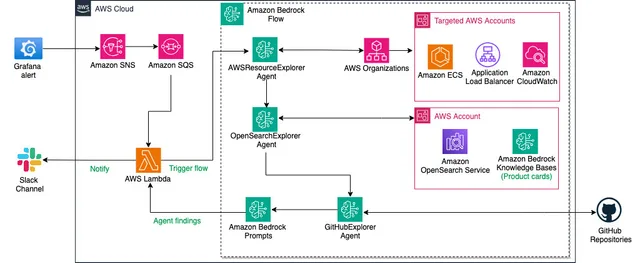
Circle K built an agentic automated triage system with Amazon Bedrock, reducing average DevOps incident triage time to under 15 minutes—a 67–75% reduction according to internal team metrics. In the system, Grafana alerts trigger AWS Lambda via Amazon SNS and Amazon SQS to invoke Amazon Bedrock Flows, which orchestrates multiple specialized agents in parallel to query logs and infrastructure, and pushes structured summaries to Slack; it has since migrated to Amazon Bedrock AgentCore.
Matched fieldsBody
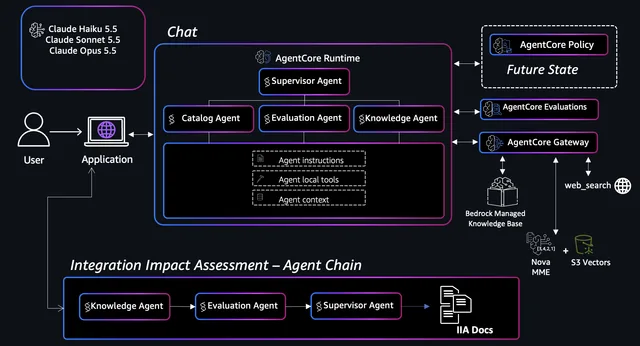
AWS demonstrated a multi-agent engineering assistant based on Amazon Bedrock AgentCore, Amazon Nova Multimodal Embeddings, and the open-source Strands Agents SDK, designed to reduce manual cross-checking in parts substitution evaluations. In the system, a planner routes tasks to three expert agents—Catalog, Evaluation, and Knowledge—which are respectively responsible for multimodal retrieval, scoring according to Python tolerance rules, and verifying lifecycle information using real-time web data, with a supervisor ultimately aggregating the results. The system only assembles evidence and drafts review documents; it does not itself recommend or approve substitutions, and every evaluation writes an audit record aligned with AS9100 8.4 and 8.5.6.
AWS demonstrated a multi-agent engineering assistant based on Amazon Bedrock AgentCore, Amazon Nova Multimodal Embeddings, and the open-source Strands Agents SDK, designed to reduce manual cross-checking in parts substitution evaluations. In the system, a planner routes tasks to three expert agents—Catalog, Evaluation, and Knowledge—which are respectively responsible for multimodal retrieval, scoring according to Python tolerance rules, and verifying lifecycle information using real-time web dat
Matched fieldsBody
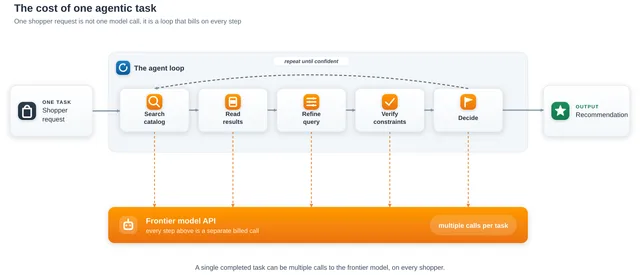
An AWS official blog post explains how to fine-tune a shopping agent on Amazon SageMaker AI using sequence-level knowledge distillation (SeqKD): using GLM-5.3 on Amazon Bedrock as the teacher model to generate trajectories, using the ShoppingBench scorer to retain only trajectories that solve the task, and then performing serverless SFT on the Qwen3.5-4B student model. On 324 held-out test questions, the distilled 4B student's average absolute success rate increased from 0.297 to 0.541, essentially on par with the teacher model and mid-sized frontier models; when the teacher's reasoning process was removed and only tool calls were learned, the average success rate dropped to 0.415.
An AWS official blog post explains how to fine-tune a shopping agent on Amazon SageMaker AI using sequence-level knowledge distillation (SeqKD): using GLM-5.3 on Amazon Bedrock as the teacher model to generate trajectories, using the ShoppingBench scorer to retain only trajectories that solve the task, and then performing serverless SFT on the Qwen3.5-4B student model. On 324 held-out test questions, the distilled 4B student's average absolute success rate increased from 0.297 to 0.541, essentia
Matched fieldsBody
A New Yorker feature documented the shockwaves AI brought to the pure mathematics community in 2026: OpenAI announced it had cracked the Navier-Stokes existence and smoothness problem, models such as GPT-5.2 Pro and Claude Fable 5 successively solved multiple Erdős problems and the Jacobian conjecture, and in early October OpenAI released new results on 372 unsolved math problems. Terence Tao and 25 other Fields Medalists jointly published an open letter warning that problem-solving and insight are becoming decoupled, that a flood of AI papers lacking derivation details is overwhelming journals, and that graduate student training has also been hit because AI can solve medium-level problems in a few hours. The report also mentioned that Anthropic refused to disclose the derivation process for a new solution to the Hadamard matrix problem, as well as the dispute between OpenAI and New York University professor Buckmaster over priority and authorship regarding the Navier-Stokes problem.
A New Yorker feature documented the shockwaves AI brought to the pure mathematics community in 2026: OpenAI announced it had cracked the Navier-Stokes existence and smoothness problem, models such as GPT-5.2 Pro and Claude Fable 5 successively solved multiple Erdős problems and the Jacobian conjecture, and in early October OpenAI released new results on 372 unsolved math problems. Terence Tao and 25 other Fields Medalists jointly published an open letter warning that problem-solving and insight
Matched fieldsBody
Apple announced that core Apple Intelligence features will be rolled out to Chinese users in December with the official release of iOS 27.3, with developer testing opening first on November 4, and confirmed a partnership with Alibaba to integrate the Qwen large model to provide support for Siri, writing tools, and more. A Claude Code plugin (version 2.1.313) in the Cursor extension marketplace that falsely used Anthropic's official name was listed for about 11 hours, affecting as many as 5,000 developers, and attempted to implant a persistent SSH backdoor. Anthropic said its internal systems and official distribution channels were not compromised.
Apple announced that core Apple Intelligence features will be rolled out to Chinese users in December with the official release of iOS 27.3, with developer testing opening first on November 4, and confirmed a partnership with Alibaba to integrate the Qwen large model to provide support for Siri, writing tools, and more. A Claude Code plugin (version 2.1.313) in the Cursor extension marketplace that falsely used Anthropic's official name was listed for about 11 hours, affecting as many as 5,000 d
Matched fieldsBody
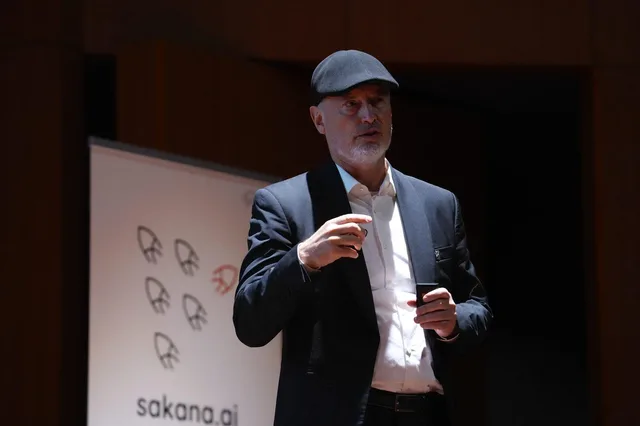
Sakana AI held a workshop at Hitotsubashi Hall in Tokyo, announcing the launch of its in-house pretrained language model series "Sakana Sawara (tentative name)," with the first model, Sawara Small (tentative name), planned for release in spring 2027. Chief Scientific Advisor Jürgen Schmidhuber gave a keynote speech and held a conversation with CEO David Ha; the event attracted more than 400 attendees from across Japan. Sakana AI frames AI sovereignty around three pillars: pretraining, post-training, and orchestration, with the latter two corresponding to Sakana Namazu and Sakana Fugu, respectively.
Sakana AI held a workshop at Hitotsubashi Hall in Tokyo, announcing the launch of its in-house pretrained language model series "Sakana Sawara (tentative name)," with the first model, Sawara Small (tentative name), planned for release in spring 2027. Chief Scientific Advisor Jürgen Schmidhuber gave a keynote speech and held a conversation with CEO David Ha; the event attracted more than 400 attendees from across Japan. Sakana AI frames AI sovereignty around three pillars: pretraining, post-train
Matched fieldsBody
Browser Use has opened its fastest browser agent, BU Ultrafast, from the waitlist to all Cloud plans in the US, including the free tier. Official data shows a median task time of 22 seconds and a cost of $0.0064 per task, compared with 79 seconds and $0.0098 for the default agent on GPT-6 Luna. To use it, simply set model to bu-ultrafast; if you need more step-by-step reasoning, you can switch to bu-fast from the same agent, which is billed at standard rates.

Matched fieldsBody
Claude Code v2.1.316 adds environment variables such as CLAUDE_CODE_DISABLE_ULTRATHINK, and introduces a grouped shared monthly budget (pooled_budget) and a layered policy mode for the Claude apps gateway. This version announces that Opus 4.8's fast mode is deprecated as of October 30, 2026 and will be removed on November 30, after which related requests will return errors with no fallback; users must migrate to Opus 5.5 to retain acceleration. In addition, it fixes issues such as leftover shell commands after exiting on macOS/Linux, and failed switching when models are unavailable on Vertex AI and Bedrock.
Claude Code v2.1.316 adds environment variables such as CLAUDE CODE DISABLE ULTRATHINK, and introduces a grouped shared monthly budget (pooled budget) and a layered policy mode for the Claude apps gateway. This version announces that Opus 4.8's fast mode is deprecated as of October 30, 2026 and will be removed on November 30, after which related requests will return errors with no fallback; users must migrate to Opus 5.5 to retain acceleration. In addition, it fixes issues such as leftover shell
Matched fieldsBody
OpenAI releases the GPT-Rosalind-6 system card addendum. This model uses the same set of weights as GPT-6 Astra, with no new training data or post-training added, and is provided only through trusted access to vetted research institutions, enterprises, and government partners. At the highest reasoning budget, MedChemBench v7 averages 49.6% (GPT-Rosalind-5.5: 28.9%), GeneBench Pro v13 single-attempt success rate is 37.7% (previous generation: 16.7%), and LifeSciBench Gold average score is 61.3% (previous generation: 44.0%). Under the Preparedness Framework, this release is rated High capability in the biological and chemical domains, below the Critical threshold; rated Critical in the cybersecurity domain; and below High in AI self-improvement.
OpenAI releases the GPT-Rosalind-6 system card addendum. This model uses the same set of weights as GPT-6 Astra, with no new training data or post-training added, and is provided only through trusted access to vetted research institutions, enterprises, and government partners. At the highest reasoning budget, MedChemBench v7 averages 49.6% (GPT-Rosalind-5.5: 28.9%), GeneBench Pro v13 single-attempt success rate is 37.7% (previous generation: 16.7%), and LifeSciBench Gold average score is 61.3% (
Matched fieldsBody
Pydantic has begun development of its next major version, Pydantic V3, with the goal of approaching final status by the end of this year; there is currently no release date. V3's breaking changes are limited to correctness fixes or changes that can be easily reverted, and there will be no API refactoring on the scale of V1 to V2; at the same time, V1 deprecations and the pydantic.v1 namespace will be removed. Pydantic has released the final V1 version, V1.10.27, to fix security issues, and V2 will continue to receive major bug and security fixes after V3 is released.
Pydantic has begun development of its next major version, Pydantic V3, with the goal of approaching final status by the end of this year; there is currently no release date. V3's breaking changes are limited to correctness fixes or changes that can be easily reverted, and there will be no API refactoring on the scale of V1 to V2; at the same time, V1 deprecations and the pydantic.v1 namespace will be removed. Pydantic has released the final V1 version, V1.10.27, to fix security issues, and V2 wi
Matched fieldsBody
At GitHub Universe 2026, held October 28–29, 2026, GitHub announced that Copilot Fusion, which integrates automatic model selection with multi-model collaboration, is now generally available. It can be used in VS Code, the GitHub Copilot app, the CLI, and JetBrains IDEs, and it automatically determines which model to use and which of three execution modes—Single, Cascade, or Critique—to apply, based on three processing tiers: Standard, High, and Max. The desktop GitHub Copilot app is also beginning a public beta of Projects, which centralizes materials, repositories, sessions, and artifacts in one place for management. GitHub says Fusion Max scores 60 on the Artificial Analysis Coding Agent Index, within 2 points of Claude Code using Opus 5.5 Max, while its average API cost per task is about half and its time is about 40% less.
At GitHub Universe 2026, held October 28–29, 2026, GitHub announced that Copilot Fusion, which integrates automatic model selection with multi-model collaboration, is now generally available. It can be used in VS Code, the GitHub Copilot app, the CLI, and JetBrains IDEs, and it automatically determines which model to use and which of three execution modes—Single, Cascade, or Critique—to apply, based on three processing tiers: Standard, High, and Max. The desktop GitHub Copilot app is also beginn
Matched fieldsBody
On October 29, 2026, Cursor disclosed that a maliciously tampered version 2.1.313 of the Anthropic.claude-code extension appeared in its VS Code extension Marketplace. The package was not developed by Anthropic and attempts to install a persistent SSH backdoor, affecting up to 5,000 users. This version was downloadable on that day from approximately 2:27 to 13:35 (Pacific Time). It collects host and user information, writes the attacker's SSH public key into authorized_keys, and establishes a reverse tunnel, while also achieving persistence through a LaunchAgent or scheduled task. Cursor has removed the version, shut down and rebuilt the Marketplace, and published indicators including hashes and IP 134.209.82.225, as well as cleanup scripts for macOS and Windows.
On October 29, 2026, Cursor disclosed that a maliciously tampered version 2.1.313 of the Anthropic.claude-code extension appeared in its VS Code extension Marketplace. The package was not developed by Anthropic and attempts to install a persistent SSH backdoor, affecting up to 5,000 users. This version was downloadable on that day from approximately 2:27 to 13:35 (Pacific Time). It collects host and user information, writes the attacker's SSH public key into authorized keys, and establishes a re
Matched fieldsBody