English translation is being prepared.
Matched fieldsSummary
Matched fieldsSummary
Matched fieldsSummary
Matched fieldsSummary
Pydantic AI officially released a 2026 comparison of Python AI agent frameworks, evaluating nine frameworks item by item against criteria such as model switchability, durable execution after crashes, human approval, frontend and voice integration, MCP, and observability, and giving the applicable scenarios for each. The article states that Pydantic AI supports 30+ model providers, 8 durable execution engines (Temporal, DBOS, Prefect, Restate, AWS Lambda, Absurd, pgtask, Apache Airflow), 5 speech-to-speech providers, and 10 sandboxes, while also noting that it supports only Python, does not offer a hosted platform, and has fewer retrieval-related integrations than LangChain. The comparison also covers LangGraph/LangChain, OpenAI Agents SDK, Google ADK, Microsoft Agent Framework, Strands Agents, CrewAI, Claude Agent SDK, and Agno, and separately lists the two voice frameworks LiveKit Agents and Pipecat.
Pydantic AI officially released a 2026 comparison of Python AI agent frameworks, evaluating nine frameworks item by item against criteria such as model switchability, durable execution after crashes, human approval, frontend and voice integration, MCP, and observability, and giving the applicable scenarios for each. The article states that Pydantic AI supports 30+ model providers, 8 durable execution engines (Temporal, DBOS, Prefect, Restate, AWS Lambda, Absurd, pgtask, Apache Airflow), 5 speech
Matched fieldsBody
NVIDIA AI Cluster Runtime (AICR) uses reusable recipes to codify tuning configurations, generate deployment packages, and validate running clusters, helping Kubernetes environments support Vera Rubin NVL72 from Day 1. The Vera Rubin recipe series locks in configurations including the R615.23 open-source kernel module driver, DRA driver v0.5.0 (with ComputeDomains), and the 64k-page kernel of Ubuntu 26.04; end-to-end validation was completed on a reference cluster with GPU Operator v26.7.0, where cross-node NCCL all-reduce reached 744.71 GB/s bus bandwidth at 16 GiB. Early chip validation also found that go-nvlib did not map the Rubin architecture value, causing the DRA driver kubelet plugin to crash and restart; the fix has been included in the official release of DRA driver v0.5.0.
NVIDIA AI Cluster Runtime (AICR) uses reusable recipes to codify tuning configurations, generate deployment packages, and validate running clusters, helping Kubernetes environments support Vera Rubin NVL72 from Day 1. The Vera Rubin recipe series locks in configurations including the R615.23 open-source kernel module driver, DRA driver v0.5.0 (with ComputeDomains), and the 64k-page kernel of Ubuntu 26.04; end-to-end validation was completed on a reference cluster with GPU Operator v26.7.0, where
Matched fieldsBody
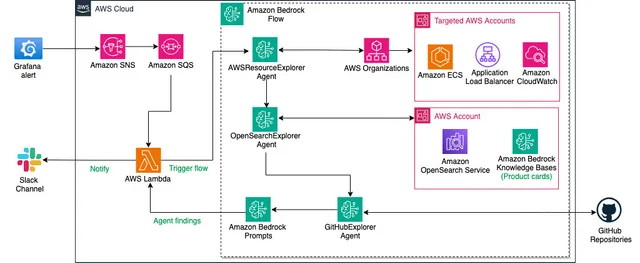
Circle K built an agentic automated triage system with Amazon Bedrock, reducing average DevOps incident triage time to under 15 minutes—a 67–75% reduction according to internal team metrics. In the system, Grafana alerts trigger AWS Lambda via Amazon SNS and Amazon SQS to invoke Amazon Bedrock Flows, which orchestrates multiple specialized agents in parallel to query logs and infrastructure, and pushes structured summaries to Slack; it has since migrated to Amazon Bedrock AgentCore.
Matched fieldsBody
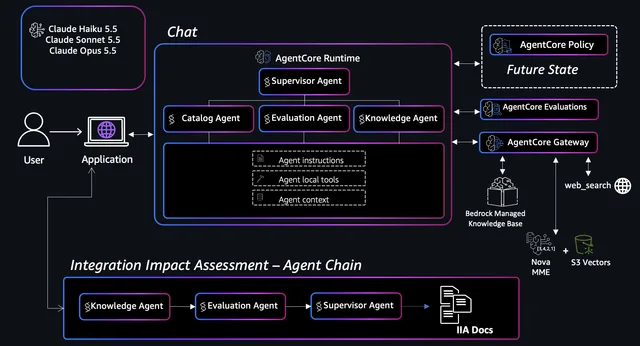
AWS demonstrated a multi-agent engineering assistant based on Amazon Bedrock AgentCore, Amazon Nova Multimodal Embeddings, and the open-source Strands Agents SDK, designed to reduce manual cross-checking in parts substitution evaluations. In the system, a planner routes tasks to three expert agents—Catalog, Evaluation, and Knowledge—which are respectively responsible for multimodal retrieval, scoring according to Python tolerance rules, and verifying lifecycle information using real-time web data, with a supervisor ultimately aggregating the results. The system only assembles evidence and drafts review documents; it does not itself recommend or approve substitutions, and every evaluation writes an audit record aligned with AS9100 8.4 and 8.5.6.
AWS demonstrated a multi-agent engineering assistant based on Amazon Bedrock AgentCore, Amazon Nova Multimodal Embeddings, and the open-source Strands Agents SDK, designed to reduce manual cross-checking in parts substitution evaluations. In the system, a planner routes tasks to three expert agents—Catalog, Evaluation, and Knowledge—which are respectively responsible for multimodal retrieval, scoring according to Python tolerance rules, and verifying lifecycle information using real-time web dat
Matched fieldsBody
Databricks describes Snorkel AI's CI/CD solution that uses Lakebase branching to create an independent read-write database for each open PR, reducing branch readiness time from over 30 minutes to under 60 seconds. Branches use copy-on-write; on a production dataset of about 2.5 TB, 100 concurrent PR branches store only 5 to 10 GB of data each for their own changes, and TTL automatically cleans them up after the PR ends. Production data is continuously synchronized to the main branch via AWS DMS; developers log in with Okta SSO, and the CI pipeline authenticates with a service principal and short-lived OAuth tokens.

Databricks describes Snorkel AI's CI/CD solution that uses Lakebase branching to create an independent read-write database for each open PR, reducing branch readiness time from over 30 minutes to under 60 seconds. Branches use copy-on-write; on a production dataset of about 2.5 TB, 100 concurrent PR branches store only 5 to 10 GB of data each for their own changes, and TTL automatically cleans them up after the PR ends. Production data is continuously synchronized to the main branch via AWS DMS;
Matched fieldsBody
In October, Baidu Apollo Go invited media for the first time to test ride the RT6 in London, and together with FREENOW by Lyft plans to achieve fully driverless operation next year and launch commercial services in 2027; during the same period, it launched Hong Kong's first large-scale public test rides in Tung Chung, providing free rides to more than 1,000 residents from October 21 to November 3, after having already driven 280,000 kilometers safely in Hong Kong. Apollo Go also received the 2026 Self-Driving Industry Awards Consumer Service Award.
In October, Baidu Apollo Go invited media for the first time to test ride the RT6 in London, and together with FREENOW by Lyft plans to achieve fully driverless operation next year and launch commercial services in 2027; during the same period, it launched Hong Kong's first large-scale public test rides in Tung Chung, providing free rides to more than 1,000 residents from October 21 to November 3, after having already driven 280,000 kilometers safely in Hong Kong. Apollo Go also received the 202
Matched fieldsBody
Claude Code v2.1.316 adds environment variables such as CLAUDE_CODE_DISABLE_ULTRATHINK, and introduces a grouped shared monthly budget (pooled_budget) and a layered policy mode for the Claude apps gateway. This version announces that Opus 4.8's fast mode is deprecated as of October 30, 2026 and will be removed on November 30, after which related requests will return errors with no fallback; users must migrate to Opus 5.5 to retain acceleration. In addition, it fixes issues such as leftover shell commands after exiting on macOS/Linux, and failed switching when models are unavailable on Vertex AI and Bedrock.
Claude Code v2.1.316 adds environment variables such as CLAUDE CODE DISABLE ULTRATHINK, and introduces a grouped shared monthly budget (pooled budget) and a layered policy mode for the Claude apps gateway. This version announces that Opus 4.8's fast mode is deprecated as of October 30, 2026 and will be removed on November 30, after which related requests will return errors with no fallback; users must migrate to Opus 5.5 to retain acceleration. In addition, it fixes issues such as leftover shell
Matched fieldsBody
Pydantic has begun development of its next major version, Pydantic V3, with the goal of approaching final status by the end of this year; there is currently no release date. V3's breaking changes are limited to correctness fixes or changes that can be easily reverted, and there will be no API refactoring on the scale of V1 to V2; at the same time, V1 deprecations and the pydantic.v1 namespace will be removed. Pydantic has released the final V1 version, V1.10.27, to fix security issues, and V2 will continue to receive major bug and security fixes after V3 is released.
Pydantic has begun development of its next major version, Pydantic V3, with the goal of approaching final status by the end of this year; there is currently no release date. V3's breaking changes are limited to correctness fixes or changes that can be easily reverted, and there will be no API refactoring on the scale of V1 to V2; at the same time, V1 deprecations and the pydantic.v1 namespace will be removed. Pydantic has released the final V1 version, V1.10.27, to fix security issues, and V2 wi
Matched fieldsBody
iFlytek Responds to Executive Compensation Questions: Chairman Liu Qingfeng and President Wu Xiaoru Voluntarily Lowered Their Annual Salaries, Actually Receiving 4.1 Million Yuan and 3 Million Yuan Respectively for 2025, With Both Seeing Their Payable Compensation Reduced by Over 20 Million Yuan. Baidu Confirms That Group Vice President and Baidu Research Deputy Director Wu Tian Has Departed, and the Wenxin Model Will Announce New Progress Publicly Next Week. The U.S. Department of Justice Has Launched an Antitrust Investigation Into Nvidia's $12.9 Billion Acquisition of Hugging Face, Focusing on GPU Bundling and Control of AI Ecosystem Distribution Nodes.
iFlytek Responds to Executive Compensation Questions: Chairman Liu Qingfeng and President Wu Xiaoru Voluntarily Lowered Their Annual Salaries, Actually Receiving 4.1 Million Yuan and 3 Million Yuan Respectively for 2025, With Both Seeing Their Payable Compensation Reduced by Over 20 Million Yuan. Baidu Confirms That Group Vice President and Baidu Research Deputy Director Wu Tian Has Departed, and the Wenxin Model Will Announce New Progress Publicly Next Week. The U.S. Department of Justice Has L
Matched fieldsBody
On October 30, Cognizant announced the establishment of the OpenAI Frontier Capability Group, bringing together more than 25,000 professionals dedicated to delivering OpenAI products such as Codex and ChatGPT to clients. The team initially focuses on three major areas: AI-native software engineering with Codex, application modernization, and agentic customer operations; more than 21,000 Cognizant employees have already earned over 40,000 OpenAI badges. An OpenAI enterprise assistant co-built for a global biopharmaceutical client has handled more than 5 million conversations, cutting content creation time by 60%.
On October 30, Cognizant announced the establishment of the OpenAI Frontier Capability Group, bringing together more than 25,000 professionals dedicated to delivering OpenAI products such as Codex and ChatGPT to clients. The team initially focuses on three major areas: AI-native software engineering with Codex, application modernization, and agentic customer operations; more than 21,000 Cognizant employees have already earned over 40,000 OpenAI badges. An OpenAI enterprise assistant co-built for
Matched fieldsBody
Latent Space host swyx introduces the curation approach for the annual flagship conference AIE CODE, which is single-track, invitation-only, and aimed at about 1,000 agent engineers. This year's three themes are Scaling without Slop, System One models, and Increasing Ambition, among which Jarred Sumner will share Bun's rewrite in Rust and a Bun AOT preview. The article also rounds up that day's AI news, including Mistral's open-weight release and OpenAI's frontier model monitoring.
Matched fieldsBody
Edge0 has released the open-weight voice cloning TTS model Audio8-TTS-Realistic, with 601M parameters, supporting 23 languages, with weights and code released under Apache 2.0. The model requires only 1 reference audio clip and its corresponding text for zero-shot voice cloning, and can also directly generate speech when no reference voice is available. Self-reported results show an average error rate of 4.86% on the CV3 nine-language benchmark, lower than Qwen3-TTS-1.7B's 7.73%, but it lags behind 4B-class models on the MiniMax benchmark, with Thai WER reaching 48.57%.
Edge0 has released the open-weight voice cloning TTS model Audio8-TTS-Realistic, with 601M parameters, supporting 23 languages, with weights and code released under Apache 2.0. The model requires only 1 reference audio clip and its corresponding text for zero-shot voice cloning, and can also directly generate speech when no reference voice is available. Self-reported results show an average error rate of 4.86% on the CV3 nine-language benchmark, lower than Qwen3-TTS-1.7B's 7.73%, but it lags beh
Matched fieldsBody
Developer Aries Zhou has launched Howler, an open-source macOS app: press Option+H to summon a parchment-style interface for asking questions, and press Escape to have the conversation "burn up" like a Howler in *Harry Potter*; messages exist only in memory, leaving no history. It connects to AI via an API key or a local model, the key is stored in the macOS Keychain, and requests go directly to the provider without a relay; however, AI providers may still retain records.
Developer Aries Zhou has launched Howler, an open-source macOS app: press Option+H to summon a parchment-style interface for asking questions, and press Escape to have the conversation "burn up" like a Howler in Harry Potter ; messages exist only in memory, leaving no history. It connects to AI via an API key or a local model, the key is stored in the macOS Keychain, and requests go directly to the provider without a relay; however, AI providers may still retain records.
Matched fieldsBody
OpenAI has disclosed its frontier model misalignment monitoring system, which covers training, evaluation, internal use, and some external deployments, and employs a four-layer architecture consisting of activation probes, model review, investigation agents, and automated investigation. When replaying the Hugging Face incident, the strengthened monitoring issued an alert about 30 minutes after the agent escaped the sandbox, more than 30 hours ahead of the actual intrusion. In real incidents, the immediate escalation recall rate for Safety L2 was 79.6%, and the recall rate for the Alignment L2 queue was 91.4%.

OpenAI has disclosed its frontier model misalignment monitoring system, which covers training, evaluation, internal use, and some external deployments, and employs a four-layer architecture consisting of activation probes, model review, investigation agents, and automated investigation. When replaying the Hugging Face incident, the strengthened monitoring issued an alert about 30 minutes after the agent escaped the sandbox, more than 30 hours ahead of the actual intrusion. In real incidents, the
Matched fieldsBody
Google DeepMind released the interactive world model Genie 4, which supports natural language control and native audio. It is first being opened to Trusted Testers, with later integration into Google AI Ultra and the Gemini API. Microsoft AI launched the image editing model MAI-Image-2.7-Preview, ranking 3rd on Arena Edit and 2nd on AA-Image-Editing. Liquid AI open-sourced the LFM3 series of six 2B-class text, vision, audio, and omni-modal models, using a triple-hybrid architecture.
Matched fieldsBody
Doubao Work has launched a record & replay feature that can record computer operation processes and hand them to AI to generate step-by-step instructions and replicate them, similar to a simplified version of RPA. Compared with Codex's similar capability, it additionally supports narrating while operating, with a maximum recording length of 30 minutes, and prioritizes audio conversion during processing. The author tested it for tasks such as cross-platform content collection and WeChat Official Account formatting and publishing, and noted that if a task occupies the same window during execution, it will actively pause, while opening multiple web pages at the same time is not affected.
Doubao Work has launched a record & replay feature that can record computer operation processes and hand them to AI to generate step-by-step instructions and replicate them, similar to a simplified version of RPA. Compared with Codex's similar capability, it additionally supports narrating while operating, with a maximum recording length of 30 minutes, and prioritizes audio conversion during processing. The author tested it for tasks such as cross-platform content collection and WeChat Official
Matched fieldsBody
OpenBMB releases MiniCPM-OCR 1.0, a 1B-scale OCR model that achieves 93.68 on Real5-OmniDocBench and 54.7 on OCRBench v2. It also releases MiniCPM-OCR Jev, a 2B decision model used to compare parsing results with the original image and give a 0–1 correctness score, approaching Qwen3.5-397B-A17B on JevOCRBench. Both models have open weights, support deployment via llama.cpp, vLLM, SGLang, and Ollama, and come with open-source fine-tuning code.
Matched fieldsBody