←Search results

By relevance · Total 6709 results Clear search

Thursday

  1. MiniMax BlogSelected

    MiniMax Code Desktop Launches Mini App

    MiniMax has launched Mini App in local sessions of the MiniMax Code desktop app (macOS / Windows). It is a persistent application with a frontend and a Node.js backend, installed as a plugin, that can call and be called by the Agent, keeping work on a continuously alive page rather than scattered across conversations. This release includes the Mini App runtime (persistent data directory, hosted MCP, Agent API, Host Connectors, and in-page tool approval), /miniapp-creator for generating a page with a single sentence, and the official Mini Apps in the plugin marketplace and the open-source community repository MiniMax-Code-MiniApps. According to the official announcement, account credentials are kept by the host and cannot be accessed by plugins or pages, and content passed from a page to the Agent first enters the input box for review.

    Cover: a hand places a card into a cluster of Mini Apps, including a stock dashboard, a 3D model, a map, and a chat, connected by a line to the Agent

    of the MiniMax Code desktop app (macOS / Windows). It is a persistent application with a frontend and a Node.js backend, installed as a plugin, that can call and be called by the Agent, keeping work on a continuously alive page rather than scattered across conversations. This release includes the Mini App runtime (persistent data directory, hosted MCP, Agent API, Host Connectors, and in-page tool approval), /miniapp-creator for generating a page with a single sentence, and the official Mini App

    Matched fieldsSummary、Body
  2. Shao Meng

    Recursive releases its first model Flint: local coding MoE, 125+ tokens/s on a MacBook

    Recursive releases its first model Flint, a MoE with 40 billion total parameters and 2.5 billion activated parameters per token, aimed at local Agent coding, with weights open-sourced under Apache 2.0. With short context, it exceeds 125 tokens per second on an M4 Pro MacBook Pro and over 150 on a 64GB RTX Spark, and supports llama.cpp, Ollama, LM Studio, vLLM, SGLang, and Unsloth. Nearly every stage of its R&D involved the automated research system Eureka Machine, including architecture search, quantizing the output layer to 4 bit with offline distillation, and fusing Metal kernels for M4/M5.

    Recursive releases its first model Flint, a MoE with 40 billion total parameters and 2.5 billion activated parameters per token, aimed at local Agent coding, with weights open-sourced under Apache 2.0. With short context, it exceeds 125 tokens per second on an M4 Pro MacBook Pro and over 150 on a 64GB RTX Spark, and supports llama.cpp, Ollama, LM Studio, vLLM, SGLang, and Unsloth. Nearly every stage of its R&D involved the automated research system Eureka Machine, including architecture search,

    Matched fieldsSummary、Body

  3. Shao Meng

    Microsoft CEO Satya Nadella's 2026 Annual Letter to Shareholders: Mapping Token Costs to Business Outcomes, Building a Frontier Ecosystem

    In his 2026 annual letter to shareholders, Microsoft CEO Satya Nadella proposed building a frontier ecosystem and introduced cost-to-outcome—the business results obtained per unit of token spend—as a new optimization metric. In fiscal year 2026, Microsoft's revenue reached $331.8 billion, up 18% year over year; Azure grew 41%, surpassing $100 billion for the first time; M365 Copilot paid seats exceeded 30 million, and GitHub Copilot users reached 50 million. The letter states that interaction is shifting from synchronous chat to asynchronous agents, with the harness separated from the model; Foundry offers more than 11,000 models and has over 100,000 customers, and Microsoft Frontier Co. was established, deploying 6,000 experts on-site.

    Microsoft's revenue reached $331.8 billion, up 18% year over year; Azure grew 41%, surpassing $100 billion for the first time; M365 Copilot paid seats exceeded 30 million, and GitHub Copilot users reached 50 million. The letter states that interaction is shifting from synchronous chat to asynchronous agents, with the harness separated from the model; Foundry offers more than 11,000 models and has over 100,000 customers, and Microsoft Frontier Co. was established, deploying 6,000 experts on-site.

    Matched fieldsSummary、Body

  4. MiniMax

    MiniMax announces Inferact as the API launch partner for M3.1 Flash

    MiniMax announces Inferact as the API launch partner for M3.1 Flash; the latter will provide vLLM engineering capabilities and the Inferact Platform to support production inference for this model. Both parties state that they will continue to jointly build serving infrastructure for complex agent workloads. In a quoted post, Inferact stated that M3.1 Flash is aimed at multi-step automation, real-codebase engineering, and visual reasoning, scoring 29.6 on Agents' Last Exam (ALE), 72.5% on AutomationBench-AA, and 73.67% on DeepSWE.

    PI launch partner for M3.1 Flash; the latter will provide vLLM engineering capabilities and the Inferact Platform to support production inference for this model. Both parties state that they will continue to jointly build serving infrastructure for complex agent workloads. In a quoted post, Inferact stated that M3.1 Flash is aimed at multi-step automation, real-codebase engineering, and visual reasoning, scoring 29.6 on Agents' Last Exam (ALE), 72.5% on AutomationBench-AA, and 73.67% on DeepSWE.

    Matched fieldsSummary、Body

  5. AWS Machine Learning

    AWS team open-sources multi-agent system Deep Insight, breaking down five major challenges in production environments

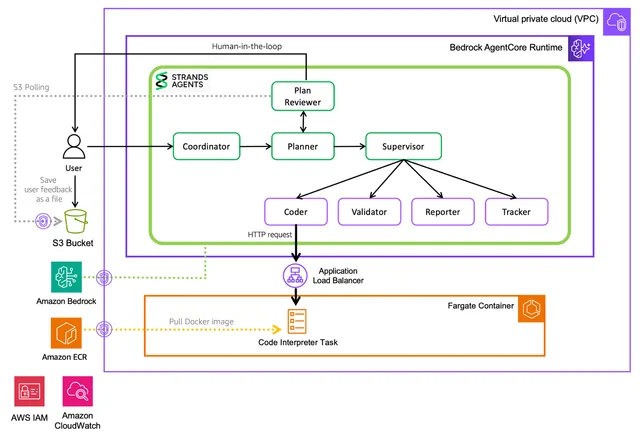
    The AWS Solutions Architecture team built and open-sourced the multi-agent system Deep Insight, which can transform CSV data and natural language prompts into cited .docx analysis reports. The system consists of eight agents—Coordinator, Planner, Supervisor, Coder, Validator, Reporter, Tracker, and others—collaborating in layers, controlling execution flow based on the Graph and Agents-as-Tools patterns of the Strands Agents SDK, and selecting Claude Haiku, Opus, and Sonnet by role. Production deployment relies on the Amazon Bedrock AgentCore runtime; LLM-generated code is executed in isolation within per-session ephemeral containers on AWS Fargate, accompanied by a Web UI and an Ops dashboard.

    Deep Insight architecture: the Strands Agents multi-agent layer on Amazon Bedrock AgentCore, with an Application Load Balancer routing code execution to AWS Fargate containers in a private VPC

    The AWS Solutions Architecture team built and open-sourced the multi-agent system Deep Insight, which can transform CSV data and natural language prompts into cited .docx analysis reports. The system consists of eight agents—Coordinator, Planner, Supervisor, Coder, Validator, Reporter, Tracker, and others—collaborating in layers, controlling execution flow based on the Graph and Agents-as-Tools patterns of the Strands Agents SDK, and selecting Claude Haiku, Opus, and Sonnet by role. Production d

    Matched fieldsSummary、Body

Wednesday

  1. Claude Blog

    Anthropic Opens Claude Duet Research Preview: An Agentic App That Can Proactively Execute Tasks

    Anthropic has opened the Claude Duet research preview, an agentic app built on Claude Opus 5.5 that can proactively advance tasks. It is now available on iOS, Android, and claude.ai for Pro and Max users in the United States, who must join a waitlist. Every morning it pushes a cross-app highlights briefing, and it can continuously execute tasks in the background; it requires user approval before sending messages, making payments, signing documents, or deleting, and securities trading and transfers between accounts are not permitted even with approval. Claude Duet can invoke more than 6,000 connectors and plugins in the Claude Marketplace, and it follows the credential-handling approach of Claude Managed Agents, never directly touching users' passwords or login tokens.

    Anthropic has opened the Claude Duet research preview, an agentic app built on Claude Opus 5.5 that can proactively advance tasks. It is now available on iOS, Android, and claude.ai for Pro and Max users in the United States, who must join a waitlist. Every morning it pushes a cross-app highlights briefing, and it can continuously execute tasks in the background; it requires user approval before sending messages, making payments, signing documents, or deleting, and securities trading and transfe

    Matched fieldsSummary、Body

  2. QbitAI

    Zijing Zhikang, incubated by Tsinghua AIR, releases multi-agent collaborative technology and upgrades Zijing AI Hospital

    Zijing Zhikang, incubated by Tsinghua AIR, has released multi-agent collaborative technology for the medical field and upgraded Zijing AI Hospital (Agent Hospital), offering two modes: on-demand reminders and consultation. When agents' opinions differ, the disagreements are highlighted and presented to doctors for judgment. As of July 2026, the system has built 54 AI doctors and millions of hyper-realistic AI patients, covering thousands of diseases; 18 clinical departments at Beijing Tsinghua Changgung Hospital have conducted outpatient testing, with more than 40 doctors using it regularly, improving overall diagnostic and treatment efficiency by 30%. AI doctors have achieved over 96% accuracy on the MedQA dataset and attained the highest scores in multiple international medical evaluation datasets.

    Zijing Zhikang, incubated by Tsinghua AIR, has released multi-agent collaborative technology for the medical field and upgraded Zijing AI Hospital (Agent Hospital), offering two modes: on-demand reminders and consultation. When agents' opinions differ, the disagreements are highlighted and presented to doctors for judgment. As of July 2026, the system has built 54 AI doctors and millions of hyper-realistic AI patients, covering thousands of diseases; 18 clinical departments at Beijing Tsinghua C

    Matched fieldsSummary、Body

  3. Kling AI

    Kling 4.0 launches on the fal platform

    Kling 4.0 is now live on the fal platform. The official description calls it a next-generation native multimodal video model, with improvements in stability for complex motion, consistency of character and scene references, and precision of cinematic narrative control. It is currently available only through the fal UX and fal Agent, with API access coming soon.

    Matched fieldsSummary

  4. fal

    Kling 4.0 Launches on the fal Platform

    Kling 4.0 is now available on the fal platform. It is a new-generation native multimodal video model that improves the stability of complex motion, reference consistency for characters and scenes, and control precision for cinematic storytelling. It is currently available only through fal UX and fal Agent, with API access coming soon.

    Matched fieldsSummary、Body

  5. ElevenLabs BlogSelected

    ElevenLabs launches Eleven Realtime Translation real-time speech translation model

    ElevenLabs releases the real-time speech translation model Eleven Realtime Translation, currently available in alpha form to ElevenAPI enterprise customers. The model uses the low-latency speech model Eleven v4 Turbo by default, supports more than 90 languages and automatic language detection, keeps the same voice consistent across languages, and can be selected from a library of more than 17,500 voices or custom voice clones. Teams can adjust the translation startup speed, trading off between high-quality translation and low latency on complex calls; Deutsche Telekom has already built new call features based on ElevenLabs in its Magenta AI Call Assistant.

    Smiling person with tousled hair against a neutral background.

    el uses the low-latency speech model Eleven v4 Turbo by default, supports more than 90 languages and automatic language detection, keeps the same voice consistent across languages, and can be selected from a library of more than 17,500 voices or custom voice clones. Teams can adjust the translation startup speed, trading off between high-quality translation and low latency on complex calls; Deutsche Telekom has already built new call features based on ElevenLabs in its Magenta AI Call Assistant.

    Matched fieldsSummary、Body

  6. Databricks Blog

    Deploying the RFD4-Proteina model on Databricks

    NVIDIA and Databricks plan to integrate NVIDIA BioNeMo's open-source protein design model RFD4-Proteina into Databricks' Genesis Workbench, running on the now generally available AI Runtime serverless NVIDIA GPU compute. The model can simultaneously generate protein sequences and all-atom structures, and supports optional reward-guided search to steer candidate designs toward target properties such as thermostability and binding affinity. Genesis Workbench includes two built-in RFD4-Proteina workflows, Antibody Design and Vaccine Design, and can be extended through Genie Code and NVIDIA BioNeMo Agent Toolkit skills.

    rfd4-proteina-databricks

    nesis Workbench, running on the now generally available AI Runtime serverless NVIDIA GPU compute. The model can simultaneously generate protein sequences and all-atom structures, and supports optional reward-guided search to steer candidate designs toward target properties such as thermostability and binding affinity. Genesis Workbench includes two built-in RFD4-Proteina workflows, Antibody Design and Vaccine Design, and can be extended through Genie Code and NVIDIA BioNeMo Agent Toolkit skills.

    Matched fieldsSummary、Body

  7. Analytics India Magazine

    NVIDIA GTC Berlin 2026 announces 12 releases, covering AI factories, telecommunications, and enterprise agents

    At GTC 2026 in Berlin, NVIDIA announced 12 releases, covering AI factory deployment, semiconductor manufacturing expansion, telecom AI-RAN, enterprise agents, robotics and autonomous driving, as well as new open models for enterprise data, protein design, and quantum computing. On the infrastructure side, the DSX POD modular AI factory reference design is said to shorten deployment time from six months to as little as 14 days, and DSX MaxLPS is said to deliver equivalent AI compute using up to 30% less power, with partners planning to deliver in early 2027. On the telecom side, T-Mobile completed what it calls the world's first AI-RAN call on a commercial network in Bellevue, Washington, with NVIDIA and Nokia, and Elisa completed Europe's first AI-RAN field trial; on the enterprise side, it expanded the open-source Agent Toolkit and introduced the OpenShell reference architecture for monitoring and restricting agent behavior.

    At GTC 2026 in Berlin, NVIDIA announced 12 releases, covering AI factory deployment, semiconductor manufacturing expansion, telecom AI-RAN, enterprise agents, robotics and autonomous driving, as well as new open models for enterprise data, protein design, and quantum computing. On the infrastructure side, the DSX POD modular AI factory reference design is said to shorten deployment time from six months to as little as 14 days, and DSX MaxLPS is said to deliver equivalent AI compute using up to 3

    Matched fieldsSummary、Body

Tuesday