←Search results

By relevance · Total 1629 results Clear search

Thursday

  1. AWS Machine Learning

    Building an Enterprise-Grade Agentic AI Platform on Amazon Bedrock AgentCore

    AWS has released an enterprise-grade Agentic AI platform blueprint based on Amazon Bedrock and AgentCore, adopting a federated operating model in which a central Platform team provides governed shared services while each Workstream team retains ownership of its own agents, tools, and data. The platform enforces model admission, regional restrictions, rate and token quotas, and budget controls through an independent inference gateway and an MCP tool gateway, and uses an evaluation pipeline to perform gate checks before agents go live.
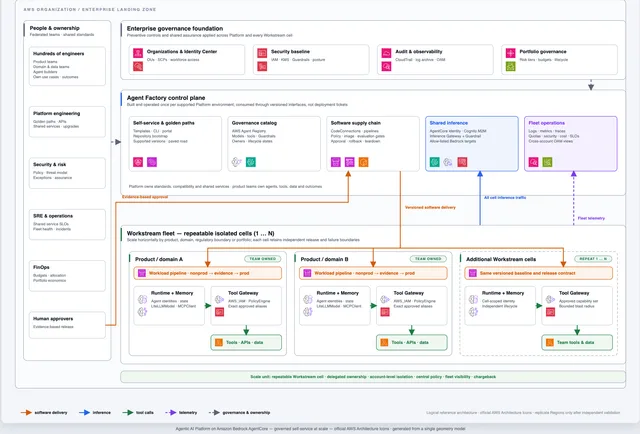
    Operating model linking the governance foundation, Platform control plane, and team-owned Workstream cells

    AWS has released an enterprise-grade Agentic AI platform blueprint based on Amazon Bedrock and AgentCore, adopting a federated operating model in which a central Platform team provides governed shared services while each Workstream team retains ownership of its own agents, tools, and data. The platform enforces model admission, regional restrictions, rate and token quotas, and budget controls through an independent inference gateway and an MCP tool gateway, and uses an evaluation pipeline to per

    Matched fieldsBody

  2. MarkTechPost

    MiniMax Open-Sources MCode Stack: 17 Agent Skills and 5 Checklists

    On October 28, MiniMax open-sourced MCode Stack under the MIT license, including the 17 SKILL.md skills and 5 checklists its team used to build MiniMax Code, but not the MiniMax Code source code. The skills are grouped into planning and decomposition, context and tools, long sessions and commands, review, and experiments and hotfixes, among which independent-review provides reviewers only with the diff, requirements, and test results. It can be installed into MiniMax Code by copying the skill directories, via a local plugin, or through the plugin marketplace, and can also be installed in Claude Code with /plugin marketplace add MiniMax-AI/mcode-stack; the original article did not publish evaluation results.

    On October 28, MiniMax open-sourced MCode Stack under the MIT license, including the 17 SKILL.md skills and 5 checklists its team used to build MiniMax Code, but not the MiniMax Code source code. The skills are grouped into planning and decomposition, context and tools, long sessions and commands, review, and experiments and hotfixes, among which independent-review provides reviewers only with the diff, requirements, and test results. It can be installed into MiniMax Code by copying the skill di

    Matched fieldsBody

  3. MarkTechPostSelected

    Google DeepMind releases Gemini 4 Carbon, focused on cybersecurity defense and coding

    Google DeepMind has launched Gemini 4 Carbon, calling it a frontier model for long-horizon agentic coding and cybersecurity defense, ranking first with 59 points on the Artificial Analysis Intelligence Index v5.0. The model achieved 96.2% on the GraphWalks long-context test, and 88.2%, 54.8%, and 71.0% on SEC-bench Pro, ExploitGym, and CWE-bench, respectively, but on OSWorld-2.1 it trailed Claude Opus 5.5's 87.2% with 81.5%. Carbon is currently available only to vetted cybersecurity defenders, with introductory pricing of $2 per million input tokens and $10 per million output tokens, later $4 and $20; the timeline for opening it to developers and the public has not been announced.

    Google DeepMind has launched Gemini 4 Carbon, calling it a frontier model for long-horizon agentic coding and cybersecurity defense, ranking first with 59 points on the Artificial Analysis Intelligence Index v5.0. The model achieved 96.2% on the GraphWalks long-context test, and 88.2%, 54.8%, and 71.0% on SEC-bench Pro, ExploitGym, and CWE-bench, respectively, but on OSWorld-2.1 it trailed Claude Opus 5.5's 87.2% with 81.5%. Carbon is currently available only to vetted cybersecurity defenders, w

    Matched fieldsBody

  4. MarkTechPost

    NVIDIA Releases Nemotron 3.5 Transcribe: An Open-Source 30B MoE Speech Model…

    NVIDIA has released Nemotron 3.5 Transcribe, an open-weight large speech model that supports 40 languages and up to 1 hour of audio per pass, and can select output formats such as verbatim, written, speaker-labeled, contextual, and translation via text instructions. The model has approximately 34B total parameters and about 4.3B activated parameters, adopts a hybrid Mamba-Transformer MoE architecture, can run in BF16 on a single H100 80GB, and the NVFP4 version at about 21GB can run on an RTX 5090. NVIDIA self-reports an average WER of 4.71% across 9 public English Open ASR test sets, the best result among open-weight models, though commercial APIs still lead; its shortcomings are that it only supports offline operation, and the Chinese far-field meeting cpCER is 34.95%.

    NVIDIA has released Nemotron 3.5 Transcribe, an open-weight large speech model that supports 40 languages and up to 1 hour of audio per pass, and can select output formats such as verbatim, written, speaker-labeled, contextual, and translation via text instructions. The model has approximately 34B total parameters and about 4.3B activated parameters, adopts a hybrid Mamba-Transformer MoE architecture, can run in BF16 on a single H100 80GB, and the NVFP4 version at about 21GB can run on an RTX 50

    Matched fieldsBody

  5. MarkTechPost

    AssemblyAI Releases Its First Speech Synthesis Model, AssemblyAI-TTS-1, at $15 per Million Characters

    AssemblyAI has released its first text-to-speech model, AssemblyAI-TTS-1, and officially opened it up, targeting real-time telephony voice agents, priced at $15 per million characters, with no annual contracts and no concurrency tiers. The model is offered only as a hosted API in us-east-1 and eu-north-1, supports HTTP, WebSocket and OpenAI-compatible interfaces, and comes with more than 4,000 voices, instant voice cloning and 6 languages. The vendor's own testing shows 93.7% entity accuracy and a median time to first byte of 47 ms, but Cekura's independent benchmark measured 159 ms streaming latency and 81.5% reading accuracy, and at launch it does not yet support SSML, speaking-rate control or emotion tags.

    AssemblyAI has released its first text-to-speech model, AssemblyAI-TTS-1, and officially opened it up, targeting real-time telephony voice agents, priced at $15 per million characters, with no annual contracts and no concurrency tiers. The model is offered only as a hosted API in us-east-1 and eu-north-1, supports HTTP, WebSocket and OpenAI-compatible interfaces, and comes with more than 4,000 voices, instant voice cloning and 6 languages. The vendor's own testing shows 93.7% entity accuracy and

    Matched fieldsBody

  6. MarkTechPost

    Block Releases Dessa, a Fully Duplex Speech Model Trained Purely on Speech

    Block's AI research lab has released Dessa, a full-duplex speech model, opening a waitlist in the form of a research preview. It is trained only on human voice conversation audio, without using text or pretrained models. The model can run locally on a MacBook Pro M4 Max or higher configuration, faster than real time; training used one NVIDIA GB200 NVL72 (72 GPUs). No benchmark scores, parameter count, weights, paper, or API have been published so far.

    Matched fieldsBody

  7. MarkTechPost

    Infini-AI-Lab open-sources the Hermit harness adapter framework

    Infini-AI-Lab has released the open-source framework Hermit, which adapts AI agents by training external harness adapters while keeping the model and harness frozen; v0.1.0 was released on October 25, 2026. The framework is implemented in Python under the Apache-2.0 license and can be installed via pip install hermit-harness, and it includes five evolution methods: GEPA, SkillOpt, MetaWorld Model, Harness², and Continual Harness. On GLM 5.3 Flash, the MWM adapter achieved 0.795 accuracy on the CL-Bench database exploration task, higher than the in-context baseline of 0.580, but most results are self-reported data from a single run.

    Infini-AI-Lab has released the open-source framework Hermit, which adapts AI agents by training external harness adapters while keeping the model and harness frozen; v0.1.0 was released on October 25, 2026. The framework is implemented in Python under the Apache-2.0 license and can be installed via pip install hermit-harness, and it includes five evolution methods: GEPA, SkillOpt, MetaWorld Model, Harness², and Continual Harness. On GLM 5.3 Flash, the MWM adapter achieved 0.795 accuracy on the C

    Matched fieldsBody

  8. Databricks Blog

    The voice agent is ready—Databricks uses context to make it truly serve customers

    Databricks argues that the value of a voice agent lies not in being able to converse, but in combining context, ontology, and governed data to understand callers in real time and execute rules. Its prototype uses LiveKit to carry calls, Deepgram for speech-to-text and default voice, and ElevenLabs for expressive voice, and can hand calls over to a human. The agent runs where customer data resides, connecting to order, loyalty, and CRM systems through read-only queries, and uses the DIVA blueprint as the starting point for the next scenario.

    Databricks argues that the value of a voice agent lies not in being able to converse, but in combining context, ontology, and governed data to understand callers in real time and execute rules. Its prototype uses LiveKit to carry calls, Deepgram for speech-to-text and default voice, and ElevenLabs for expressive voice, and can hand calls over to a human. The agent runs where customer data resides, connecting to order, loyalty, and CRM systems through read-only queries, and uses the DIVA blueprin

    Matched fieldsBody

Friday

  1. AWS Machine Learning

    Epsilon Builds Intent-Driven UI Testing with Amazon Nova Act

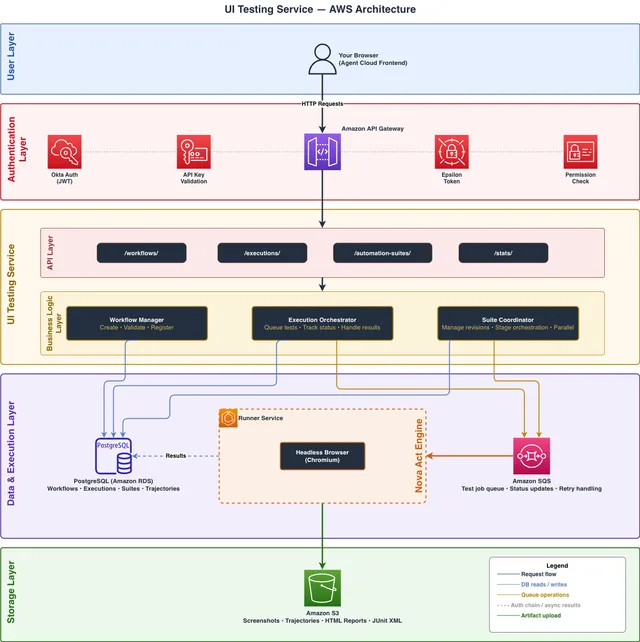
    Epsilon's Agentic Platform team used Amazon Nova Act together with Amazon Bedrock AgentCore Browser to turn intent-driven UI testing into a multi-tenant platform service layered on top of its existing Playwright regression suite. Test steps are written in natural language, executed by Nova Act over a CDP WebSocket, with per-step screenshots and pass-rate statistics, and results stored in Amazon S3. The solution provides managed temporary browser sessions, AWS IAM-based authentication, and cross-account AssumeRole isolation, and the article also presents an 18-step test workflow.

    Epsilon UI Testing Service architecture with user, authentication, API, execution runner, and Amazon S3 storage layers

    Epsilon's Agentic Platform team used Amazon Nova Act together with Amazon Bedrock AgentCore Browser to turn intent-driven UI testing into a multi-tenant platform service layered on top of its existing Playwright regression suite. Test steps are written in natural language, executed by Nova Act over a CDP WebSocket, with per-step screenshots and pass-rate statistics, and results stored in Amazon S3. The solution provides managed temporary browser sessions, AWS IAM-based authentication, and cross-

    Matched fieldsBody

  2. MarkTechPost

    Prime Intellect Releases Prime Mega MoE Training Kernel, Up to 3.11x Faster in Forward Pass

    Prime Intellect has released Prime Mega MoE, which builds on the Mega MoE kernel from DeepSeek's open-source DeepGEMM library by adding a fused and overlapped backward pass, making it usable for training rather than inference only. In the prime-rl trainer, the full training step for Qwen3 MoE models is 32% to 34% faster than the baseline and 48% to 55% faster than TorchTitan; the single-layer forward pass is up to 3.11x faster (from 12.0 ms to 3.9 ms), but the backward pass for Qwen3-235B-A22B is only 1.24x faster. The kernel supports BF16, MXFP8 on Blackwell, and blockwise FP8 on Hopper, is released with prime-rl under Apache 2.0, and is enabled through the mega_moe dispatch backend.

    Prime Intellect has released Prime Mega MoE, which builds on the Mega MoE kernel from DeepSeek's open-source DeepGEMM library by adding a fused and overlapped backward pass, making it usable for training rather than inference only. In the prime-rl trainer, the full training step for Qwen3 MoE models is 32% to 34% faster than the baseline and 48% to 55% faster than TorchTitan; the single-layer forward pass is up to 3.11x faster (from 12.0 ms to 3.9 ms), but the backward pass for Qwen3-235B-A22B i

    Matched fieldsBody

  3. MarkTechPost

    Baseten Releases 2B Decision Model joey-1, Priced at $0.01 per Million Tokens

    Baseten's Base Labs has released a 2B decision model, joey-1, post-trained on Qwen3.5-2B, which directly returns labels and calibrated probabilities instead of generating text, targeting high-concurrency routing, classification, and guardrail checks. The model scores 63.30 on the public Jev Decision Index 0.4 set, the highest among models under 4B, but 8.94 points lower than the 9B elephant-1. Model APIs are priced at $0.01 per million input tokens, with a P50 latency of 20 ms for an average 2000-token request; the weights are open-sourced under the MIT license on Hugging Face and can be self-hosted on a single CUDA GPU.

    Baseten's Base Labs has released a 2B decision model, joey-1, post-trained on Qwen3.5-2B, which directly returns labels and calibrated probabilities instead of generating text, targeting high-concurrency routing, classification, and guardrail checks. The model scores 63.30 on the public Jev Decision Index 0.4 set, the highest among models under 4B, but 8.94 points lower than the 9B elephant-1. Model APIs are priced at $0.01 per million input tokens, with a P50 latency of 20 ms for an average 200

    Matched fieldsBody

Wednesday

  1. MarkTechPost

    Google DeepMind Releases Genie 4 Real-Time World Model with Native Audio Generation

    Google DeepMind has released the Genie 4 world model as a research preview to trusted testers; it can generate explorable worlds in real time from text and image prompts, and natively generate ambient sound, music, and character dialogue. The model introduces Gemini 3.8 Flash as a planner within the simulation loop, responsible for breaking down goals, inspecting frames, and replanning, which DeepMind calls an early step toward hybrid world models. Genie 4 is hosted only on Google's platform and will later be opened to AI Ultra users and Gemini API partners; all video and audio carry SynthID watermarks.

    Google DeepMind has released the Genie 4 world model as a research preview to trusted testers; it can generate explorable worlds in real time from text and image prompts, and natively generate ambient sound, music, and character dialogue. The model introduces Gemini 3.8 Flash as a planner within the simulation loop, responsible for breaking down goals, inspecting frames, and replanning, which DeepMind calls an early step toward hybrid world models. Genie 4 is hosted only on Google's platform and

    Matched fieldsBody

  2. MarkTechPost

    Polymathic AI and Princeton University Release FlashMap: Achieving 6.14x LLM Decoding Speedup with a Flow-Mapping Drafter

    Polymathic AI, Princeton University, and other institutions have released FlashMap, which replaces discrete diffusion drafters with continuous flow mapping to draft a complete block of 16 tokens in a single forward pass. On Qwen3-8B, it achieves up to 6.14x lossless speedup on GSM8K at temperature 0, with the drafter having only 0.5B parameters. The drafter weights for Qwen3-8B and Qwen3-4B are now available on Hugging Face, along with vLLM and SGLang plugins.

    Matched fieldsBody

  3. Simon Willison

    Simon Willison: October 2026 is the inflection point for vibe coding game development

    Simon Willison believes that October 2026 is the inflection point for vibe coding game development. Claude Opus 5.5 has made notable improvements in 3D modeling, music generation, and game design. After having the model make games more fun, he spent a few weeks building four browser games he genuinely wants to play. Each of these projects took no more than four hours of investment, and all were built with HTML and JavaScript and run in the browser; he suggests starting with prompts like "Build a mobile-friendly three.js game where..." and switching to Claude Code or Codex once a project gets past the prototype stage.

    Simon Willison believes that October 2026 is the inflection point for vibe coding game development. Claude Opus 5.5 has made notable improvements in 3D modeling, music generation, and game design. After having the model make games more fun, he spent a few weeks building four browser games he genuinely wants to play. Each of these projects took no more than four hours of investment, and all were built with HTML and JavaScript and run in the browser; he suggests starting with prompts like "Build a

    Matched fieldsBody

  4. Leiphone

    LimX Dynamics' Open-Source FluxVLA Engine Update Connects the Entire Embodied Intelligence Pipeline from Data and Training to Evaluation and Deployment

    LimX Dynamics' open-source embodied intelligence engineering foundation FluxVLA Engine completed a major update on October 22. The technical report shows that it has incorporated heterogeneous policies such as OpenVLA, π0.5, DiT4DiT, and GR00T into a single pipeline for data, training, evaluation, and deployment. On the NVIDIA AGX Orin 64GB, GR00T's inference frequency increased from 3.2Hz to 7.4Hz, and π0.5 from 1.4Hz to 4.4Hz; together with RTC and a three-step trajectory post-processing mechanism, it connects to real-robot execution. In terms of online RL, SmolVLA's success rate on LIBERO-10 rose from 66.2% to 76.2%, and on 10 tasks in RoboTwin Clean from 45.9% to 61.3%.

    LimX Dynamics' open-source embodied intelligence engineering foundation FluxVLA Engine completed a major update on October 22. The technical report shows that it has incorporated heterogeneous policies such as OpenVLA, π0.5, DiT4DiT, and GR00T into a single pipeline for data, training, evaluation, and deployment. On the NVIDIA AGX Orin 64GB, GR00T's inference frequency increased from 3.2Hz to 7.4Hz, and π0.5 from 1.4Hz to 4.4Hz; together with RTC and a three-step trajectory post-processing mecha

    Matched fieldsBody

  5. Shao Meng

    Hugging Face Shares Industry Practices for Training Agents: Environments, Evaluation, and Rewards Are Harder Than the Model

    Hugging Face released four talks, a panel discussion, and a Q&A, discussing practical approaches to training Agents in industry, with the core conclusion being that environment, evaluation, and reward design are harder than the model itself. Miles used 64×B300 fully asynchronous training on Terminal Bench 2, and after about 100 steps the reward rose from about 0.44 to 0.56; OpenEnv Arena, after filtering down layer by layer from about 90,000 findable RL environments, had only about 800 relatively clean and usable ones left. The talks also mentioned cheating problems such as Agents finding reference answers in the sandbox and modifying the scoring logic to fake a pass, as well as about 1% of cheating problems contaminating an entire round of training.

    Hugging Face released four talks, a panel discussion, and a Q&A, discussing practical approaches to training Agents in industry, with the core conclusion being that environment, evaluation, and reward design are harder than the model itself. Miles used 64×B300 fully asynchronous training on Terminal Bench 2, and after about 100 steps the reward rose from about 0.44 to 0.56; OpenEnv Arena, after filtering down layer by layer from about 90,000 findable RL environments, had only about 800 relativel

    Matched fieldsBody

  6. OpenBMB

    OpenBMB Open-Sources MiniCPM-OCR Suite, Featuring a 1B Parsing Model and a 2B Verification Model

    OpenBMB has released the open-source MiniCPM-OCR suite, comprising the 1B MiniCPM-OCR 1.0 and the 2B decision model MiniCPM-OCR Jev. MiniCPM-OCR 1.0 scores 93.68 on Real5-OmniDocBench and 54.7 on OCRBench v2; Jev can perform cross-model verification of text, formulas, and tables, scoring 93.6 on JevOCRBench, surpassing JEV-35B-A3B's 90.1 and approaching Qwen3.5-397B-A17B's 93.8. Powered by DSpark, its speed is 1.49 times that of PaddleOCR-VL-1.6 and 3.62 times that of MinerU2.5 Pro; with SDK concurrency optimization, it can reach 128 pages per minute, and it supports deployment on vLLM, SGLang, llama.cpp, and Ollama.

    OpenBMB has released the open-source MiniCPM-OCR suite, comprising the 1B MiniCPM-OCR 1.0 and the 2B decision model MiniCPM-OCR Jev. MiniCPM-OCR 1.0 scores 93.68 on Real5-OmniDocBench and 54.7 on OCRBench v2; Jev can perform cross-model verification of text, formulas, and tables, scoring 93.6 on JevOCRBench, surpassing JEV-35B-A3B's 90.1 and approaching Qwen3.5-397B-A17B's 93.8. Powered by DSpark, its speed is 1.49 times that of PaddleOCR-VL-1.6 and 3.62 times that of MinerU2.5 Pro; with SDK con

    Matched fieldsBody

  7. TMTPost · AGI

    Edge AI Daily Morning Brief: Anthropic Files for IPO, OpenAI Releases GPT-6.1…

    On October 26, 2026, Anthropic submitted an S-1 to the SEC, planning to list on Nasdaq under the ticker "ANT," with an IPO valuation potentially exceeding $2 trillion. OpenAI released GPT-6.1 Terra the same day, priced at $1 per million input tokens and $5 per million output tokens on the standard API, completing tasks more than three times faster than the flagship GPT-6 Astra. Google DeepMind launched a research preview of its world model Genie 4, achieving synchronized audio and video generation for the first time and doubling its consistency duration to two minutes.

    On October 26, 2026, Anthropic submitted an S-1 to the SEC, planning to list on Nasdaq under the ticker "ANT," with an IPO valuation potentially exceeding $2 trillion. OpenAI released GPT-6.1 Terra the same day, priced at $1 per million input tokens and $5 per million output tokens on the standard API, completing tasks more than three times faster than the flagship GPT-6 Astra. Google DeepMind launched a research preview of its world model Genie 4, achieving synchronized audio and video generati

    Matched fieldsBody

  8. Thurrott

    RTX Spark Local AI Coding Hands-On Test: Repeated Attempts Still Fail to Find a Stable, Reproducible Solution

    The author spent several days trying local AI coding on the RTX Spark but was never able to find a stable, reproducible workflow. He tested Llama Windows, the graphical front end for llama.cpp that Hugging Face released alongside the RTX Spark, but the burden of choosing local model versions and sizes, along with development environment errors, falls entirely on the user. So far, only general chat scenarios can be considered a modest success.

    Matched fieldsBody

  9. Unite.AI

    Perplexity Publishes LLM Gateway Best Practices Guide, Outlining Request Flow and Production Risks

    On October 27, 2026, Perplexity published an LLM gateway best practices guide explaining how this middleware layer routes, authenticates, caches, and logs model calls, and distinguishing four categories: API gateways, LLM gateways, MCP gateways, and AI gateways. The guide breaks down the mechanism through a six-step request lifecycle, while warning that the gateway centralizes credentials from various providers, and cites the LiteLLM gateway breach disclosed by Microsoft and two high-severity vulnerabilities, CVE-2026-35029 and CVE-2026-59823, reported by Check Point (already fixed in LiteLLM 1.83.9). The article also lists postmortems of Cloudflare AI Gateway and OpenRouter outages, four deployment paths, and paid plans starting at about $50 per month.

    On October 27, 2026, Perplexity published an LLM gateway best practices guide explaining how this middleware layer routes, authenticates, caches, and logs model calls, and distinguishing four categories: API gateways, LLM gateways, MCP gateways, and AI gateways. The guide breaks down the mechanism through a six-step request lifecycle, while warning that the gateway centralizes credentials from various providers, and cites the LiteLLM gateway breach disclosed by Microsoft and two high-severity vu

    Matched fieldsBody