English translation is being prepared.
Matched fieldsBody
Matched fieldsBody
Matched fieldsBody
Matched fieldsBody
Google integrates TorchTPU into Meta's TorchTitan; Cloud TPU can now train PyTorch models directly through the native backend torch.device("tpu"), without rewriting them into JAX. The TorchTitan TPU branch provides pretraining recipes for Llama 3 70B/405B, Qwen 3 8B/32B/235B MoE, and FLUX.1 12B, and replaces standard implementations with Pallas kernels such as Splash Attention. On FLUX, SimpleFSDP brings TorchTitan to 99% performance parity with JAX MaxDiffusion.

Matched fieldsBody

Matched fieldsBody
DeepSeek open-sources its self-developed inference framework DeepInfer (Apache 2.0) and the production-grade Token codec component deepseek-recipe (MIT), supporting DeepSeek V4.1 Flash in serving 155 trillion Tokens per day on a single cluster. Official online statistics show an average of 77K Tokens input per request, a time to first token of about 400 milliseconds, 230 Tokens output per second during the generation phase, and an average of 96% of input hitting the cache. DeepInfer currently supports V4.1 Flash; the open-source version provides only offline inference, and the KV cache management and load balancing code has not yet been fully open-sourced because it is tied to internal infrastructure.
DeepSeek open-sources its self-developed inference framework DeepInfer (Apache 2.0) and the production-grade Token codec component deepseek-recipe (MIT), supporting DeepSeek V4.1 Flash in serving 155 trillion Tokens per day on a single cluster. Official online statistics show an average of 77K Tokens input per request, a time to first token of about 400 milliseconds, 230 Tokens output per second during the generation phase, and an average of 96% of input hitting the cache. DeepInfer currently su
Matched fieldsBody
Matched fieldsBody
Matched fieldsBody
PyTorch 2.15 adds FP8 support to the MPS backend and makes MoE model decoding 5–6.5 times faster than 2.14: on an M3 Ultra with torch.compile, Qwen3.6-35B-A3B goes from 9.4 tokens/s to 61.3 tokens/s, and LFM2.5-8B-A1B goes from 23.6 to 123.6 tokens/s. For Wan2.2's tiled VAE video decoding, peak driver memory drops from about 270 GiB to 8 GiB, and the image corruption issue with Qwen-Image-2.1's VAE encoding on MPS is also fixed with a padding change, raising the encode-decode round-trip PSNR from 10.06 dB to 29.95 dB. This version requires macOS 15 or later and Python 3.11 or later.
PyTorch 2.15 adds FP8 support to the MPS backend and makes MoE model decoding 5–6.5 times faster than 2.14: on an M3 Ultra with torch.compile, Qwen3.6-35B-A3B goes from 9.4 tokens/s to 61.3 tokens/s, and LFM2.5-8B-A1B goes from 23.6 to 123.6 tokens/s. For Wan2.2's tiled VAE video decoding, peak driver memory drops from about 270 GiB to 8 GiB, and the image corruption issue with Qwen-Image-2.1's VAE encoding on MPS is also fixed with a padding change, raising the encode-decode round-trip PSNR fro
Matched fieldsBody
Hugging Face has released AnyLanguageModel 1.0, which lets developers use the same session code to call system models, open-weight models from llama.cpp, MLX, and Core ML, as well as multiple hosted service providers. This version extends tool calling and guided generation to all providers, supports attaching images in prompts, and adds support for the Anthropic Messages API, Gemini API, Ollama, Private Cloud Compute, and Hugging Face Inference Providers. The article also lists currently high-download models such as Gemma 4 E2B, LFM2.5 2.6B, and Qwen3.8 27B, along with their quantized sizes.
Hugging Face has released AnyLanguageModel 1.0, which lets developers use the same session code to call system models, open-weight models from llama.cpp, MLX, and Core ML, as well as multiple hosted service providers. This version extends tool calling and guided generation to all providers, supports attaching images in prompts, and adds support for the Anthropic Messages API, Gemini API, Ollama, Private Cloud Compute, and Hugging Face Inference Providers. The article also lists currently high-do
Matched fieldsBody
Matched fieldsBody
Matched fieldsBody

Matched fieldsBody
NVIDIA has released Cosmos3-H-Dreams, specialized from the 16-billion-parameter Cosmos3-H-Embodied-Nano for action-conditioned video generation of cholecystectomy. The model is trained with 28 action dimensions, 832 x 480 video, and 10 Hz action alignment, and distillation yields two student checkpoints, four-step and two-step; the two-step version is trained separately, offering faster inference but lower image quality. NVIDIA also provides the FlashDreams streaming runtime and methods for adapting to custom data and controllers, and states that the model is a research simulator, not a validated clinical system.
NVIDIA has released Cosmos3-H-Dreams, specialized from the 16-billion-parameter Cosmos3-H-Embodied-Nano for action-conditioned video generation of cholecystectomy. The model is trained with 28 action dimensions, 832 x 480 video, and 10 Hz action alignment, and distillation yields two student checkpoints, four-step and two-step; the two-step version is trained separately, offering faster inference but lower image quality. NVIDIA also provides the FlashDreams streaming runtime and methods for adap
Matched fieldsBody
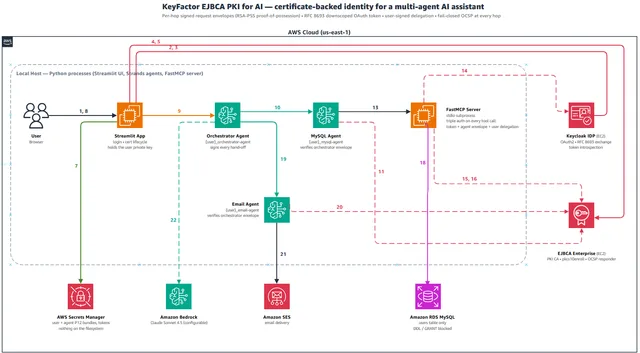
AWS and Keyfactor jointly released a reference architecture that uses Keyfactor EJBCA's X.509 PKI to establish verifiable, revocable cryptographic identities for AI agents, filling the gap left by MCP's lack of a built-in authentication standard. The solution combines Amazon Bedrock, the AWS Strands Agents SDK, AWS Secrets Manager, and Amazon RDS, and covers three trust boundaries—user authentication, agent-to-agent communication, and MCP tool invocation—through four layers of mechanisms: signed request envelopes, user-signed delegation assertions, RFC 8693 audience-restricted tokens, and real-time OCSP revocation checks.
AWS and Keyfactor jointly released a reference architecture that uses Keyfactor EJBCA's X.509 PKI to establish verifiable, revocable cryptographic identities for AI agents, filling the gap left by MCP's lack of a built-in authentication standard. The solution combines Amazon Bedrock, the AWS Strands Agents SDK, AWS Secrets Manager, and Amazon RDS, and covers three trust boundaries—user authentication, agent-to-agent communication, and MCP tool invocation—through four layers of mechanisms: signed
Matched fieldsBody
torch-spyre's backend compiler uses KTIR (Kernel Tile IR) to take over the parallel partitioning already determined by Inductor, and then the open-source Dataflow Scheduler breaks each tile's work into programs, progressively expanding from a load → compute → store pipeline into nested, double-buffered, multi-instance scheduling, outputting DataflowIR and generating SpyreCode. KTIR targets Spyre hardware with 32 cores and 2 MB of scratchpad per core, moving data in 128-byte sticks; the scheduler and its dialects are open-sourced under Apache-2.0.

torch-spyre's backend compiler uses KTIR (Kernel Tile IR) to take over the parallel partitioning already determined by Inductor, and then the open-source Dataflow Scheduler breaks each tile's work into programs, progressively expanding from a load → compute → store pipeline into nested, double-buffered, multi-instance scheduling, outputting DataflowIR and generating SpyreCode. KTIR targets Spyre hardware with 32 cores and 2 MB of scratchpad per core, moving data in 128-byte sticks; the scheduler
Matched fieldsBody
Google and Meta's PyTorch teams have collaborated to launch the open-source project TorchTPU, providing a native PyTorch backend for Google TPUs; migration only requires changing model.to("cuda") to model.to("tpu"). The project supports both eager and torch.compile modes, adds a new DeferAndFuse eager mode, covers about 450 Aten operators, and has been verified to run out of the box on 4,917 Hugging Face models, with a Tier 1 pass rate of 98% and Tier 2 numerical consistency relative to GPUs of 97%. According to the official announcement, it has already been used in the inference and training production workloads of some major Google Cloud customers, and is integrated with vLLM, SGLang, TorchTitan, Ray, and TorchRec.
Google and Meta's PyTorch teams have collaborated to launch the open-source project TorchTPU, providing a native PyTorch backend for Google TPUs; migration only requires changing model.to("cuda") to model.to("tpu"). The project supports both eager and torch.compile modes, adds a new DeferAndFuse eager mode, covers about 450 Aten operators, and has been verified to run out of the box on 4,917 Hugging Face models, with a Tier 1 pass rate of 98% and Tier 2 numerical consistency relative to GPUs of
Matched fieldsBody
Matched fieldsBody
The open-source menu bar monitoring tool eul, unmaintained for 5 years, completed a low-level fix with Workbuddy and once again reads CPU temperature and GPU information on the Mac Mini 6 with the Apple M6 chip. The root cause is that SMCParamStruct changed from 80 bytes to 88 bytes in arm64 user mode, and all 135 temperature keys on the M6 are of the flt type rather than the sp78 type from the Intel era. After the fix, it dynamically enumerates 2,066 SMC keys, retains 126 valid sensors, and remains compatible with the logic for Intel models.
The open-source menu bar monitoring tool eul, unmaintained for 5 years, completed a low-level fix with Workbuddy and once again reads CPU temperature and GPU information on the Mac Mini 6 with the Apple M6 chip. The root cause is that SMCParamStruct changed from 80 bytes to 88 bytes in arm64 user mode, and all 135 temperature keys on the M6 are of the flt type rather than the sp78 type from the Intel era. After the fix, it dynamically enumerates 2,066 SMC keys, retains 126 valid sensors, and rem
Matched fieldsBody
PyTorch Helion can now search ptxas compiler control parameters through NVIDIA CompileIQ, jointly with the existing kernel configuration search, further tapping performance headroom on the roughly 27 kernels that have already been pre-tuned. CompileIQ packages tuning results as a portable Advanced Control File (ACF); Helion supports specifying a fixed ACF, and also supports searching multiple ACFs together as one dimension of autotuning. These compiler controls are exposed by ptxas starting from CUDA 13.3.

PyTorch Helion can now search ptxas compiler control parameters through NVIDIA CompileIQ, jointly with the existing kernel configuration search, further tapping performance headroom on the roughly 27 kernels that have already been pre-tuned. CompileIQ packages tuning results as a portable Advanced Control File (ACF); Helion supports specifying a fixed ACF, and also supports searching multiple ACFs together as one dimension of autotuning. These compiler controls are exposed by ptxas starting from
Matched fieldsBody