English translation is being prepared.
Matched fieldsSummary
Matched fieldsSummary
Matched fieldsSummary
Matched fieldsSummary
Matched fieldsSummary
Ant Ling has published a practice article describing how it used the local post-training toolkit AReno on a DGX Spark to perform Agentic RL on Ling-3.0-tiny, using tic-tac-toe as a minimal validation task to complete the four-step loop of baseline evaluation, Reward definition, post-training, and re-evaluation in the same environment. The experiment used GSPO for 400 training steps; rollout/rewards_mean rose from about -0.5 to around 0.4, response_len dropped to about 850 tokens, and tool calling and move selection became more stable in the re-evaluation. Ling-3.0-tiny is a hybrid reasoning model with 7.9B total parameters and 1.3B activated parameters; BF16, FP8, and INT4 versions have been open-sourced, and AReno provides a Docker reproduction tutorial.

Ant Ling has published a practice article describing how it used the local post-training toolkit AReno on a DGX Spark to perform Agentic RL on Ling-3.0-tiny, using tic-tac-toe as a minimal validation task to complete the four-step loop of baseline evaluation, Reward definition, post-training, and re-evaluation in the same environment. The experiment used GSPO for 400 training steps; rollout/rewards mean rose from about -0.5 to around 0.4, response len dropped to about 850 tokens, and tool callin
Matched fieldsSummary、Body
Matched fieldsSummary
Matched fieldsSummary
Matched fieldsSummary

Matched fieldsSummary
Matched fieldsSummary
Matched fieldsSummary
Matched fieldsSummary
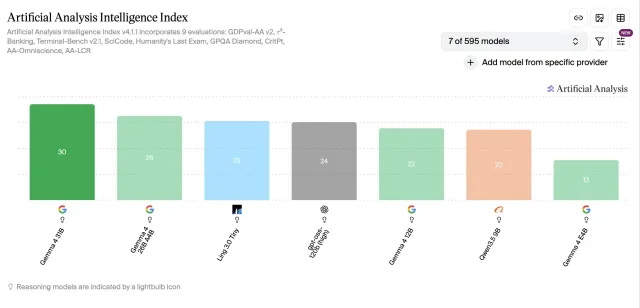
Ant Ling has officially open-sourced Ling-3.0-tiny, a native hybrid reasoning model with 7.9B total parameters that activates only 1.3B parameters during inference, available in BF16, FP8, and INT4 versions. The company says it scores 25 on the Artificial Analysis Intelligence Index and 16 on the Agentic Index, with output speed exceeding 160 tokens/s. The model can run FP8 inference on a single NVIDIA DGX Spark with weights of about 7.85GB, and has been adapted for local execution on Apple Silicon MacBook and Mac mini.
Ant Ling has officially open-sourced Ling-3.0-tiny, a native hybrid reasoning model with 7.9B total parameters that activates only 1.3B parameters during inference, available in BF16, FP8, and INT4 versions. The company says it scores 25 on the Artificial Analysis Intelligence Index and 16 on the Agentic Index, with output speed exceeding 160 tokens/s. The model can run FP8 inference on a single NVIDIA DGX Spark with weights of about 7.85GB, and has been adapted for local execution on Apple Sili
Matched fieldsSummary、Body
Matched fieldsSummary
Matched fieldsSummary
Fireworks has launched Meta's Muse Glimmer 30B dense model under the Apache 2.0 license, supporting 128K+ token context and native image understanding, targeting persistent agents that require multi-turn tool calling. The model scores 75.5 on MCP Atlas, 74.6 on DeepSearch QA, and 51.2 on SWE-Bench Pro, all higher than the corresponding results of Gemma 4 31B and Qwen 3.6 27B; these benchmark figures are reported by Meta. Fireworks also provides recommended settings of temperature 1.0, top_p 0.95, and top_k 64, and supports adjusting reasoning intensity in the system prompt.
Fireworks has launched Meta's Muse Glimmer 30B dense model under the Apache 2.0 license, supporting 128K+ token context and native image understanding, targeting persistent agents that require multi-turn tool calling. The model scores 75.5 on MCP Atlas, 74.6 on DeepSearch QA, and 51.2 on SWE-Bench Pro, all higher than the corresponding results of Gemma 4 31B and Qwen 3.6 27B; these benchmark figures are reported by Meta. Fireworks also provides recommended settings of temperature 1.0, top p 0.95
Matched fieldsSummary、Body
Matched fieldsSummary
Matched fieldsSummary
Matched fieldsSummary
Nathan Lambert published an article in Interconnects reviewing the OpenAI-HuggingFace hacking incident, arguing that the AI industry as a whole is severely underprepared for the risks of the next 12-24 months. He noted that OpenAI's models are stronger than Claude in inference persistence, possibly because OpenAI has bet more heavily on inference-time scaling, and that such models that continuously pursue goals deserve more safety attention. He also argued that public models and open research are irreplaceable for understanding frontier risks; currently open models lag by only 3-9 months, and restricting open models would instead weaken society's ability to respond.
Nathan Lambert published an article in Interconnects reviewing the OpenAI-HuggingFace hacking incident, arguing that the AI industry as a whole is severely underprepared for the risks of the next 12-24 months. He noted that OpenAI's models are stronger than Claude in inference persistence, possibly because OpenAI has bet more heavily on inference-time scaling, and that such models that continuously pursue goals deserve more safety attention. He also argued that public models and open research ar
Matched fieldsSummary、Body