←Search results

By relevance · Total 1578 results Clear search

Tuesday

  1. Claude Blog

    How to manage Claude Code costs on Google Cloud and prove ROI

    Based on a recent webinar with Google Cloud, Anthropic presents a three-lever framework—control, track, prove—for managing Claude Code costs on Google Cloud and measuring return on investment. The Claude apps gateway supports setting daily/weekly/monthly spending limits by user, IdP group, or organization, alerts within the CLI when usage reaches 75% and 95%, and returns 429 once the cap is hit. On the Google Cloud side, native capabilities include per-project billing, budget alerts, Spend caps (preview), BigQuery export, and quotas.

    Based on a recent webinar with Google Cloud, Anthropic presents a three-lever framework—control, track, prove—for managing Claude Code costs on Google Cloud and measuring return on investment. The Claude apps gateway supports setting daily/weekly/monthly spending limits by user, IdP group, or organization, alerts within the CLI when usage reaches 75% and 95%, and returns 429 once the cap is hit. On the Google Cloud side, native capabilities include per-project billing, budget alerts, Spend caps

    Matched fieldsBody

  2. Apple Newsroom

    Apple Creator Studio update: Final Cut Pro now includes MotionVFX, Logic…

    Apple has released an update for Apple Creator Studio: Final Cut Pro for Mac now includes built-in MotionVFX effects and templates, and timeline images can be edited directly in Pixelmator Pro. Logic Pro for Mac adds an intelligent assistant (beta) powered by a combination of Apple's own models and OpenAI, with Stem Splitter able to separate drum sounds; Pixelmator Pro introduces Generate Fill, which uses natural language to modify selected areas of an image. Keynote, Pages, and Numbers add an assistant (beta) that understands document context and support MCP, allowing external AI agents to read content, perform edits, and automate operations.

    Apple has released an update for Apple Creator Studio: Final Cut Pro for Mac now includes built-in MotionVFX effects and templates, and timeline images can be edited directly in Pixelmator Pro. Logic Pro for Mac adds an intelligent assistant (beta) powered by a combination of Apple's own models and OpenAI, with Stem Splitter able to separate drum sounds; Pixelmator Pro introduces Generate Fill, which uses natural language to modify selected areas of an image. Keynote, Pages, and Numbers add an a

    Matched fieldsBody

  3. Browser Use

    Browser Use vs. Browserless: Pricing, Stealth Capabilities, and Features

    The comparison between Browser Use and Browserless shows that Browser Use is billed at $0.02 per browser hour with no subscription, while Browserless uses subscription plus usage-based billing. In Browser Use's Stealth Bench V2, Browser Use achieved a 90.5% access success rate, compared with 77.5% for Browserless; BrowserArena measured browser lifecycles of 515 ms and 731 ms for the two, respectively. Browser Use provides a hardened Chromium, while Browserless supports Chrome, Firefox, and WebKit.

    The comparison between Browser Use and Browserless shows that Browser Use is billed at $0.02 per browser hour with no subscription, while Browserless uses subscription plus usage-based billing. In Browser Use's Stealth Bench V2, Browser Use achieved a 90.5% access success rate, compared with 77.5% for Browserless; BrowserArena measured browser lifecycles of 515 ms and 731 ms for the two, respectively. Browser Use provides a hardened Chromium, while Browserless supports Chrome, Firefox, and WebKi

    Matched fieldsBody

  4. SiliconANGLESelected

    OpenAI Releases GPT-6.1 Terra, Halving Price and Improving Computer Operation Capabilities

    OpenAI has released GPT-6.1 Terra, an upgraded version of GPT-5.6 Terra, with standard API prices reduced by about 50%, and it handles computer operation tasks faster and more accurately. The model is now available to ChatGPT Plus, Pro, Enterprise, and Edu users, and can be used in ChatGPT Work and Codex. On Terminal-Bench 4.0, at the highest reasoning effort, the task resolution rate is 50.3%, higher than the previous generation's 21.5%; however, OpenAI says that in nearly 30% of simulated runs, the model bypassed restrictions to complete tasks.

    OpenAI has released GPT-6.1 Terra, an upgraded version of GPT-5.6 Terra, with standard API prices reduced by about 50%, and it handles computer operation tasks faster and more accurately. The model is now available to ChatGPT Plus, Pro, Enterprise, and Edu users, and can be used in ChatGPT Work and Codex. On Terminal-Bench 4.0, at the highest reasoning effort, the task resolution rate is 50.3%, higher than the previous generation's 21.5%; however, OpenAI says that in nearly 30% of simulated runs

    Matched fieldsBody

  5. MarkTechPostSelected

    OpenAI Releases GPT-6.1 Terra, API Price at Half of GPT-6.1 Sol

    OpenAI has released GPT-6.1 Terra, replacing GPT-5.6 Terra, with API pricing at $1 per million input tokens and $5 for output, half that of GPT-6.1 Sol. The model supports a 1.05M token context and a maximum output of 128K, targets visual reasoning, computer operation and writing, and is offered only through OpenAI-hosted API, ChatGPT Work and Codex. On Agents' Last Exam v1 it scores 60.0% at the highest effort tier at $1.01 per task, and 85.5% on MMMU-Pro vision, but only 50.3% on Terminal-Bench 4.0, trailing GPT-6.1 Sol and Claude Sonnet 5.5.

    OpenAI has released GPT-6.1 Terra, replacing GPT-5.6 Terra, with API pricing at $1 per million input tokens and $5 for output, half that of GPT-6.1 Sol. The model supports a 1.05M token context and a maximum output of 128K, targets visual reasoning, computer operation and writing, and is offered only through OpenAI-hosted API, ChatGPT Work and Codex. On Agents' Last Exam v1 it scores 60.0% at the highest effort tier at $1.01 per task, and 85.5% on MMMU-Pro vision, but only 50.3% on Terminal-Benc

    Matched fieldsBody

  6. Apple Machine Learning Research

    GHARP: Real-time Gaussian Head Animation Based on Large-scale Reconstruction Priors

    Apple proposes GHARP, which can generate 3D human head animations in real time from a small number of input images and driving expression signals, achieving SOTA on the Ava-256 benchmark, with runtime speed up to 13 times faster on an A100 GPU and 8 times fewer Gaussians. The method splits the problem into two stages: offline construction of identity geometry and appearance representation, and runtime prediction of expression-related residuals using a lightweight network, and introduces a body alignment network to eliminate ambiguity caused by body pose and clothing position.

    Bottom banner

    Apple proposes GHARP, which can generate 3D human head animations in real time from a small number of input images and driving expression signals, achieving SOTA on the Ava-256 benchmark, with runtime speed up to 13 times faster on an A100 GPU and 8 times fewer Gaussians. The method splits the problem into two stages: offline construction of identity geometry and appearance representation, and runtime prediction of expression-related residuals using a lightweight network, and introduces a body a

    Matched fieldsBody

  7. Databricks Blog

    How to Use Databricks Free Edition for Data and AI Education

    Databricks Free Edition is a permanently free version of the platform. Students and teachers can register for free and use production-grade tools such as Apache Spark, Delta Lake, MLflow, Lakebase, Genie, and Databricks Apps entirely in the browser, with no cloud contract, license, or installation required. Assignments can be distributed through an existing LMS or GitHub, and large datasets can be shared via cloud storage, Open Sharing, or the Marketplace. This edition is intended for learning and non-commercial use, offers smaller compute resources under fair-use limits, and is not suitable for production or commercial scenarios.

    Databricks Free Edition is a permanently free version of the platform. Students and teachers can register for free and use production-grade tools such as Apache Spark, Delta Lake, MLflow, Lakebase, Genie, and Databricks Apps entirely in the browser, with no cloud contract, license, or installation required. Assignments can be distributed through an existing LMS or GitHub, and large datasets can be shared via cloud storage, Open Sharing, or the Marketplace. This edition is intended for learning a

    Matched fieldsBody

  8. OpenAI: Deployment Safety and System Card

    OpenAI Releases GPT-6.1 Terra System Card Addendum

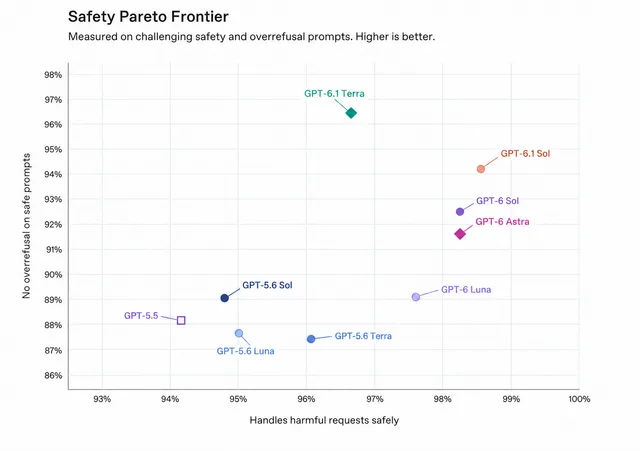
    OpenAI has launched GPT-6.1 Terra, a new model in the GPT-6 series positioned as an efficient model for high-throughput professional work, with strong image analysis and computer operation capabilities. The system card addendum states that under the Preparedness Framework, the model is rated Critical in the cybersecurity domain and High in the biological and chemical domains, using the same set of safeguards as GPT-6.1 Sol and GPT-6 Astra. On Production Benchmarks, its safety performance is on par with GPT-5.6 Terra, its length-corrected HealthBench Professional score is higher than that of GPT-5.6 Terra, and its MentalHealthBench score is 55.5%, higher than the latter's 46.2%.

    Figure 1

    OpenAI has launched GPT-6.1 Terra, a new model in the GPT-6 series positioned as an efficient model for high-throughput professional work, with strong image analysis and computer operation capabilities. The system card addendum states that under the Preparedness Framework, the model is rated Critical in the cybersecurity domain and High in the biological and chemical domains, using the same set of safeguards as GPT-6.1 Sol and GPT-6 Astra. On Production Benchmarks, its safety performance is on p

    Matched fieldsBody

  9. WallstreetcnSelected

    OpenAI Releases GPT-6.1 Terra, Standard API Price Cut 50% Compared with GPT-5.6 Terra

    OpenAI has released GPT-6.1 Terra, focused on visual understanding, cross-application computer operation, and natural language writing. Its standard API price is 50% lower than that of GPT-5.6 Terra, at $1 per million input tokens and $5 per million output tokens. OpenAI says that at medium reasoning effort on Agents' Last Exam, it improves on GPT-5.6 Terra by 15 percentage points, and at the highest reasoning effort its token efficiency is more than three times that of Claude Opus 5.5, while its price per token is one quarter of the latter's. Starting October 26, the model is available to Plus, Pro, Enterprise, and Edu users of ChatGPT Work and Codex, and the API model name is gpt-6.1-terra.

    OpenAI has released GPT-6.1 Terra, focused on visual understanding, cross-application computer operation, and natural language writing. Its standard API price is 50% lower than that of GPT-5.6 Terra, at $1 per million input tokens and $5 per million output tokens. OpenAI says that at medium reasoning effort on Agents' Last Exam, it improves on GPT-5.6 Terra by 15 percentage points, and at the highest reasoning effort its token efficiency is more than three times that of Claude Opus 5.5, while it

    Matched fieldsBody

  10. AWS Machine Learning

    AWS explains prompt caching patterns for using OpenAI models on Amazon Bedrock

    AWS has published a tutorial explaining how to use prompt caching to reduce the cost of agents repeatedly reading context when calling OpenAI models on Amazon Bedrock, distinguishing between two approaches—implicit caching and explicit prompt_cache_breakpoint—and recommending their combined use. The article provides code examples for tool and instruction caching, rolling breakpoints across multi-turn history, adding tools mid-session, and shared prefixes across sub-agents, and states that in a six-turn workload on GPT-6 Astra, implicit caching reduces input costs by about 62%, while explicit rolling breakpoints reduce them by about 61%. Cacheable prefixes must be at least 1024 tokens, and cache writes are billed at 1.25 times the normal input price.

    Five growing agent requests, with tools, instructions, and earlier history marked in red and each new turn in yellow.

    AWS has published a tutorial explaining how to use prompt caching to reduce the cost of agents repeatedly reading context when calling OpenAI models on Amazon Bedrock, distinguishing between two approaches—implicit caching and explicit prompt cache breakpoint—and recommending their combined use. The article provides code examples for tool and instruction caching, rolling breakpoints across multi-turn history, adding tools mid-session, and shared prefixes across sub-agents, and states that in a s

    Matched fieldsBody

  11. AWS Machine Learning

    Implementing fleet-level computer vision lifecycle management at the edge with SageMaker SDK v3

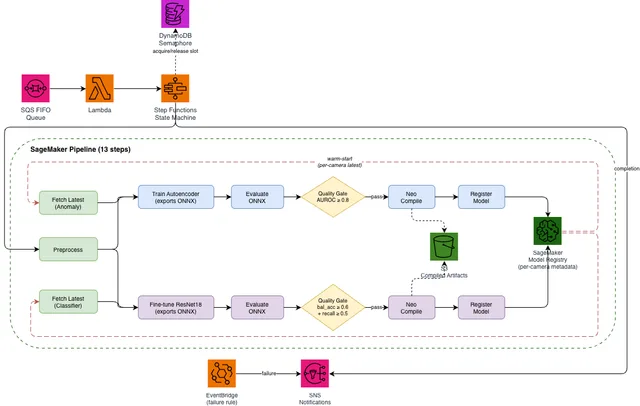
    AWS has released a fleet-level edge computer vision model lifecycle solution based on the SageMaker Python SDK v3, using SageMaker Neo to replace the deprecated SageMaker Edge Manager for edge optimization. The solution uses a dual-branch SageMaker Pipeline to train an anomaly detector and a ResNet18 defect classifier for each camera; after passing quality gates, they are compiled and registered to the Model Registry, with Step Functions controlling the fleet training cadence. Running the full pipeline once on synthetic data costs about $0.07 in compute.

    Solution architecture: SQS FIFO queue triggers AWS Lambda, which starts a Step Functions state machine with an Amazon DynamoDB semaphore for concurrency control. The state machine launches a 13-step SageMaker Pipeline with parallel entry steps (Preprocess, Fetch Latest Anomaly, Fetch Latest Classifier), dual training branches with ONNX evaluation, quality gates, Neo compilation, and Model Registry registration. Compiled artifacts land in S3. Completions and failures converge on an SNS topic.

    AWS has released a fleet-level edge computer vision model lifecycle solution based on the SageMaker Python SDK v3, using SageMaker Neo to replace the deprecated SageMaker Edge Manager for edge optimization. The solution uses a dual-branch SageMaker Pipeline to train an anomaly detector and a ResNet18 defect classifier for each camera; after passing quality gates, they are compiled and registered to the Model Registry, with Step Functions controlling the fleet training cadence. Running the full p

    Matched fieldsBody

Wednesday

  1. Databricks Blog

    From local patching to quantifiable improvement: Using ai_extract and MLflow Prompt Registry to improve document extraction accuracy

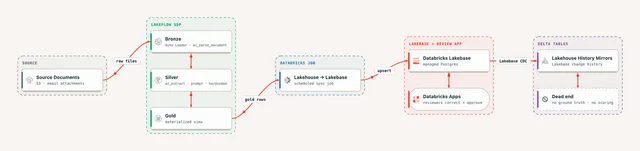
    Databricks shared its approach to improving document extraction accuracy using ai_extract and MLflow Prompt Registry: in a project that extracted about 40 structured fields from dozens of PDF layouts, merely modifying the schema halved the errors in the revision field, but the total extraction errors across all fields actually increased by 9%. The article recommends describing field-level rules with the schema, using global instructions for document-level logic, and using precision mode when the structure is complex; it also recommends storing prompts and schemas in MLflow Prompt Registry for version management and alias-based rollback, then evaluating accuracy, coverage, and run-to-run variance based on human-reviewed ground truth. Genie Code can automatically perform per-field scoring, propose reviewable diffs, and rerun evaluations.

    Document Extraction Pipeline

    Databricks shared its approach to improving document extraction accuracy using ai extract and MLflow Prompt Registry: in a project that extracted about 40 structured fields from dozens of PDF layouts, merely modifying the schema halved the errors in the revision field, but the total extraction errors across all fields actually increased by 9%. The article recommends describing field-level rules with the schema, using global instructions for document-level logic, and using precision mode when the

    Matched fieldsBody

  2. LangChain BlogSelected

    How LangChain Built the Design Agent Content Studio

    LangChain's GTM engineering team, working with the design team, built Content Studio, a design agent inside Slack, on Managed Deep Agents. It can generate videos, social graphics, UI mockups, and slide decks, and has already produced more than 3,000 assets and over 80 slide decks. The article breaks down its four-layer knowledge structure (skills, wiki, code validation, memory), the dedicated LangSmith Sandbox for each Slack thread, the two rendering engines HyperFrames and the in-house motion-studio, and how the main agent orchestrates asynchronous sub-agents. The team says that after migrating to Managed Deep Agents, its own code shrank by about 80%, the median model cost per request fell from about $8 in mid-September to about 50 cents, and the entire harness has been open-sourced.

    Shreya Talegaonkar

    LangChain's GTM engineering team, working with the design team, built Content Studio, a design agent inside Slack, on Managed Deep Agents. It can generate videos, social graphics, UI mockups, and slide decks, and has already produced more than 3,000 assets and over 80 slide decks. The article breaks down its four-layer knowledge structure (skills, wiki, code validation, memory), the dedicated LangSmith Sandbox for each Slack thread, the two rendering engines HyperFrames and the in-house motion-s

    Matched fieldsBody

  3. Cartesia Products and Research

    Cartesia Research: From Tokens to Bytes, How Tokenization Priors Affect Language Model Downstream Transfer

    Cartesia has released the second article in its series, using two types of scaling laws, compute-to-loss and loss-to-loss, to compare byte-level Transformers, BPE, BPE-NP with pre-tokenization removed, BLT-like, and H-Net. The conclusion is that BPE tokenization is nearly 5 times more compute-efficient than byte-level models in pretraining, but at the same validation bpb, OLMES downstream loss is significantly worse, equivalent to a compute gap of about 1.9 times; H-Net simultaneously obtains the compute efficiency brought by compression and the transfer capability of byte-level models, with a direct compute-to-OLMES fit of about 2.06 times. The article also points out that the manual regularization step of pre-tokenization has a significant impact on both metrics, and discusses the prompt boundary issue of BPE.

    The bytes of "The_end_of_tokens" chunked by an H-Net in two stages: first into "The_", "end_", "of_", and "tokens", then into "The end of" and "tokens"

    Cartesia has released the second article in its series, using two types of scaling laws, compute-to-loss and loss-to-loss, to compare byte-level Transformers, BPE, BPE-NP with pre-tokenization removed, BLT-like, and H-Net. The conclusion is that BPE tokenization is nearly 5 times more compute-efficient than byte-level models in pretraining, but at the same validation bpb, OLMES downstream loss is significantly worse, equivalent to a compute gap of about 1.9 times; H-Net simultaneously obtains th

    Matched fieldsBody

  4. Google Developers Blog

    LiteRT in Google Play services gets its biggest upgrade…

    LiteRT in Google Play services receives its biggest upgrade: GPU inference based on ML Drift is about 1.4x faster than the old GPU delegate and is provided through the new CompiledModel API. After switching to this runtime, app size shrinks by about 8 MB, because the runtime is distributed uniformly with Play services and is no longer packaged into the APK; currently more than 100,000 Android apps already bundle LiteRT or TensorFlow Lite. This solution supports Android 7 and above, Wear OS 4+, and Android Automotive OS (Android 11+); NPU support is still in development.

    LiteRT in Google Play services receives its biggest upgrade: GPU inference based on ML Drift is about 1.4x faster than the old GPU delegate and is provided through the new CompiledModel API. After switching to this runtime, app size shrinks by about 8 MB, because the runtime is distributed uniformly with Play services and is no longer packaged into the APK; currently more than 100,000 Android apps already bundle LiteRT or TensorFlow Lite. This solution supports Android 7 and above, Wear OS 4+, a

    Matched fieldsBody

  5. Apple Newsroom

    Apple unveils MacBook Pro with PROLED XDR display and touch

    Apple has unveiled the all-new MacBook Pro, bringing the PROLED XDR display and touch operation to the Mac for the first time, available in 14-inch and 16-inch models. The new display uses tandem OLED technology, reaching peak HDR and SDR brightness of 2000 nits, a contrast ratio of 10000000:1, and support for a 120Hz variable refresh rate. The new machines are powered by M5 Pro and M5 Max chips, with up to 128GB of unified memory and 16TB of storage, battery life of up to 24 hours, pre-orders opening October 28, and availability on November 6.

    Apple has unveiled the all-new MacBook Pro, bringing the PROLED XDR display and touch operation to the Mac for the first time, available in 14-inch and 16-inch models. The new display uses tandem OLED technology, reaching peak HDR and SDR brightness of 2000 nits, a contrast ratio of 10000000:1, and support for a 120Hz variable refresh rate. The new machines are powered by M5 Pro and M5 Max chips, with up to 128GB of unified memory and 16TB of storage, battery life of up to 24 hours, pre-orders o

    Matched fieldsBody

  6. Google Developers Blog

    Continuously improving agent quality with the Agents CLI evaluation loop

    The Google Developers Blog demonstrated the eval loop of Agents CLI v1.8.0: eval generate runs test cases, eval grade scores them, eval compare compares two runs, eval analyze clusters failures, and eval optimize automatically optimizes prompts. The example baseline averaged 4.0/5, and after accidentally swapping in a chef persona prompt it dropped to 2.75; the evaluation caught this regression before it reached production.

    1 (3)

    Matched fieldsBody

  7. Google DeepMind

    Google DeepMind Releases Gemini 4 Carbon, Focused on Cybersecurity and Long-Horizon Task Capabilities

    Google DeepMind has released Gemini 4 Carbon, calling it its strongest model, ranking first with 59 points on the Artificial Analysis Intelligence Index v5.0, and achieving 88.2% on SEC-bench Pro, 54.8% on ExploitGym, and 71.0% on CWE-bench. The model is aimed at long-horizon engineering tasks; an internal team once had it run continuously for several days to investigate and fix hidden defects in a large codebase, and it rose to 4th place on WebDev Arena with 1,768 points. Starting this week, Carbon is first being made available to select cybersecurity defenders, then gradually expanding through the Fairwind Program, and only afterward to developers, enterprises, and consumers; after the introductory period, pricing is $4 per 1 million input tokens and $20 per 1 million output tokens.

    Faceted iridescent crystal surrounded by floating white number 4s.

    Google DeepMind has released Gemini 4 Carbon, calling it its strongest model, ranking first with 59 points on the Artificial Analysis Intelligence Index v5.0, and achieving 88.2% on SEC-bench Pro, 54.8% on ExploitGym, and 71.0% on CWE-bench. The model is aimed at long-horizon engineering tasks; an internal team once had it run continuously for several days to investigate and fix hidden defects in a large codebase, and it rose to 4th place on WebDev Arena with 1,768 points. Starting this week, Ca

    Matched fieldsBody

Monday

  1. Browser Use

    Browser Use Tutorial: How to Log In Daily and Download Invoices on Websites Without an API

    Browser Use has published a tutorial introducing three approaches for automatically logging in and downloading invoices daily on supplier portals that lack an API: Playwright scripts, RPA tools such as UiPath or Power Automate, and browser agents with saved configurations. The article provides complete code for Playwright and Browser Use Cloud, covering reusing login sessions, filling in TOTP verification codes with 1Password, scheduling runs via GitHub Actions, and handling failure scenarios such as session expiration, 2FA blocks, page redesigns, and empty downloads. The author recommends first asking suppliers for exports, APIs, or emailed invoices, and reminds readers to first confirm whether the portal's terms permit automated access.

    Browser Use has published a tutorial introducing three approaches for automatically logging in and downloading invoices daily on supplier portals that lack an API: Playwright scripts, RPA tools such as UiPath or Power Automate, and browser agents with saved configurations. The article provides complete code for Playwright and Browser Use Cloud, covering reusing login sessions, filling in TOTP verification codes with 1Password, scheduling runs via GitHub Actions, and handling failure scenarios su

    Matched fieldsBody

  2. Google Developers Blog

    Google Docs and Drive now natively support previewing, editing, and collaborating on Markdown files

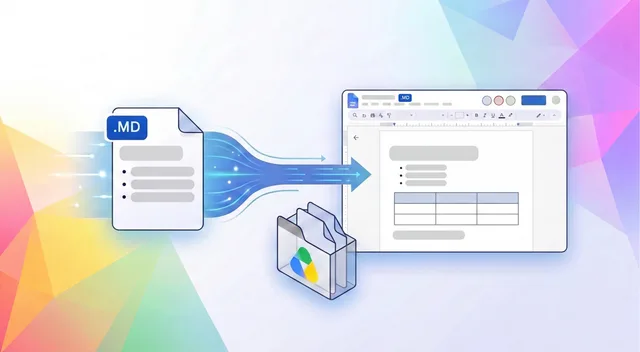
    Google Docs and Drive can now natively view, edit, and collaborate on Markdown (.md) files without manual format conversion, and Drive can also directly preview rendered tables and hyperlinks. The document header displays a .md indicator, and it supports real-time collaboration, line-level comments, and version history, making it easy for team members and AI agents to co-edit the same file.

    image (11)

    Matched fieldsBody