←Search results

By relevance · Total 2018 results Clear search

Wednesday

  1. The Rundown AI

    Google DeepMind releases the Genie 4 world model, which can generate sound effects and converse with characters in the scene

    Google DeepMind has released Genie 4, a new-generation world model that can turn prompts into explorable, realistic scenes in real time, and for the first time the Genie model itself generates background sounds and music, while characters in the scene can also hold real-time conversations. Users move via the keyboard and use text prompts to modify content in the scene instantly, with the scene remaining coherent across multiple inputs. In the demo, a simulated Apptronik Apollo robot plays checkers, with each move planned by Gemini 4 Argon, pointing to Genie's future use in robot training.

    Google DeepMind has released Genie 4, a new-generation world model that can turn prompts into explorable, realistic scenes in real time, and for the first time the Genie model itself generates background sounds and music, while characters in the scene can also hold real-time conversations. Users move via the keyboard and use text prompts to modify content in the scene instantly, with the scene remaining coherent across multiple inputs. In the demo, a simulated Apptronik Apollo robot plays checke

    Matched fieldsBody

  2. QbitAI

    LimX Dynamics updates the FluxVLA Engine V2 technical report, adding online reinforcement learning and real-robot deployment evaluations

    LimX Dynamics has updated the second version of the technical report for its open-source embodied engineering foundation FluxVLA Engine. Compared with the first version in September, it newly adds post-training experiments with online reinforcement learning and expands the coverage of simulation evaluations and real-robot deployment. The report shows that after online reinforcement learning, SmolVLA's success rates on the ten tasks of LIBERO-10 and RoboTwin Clean increased by 10.0 and 15.4 percentage points, respectively; the inference frequency of 8 model-and-device combinations increased to 2.31–9.64 times. On the real-robot side, the deployment pipeline from model checkpoint to closed-loop execution was validated on ALOHA, the dual-arm Franka, Rebot, and the self-developed humanoid robot LimX Oli.

    LimX Dynamics has updated the second version of the technical report for its open-source embodied engineering foundation FluxVLA Engine. Compared with the first version in September, it newly adds post-training experiments with online reinforcement learning and expands the coverage of simulation evaluations and real-robot deployment. The report shows that after online reinforcement learning, SmolVLA's success rates on the ten tasks of LIBERO-10 and RoboTwin Clean increased by 10.0 and 15.4 perce

    Matched fieldsBody

  3. MarkTechPost

    Google DeepMind Releases Genie 4 Real-Time World Model with Native Audio Generation

    Google DeepMind has released the Genie 4 world model as a research preview to trusted testers; it can generate explorable worlds in real time from text and image prompts, and natively generate ambient sound, music, and character dialogue. The model introduces Gemini 3.8 Flash as a planner within the simulation loop, responsible for breaking down goals, inspecting frames, and replanning, which DeepMind calls an early step toward hybrid world models. Genie 4 is hosted only on Google's platform and will later be opened to AI Ultra users and Gemini API partners; all video and audio carry SynthID watermarks.

    Google DeepMind has released the Genie 4 world model as a research preview to trusted testers; it can generate explorable worlds in real time from text and image prompts, and natively generate ambient sound, music, and character dialogue. The model introduces Gemini 3.8 Flash as a planner within the simulation loop, responsible for breaking down goals, inspecting frames, and replanning, which DeepMind calls an early step toward hybrid world models. Genie 4 is hosted only on Google's platform and

    Matched fieldsBody

  4. MarkTechPost

    Polymathic AI and Princeton University Release FlashMap: Achieving 6.14x LLM Decoding Speedup with a Flow-Mapping Drafter

    Polymathic AI, Princeton University, and other institutions have released FlashMap, which replaces discrete diffusion drafters with continuous flow mapping to draft a complete block of 16 tokens in a single forward pass. On Qwen3-8B, it achieves up to 6.14x lossless speedup on GSM8K at temperature 0, with the drafter having only 0.5B parameters. The drafter weights for Qwen3-8B and Qwen3-4B are now available on Hugging Face, along with vLLM and SGLang plugins.

    Matched fieldsBody

  5. Rohan Paul

    Google TPUs will run on a hyperscale cloud outside Google for the first time, with Oracle deploying starting in 2027

    Google's TPUs will run on a hyperscale cloud outside Google for the first time, with Oracle deploying capacity starting in calendar year 2027 and gradually expanding over several years. Oracle provides power, cooling, and data center networking; its Acceleron network connects TPU clusters to Oracle's databases and storage, letting enterprises fine-tune and deploy models next to their data without cross-cloud transfers. Google says the eighth-generation TPU delivers up to 12.6 PFLOPS of FP4 compute per chip, achieves over 97% effective cluster uptime during large-scale training, and improves performance per dollar by up to 80% for low-latency serving; its open-source TorchTPU stack lets existing PyTorch code and tools such as vLLM and SGLang run on TPUs without rewriting models.

    Google's TPUs will run on a hyperscale cloud outside Google for the first time, with Oracle deploying capacity starting in calendar year 2027 and gradually expanding over several years. Oracle provides power, cooling, and data center networking; its Acceleron network connects TPU clusters to Oracle's databases and storage, letting enterprises fine-tune and deploy models next to their data without cross-cloud transfers. Google says the eighth-generation TPU delivers up to 12.6 PFLOPS of FP4 compu

    Matched fieldsBody

  6. OpenBMB

    OpenBMB Open-Sources MiniCPM-OCR Suite, Featuring a 1B Parsing Model and a 2B Verification Model

    OpenBMB has released the open-source MiniCPM-OCR suite, comprising the 1B MiniCPM-OCR 1.0 and the 2B decision model MiniCPM-OCR Jev. MiniCPM-OCR 1.0 scores 93.68 on Real5-OmniDocBench and 54.7 on OCRBench v2; Jev can perform cross-model verification of text, formulas, and tables, scoring 93.6 on JevOCRBench, surpassing JEV-35B-A3B's 90.1 and approaching Qwen3.5-397B-A17B's 93.8. Powered by DSpark, its speed is 1.49 times that of PaddleOCR-VL-1.6 and 3.62 times that of MinerU2.5 Pro; with SDK concurrency optimization, it can reach 128 pages per minute, and it supports deployment on vLLM, SGLang, llama.cpp, and Ollama.

    OpenBMB has released the open-source MiniCPM-OCR suite, comprising the 1B MiniCPM-OCR 1.0 and the 2B decision model MiniCPM-OCR Jev. MiniCPM-OCR 1.0 scores 93.68 on Real5-OmniDocBench and 54.7 on OCRBench v2; Jev can perform cross-model verification of text, formulas, and tables, scoring 93.6 on JevOCRBench, surpassing JEV-35B-A3B's 90.1 and approaching Qwen3.5-397B-A17B's 93.8. Powered by DSpark, its speed is 1.49 times that of PaddleOCR-VL-1.6 and 3.62 times that of MinerU2.5 Pro; with SDK con

    Matched fieldsBody

  7. Unite.AI

    Liquid AI Releases Six 2B-Class Open-Weight Models in the LFM3 Series

    On October 27, Liquid AI released the LFM3 series. All six 2B-parameter-class open-weight models branch from the same LFM3-1.7B-Base, covering text, vision, audio, omni-modal, and decision models. LFM3-1.7B has 1.73B parameters, a 256K token context, supports 16 languages, and adopts a Tri-Hybrid architecture with 13 layers of gated short convolutions, 5 layers of sliding-window attention, and 6 layers of global attention. It is available under the LFM Open License v1.0 on Hugging Face, the Liquid AI Playground, and via API. The company claims that LFM3-1.7B surpasses LFM2.5-2.6B with 35% fewer parameters and occupies about 1 GB of memory at 4-bit precision, but the model card states that it is not suitable for agentic coding or complex multi-step reasoning.

    On October 27, Liquid AI released the LFM3 series. All six 2B-parameter-class open-weight models branch from the same LFM3-1.7B-Base, covering text, vision, audio, omni-modal, and decision models. LFM3-1.7B has 1.73B parameters, a 256K token context, supports 16 languages, and adopts a Tri-Hybrid architecture with 13 layers of gated short convolutions, 5 layers of sliding-window attention, and 6 layers of global attention. It is available under the LFM Open License v1.0 on Hugging Face, the Liqu

    Matched fieldsBody

  8. Unite.AI

    Anthropic Publishes Early Progress of Claude in Drug Discovery

    On October 27, 2026, Anthropic released a life sciences progress update, disclosing early results from collaborations with six institutions—BigHat Biosciences, Bristol Myers Squibb, Divergence Labs, Enveda, Generate Biomedicines, and The Column Group—as well as its first in-house drug program. Six scientists at Generate used Claude Code to build an agent system and selected candidates from 186 CAR T cell therapy signaling domain redesigns; one design was about 70% shorter than the standard version, and in laboratory tests the number of cell surface receptors was about 10 times the original. Divergence Labs said Claude generated about 35,000 antibody designs under about 2,750 hours of H100 compute, and 20 of the 91 tested disruptor designs measurably stripped already-bound IgE. Enveda used Claude to review 1,061 pages of production batch records, reducing review time from 25.9 hours to 2.8 hours, and said drafting Module 2 of an investigational new drug application was shortened from about three months to four hours. Anthropic emphasized that these results are still early, mostly preclinical, and safety and efficacy have not yet been validated in patients.

    On October 27, 2026, Anthropic released a life sciences progress update, disclosing early results from collaborations with six institutions—BigHat Biosciences, Bristol Myers Squibb, Divergence Labs, Enveda, Generate Biomedicines, and The Column Group—as well as its first in-house drug program. Six scientists at Generate used Claude Code to build an agent system and selected candidates from 186 CAR T cell therapy signaling domain redesigns; one design was about 70% shorter than the standard versi

    Matched fieldsBody

  9. Publickey

    Oracle Cloud announces the introduction of Google TPU, with services to begin in 2027

    At the Oracle AI World 2026 keynote, Oracle announced that it will bring Google's self-developed AI chip, Google TPU, into Oracle Cloud Infrastructure, and plans to begin offering Google TPU services in 2027. Oracle said it will provide supporting infrastructure such as power, cooling, and intra-data-center networking for large-scale deployments. The article also mentioned that Google Cloud last week open-sourced TorchTPU, which enables native PyTorch support for TPU.

    Matched fieldsBody

Thursday

  1. The Rundown AI

    Google releases Gemini 4 Carbon, topping 15 of 17 benchmarks

    Google has released Gemini 4 Carbon, a frontier model aimed at cybersecurity and long-horizon coding tasks, topping 15 of Google's own 17 benchmarks, but it has not yet been made public and is available only to some cybersecurity defenders. It scores 59 on Artificial Analysis' Intelligence Index, surpassing Claude Opus 5.5 and up 9 points from Argon four weeks ago; on long-input reasoning it leads OpenAI Astra and Opus by 24 points. The introductory API price is $2 per million input tokens and $10 per million output tokens, half that of Opus 5.5, doubling after the discount period to Opus's rates. Google has not announced when it will broaden access.

    Google has released Gemini 4 Carbon, a frontier model aimed at cybersecurity and long-horizon coding tasks, topping 15 of Google's own 17 benchmarks, but it has not yet been made public and is available only to some cybersecurity defenders. It scores 59 on Artificial Analysis' Intelligence Index, surpassing Claude Opus 5.5 and up 9 points from Argon four weeks ago; on long-input reasoning it leads OpenAI Astra and Opus by 24 points. The introductory API price is $2 per million input tokens and $

    Matched fieldsBody

  2. Mistral AISelected

    Mistral Releases Open Weights for Mistral Large 4 (Le Chonk)

    Mistral has released the open weights for Mistral Large 4 (Le Chonk), a 1-trillion-parameter natively multimodal model that continues reinforcement learning on top of the preview version, with improved coding and defensive cybersecurity capabilities. It scores 19.7% on FrontierCode 2.0 and 48% on the Artificial Analysis Coding Agent Index, roughly on par with GLM-5.3, but uses an average of 47% fewer tokens per task; on Terminal-Bench 4.0 it improves by 13 percentage points to 41%. The model supports three reasoning modes, uses a modified MIT-based Mistral Ecosystem Open-Weight license, and is priced via API at $0.70 per million input tokens, $0.07 for cached input, and $2.10 for output.

    Le Chonk signal

    Mistral has released the open weights for Mistral Large 4 (Le Chonk), a 1-trillion-parameter natively multimodal model that continues reinforcement learning on top of the preview version, with improved coding and defensive cybersecurity capabilities. It scores 19.7% on FrontierCode 2.0 and 48% on the Artificial Analysis Coding Agent Index, roughly on par with GLM-5.3, but uses an average of 47% fewer tokens per task; on Terminal-Bench 4.0 it improves by 13 percentage points to 41%. The model sup

    Matched fieldsBody

  3. TechSpot

    Microsoft's AI infrastructure spending is $6.5 billion less than expected due to delayed data center deliveries

    Microsoft's capital expenditure (including finance leases) for the September quarter was $45.2 billion, $6.5 billion less than analysts' expected $51.7 billion, but still up about 30% year-over-year. CFO Amy Hood attributed the shortfall to delays in third-party data center capacity deliveries, with the related facilities expected to come online in the second half of Microsoft's fiscal year, while also lowering its calendar 2026 spending forecast from $175 billion to $170 billion. Microsoft added 24 data centers in the quarter and has signed contracts worth more than $80 billion with CoreWeave, Nebius, and Nscale since 2023; Azure revenue grew 48% to $33.2 billion.

    Microsoft's capital expenditure (including finance leases) for the September quarter was $45.2 billion, $6.5 billion less than analysts' expected $51.7 billion, but still up about 30% year-over-year. CFO Amy Hood attributed the shortfall to delays in third-party data center capacity deliveries, with the related facilities expected to come online in the second half of Microsoft's fiscal year, while also lowering its calendar 2026 spending forecast from $175 billion to $170 billion. Microsoft adde

    Matched fieldsBody

  4. MarkTechPost

    MiniMax Open-Sources MCode Stack: 17 Agent Skills and 5 Checklists

    On October 28, MiniMax open-sourced MCode Stack under the MIT license, including the 17 SKILL.md skills and 5 checklists its team used to build MiniMax Code, but not the MiniMax Code source code. The skills are grouped into planning and decomposition, context and tools, long sessions and commands, review, and experiments and hotfixes, among which independent-review provides reviewers only with the diff, requirements, and test results. It can be installed into MiniMax Code by copying the skill directories, via a local plugin, or through the plugin marketplace, and can also be installed in Claude Code with /plugin marketplace add MiniMax-AI/mcode-stack; the original article did not publish evaluation results.

    On October 28, MiniMax open-sourced MCode Stack under the MIT license, including the 17 SKILL.md skills and 5 checklists its team used to build MiniMax Code, but not the MiniMax Code source code. The skills are grouped into planning and decomposition, context and tools, long sessions and commands, review, and experiments and hotfixes, among which independent-review provides reviewers only with the diff, requirements, and test results. It can be installed into MiniMax Code by copying the skill di

    Matched fieldsBody

  5. MarkTechPostSelected

    Google DeepMind releases Gemini 4 Carbon, focused on cybersecurity defense and coding

    Google DeepMind has launched Gemini 4 Carbon, calling it a frontier model for long-horizon agentic coding and cybersecurity defense, ranking first with 59 points on the Artificial Analysis Intelligence Index v5.0. The model achieved 96.2% on the GraphWalks long-context test, and 88.2%, 54.8%, and 71.0% on SEC-bench Pro, ExploitGym, and CWE-bench, respectively, but on OSWorld-2.1 it trailed Claude Opus 5.5's 87.2% with 81.5%. Carbon is currently available only to vetted cybersecurity defenders, with introductory pricing of $2 per million input tokens and $10 per million output tokens, later $4 and $20; the timeline for opening it to developers and the public has not been announced.

    Google DeepMind has launched Gemini 4 Carbon, calling it a frontier model for long-horizon agentic coding and cybersecurity defense, ranking first with 59 points on the Artificial Analysis Intelligence Index v5.0. The model achieved 96.2% on the GraphWalks long-context test, and 88.2%, 54.8%, and 71.0% on SEC-bench Pro, ExploitGym, and CWE-bench, respectively, but on OSWorld-2.1 it trailed Claude Opus 5.5's 87.2% with 81.5%. Carbon is currently available only to vetted cybersecurity defenders, w

    Matched fieldsBody

  6. MarkTechPost

    AssemblyAI Releases Its First Speech Synthesis Model, AssemblyAI-TTS-1, at $15 per Million Characters

    AssemblyAI has released its first text-to-speech model, AssemblyAI-TTS-1, and officially opened it up, targeting real-time telephony voice agents, priced at $15 per million characters, with no annual contracts and no concurrency tiers. The model is offered only as a hosted API in us-east-1 and eu-north-1, supports HTTP, WebSocket and OpenAI-compatible interfaces, and comes with more than 4,000 voices, instant voice cloning and 6 languages. The vendor's own testing shows 93.7% entity accuracy and a median time to first byte of 47 ms, but Cekura's independent benchmark measured 159 ms streaming latency and 81.5% reading accuracy, and at launch it does not yet support SSML, speaking-rate control or emotion tags.

    AssemblyAI has released its first text-to-speech model, AssemblyAI-TTS-1, and officially opened it up, targeting real-time telephony voice agents, priced at $15 per million characters, with no annual contracts and no concurrency tiers. The model is offered only as a hosted API in us-east-1 and eu-north-1, supports HTTP, WebSocket and OpenAI-compatible interfaces, and comes with more than 4,000 voices, instant voice cloning and 6 languages. The vendor's own testing shows 93.7% entity accuracy and

    Matched fieldsBody

  7. MarkTechPost

    Infini-AI-Lab open-sources the Hermit harness adapter framework

    Infini-AI-Lab has released the open-source framework Hermit, which adapts AI agents by training external harness adapters while keeping the model and harness frozen; v0.1.0 was released on October 25, 2026. The framework is implemented in Python under the Apache-2.0 license and can be installed via pip install hermit-harness, and it includes five evolution methods: GEPA, SkillOpt, MetaWorld Model, Harness², and Continual Harness. On GLM 5.3 Flash, the MWM adapter achieved 0.795 accuracy on the CL-Bench database exploration task, higher than the in-context baseline of 0.580, but most results are self-reported data from a single run.

    Infini-AI-Lab has released the open-source framework Hermit, which adapts AI agents by training external harness adapters while keeping the model and harness frozen; v0.1.0 was released on October 25, 2026. The framework is implemented in Python under the Apache-2.0 license and can be installed via pip install hermit-harness, and it includes five evolution methods: GEPA, SkillOpt, MetaWorld Model, Harness², and Continual Harness. On GLM 5.3 Flash, the MWM adapter achieved 0.795 accuracy on the C

    Matched fieldsBody

Friday

  1. MarkTechPost

    Prime Intellect Releases Prime Mega MoE Training Kernel, Up to 3.11x Faster in Forward Pass

    Prime Intellect has released Prime Mega MoE, which builds on the Mega MoE kernel from DeepSeek's open-source DeepGEMM library by adding a fused and overlapped backward pass, making it usable for training rather than inference only. In the prime-rl trainer, the full training step for Qwen3 MoE models is 32% to 34% faster than the baseline and 48% to 55% faster than TorchTitan; the single-layer forward pass is up to 3.11x faster (from 12.0 ms to 3.9 ms), but the backward pass for Qwen3-235B-A22B is only 1.24x faster. The kernel supports BF16, MXFP8 on Blackwell, and blockwise FP8 on Hopper, is released with prime-rl under Apache 2.0, and is enabled through the mega_moe dispatch backend.

    Prime Intellect has released Prime Mega MoE, which builds on the Mega MoE kernel from DeepSeek's open-source DeepGEMM library by adding a fused and overlapped backward pass, making it usable for training rather than inference only. In the prime-rl trainer, the full training step for Qwen3 MoE models is 32% to 34% faster than the baseline and 48% to 55% faster than TorchTitan; the single-layer forward pass is up to 3.11x faster (from 12.0 ms to 3.9 ms), but the backward pass for Qwen3-235B-A22B i

    Matched fieldsBody

  2. MarkTechPost

    Baseten Releases 2B Decision Model joey-1, Priced at $0.01 per Million Tokens

    Baseten's Base Labs has released a 2B decision model, joey-1, post-trained on Qwen3.5-2B, which directly returns labels and calibrated probabilities instead of generating text, targeting high-concurrency routing, classification, and guardrail checks. The model scores 63.30 on the public Jev Decision Index 0.4 set, the highest among models under 4B, but 8.94 points lower than the 9B elephant-1. Model APIs are priced at $0.01 per million input tokens, with a P50 latency of 20 ms for an average 2000-token request; the weights are open-sourced under the MIT license on Hugging Face and can be self-hosted on a single CUDA GPU.

    Baseten's Base Labs has released a 2B decision model, joey-1, post-trained on Qwen3.5-2B, which directly returns labels and calibrated probabilities instead of generating text, targeting high-concurrency routing, classification, and guardrail checks. The model scores 63.30 on the public Jev Decision Index 0.4 set, the highest among models under 4B, but 8.94 points lower than the 9B elephant-1. Model APIs are priced at $0.01 per million input tokens, with a P50 latency of 20 ms for an average 200

    Matched fieldsBody

Tuesday

  1. Together AI Blog

    Together AI Details GPU Cluster Auto-Repair: From GPU Failure to Healthy Node

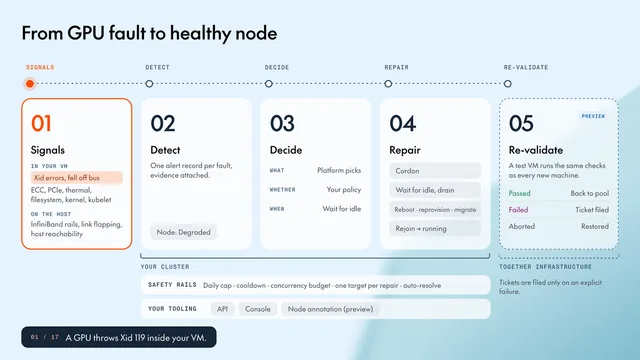
    Together AI introduces its GPU cluster auto-repair system, which now officially offers passive health checks, repair recommendations, auto-repair policies (including per-fault and per-node authorization), wait-for-idle controls, escalation ladders, safety guardrails, and API and console repairs; custom detection onboarding based on node labels remains in preview. The system is divided into four stages: detection, decision, repair, and re-verification. The first three stages run within the user's cluster, while re-verification is performed on the Together side on the freed-up physical machines. The platform maps each signal to the lightest repair action, and users can decide whether to execute automatically and how long to wait; after the same action is repeated twice for the same fault, it automatically escalates one level.

    Auto repair pipeline: signals from inside the VM and from the host feed Detect, Decide and Repair inside your cluster; migrated hosts go to Re-validate on Together infrastructure.

    Together AI introduces its GPU cluster auto-repair system, which now officially offers passive health checks, repair recommendations, auto-repair policies (including per-fault and per-node authorization), wait-for-idle controls, escalation ladders, safety guardrails, and API and console repairs; custom detection onboarding based on node labels remains in preview. The system is divided into four stages: detection, decision, repair, and re-verification. The first three stages run within the user's

    Matched fieldsBody

  2. TMTPost · AGI

    Edge AI Daily Morning Brief: Anthropic Files for IPO, OpenAI Releases GPT-6.1 Terra

    On October 26, 2026, Anthropic submitted an S-1 to the SEC, planning to list on Nasdaq under the ticker "ANT" with a target valuation of approximately $2 trillion and plans to raise up to $100 billion, with its annualized revenue run rate surpassing $65 billion. On the same day, OpenAI released GPT-6.1 Terra, with standard API pricing at $1 per million input tokens and $5 per million output tokens, half that of GPT-6.1 Sol. Meta, meanwhile, launched an equity financing of up to $95 billion to support AI infrastructure, with Nvidia, AMD, and Broadcom intending to subscribe for up to $5 billion in total.

    with a target valuation of approximately $2 trillion and plans to raise up to $100 billion, with its annualized revenue run rate surpassing $65 billion. On the same day, OpenAI released GPT-6.1 Terra, with standard API pricing at $1 per million input tokens and $5 per million output tokens, half that of GPT-6.1 Sol. Meta, meanwhile, launched an equity financing of up to $95 billion to support AI infrastructure, with Nvidia, AMD, and Broadcom intending to subscribe for up to $5 billion in total.

    Matched fieldsBody