English translation is being prepared.
Matched fieldsBody
Matched fieldsBody
Matched fieldsBody
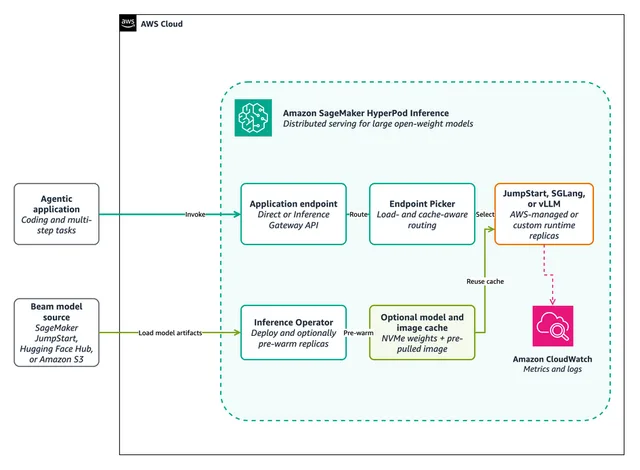
On October 16, Reflection released its first open-weight model Beam on Hugging Face under the Apache 2.0 license, and Baseten provided day-0 support the same day through Model APIs and Dedicated Inference. Beam is a 501B total-parameter MoE autoregressive Transformer with 23B activated per token, a context window of up to 1 million tokens, pretraining on 23.8 trillion tokens, and weights released in BF16, FP8, and NVFP4 precisions. The evaluation results given by Reflection are GPQA Diamond 90.5%, SWE-bench Verified 80.9%, AIME 2026 97.8%, Terminal-Bench 2.1 80.1%, and MCP Atlas 78.7%, and it also open-sourced the terminal agent tool Mirror CLI.
On October 16, Reflection released its first open-weight model Beam on Hugging Face under the Apache 2.0 license, and Baseten provided day-0 support the same day through Model APIs and Dedicated Inference. Beam is a 501B total-parameter MoE autoregressive Transformer with 23B activated per token, a context window of up to 1 million tokens, pretraining on 23.8 trillion tokens, and weights released in BF16, FP8, and NVFP4 precisions. The evaluation results given by Reflection are GPQA Diamond 90.5
Matched fieldsBody
Aleph Alpha has released the open-weight model Kolibri-1, with 78B total parameters. It uses a MoE architecture with 384 experts and 6 routed experts, activating only 3.46B parameters during inference, with a 256K Token context that can be extrapolated to about 1 million Tokens. The model focuses on German and English, and its tokenizer segments German words more token-efficiently; for example, the German Bundestag glossary requires only 1137 Tokens, whereas the compared DeepSeek-V4.1-Flash requires 1910 Tokens. Pretraining used 20 trillion Tokens, with data current as of June 18, 2026. The author's hands-on test found its answers correct and its German-language reasoning process evident, and stated that the Merlin-Arthur protocol makes the model hallucinate less in benchmarks, but its actual performance still needs to be verified in real-world use.
Aleph Alpha has released the open-weight model Kolibri-1, with 78B total parameters. It uses a MoE architecture with 384 experts and 6 routed experts, activating only 3.46B parameters during inference, with a 256K Token context that can be extrapolated to about 1 million Tokens. The model focuses on German and English, and its tokenizer segments German words more token-efficiently; for example, the German Bundestag glossary requires only 1137 Tokens, whereas the compared DeepSeek-V4.1-Flash requ
Matched fieldsBody
Matched fieldsBody
Matched fieldsBody
Matched fieldsBody
Matched fieldsBody
Matched fieldsBody
Hugging Face has released Beam, a 501B-parameter sparse MoE open source model aimed at long-text reasoning and agent tasks with 1M context, activating only about 23B parameters per token. The model uses 52 layers of hybrid attention, with 43 layers using a 512-token sliding window and 9 layers using global attention; the KV cache grows by 36 KiB per token, about one-sixth that of a full-attention approach. The official release provides three checkpoints—BF16, FP8, and NVFP4; NVFP4 can compress the weights from about 1 TB to about 280 GB, and day-0 support is already available in transformers, vLLM, and SGLang.
Hugging Face has released Beam, a 501B-parameter sparse MoE open source model aimed at long-text reasoning and agent tasks with 1M context, activating only about 23B parameters per token. The model uses 52 layers of hybrid attention, with 43 layers using a 512-token sliding window and 9 layers using global attention; the KV cache grows by 36 KiB per token, about one-sixth that of a full-attention approach. The official release provides three checkpoints—BF16, FP8, and NVFP4; NVFP4 can compress t
Matched fieldsBody

Matched fieldsBody
Matched fieldsBody
Matched fieldsBody
Matched fieldsBody
Matched fieldsBody
Matched fieldsBody
Matched fieldsBody
Elorian has released its first model, Glimpse, opening the API as a research preview, with a waitlist for the chat interface. During reasoning, the model can crop image regions, extract video frames, or run code to measure and compare what it sees, which Elorian calls a visual draft space. Glimpse is priced at $0.60 per million input tokens and $3 per million output tokens, and according to Elorian's evaluations it surpasses GPT-6 Astra on scientific chart reasoning and short video description. The company says the model was trained on several hundred GPUs, a scale notably smaller than the frontier systems it benchmarks against, and it initially targets enterprises with large amounts of video, such as robotics, research laboratories, and media and creative firms.
Elorian has released its first model, Glimpse, opening the API as a research preview, with a waitlist for the chat interface. During reasoning, the model can crop image regions, extract video frames, or run code to measure and compare what it sees, which Elorian calls a visual draft space. Glimpse is priced at $0.60 per million input tokens and $3 per million output tokens, and according to Elorian's evaluations it surpasses GPT-6 Astra on scientific chart reasoning and short video description.
Matched fieldsBody
Matched fieldsBody
Matched fieldsBody