 AI Trends
Published 11/26/2026
Distilling Kimi-K3.1-Pro into Qwen3.8-27B: Teaching a model a new languageQwen3.8-27B answered in Thai when we asked it for Lao. We distilled Kimi-K3.1-Pro's Lao translation into it with Together Post-Training and reached 93% of the teacher's score, with Thai intact.
Authors
Zain Hasan
Table of contents
Links in this article
Summary
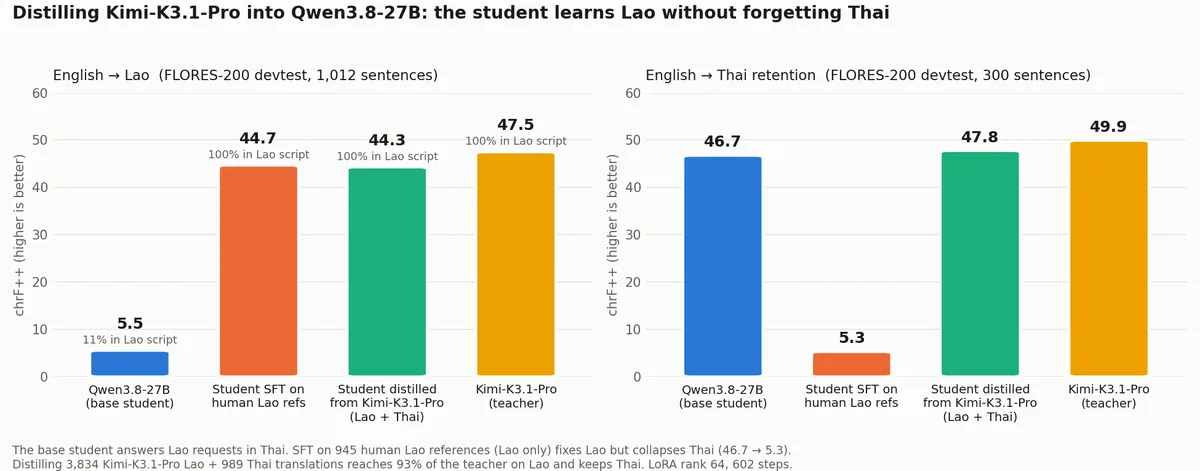
- The gap: Qwen3.8-27B answers in Thai when asked for Lao and scores 5.5 chrF++, while Kimi-K3.1-Pro scores 47.5 on the same test.
- The fix: We trained a LoRA adapter on about 3,800 of Kimi-K3.1-Pro's translations using Together Post-Training.
- The result: The student writes Lao on every test sentence and scores 44.3, which is 93% of the teacher's score, and it keeps its Thai.
- The cost: All the experiments together cost \$260, and the code is in the post-training cookbook.
While running some experiments we found out that Qwen3.8-27B, one of the most popular small language models (SLMs), can't write Lao, a Southwestern Tai language and the official language of Laos. If you ask it to translate an English sentence into Lao, it answers in Thai, Lao's closest relative, which uses an entirely different script. On the FLORES-200 Lao test set, the model scores 5.5 chrF++, a 0 to 100 score for how closely a translation matches a human reference, and only 11% of its outputs are in Lao script. Kimi-K3.1-Pro scores 47.5 on the same test.
Admittedly, this is a niche use case, but the pattern is quite common: a small language model displays jagged intelligence, falling flat on a narrow task you care about while a larger, more expensive model handles it with ease. To fix this, we used Kimi-K3.1-Pro as a teacher and distilled its Lao translation ability into Qwen3.8-27B using Together Post-Training.
After training on about 3,800 of Kimi-K3.1-Pro's translations, the 27B student answers in Lao on every test sentence and scores 44.3, which is 93% of the teacher's score. It also kept its Thai translation ability, which interestingly turned out to be the hardest part. Our first attempt fixed Lao within 25 training steps but also lost Thai translating capabilities along with it.
This post walks through how we found the gap and what ended up working. The code, settings and costs are in the second half. All the experiments together cost \$260.
Finding the gap
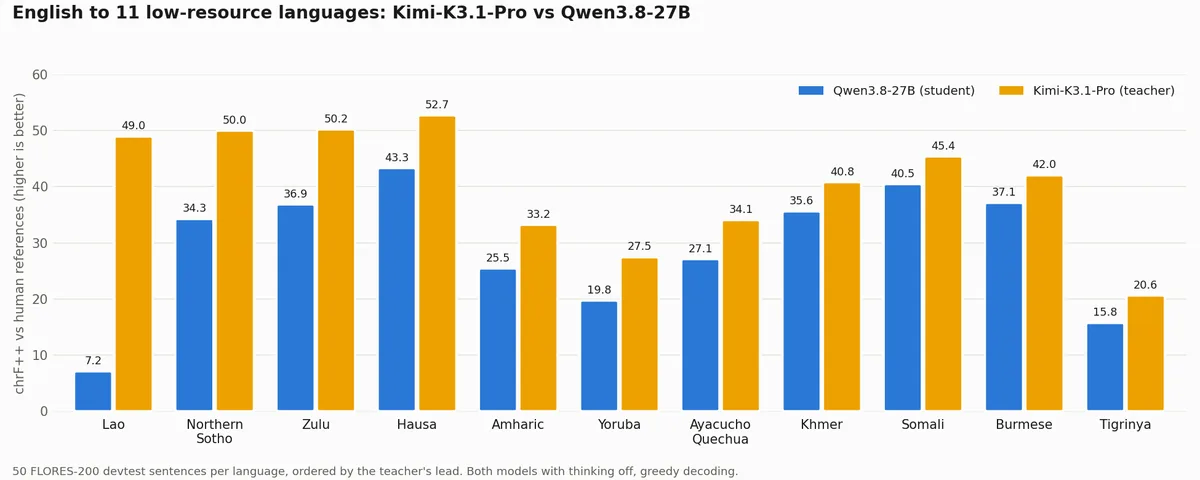
The metric we use is chrF++, which scores character and word overlap with a human reference translation, from 0 to 100. The important thing to know about Qwen's low Lao score is that, to chrF++, a Thai answer shares almost nothing with a Lao reference. When asked to translate into Lao, the student's output contained Thai script in 45 of 50 sentences and Lao in only 6:
English: "We now have 4-month-old mice that are non-diabetic that used to be diabetic," he added.
Qwen3.8-27B (base): “We now have 4-month-old mice that are non-diabetic that used to be diabetic,” he added.
Kimi-K3.1-Pro: “We now have 4-month-old mice that are non-diabetic that used to be diabetic,” he added.
The base model's Thai is a reasonable translation, just in the wrong language. We'll come back to this in the results.
One note on the numbers: on these 50 sentences Lao scores 7.2 for Qwen3.8-27B and 49.0 for Kimi-K3.1-Pro, and on the full 1,012-sentence test set it's 5.5 and 47.5. The test sets are listed under "How we built it."
The plan: off-policy distillation
Distillation trains a small model (the student) to behave like a large one (the teacher) on a given domain. There are two ways to do it.
On-policy distillation (OPD), described in Thinking Machines' post on the topic, has the student generate text and the teacher grade every token. It needs the teacher's log-probabilities on the student's tokens, which in practice means the two models have to share a tokenizer. Here since we are distilling Kimi into Qwen and they don’t share a tokenizer we went another direction.
Off-policy distillation has the teacher generate the text and trains the student to imitate it with supervised fine-tuning (SFT). In its simplest form it only needs the teacher's text.
We used off-policy distillation. It keeps the teacher side fairly cheap: every teacher call is an ordinary serverless chat request, and Kimi-K3.1-Pro, which is quite a large model, never needs a training resource of its own.
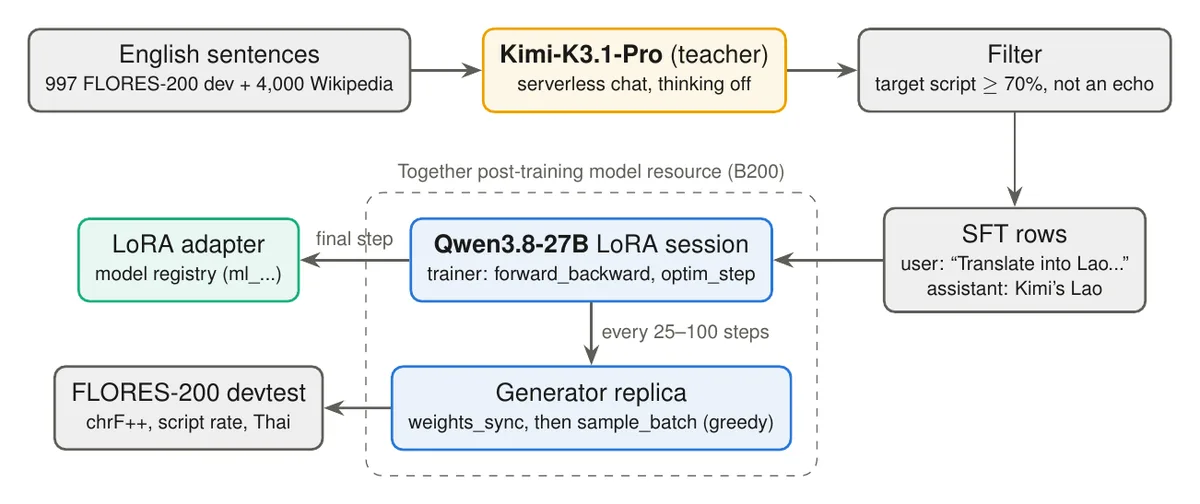
The steps:
- Collect English source sentences.
- Have Kimi-K3.1-Pro translate them, with thinking turned off.
- Drop any translation that isn't mostly in the target script.
- Fine-tune a LoRA adapter on Qwen3.8-27B with the translations as targets, evaluating on held-out test sentences as it trains.
- Save the adapter to the model registry.
We trained the student on Together Post-Training. One model resource both trains the LoRA adapter and samples from it, so we could score the model as it trained. We scored every evaluation on four metrics:
- chrF++ against human references on FLORES-200 devtest: all 1,012 sentences at the start and end of each run, and 300 every 25 steps (every 50 or 100 in the two longest runs).
- Lao-script rate: the share of outputs whose letters are mostly Lao. This catches the Thai problem directly.
- Thai retention: chrF++ on 300 English-to-Thai test sentences, to check the model hasn't lost a language it already had.
- Round-trip adequacy: Kimi-K3.1-Pro translates each system's Lao back into English, and we score that against the original English. This checks meaning independently of reference style.
Thai retention while also gaining Lao translation capability ended up being the trickiest part.
The Thai surprise
One run was a control: it trained on human Lao references, 945 of them from FLORES dev, with no teacher involved. Lao jumped from 6.7 to 43.3 within 25 steps.
Then we looked at Thai. It had dropped from 46.7 to 11.7, and by the end of the run it was 5.3, with 0% of Thai outputs in Thai script. The model had learned to "write Lao when asked to translate", not "write the language you were asked for". The problem had swapped direction.
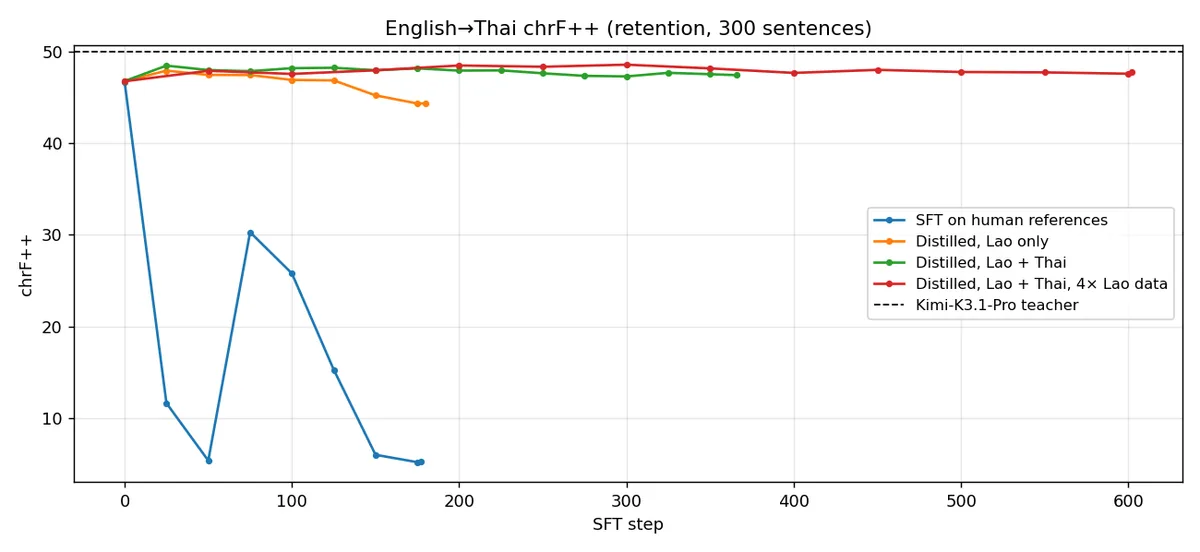
If we'd evaluated Lao alone, this run would have looked like the winner. It has the highest Lao score of any student in this post.
Fixing Thai
The Lao-only distillation run trains on Kimi-K3.1-Pro's translations of the same sentences in place of the human ones. That slowed the damage a lot but didn't stop it. Thai held for two epochs, then slipped to 44.3 in the third, with 17 of 300 Thai answers written in Lao.
Adding about 1,000 Kimi-K3.1-Pro Thai translations to the training data fixed it. Thai finished at 47.4 and 47.8 in the two mixed runs, above the base model, and never dropped below 47.3 at any evaluation.
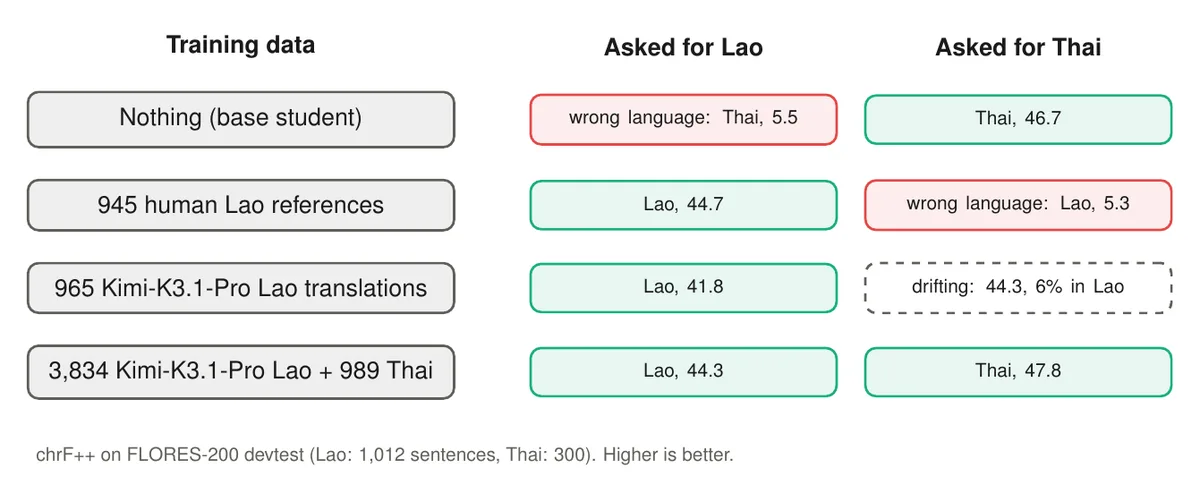
This is a great point to make about continual learning: when you teach a model something new, mix in data that protects what it already does well, so you don't get regressions in things you care about. Here that was Thai, the language most easily confused with Lao.
Closing the rest of the Lao gap
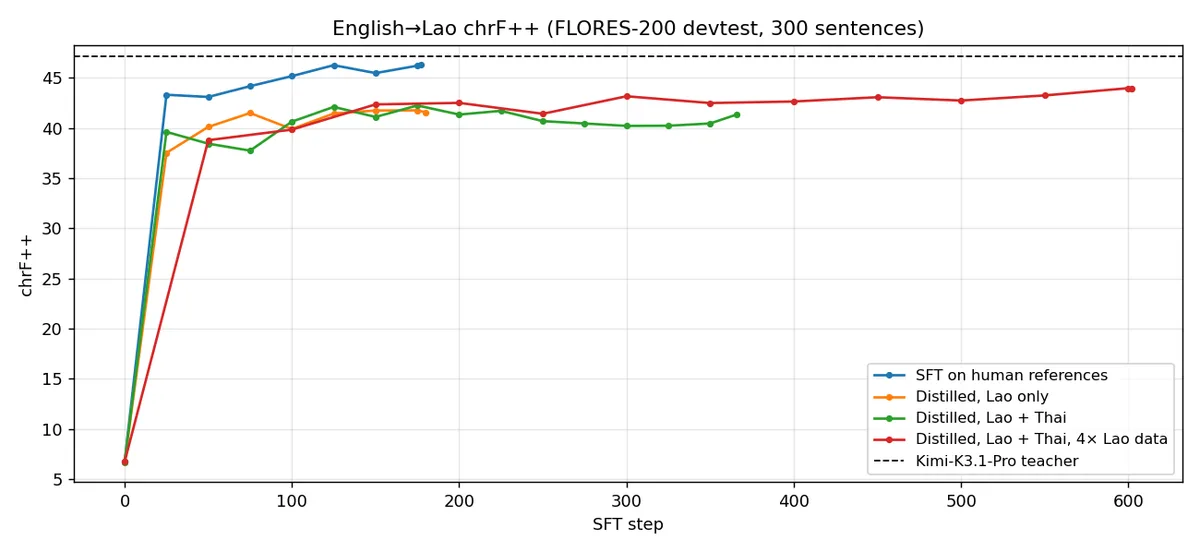
Thai was safe, but Lao was still short. With about 950 Lao examples each, the student trained on human references scored 44.7 and the two distilled students scored 41.8 and 41.9.
Part of that is expected. Human references do better on a human-reference metric: FLORES dev and devtest were translated through the same human process, so training on dev teaches devtest's reference style. The distilled student learns the teacher's style instead. Scored against Kimi-K3.1-Pro's own translations, the distilled student climbed from 8 to 58 chrF++, and the student trained on human references reached 47.
The other difference is supply. FLORES dev has 997 human references and no more, while Kimi-K3.1-Pro can translate any English text you have. Adding its translations of 3,000 Wikipedia sentences took the Lao training set from 965 to 3,834 examples and raised Lao from 41.9 to 44.3. That's within half a point of the human-reference run, with Thai intact.
More data also beat more passes: one epoch of the 4× data reached 43.2 on the 300 test sentences, against 41.3 after three epochs of the smaller Lao + Thai set.
Results
| Run | Training data | Lao chrF++ | Lao script | Thai chrF++ |
|---|---|---|---|---|
| Base student | none | 5.5 | 11% | 46.7 |
| SFT on human references | 945 human Lao translations | 44.7 | 100% | 5.3 |
| Distilled, Lao only | 965 Kimi-K3.1-Pro Lao translations | 41.8 | 100% | 44.3 |
| Distilled, Lao + Thai | 965 Lao + 989 Thai, from Kimi-K3.1-Pro | 41.9 | 100% | 47.4 |
| Distilled, Lao + Thai, 4× Lao data | 3,834 Lao + 989 Thai, from Kimi-K3.1-Pro | 44.3 | 100% | 47.8 |
| Kimi-K3.1-Pro teacher | - | 47.5 | 100% | 49.9 |
Lao numbers use all 1,012 test sentences and Thai uses 300. The best run reaches 93% of the teacher's score. Measured from where the base model started, it closed 92% of the base-to-teacher gap on Lao:
$$\text{gap closed} = \frac{s_{\text{student}} - s_{\text{base}}}{s_{\text{teacher}} - s_{\text{base}}} = \frac{44.3 - 5.5}{47.5 - 5.5} = 0.92$$
The base model mostly had the meaning; it just wrote the wrong language. Remember the mice example. On round-trip adequacy, the base model's Thai output scored 64.6, slightly above human Lao references (64.0). The distilled student scored 65.7 and wrote Lao on 100% of the test sentences. So the main gap was language identity, which is why every run had fixed the script by its first evaluation, 25 or 50 steps in.
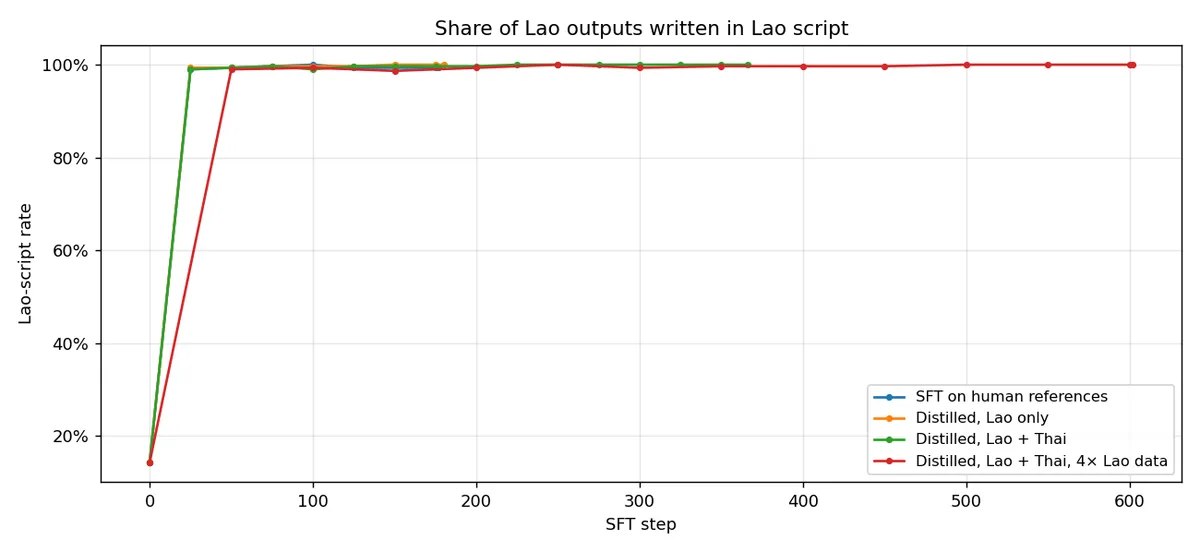
Loss curves, token counts and per-run details can be found in the appendix.
Training on five languages
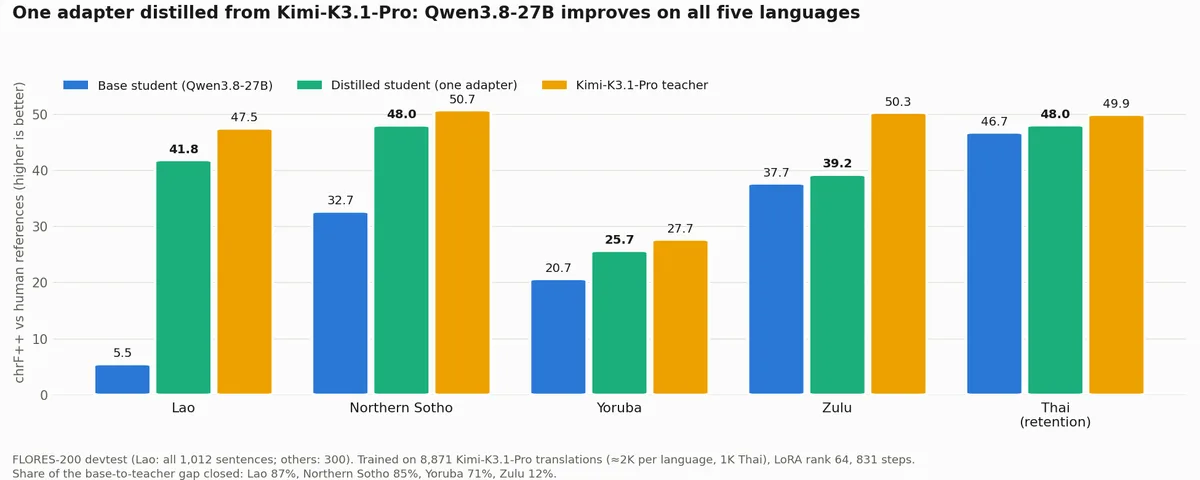
To check this wasn't specific to Lao, we trained one adapter on Lao, Northern Sotho and Zulu (the three largest gaps) plus Yoruba, the lowest-scoring Latin-script language for both models, with Thai for retention: 8,871 Kimi-K3.1-Pro translations in all, about 2,000 per language and 1,000 for Thai, over 831 steps.
| Language | Base student | Distilled | Kimi-K3.1-Pro | Gap closed |
|---|---|---|---|---|
| Lao | 5.5 | 41.8 | 47.5 | 87% |
| Northern Sotho | 32.7 | 48.0 | 50.7 | 85% |
| Yoruba | 20.7 | 25.7 | 27.7 | 71% |
| Zulu | 37.7 | 39.2 | 50.3 | 12% |
| Thai | 46.7 | 48.0 | 49.9 | improved |
Lao is on all 1,012 test sentences; the rest use 300, with the teacher scored on the same sentences. Every language improved. Zulu improved least: 1 to 2% of its outputs fell into repetition loops during training, so more Zulu data or a repetition penalty is the first thing we'd try.
If you have a gap like this
Here's what we'd do again:
- Screen first. Fifty sentences per language was enough to see where the teacher was far ahead.
- Look at what the base model is getting wrong before you train. Here the meaning was there and the language was wrong, which is why the script was fixed within the first 25 to 50 steps.
- When the student plateaus, generate more teacher data before you add epochs.
- Mix in data for the nearby skill you want to keep, and score it during training. A Lao-only evaluation would have picked the run that broke Thai as the best one.
How we built it
The rest of this post is the how-to: the teacher data, the training loop, the settings, the test sets and the cost.
Generating teacher data with serverless Kimi-K3.1-Pro
Every teacher call is an ordinary chat completion with thinking turned off. Translation doesn't need long reasoning: with thinking on, Kimi-K3.1-Pro scored lower on 300 Lao test sentences (43.5 against 47.3) and used about 8 times as many tokens. With it off, a Lao answer averages about 175 output tokens.
from together import Together

client = Together()
resp = client.chat.completions.create(
    model="moonshotai/Kimi-K3.1-Pro",
    messages=[{"role": "user", "content": (
        "Translate the following English text into Lao. "
        "Output only the Lao translation, with no explanation.\n\n" + english
    )}],
    max_tokens=1024,
    temperature=0.0,
    chat_template_kwargs={"thinking": False},
)
lao = resp.choices[0].message.content
The source text was the 997 sentences of FLORES-200 dev, plus 4,000 sentences from English Wikipedia (3,000 for Lao, 1,000 for Thai).
Two things worth knowing about the data:
- Generating data from the teacher is cheap. Kimi-K3.1-Pro serverless costs \$2 per million input tokens and \$10 per million output tokens. All 4,000 Lao translations together cost \$7.46.
- Filter before training. We kept a translation only if at least 70% of its letters were in the target script and it wasn't an echo of the English. The filter removed 4% of Kimi-K3.1-Pro's Lao.
Each surviving translation becomes one chat-format training row:
{"messages": [
  {"role": "user", "content": "Translate the following English text into Lao. Output only the Lao translation, with no explanation.\n\n<English sentence>"},
  {"role": "assistant", "content": "<Kimi-K3.1-Pro's Lao translation>"}
]}
Training the student on Together Post-Training
Together Post-Training splits a training run between your code and the GPUs. A model resource is a set of GPUs (B200s here) with the base model loaded. It has a trainer, which runs forward_backward and optim_step, and optionally a generator that samples text from intermediate checkpoints. A session is one LoRA adapter training on that resource.
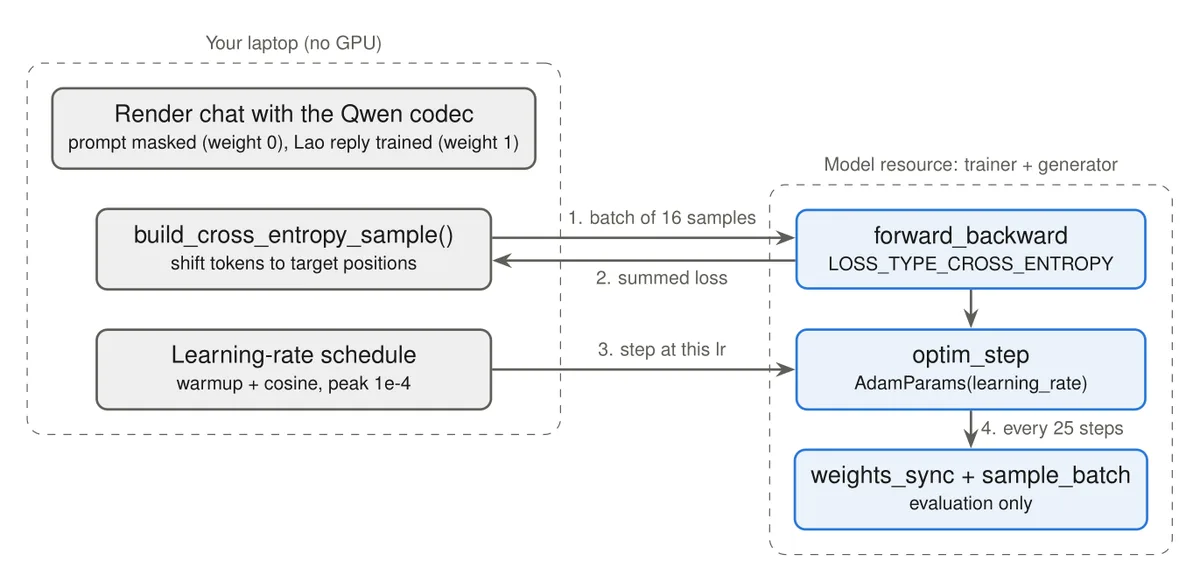
We used the cookbook for three things:
get_codec("Qwen/Qwen3.8-27B", enable_thinking=False)renders each chat with Qwen's own template.build_conversation_samplesmasks the prompt (loss weight 0) and trains only the assistant's translation (weight 1), including the end-of-turn token, so the model learns when to stop.build_cross_entropy_sampleshifts the tokens to the next-token targets the API expects.
from together import Together
from together.post_training import (AdamParams, LoraConfig, LossConfig,
                                    ModelResourcesClient, SamplingParams)
from post_training_cookbook.codecs import get_codec
from post_training_cookbook.samples import make_prompt
from post_training_cookbook.sft.train import TRAIN_ON_LAST, build_conversation_samples

codec = get_codec("Qwen/Qwen3.8-27B", enable_thinking=False)
samples = [s for row in rows for s in build_conversation_samples(
    row["messages"], codec=codec, train_on_what=TRAIN_ON_LAST, max_length=2048)]

# One resource with one generator replica: train and evaluate on the same resource.
raw = Together().post_training.model_resources.create(
    base_model="Qwen/Qwen3.8-27B", lora_enabled=True,
    compute_config={"gpu_type": "B200-SXM", "num_generator_replicas": 1},
    extra_body={"inactive_timeout": 1200})
record_in_ledger(raw.id)            # before waiting, so a crash can't leak it
wait_until_ready(raw.id)            # about 4 to 5 minutes for us
resources = ModelResourcesClient.attach(model_resources_id=raw.id)
session = resources.create_session(lora_config=LoraConfig(rank=64, alpha=128))

for step in range(total_steps):
    batch = next_batch(samples, size=16)
    session.trainer.forward_backward(samples=batch,
                                     loss=LossConfig(type="LOSS_TYPE_CROSS_ENTROPY"))
    session.trainer.optim_step(adam_params=AdamParams(learning_rate=lr_at(step)))

    if (step + 1) % 25 == 0:
        session.trainer.weights_sync()              # publish new weights to the generator
        outs = session.generator.sample_batch(
            [make_prompt(codec.encode_messages(m, add_generation_prompt=True)) for m in test_prompts],
            num_samples=1, sampling_params=SamplingParams(max_tokens=1024, temperature=0.0))
        score(outs)

checkpoint = session.create_inference_checkpoint() # registers the adapter (ml_...)record_in_ledger, wait_until_ready, next_batch, lr_at and score are small helpers of ours.
The settings were:
- LoRA rank 64 (Qwen3.8-27B's maximum) and alpha 128
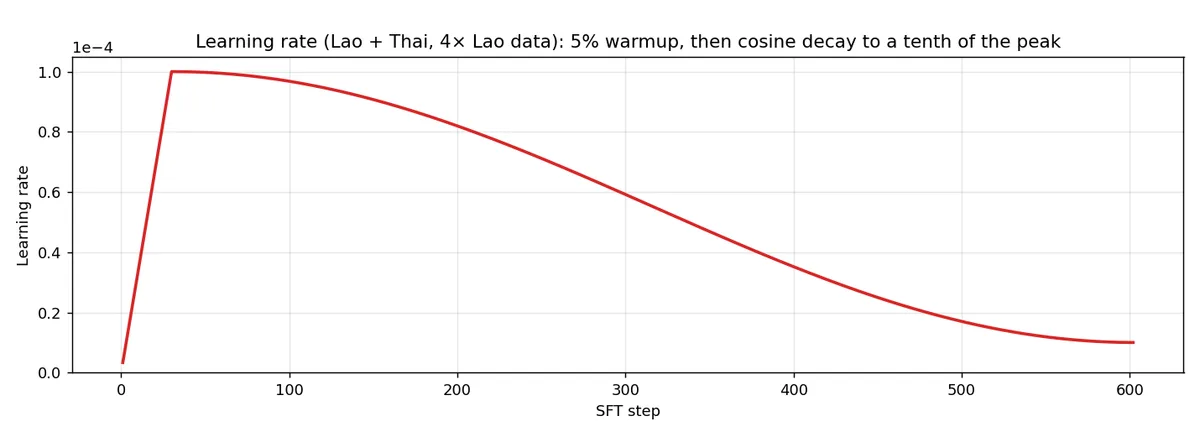
- peak learning rate 1e-4, with 5% warmup and cosine decay to a tenth of the peak
- batch size 16
Because the resource has a generator, we didn't need to deploy a separate endpoint to evaluate.
The test sets
You'll see slightly different scores for the same model in different places, because we scored on three sets of FLORES-200 sentences:
| Slice | Used for | Base Lao | Teacher Lao |
|---|---|---|---|
| 50 sentences per language | The 11-language screen | 7.2 | 49.0 |
| 300 devtest sentences | Evaluations during training, and Thai | 6.7 | 47.3 |
| All 1,012 devtest sentences | Start and end of each run, and the headline results | 5.5 | 47.5 |
FLORES-200 devtest was never used for training. We kept it as the test set throughout.
Time and cost
All the experiments in this post cost \$260 together assuming training on B200’s. Teacher data is the cheap part: all 4,000 Lao translations cost \$7.46.
As for time, the first step of every run took 2.5 to 3 minutes. After that, a step took a median of 2.6 to 3.2 seconds at batch 16, and evaluating 300 test sentences on the generator took about 20 seconds. The best Lao run held its resource for 46 minutes: 33.7 minutes of training steps, 7.1 minutes across 30 evaluation passes, and the rest on starting the session, saving the adapter and shutting down.
Try it yourself
The code for this post is in the post-training cookbook:
recipes/distillation/screen_languages.pymeasures the teacher–student gap.recipes/distillation/lao_from_kimi_k31_pro.pygenerates the teacher data, filters it, trains and evaluates the Lao student.recipes/distillation/multilingual_from_kimi_k31_pro.pytrains the five-language adapter.
To serve the adapter after training, see Deploy a checkpoint.
Together Post-Training Distill a larger model into your own Train a LoRA adapter and evaluate it on the same model resource, starting from the recipes in this post. Get startedAppendix: what training looked like
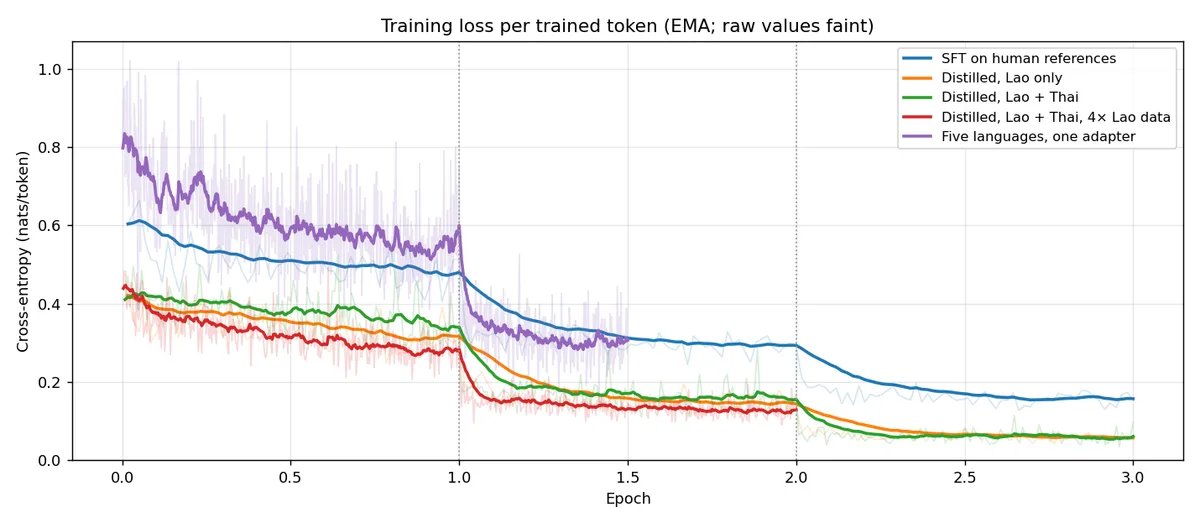
| Run | Steps | Epochs | Trained tokens | Loss, first 10 steps | Loss, last 25 steps |
|---|---|---|---|---|---|
| SFT on human references | 177 | 3 | 0.37M | 0.54 | 0.16 |
| Distilled, Lao only | 180 | 3 | 0.38M | 0.36 | 0.06 |
| Distilled, Lao + Thai | 366 | 3 | 0.49M | 0.43 | 0.06 |
| Distilled, Lao + Thai, 4× Lao data | 602 | 2 | 1.11M | 0.43 | 0.13 |
| Five languages, one adapter | 831 | 1.5 | 1.04M | 0.82 | 0.30 |
Loss is cross-entropy in nats per trained token. Trained tokens count only the assistant's translation tokens, the ones that carry loss, not the prompts. The five-language run is the one from "Training on five languages".
Three observations from these runs:
- Kimi-K3.1-Pro's Lao is easier for the student to learn than human Lao. The human-reference run and the Lao-only distillation run translate the same FLORES dev sentences, yet the student starts at 0.54 nats per token on the human translations and 0.36 on Kimi-K3.1-Pro's, and finishes at 0.16 against 0.06. Our guess is that one model's translations are more consistent than a team of human translators', so the student has less to fit.
- The loss drops at every epoch boundary, and held-out quality doesn't follow it. Each drop is the model meeting rows it has already seen. In the four Lao runs, training loss fell by more than half after the first epoch, while Lao chrF++ on the 300 test sentences moved by between −1 and +3 points. More data beat more passes: one epoch of the 4× data reached 43.2 on those sentences, against 41.3 after three epochs of the smaller Lao + Thai set.
- The five-language run has the highest loss through its first epoch. Four of its five languages started well below the teacher, against one of two in the Lao runs.