 AI Trends
- Our latest customer hackathon put Databricks Lakebase in the spotlight, and the eleven projects show the full range of what a Postgres database built for the lakehouse can do.
- The two tracks line up with two ways teams use Lakebase: building applications on it with database branching, and connecting it to the lakehouse to serve data and ML features in real time.
- From AI agents that test their actions on a branch before touching production to an insurer retiring a separate search index, the builds show why the operational database is becoming part of the data platform instead of a system that sits next to it.
How Databricks hackathons work
We run these hackathons for a simple reason: the fastest way to learn a product is to build something with it. Each one starts with an enablement session where teams learn the product and where it’s headed on the roadmap. Then the building starts. Teams work together for about a week and submit a project, and the strongest solutions earn prizes.
This time, we opened the hackathon to a much wider group of customers than ever before, and the product in the spotlight was Databricks Lakebase.
Why Lakebase made for a great hackathon
Lakebase is fully managed Postgres, so any developer who has written a SQL query or used an ORM can start building right away. What makes it different is what sits underneath. Storage is separated from compute, and the database lives next to your lakehouse data under the same Unity Catalog governance. That opens up three things a typical Postgres database can’t do as easily:
- Branch it. Lakebase branches work like Git branches for your database. A new branch is created instantly using copy-on-write storage, so you only pay for the data that changes, and creating one has no performance impact on production.
- Sync it. Synced tables continuously copy Unity Catalog tables into Postgres as read-only tables, so applications can query lakehouse data with low latency. This is commonly called reverse ETL. In the other direction, Lakehouse Sync replicates Postgres tables back into Unity Catalog Delta tables using change data capture.
- Serve it. Lakebase can hold application state, power search with extensions like pgvector, PostGIS, and pg_trgm, and act as the online store behind Databricks Online Feature Stores for real-time ML.
Those map to the two tracks we ran. Track 1 focused on branching and building applications. Track 2 focused on syncing and serving. Underneath both, Unity Catalog governs who can see what, whether the data is being queried in a notebook or read by a production app.
Track 1: Build applications with Lakebase branching
Who it’s for: application developers. These are the engineers who build the apps, APIs, and agents that run on operational data, and who have usually had to choose between a slow, shared staging database and an expensive copy for every developer. Branching removes that tradeoff. Every Lakebase project starts with a production branch, and you can create child branches from it for development, testing, or experiments. Because branches use copy-on-write, a branch of a large database is ready in seconds, and only the changes take up new storage. Teams in this track used Genie Code to build their apps and treated branches as cheap, disposable copies of production.
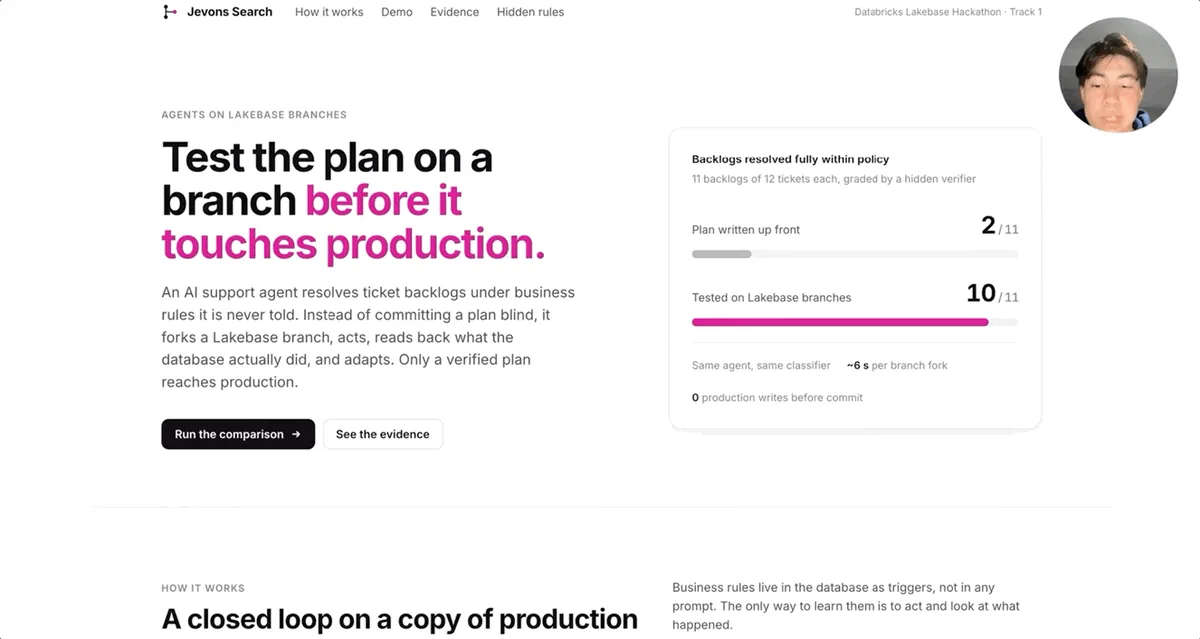
Lyft took on a problem that’s growing as AI agents start acting on production data: agents that issue refunds, cancel bookings, or close tickets without knowing the business rules that live inside the database as triggers. Their project, Jevons Search, gives the agent a Lakebase branch to work on. For each batch of support tickets, the agent forks a copy-on-write branch of production in about six seconds, applies its actions, reads back what the database actually did, and adjusts. Instead of using a large LLM to plan, a lightweight classifier built on gte-large embeddings, tracked in MLflow, and served on Model Serving sorts each ticket into one of eight policy categories, with no LLM tokens used at runtime. On a synthetic dataset built from the Wanderbricks sample data, planning up front fully resolved 2 of 11 support backlogs within policy. Testing on branches resolved 10 of 11. The team also tested the idea behind the project’s name: Lakebase forked fast enough to score more than four times as many branches in the same minute, but more branches didn’t lead to more passes. Precise decisions plus real feedback from the database beat brute force.
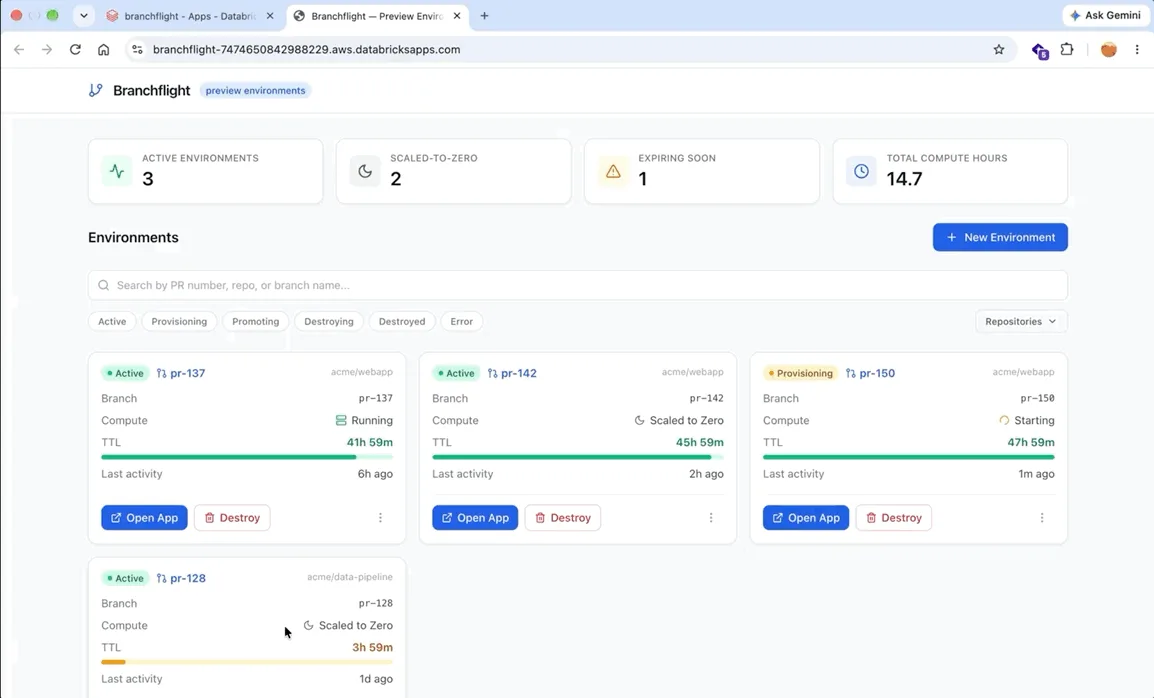
CIBC built Branchflight, a platform that gives every pull request its own preview environment. When a pull request opens, Branchflight creates a zero-copy Lakebase branch from a PII-masked template branch in under five seconds and deploys a preview Databricks App connected to it. Environments scale to zero when no one is using them, expire automatically after a set time, and pass through a schema-diff check before changes merge. The platform’s own state, audit logs, and cost metrics live in Lakebase too.
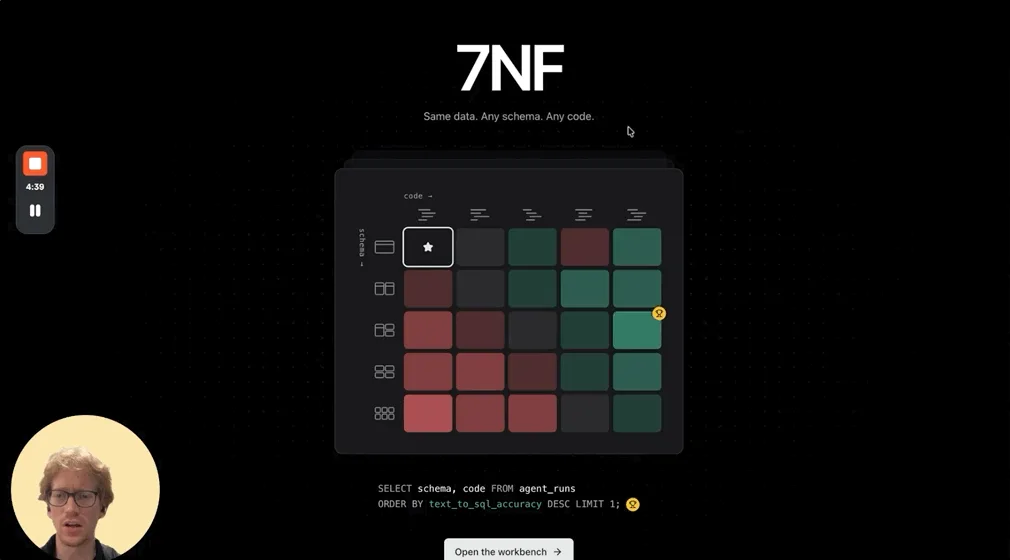
Arbital Health asked a question every team putting text-to-SQL in front of users should think about: how much does the schema itself affect accuracy? Their benchmark, 7NF, keeps the data fixed and changes the schema, with each layout running as its own Lakebase branch. Models are graded only on whether they return the correct rows, so teams can pick the best schema for a customer database or improve their own text-to-SQL models.
Branching also showed up in some unexpected places.
For their hackathon submission, OneTrust brought Lakebase branching to network security by treating firewall rules like code. To evaluate proposed changes without risk to live infrastructure, they experimented with having a Go app spin up a copy-on-write Lakebase branch with dedicated compute and connect a test instance to run recursive reachability queries and policy checks. In testing, trial runs that expanded the attack surface were discarded instantly, while validated rules merged directly into production.
A second CIBC team built BranchCut, a 3D cinematic workspace that brings Git-style branching and merging to creative work. Creators branch from any point in a scene, try different camera moves or lighting, compare versions side by side, and merge the best one back, with Lakebase tracking projects, branches, scene state, and merge history.
Reach Mobile built StreetCart, which helps shoppers compare nearby stores on price, distance, and stock instead of walking store to store. Lakebase is the app’s operational database for products, stores, and inventory, and Lakebase search powers product discovery. The team used branching to test new product category attributes before changing the production schema.
Markel went after a system most property and casualty insurers run: a separate search index, often Elasticsearch, kept only so claims, underwriting, and call center teams get fast reads. That second copy has its own pipeline, its own schema drift, and its own governance gaps. Markel’s app serves those reads from the same governed gold tables used for analytics, through Lakebase. Claims analysts search for policies by number, name, address, or phone; call center agents identify callers by phone number across policy, claims, and broker data; and underwriters see loss runs for a broker in one place. New claims are scored for risk as they arrive.
Track 2: Connect Lakebase to the lakehouse
Building on Lakebase is only half the story. The other half is what happens when the operational database and the lakehouse stop being separate systems.
Who it’s for: data and ML engineers. These are the people who build the pipelines and models, and who usually have to build a separate path to get that data into the apps and services that need it in milliseconds.
This track was about closing that gap. Synced tables move curated Unity Catalog data into Lakebase Postgres through managed Spark Declarative Pipelines, so apps can join it with their own tables. Lakebase Change Data Feed goes the other way and streams changes made in Postgres back to Delta for analytics. And because Databricks Online Feature Stores run on Lakebase, features defined in the lakehouse can be served to models in real time.
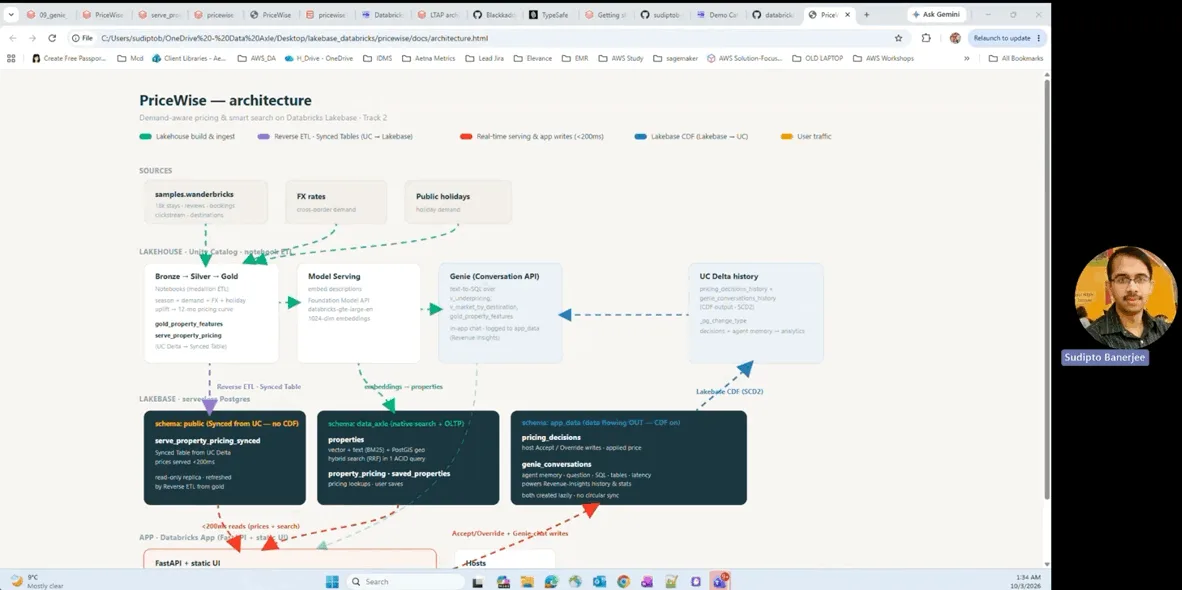
Data Axle built PriceWise for vacation rental hosts who set one flat nightly price while demand changes dramatically across the year. Across more than 18,000 listings, the team estimated hosts leave about 64% of potential nightly revenue on the table. PriceWise combines hybrid search (pgvector embeddings plus BM25, merged with Reciprocal Rank Fusion), pricing suggestions broken down into four demand drivers including PostGIS comparisons of listings within 20 miles, and an embedded Genie agent that answers questions like which amenities top competitors have. Every Genie conversation is saved in Lakebase as agent memory, so hosts can pick up where they left off. Search, pricing, agent memory, and feature serving all run from one Lakebase database kept current through synced tables, with pricing responses in as little as 4 milliseconds, and host decisions written back to Lakebase.
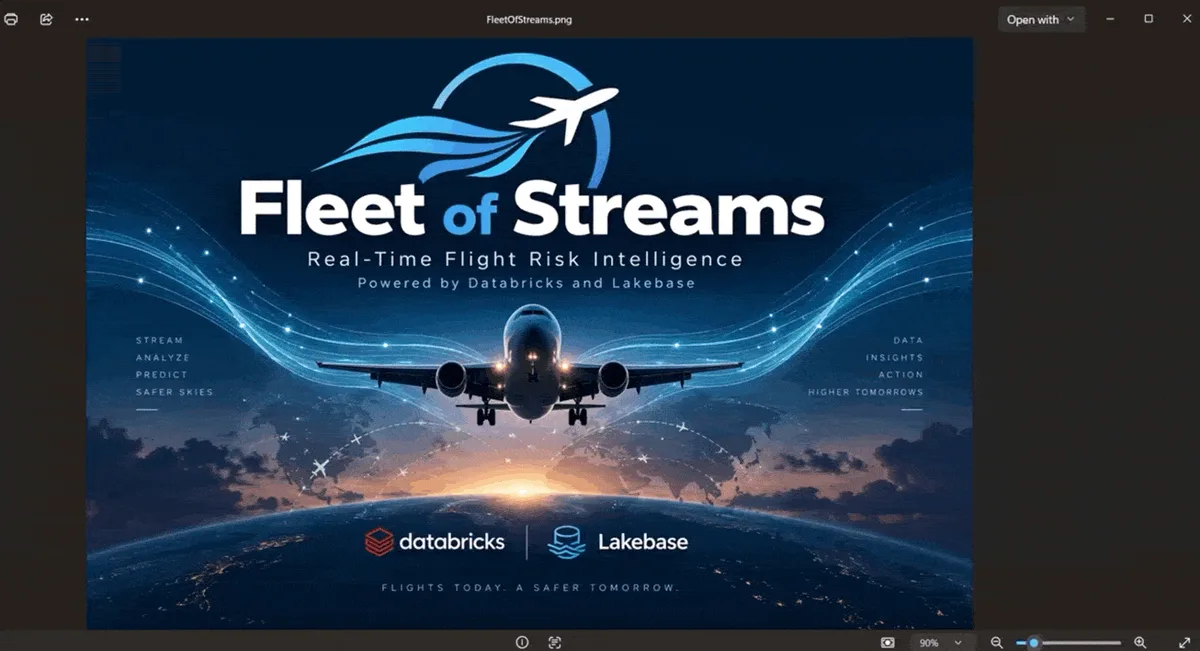
A team from a transportation company built a real-time flight risk app that turns streaming data into a live operational view. They synced flight, airport, and weather alert tables from Unity Catalog into Lakebase to power a live map in a Databricks App, showing how synced tables let the same pipelines that feed analytics feed an operational app.
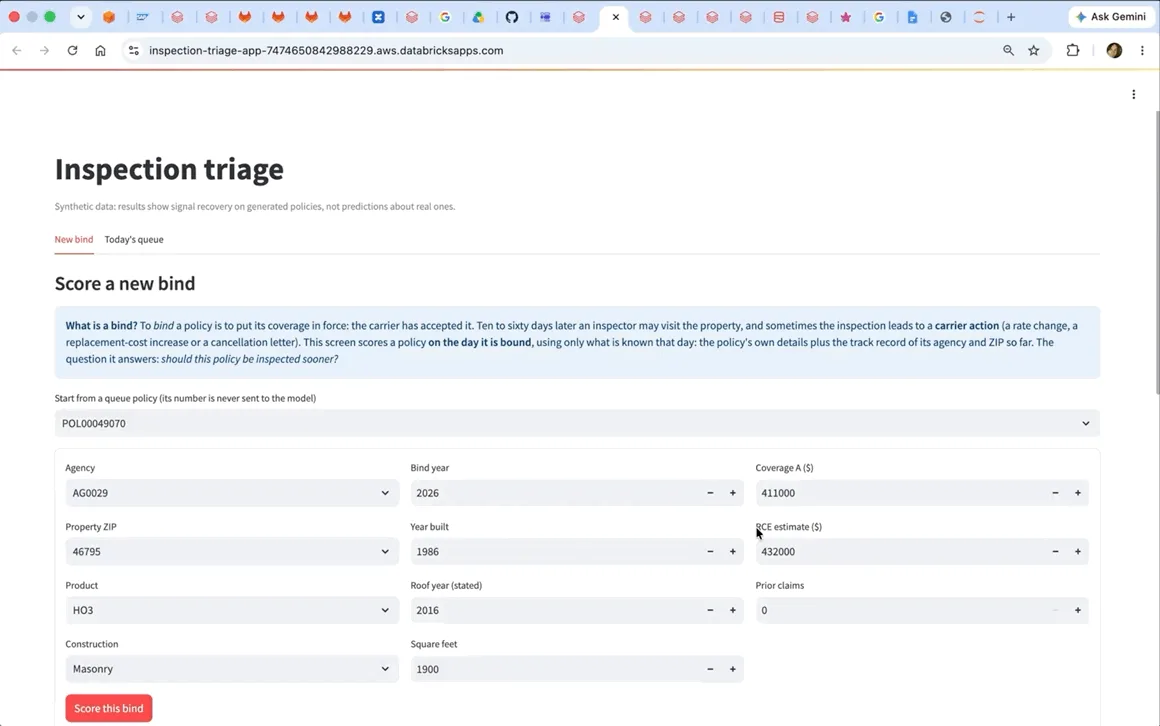
Another team from an insurance company focused on a gap that comes after a policy is issued. Risk scoring usually happens before a policy is bound, but no one predicts what the inspector will find afterward. Their app scores how likely each post-bind inspection is to lead to carrier action and ranks the inspection queue so the riskiest policies are seen first, with plain-language reasons. Features are defined once as Databricks Feature Views and served from a Lakebase online store, so the same definitions power training and real-time scoring.
Sobeys built a conversational shopping assistant with three agents. A recipe agent finds recipes with Vector Search, a product agent matches ingredients to store products using fuzzy Postgres trigram search, and a health agent checks every recipe against the family’s allergy profiles. Ask for Thai recipes that are safe for a peanut allergy, and the app goes from recipe to ingredients to cart in one conversation.
The bigger picture
Read the two tracks back to back and you get a working tour of Lakebase. A developer gives an AI agent a branch instead of production. A platform team gives every pull request its own database in seconds. A data engineer syncs curated tables into Postgres to power a live app. An ML engineer defines features once and serves them in real time.
What ties all of it together is that Lakebase doesn’t sit apart from the data platform. The same Unity Catalog governance applies to the lakehouse tables and the Postgres tables that serve them, and the same data that powers a dashboard can power an app, an agent, or a model. Several teams replaced a separate system, like a search index, a staging database, or a hand-built sync job, with something Lakebase handles directly.
Hats off to all eleven teams for building something real. A few resources to get started with Lakebase:
FAQ
What is Databricks Lakebase?
Lakebase is fully managed Postgres built for the lakehouse. Storage is separated from compute, and the database lives next to your lakehouse data under the same Unity Catalog governance, so any developer who has written a SQL query or used an ORM can start building right away.
How does database branching work in Lakebase?
Lakebase branches work like Git branches for your database. Every project starts with a production branch, and new child branches are created instantly using copy-on-write storage, so you only pay for the data that changes and creating a branch has no performance impact on production.
What are Lakebase synced tables?
Synced tables continuously copy Unity Catalog tables into Postgres as read-only tables, so applications can query lakehouse data with low latency. This is commonly called reverse ETL. In the other direction, Lakehouse Sync replicates Postgres tables back into Unity Catalog Delta tables using change data capture.
Can Lakebase power search and real-time ML?
Yes. Lakebase supports Postgres extensions like pgvector, PostGIS, and pg_trgm for search, and it acts as the online store behind Databricks Online Feature Stores, so features defined in the lakehouse can be served to models in real time.
How do Databricks customer hackathons work?
Each hackathon starts with an enablement session on the product and its roadmap. Teams then build together for about a week and submit a project, and the strongest solutions earn prizes. This Lakebase hackathon had two tracks and eleven customer projects.
- New to Lakebase? Start with the Lakebase product page and the docs on branches.
- Want to bring lakehouse data into your app? Read about synced tables and Lakehouse Sync.
- Building search or real-time ML? See the supported Postgres extensions and Lakebase-powered Online Feature Stores.
- Ready to try it? Start a free trial and create your first Lakebase project.
- Subscribe to our blog and get the latest posts delivered to your inbox.
Solutions, Events, Insights and Data Engineering
Get the latest posts in your inbox
Subscribe to our blog and get the latest posts delivered to your inbox.