NAll news

Friday74 items

  1. AWS Machine LearningFirst-partyProduct release
    AI score61

    AWS launches training sessions GA for SageMaker AI serverless model customization

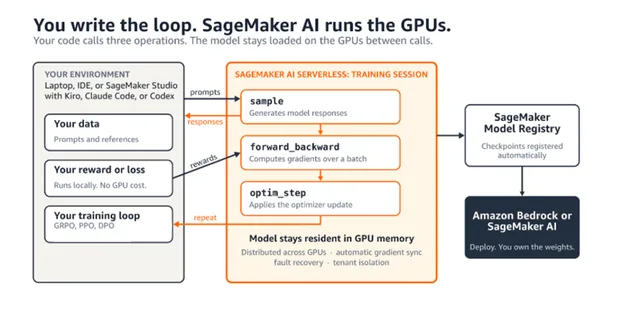
    AWS announced that training sessions for SageMaker AI serverless model customization are generally available; users can write and orchestrate their own training loops, including custom loss functions and reward signals, while SageMaker AI handles GPU allocation, distributed execution, fault recovery, and checkpoint storage. The feature supports SFT, DPO, RLVR, RLAIF, and multi-turn RL, with a choice of LoRA or full fine-tuning, and currently supports gpt-oss-20b, gemma-4-31B-it, Qwen3.6-27B, and Qwen3.8-27B. Billing is per token processed by SageMaker AI, billing stops when the reward function scores in the user's environment, and no reserved capacity is required.
    #Product updates#English text is being prepared.#English text is being prepared.

  2. The DecoderProduct release
    AI score69

    Google launches Agent Compute Engine, allocating a hardware-isolated microVM to each Gemini agent

    Google announced Agent Compute Engine, which provides each AI agent with an independently isolated virtual machine. The service already powers Gemini and will open in preview over the coming months. Each agent runs in a microVM protected by Google Titanium chips, automatically suspends when idle to free up machines, and shared memory between virtual machines lowers per-machine costs. Google says its open-source Kubernetes runtime Agent Substrate can host ten times as many agents on a single server, and in a test with 200,000 agents, suspend and resume took under 500 milliseconds. It also adds token tracking, model routing, and support for third-party identity providers such as Ping Identity and SailPoint; these controls will extend to Cloud Run, GKE, and managed endpoints.

    Same story · 6 reports

    #Product updates#Agents#English text is being prepared.

  3. David SingletonProduct release
    AI score59

    Muse integrates 1Password; agent logins require user approval each time

    Muse announced that it will integrate 1Password directly into its product; users must approve each login themselves, and passwords remain stored in their own vaults. The feature will roll out across all platforms over the coming days. 1Password released the 1Password for Agents platform the same day: when an agent encounters a login form, it requests credentials from the password vault, and after the user approves, 1Password autofills directly, so the agent cannot see or hold the credentials. The feature is free and optional for individual and family accounts; when the connector is not enabled, agents cannot access the password vault.

    Today we announce 1Password for Agents platform, building with companies @Muse, SpaceX Super Intelligence Grok @Bot, @AnthropicAI’s @Claudeai, @OpenAI, @TownAI, @Browserbase, @Browser_use, @heydana_ai, Instinct, @usekernel, @Perplexity_ai, @tryramp, @Tomo, and @wajo_ai, with more integrations on the way. 🎉 We've heard from so many of our customers who want to use these new personal AI agents to help them get more done, but want more control over what the agent can access with the same trust and ease of use they get when using 1Password directly. 1Password for Agents gives your agents access without giving up your passwords. When an agent reaches a sign-in form, it requests a credential from your vault. If you approve the request, 1Password directly auto-fills the credential in the destination site so the agent can’t see or take possession of the credentials. The agent gets the task done, but it doesn’t get your passwords.. You stay in control. 1Password for Agents free and optional for personal and family accounts. Unless you opt-in to an agent connector, agents cannot touch your vault. ➡️Learn more: https://t.co/KxDcCum2iE

    Same story · 13 reports

    #Product updates#Agents#English text is being prepared.

  4. Testing CatalogProduct release
    AI score62

    Google Cloud launches Agent Compute Engine, providing dedicated VMs for AI agents

    At AGNTCon + MCPCon, Google Cloud announced the launch of Agent Compute Engine (ACE), a VM type built specifically for AI agents and aimed at large-scale operation scenarios. The system comprises four components—Agent Gateway, Agent Registry, Agent Identity, and Agent Observability—and also expands Gemini's capabilities for enterprise agent governance.

    Announced at AGNTCon + MCPCon: the new Agent Compute Engine plus expanded Gemini for business agent governance deliver the control you need to run, govern, and scale your agents. Learn more about Agent Compute Engine and expanded agent governance → https://t.co/z1fW5Mxs0I https://t.co/TTUmhe98Yt

    Same story · 6 reports

    #Product updates#Agents#Google

  5. Data Center KnowledgeProduct release
    AI score55

    Nvidia unveils DSX POD modular data center solution at GTC Berlin

    Nvidia unveiled its prefabricated modular reference design DSX POD at GTC Berlin, aimed at partners including Dell, HPE, Schneider Electric and Vertiv, based on Vera Rubin infrastructure, and claims it can cut deployment time from about six months to as fast as 14 days. Jensen Huang said a gigawatt-scale data center costs $50 billion, and a three-month delay would mean losing $10 billion in revenue. Before the event, Greenpeace protesters interrupted the keynote, raising questions about data center environmental issues and reports of Nvidia technology appearing in Russian drones.

    Same story · 20 reports

    #Product updates#English text is being prepared.#English text is being prepared.

  6. Cohere Product and Research BlogFirst-partyProduct release
    AI score58

    Cohere Model Vault Launches Confidential Computing Public Beta

    Cohere announced that the confidential computing feature of Model Vault has entered public beta, providing hardware-level isolation for hosted model inference based on the NVIDIA H100 GPU confidential computing capability on Microsoft Azure. This feature extends the scope of encryption from data at rest and in transit to prompts, documents, responses, and model execution during inference; after end-to-end encryption on the application workload side, decryption can only occur in a confidential environment that has passed remote attestation. Customers can cryptographically verify the hardware, firmware, and software configuration before sending sensitive data; if it does not comply with the security policy, the client will refuse to send the request. The existing Model Vault API and request format remain unchanged.

    Rerank 5 logo

    #Product updates#English text is being prepared.#English text is being prepared.

  7. Cohere Product and Research BlogFirst-partyProduct release
    AI score58

    Cohere Model Vault Launches Verifiable Confidential AI Inference

    Cohere has launched confidential computing capabilities on Model Vault, currently in public beta, running on NVIDIA GPUs on Microsoft Azure. The feature combines confidential CPU and GPU execution, OHTTP end-to-end encryption of request content, and remote attestation, allowing customers to verify the target environment before releasing sensitive data. Cohere plans to open-source the confidential inference stack and advance support for NVIDIA Blackwell and B200 GPUs.

    Rerank 5 logo

    #Product updates#Safety / alignment#English text is being prepared.

  8. NVIDIA Developer · Generative AIFirst-partyProduct release
    AI score55

    NVIDIA DGX Spark supports eight-node clusters, unified memory expands to 1TB

    At GTC Berlin, NVIDIA announced that DGX Spark officially supports eight-node clusters, with unified memory expanding to 1TB, enabling local execution of frontier models such as Z.ai's full GLM 5.3 (753B). Official benchmarks show that Qwen3.8-27B (NVFP4) decoding throughput rises from about 12 tokens/s on a single node to 52 tokens/s on eight nodes, and with the Spark-optimized RoCEnante collective communication backend, achieves a 4.43x decoding speedup on eight nodes. From-scratch pretraining of the nanochat model on eight nodes achieved a 7.79x speedup and 97.4% scaling efficiency. NVIDIA Sync's eight-node cluster support will launch before the end of the year.

    Line chart showing decode speedup (vs. one Spark) as the number of Spark nodes increases from one to eight. Two lines are plotted: “with ROCEnante” and “without ROCEnante.” Both start at 1.00x at one Spark. At four Spark nodes, ROCEnante reaches 3.06x vs. 2.56x without. At eight Spark nodes, ROCEnante reaches 4.43x vs. 3.05x without. Configuration: switch topology, Qwen3.8-27B-NVFP4, speculative decoding disabled.

    Same story · 3 reports

    #Product updates#English text is being prepared.#Reasoning

  9. Microsoft ResearchFirst-partyProduct release
    AI score54

    Microsoft Research releases Flint-interactive, enabling agents to generate interactive data visualizations

    Microsoft Research has released Flint-interactive, an interactive data visualization language built on top of Flint that enables agents to generate charts supporting clicking, filtering, zooming, highlighting, and cross-chart linking. It uses the Flint compiler to parse raw triggers such as clicks and drags into semantic events, so users only need to describe update behaviors with high-level operators without writing low-level visualization code. The language is already usable in conversations through Flint-MCP and MCP Apps, and it also offers a programming API for developers to build dashboards and data stories.

    #Product updates#Agents#English text is being prepared.

  10. LMSYS BlogFirst-partyProduct release
    AI score52

    LMSYS Releases SGLang AWS Trainium Plugin Beta

    LMSYS, in collaboration with AWS, has released the SGLang Trainium plugin Beta, built on the newly released TorchNeuron, supporting LLM inference serving and RL rollout generation on Trainium2 and Trainium3. Initial coverage includes Qwen3 (dense), Qwen3-MoE-30B-A3B, DeepSeek-V2-Lite, GLM-4, and GLM-5.2/5.3, and supports data parallelism, tensor parallelism, expert parallelism, Radix Cache, BF16/FP8, and asynchronous scheduling. In the first end-to-end heterogeneous RL run, SGLang generated rollouts for Qwen3-MoE-30B-A3B on Trainium3, while Miles trained a GRPO policy with Megatron on a single H200 node. The Beta is currently limited to a small number of teams.

    #Product updates#English text is being prepared.#Open-source ecosystem

Thursday124 items

  1. Google Developers BlogFirst-partyProduct release
    AI score52

    Google API Gateway supports streaming and enters public preview

    Google announced that streaming support for API Gateway has entered public preview. SSE, chunked transfer, WebSocket, and gRPC streaming endpoints can share the same gateway and policies with existing APIs, with no changes required to API specifications. Streams can remain open for up to one hour; during the preview period, this must be enabled when creating a gateway, and existing gateways cannot be converted in place. Combined with model routing, clients can use a single OpenAI-compatible endpoint to route to Gemini, Claude, and OpenAI gpt-oss models based on the model field in the request and return streamed responses. The gateway's default domain name has changed to a fixed format composed of the gateway ID, project number, and region, which can be written into the configuration before creation.

    Streaming feature in  API Gateway _ Header

    #Product updates#English text is being prepared.#English text is being prepared.

  2. 36Kr · AIProduct release
    AI score72

    Anthropic Releases Research Preview of Personal AI Agent Claude Duet

    On October 21, Anthropic released the personal AI agent Claude Duet and launched a research preview, initially available to Claude Pro and Max individual subscribers in the United States. The product is based on the Opus 5.5 model and can connect to more than 6,000 tools and services through connectors and plugins in the Claude Marketplace. It also has a cloud-based virtual machine and browser environment, allowing users to continue executing tasks after they exit the app. Anthropic said that sensitive actions such as sending messages, making payments, signing contracts, or deleting data still require user confirmation, and that background work consumes the existing Claude subscription quota.

    Same story · 44 reports

    #Product updates#Agents#Anthropic

  3. ThurrottProduct release
    AI score60

    1Password Launches Credential Management Platform 1Password for Agents for AI Agents

    1Password has released 1Password for Agents, allowing supported AI agents to access credentials in a user's personal 1Password vault in order to complete tasks on their behalf. At launch, the platform supports agents such as Anthropic Claude Duet, Meta Muse, OpenAI ChatGPT, and Dots. The agents themselves cannot see the user's credentials; after the user approves the login, 1Password fills in the credentials directly without sending them to the agent. 1Password said that partners including Browserbase, Browser Use, Perplexity, and Ramp will also add support in succession.

    Same story · 13 reports

    #Product updates#Agents#English text is being prepared.

  4. 9to5GoogleProduct release
    AI score68

    1Password Launches 1Password for Agents, Letting AI Agents Complete Logins Without Seeing Passwords

    1Password has launched 1Password for Agents, connecting its password vault to AI agents: when an agent reaches a login form, it authenticates to 1Password using a digital key; after the user confirms which credentials are needed and what they are for, 1Password fills in the form directly—credentials are never handed to the agent and are removed once login succeeds, so the agent cannot read or reuse them. The integration currently supports only Meta's Muse and Grok Bot, with OpenAI Dots and Anthropic Claude Duet to follow.

    Same story · 13 reports

    #Product updates#Agents#English text is being prepared.

  5. SiliconANGLEProduct release
    AI score52

    Action State Launches Open Source Tool to Verify AI Agent Interaction Records

    Action State Group has released an open source toolset for enterprises to independently verify records of AI agent behavior, including EvidenceBook, which preserves tamper-proof records, Terms Packs, which evaluate agent behavior, and Countersign, an independent verification service. EvidenceBook is released under the Apache 2.0 license and uses a signed Agent Action Capsules format and cryptographic checkpoints; verification can be performed offline and is free. Founder Steven Mih said the tool can verify that reported events actually occurred, but cannot confirm whether agreements were fulfilled, and Countersign does not certify the authenticity of results or the integrity of evidence.

    #Product updates#Agents#Open-source ecosystem

  6. SiliconANGLEProduct release
    AI score61

    1Password launches 1Password for Agents, letting personal AI agents log in without touching passwords

    1Password has released 1Password for Agents, a login platform for personal AI agents, in which agents do not see passwords when logging in. In the flow, an agent identifies itself to 1Password via a unique digital key; after the user confirms on their own device which account is to be accessed and for what purpose, 1Password itself fills the password into the page. OpenAI has already integrated ChatGPT Work and the always-on Dots agent; Meta's Muse, SpaceXSI's Grok Bot and Town.com have also signed on, and Anthropic's Claude Duet will be integrated later; another 9 companies are developing integrations, including Perplexity and Browserbase.

    Same story · 13 reports

    #Product updates#Agents#English text is being prepared.

  7. SiliconANGLEProduct release
    AI score56

    Thomson Reuters adds AI agents to its tax and audit software CoCounsel

    Thomson Reuters has released a rebuilt version of the CoCounsel Tax, Audit & Accounting platform, expanding from answering questions to planning tasks, performing calculations, and generating documents for review, and it is now available to all U.S. customers. The platform uses Checkpoint's more than 12 million primary and analytical documents as its research library, supports multiple AI models, can break down complex requests and invoke tools, and provides citations, assumptions, and calculation steps for professionals to review. In a demonstration, the system used a commercial loan agreement and a spreadsheet template to generate an amortization schedule for a $5 million loan, and used a Python routine to recalculate the results as a check; the platform supports MCP and can connect to third-party AI tools such as Claude and Copilot.

    #Product updates#Agents#English text is being prepared.

  8. SiliconANGLEProduct release
    AI score72

    Anthropic launches proactive AI agent Claude Duet

    Anthropic has launched Claude Duet, a proactive AI agent for professionals and small business owners, currently in research preview. Every morning it pushes a briefing of important items from connected apps, checks messages only when attention is needed, and can schedule meetings, build dashboards, generate financial or sales forecasts, and prototype web apps. Duet is integrated into Claude and can directly call existing memory, skills, and apps without additional setup; Anthropic says it follows the trusted agent framework, with automatic classifiers that check for sensitive information leaks and confirm with users before important actions. This version may still misread conversation threads or misjudge urgency, and it cannot show its browser.

    Same story · 44 reports

    #Product updates#Agents#Anthropic

  9. The New StackProduct release
    AI score66

    Google opens the infrastructure behind Gemini agents as a cloud service, Agent Compute Engine

    Google announced that it will open a preview of Agent Compute Engine to Google Cloud users later this year, providing each AI agent with a hardware-isolated microVM that balances container startup speed with sandbox security. The service was originally internal infrastructure for Gemini, Antigravity, and Google's model training pipelines; when an agent is idle, it checkpoints the microVM to free up resources. Google is also offering an open-source runtime, Agent Substrate, which can run on any Kubernetes cluster; the company says that in a benchmark of 200,000 agents it achieved 500 activations per second, with suspend and resume taking under half a second.

    Same story · 6 reports

    #Product updates#Agents#English text is being prepared.

  10. The New StackProduct release
    AI score67

    Google open-sources TorchTPU, AWS launches TorchNeuron public beta

    At PyTorch Conference North America 2026, Google open-sourced TorchTPU, a native PyTorch stack for TPU, while AWS released the open-source backend TorchNeuron public beta for Trainium; both are already available on GitHub. TorchTPU was developed by Google in collaboration with Meta's PyTorch team, and its runtime no longer depends on JAX, so existing workloads can be migrated with only minor code changes; TorchNeuron supports Trainium2 and Trainium3 instances, and migration only requires switching to .to('neuron') for eager execution. The PyTorch side points out that TorchTPU's default Skinny Collectives scheme suffers roughly 30–40% end-to-end performance loss on distributed workloads compared with optimized schemes, and achieving peak performance still requires Pallas kernels and production-grade stacks such as vLLM-TorchTPU and SGLang-TorchTPU.

    Same story · 2 reports

    #Product updates#Open-source ecosystem#English text is being prepared.