English translation is being prepared.
Matched fieldsSummary
Matched fieldsSummary
Matched fieldsSummary
Matched fieldsSummary
Matched fieldsSummary
On August 14, 2026, Ant's ASystem team launched the AReno local large-model post-training toolkit. On the same day, Ant Ling released a practice article describing how AReno was used on DGX Spark to perform Agentic RL on Ling-3.0-tiny, using tic-tac-toe as the minimal validation task and completing a four-step closed loop of baseline evaluation, reward definition, post-training, and re-testing in the same environment. The experiment used GSPO to train for 400 steps; rollout/rewards_mean rose from about -0.5 to around 0.4, response_len dropped to about 850 tokens, and in the re-test, tool calls and move selection were more stable. Ling-3.0-tiny is a hybrid reasoning model with 7.9B total parameters and 1.3B activated parameters, and BF16, FP8, and INT4 versions have been open-sourced; AReno provides a Docker reproduction tutorial. The toolkit has now been made public together with the above practice.
System team launched the AReno local large-model post-training toolkit. On the same day, Ant Ling released a practice article describing how AReno was used on DGX Spark to perform Agentic RL on Ling-3.0-tiny, using tic-tac-toe as the minimal validation task and completing a four-step closed loop of baseline evaluation, reward definition, post-training, and re-testing in the same environment. The experiment used GSPO to train for 400 steps; rollout/rewards mean rose from about -0.5 to around 0.4,
Matched fieldsSummary
Browser Use published a guide introducing several ways to let coding agents work in a real, already-logged-in Chrome, including Claude in Chrome, Playwright MCP extension mode, Chrome DevTools MCP auto-connect mode, the Gemini CLI built-in browser agent, the ChatGPT desktop browser extension, and Browser Harness. The article gives configuration commands and limitations separately for agents such as Claude Code, Codex, Gemini CLI, and Cursor, and explains that starting with Chrome 136, --remote-debugging-port and --remote-debugging-pipe on the default data directory will be ignored, so the old practice of copying cookies to a new browser will fail in scenarios such as device-bound sessions.

Browser Use published a guide introducing several ways to let coding agents work in a real, already-logged-in Chrome, including Claude in Chrome, Playwright MCP extension mode, Chrome DevTools MCP auto-connect mode, the Gemini CLI built-in browser agent, the ChatGPT desktop browser extension, and Browser Harness. The article gives configuration commands and limitations separately for agents such as Claude Code, Codex, Gemini CLI, and Cursor, and explains that starting with Chrome 136, --remote-d
Matched fieldsBody
On October 23, OpenAI disclosed the training environment for its frontier models. When practicing searching, browsing, and operating web pages, the models use pre-saved and indexed web resources and do not directly access the real internet; all of its frontier models' reinforcement learning training uses this kind of offline interaction. The environment employs multiple layers of isolation, including restricted containers, lightweight virtual machines, hypervisors, firewalls and identity and permission management, and monitoring and suspension mechanisms, but OpenAI still retains some external connections for collecting metrics, logging, and managing authentication. In experiments specifically testing the effectiveness of the isolation, OpenAI had two AIs attempt to pass messages to each other through the CPU cache; in most tests, researchers had given hints about the communication direction or encoding rules; OpenAI said it has patched the issues found and added monitoring for these communication methods.
On October 23, OpenAI disclosed the training environment for its frontier models. When practicing searching, browsing, and operating web pages, the models use pre-saved and indexed web resources and do not directly access the real internet; all of its frontier models' reinforcement learning training uses this kind of offline interaction. The environment employs multiple layers of isolation, including restricted containers, lightweight virtual machines, hypervisors, firewalls and identity and per
Matched fieldsBody
Matched fieldsSummary
Matched fieldsSummary
The article uses DeepSeek-R1-Zero's pass@1 on AIME 2024 rising from 15.6% to 71.0% as an example to show that a rule-based judge gives only a single score for the entire response, whereas training needs to adjust the probability of each token. The author uses the sampling example "Is OpenAI open?" to explain in turn policy, state, action, reward, return, value, Q, advantage, baseline, TD error, GAE, clipping, and KL, and points out that PPO uses a critic to learn V, while GRPO uses the average score within a group to replace V.
The article uses DeepSeek-R1-Zero's pass@1 on AIME 2024 rising from 15.6% to 71.0% as an example to show that a rule-based judge gives only a single score for the entire response, whereas training needs to adjust the probability of each token. The author uses the sampling example "Is OpenAI open?" to explain in turn policy, state, action, reward, return, value, Q, advantage, baseline, TD error, GAE, clipping, and KL, and points out that PPO uses a critic to learn V, while GRPO uses the average s
Matched fieldsBody
Michael Pfaffenberger of Pydantic used 5 small Pydantic AI applications and 8 models to conduct 5,276 scored runs, comparing code mode with direct tool calling. On long tasks, code mode reduced average cost by 58%, latency by 51%, and increased success rate by 16 percentage points; however, for short tasks with 5 items, 3 out of 5 tasks were instead 21% to 38% more expensive. The author argues that models are better at writing loops than at acting as the loop, and the gap widens as tasks get longer.

Michael Pfaffenberger of Pydantic used 5 small Pydantic AI applications and 8 models to conduct 5,276 scored runs, comparing code mode with direct tool calling. On long tasks, code mode reduced average cost by 58%, latency by 51%, and increased success rate by 16 percentage points; however, for short tasks with 5 items, 3 out of 5 tasks were instead 21% to 38% more expensive. The author argues that models are better at writing loops than at acting as the loop, and the gap widens as tasks get lon
Matched fieldsBody
On October 27, 2026, Perplexity published an LLM gateway best practices guide explaining how this middleware layer routes, authenticates, caches, and logs model calls, and distinguishing four categories: API gateways, LLM gateways, MCP gateways, and AI gateways. The guide breaks down the mechanism through a six-step request lifecycle, while warning that the gateway centralizes credentials from various providers, and cites the LiteLLM gateway breach disclosed by Microsoft and two high-severity vulnerabilities, CVE-2026-35029 and CVE-2026-59823, reported by Check Point (already fixed in LiteLLM 1.83.9). The article also lists postmortems of Cloudflare AI Gateway and OpenRouter outages, four deployment paths, and paid plans starting at about $50 per month.
On October 27, 2026, Perplexity published an LLM gateway best practices guide explaining how this middleware layer routes, authenticates, caches, and logs model calls, and distinguishing four categories: API gateways, LLM gateways, MCP gateways, and AI gateways. The guide breaks down the mechanism through a six-step request lifecycle, while warning that the gateway centralizes credentials from various providers, and cites the LiteLLM gateway breach disclosed by Microsoft and two high-severity vu
Matched fieldsBody
The author used Cursor together with Claude Opus 5.5 to build a zero-dependency local web tool called "EQ plugin," which rewrites emotionally charged drafts according to the four elements of Nonviolent Communication, and includes seven types of communication targets and three tone levels: gentle, firm, and direct. The tool runs on the local machine at 127.0.0.1:8787, and the UUMit client generates a fixed HTTPS link to distribute to colleagues, with no need to buy a server or file for registration, and permissions can be granted and revoked per person. The article also provides an 800-character limit per input, default rate limits of 10 times per minute and 200 times per day, as well as the source code and System Prompt for two GitHub repositories.
The author used Cursor together with Claude Opus 5.5 to build a zero-dependency local web tool called "EQ plugin," which rewrites emotionally charged drafts according to the four elements of Nonviolent Communication, and includes seven types of communication targets and three tone levels: gentle, firm, and direct. The tool runs on the local machine at 127.0.0.1:8787, and the UUMit client generates a fixed HTTPS link to distribute to colleagues, with no need to buy a server or file for registrati
Matched fieldsBody
The Google A2UI team and CopilotKit CEO Atai Barkai explain how to build generative UI applications using the A2UI open standard and CopilotKit. A2UI describes interfaces with declarative JSON, and the client only renders components from a trusted component catalog; the same response can be rendered to React, Angular, SwiftUI, Jetpack Compose, and Flutter. The article provides a code example for integrating CopilotKit with Google ADK, and explains the bidirectional flow, implemented via the AG-UI protocol, in which user actions are sent back and the agent regenerates the interface.
pplications using the A2UI open standard and CopilotKit. A2UI describes interfaces with declarative JSON, and the client only renders components from a trusted component catalog; the same response can be rendered to React, Angular, SwiftUI, Jetpack Compose, and Flutter. The article provides a code example for integrating CopilotKit with Google ADK, and explains the bidirectional flow, implemented via the AG-UI protocol, in which user actions are sent back and the agent regenerates the interface.
Matched fieldsBody
Beijing News Shell Finance reporters tested Alibaba's Qwen Go! and Ant's Lingguang 2.0. The former set up a daily 8 a.m. medication reminder with a single sentence and checked it item by item, while the latter, after authorization on Alipay, sorted out the past six months of bills. The article also reviews the layouts of Meta Muse, OpenAI dots, as well as ByteDance and Tencent, and points out that cross-ecosystem permissions are currently the hardest wall to break down, with ByteDance's SAEP published rejection list reaching 155 apps.
Beijing News Shell Finance reporters tested Alibaba's Qwen Go! and Ant's Lingguang 2.0. The former set up a daily 8 a.m. medication reminder with a single sentence and checked it item by item, while the latter, after authorization on Alipay, sorted out the past six months of bills. The article also reviews the layouts of Meta Muse, OpenAI dots, as well as ByteDance and Tencent, and points out that cross-ecosystem permissions are currently the hardest wall to break down, with ByteDance's SAEP pub
Matched fieldsBody
Browser Use has published a tutorial introducing three approaches for automatically logging in and downloading invoices daily on supplier portals that lack an API: Playwright scripts, RPA tools such as UiPath or Power Automate, and browser agents with saved configurations. The article provides complete code for Playwright and Browser Use Cloud, covering reusing login sessions, filling in TOTP verification codes with 1Password, scheduling runs via GitHub Actions, and handling failure scenarios such as session expiration, 2FA blocks, page redesigns, and empty downloads. The author recommends first asking suppliers for exports, APIs, or emailed invoices, and reminds readers to first confirm whether the portal's terms permit automated access.

aches for automatically logging in and downloading invoices daily on supplier portals that lack an API: Playwright scripts, RPA tools such as UiPath or Power Automate, and browser agents with saved configurations. The article provides complete code for Playwright and Browser Use Cloud, covering reusing login sessions, filling in TOTP verification codes with 1Password, scheduling runs via GitHub Actions, and handling failure scenarios such as session expiration, 2FA blocks, page redesigns, and em
Matched fieldsBody
Browser Use published a tutorial introducing a workflow for extracting structured data across multiple websites using a single JSON Schema: static pages are scraped to Markdown and then filled in by an LLM, while pages requiring login or clicks are handed off to a browser agent. The article provides a reliability checklist, including enabling structured output, validating with Pydantic or Zod, returning null for missing fields, preserving source_url and original-text citations, deduplicating by stable keys, respecting robots.txt, and spot-checking samples. It also compares Firecrawl, Crawl4AI, Browser Use, Stagehand, and a self-built Fetch+Markdown+LLM setup in terms of login and JS workflows, Schema support, open-source status, and billing.
multiple websites using a single JSON Schema: static pages are scraped to Markdown and then filled in by an LLM, while pages requiring login or clicks are handed off to a browser agent. The article provides a reliability checklist, including enabling structured output, validating with Pydantic or Zod, returning null for missing fields, preserving source url and original-text citations, deduplicating by stable keys, respecting robots.txt, and spot-checking samples. It also compares Firecrawl, Cr
Matched fieldsBody
AWS has published a tutorial explaining how to use prompt caching to reduce the cost of agents repeatedly reading context when calling OpenAI models on Amazon Bedrock, distinguishing between two approaches—implicit caching and explicit prompt_cache_breakpoint—and recommending their combined use. The article provides code examples for tool and instruction caching, rolling breakpoints across multi-turn history, adding tools mid-session, and shared prefixes across sub-agents, and states that in a six-turn workload on GPT-6 Astra, implicit caching reduces input costs by about 62%, while explicit rolling breakpoints reduce them by about 61%. Cacheable prefixes must be at least 1024 tokens, and cache writes are billed at 1.25 times the normal input price.
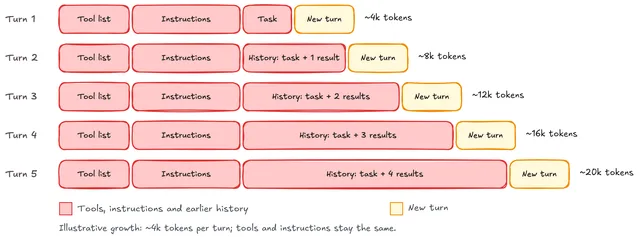
AWS has published a tutorial explaining how to use prompt caching to reduce the cost of agents repeatedly reading context when calling OpenAI models on Amazon Bedrock, distinguishing between two approaches—implicit caching and explicit prompt cache breakpoint—and recommending their combined use. The article provides code examples for tool and instruction caching, rolling breakpoints across multi-turn history, adding tools mid-session, and shared prefixes across sub-agents, and states that in a s
Matched fieldsBody
Netflix built the Observability Ontology and the RDF knowledge graph QuipuDB, using type constraints to turn non-deterministic outputs from LLMs, fuzzy matching, and the like into deterministic triples that can be queried with SPARQL, which are then fed to AutoRCA. The graph covers about 12 namespaces, and Application is validated against a software catalog of about 49,000 entries; the Correlation Engine reads 13 types of signals and, within a window of about 10 minutes, finds paths by temporal proximity and severity, discarding correlation chains with confidence below 0.6. The author also summarizes eight principles for building your own, and mentions plans to next integrate with Upper, the domain modeling language of Netflix UDA.
Netflix built the Observability Ontology and the RDF knowledge graph QuipuDB, using type constraints to turn non-deterministic outputs from LLMs, fuzzy matching, and the like into deterministic triples that can be queried with SPARQL, which are then fed to AutoRCA. The graph covers about 12 namespaces, and Application is validated against a software catalog of about 49,000 entries; the Correlation Engine reads 13 types of signals and, within a window of about 10 minutes, finds paths by temporal
Matched fieldsBody
The SemiAnalysis engineering team benchmarked the native PyTorch training stack TorchNeuron and TorchTitan on Trainium3, training Qwen3-32B on 16 Trainium2 chips; eager mode reached 11,099 tokens/s and 23.89% MFU, while compiled mode reached 14,156 tokens/s and 30.47% MFU. The author considers the Neuron Explorer profiler superior to Nvidia's and AMD's solutions, but first-time compilation takes too long: the first-step compilation for the gpt-oss training recipe took 27 minutes 17 seconds. FlexAttention tests passed 89 of 96 cases, with all 7 failures due to compilation timeouts rather than numerical errors.
The SemiAnalysis engineering team benchmarked the native PyTorch training stack TorchNeuron and TorchTitan on Trainium3, training Qwen3-32B on 16 Trainium2 chips; eager mode reached 11,099 tokens/s and 23.89% MFU, while compiled mode reached 14,156 tokens/s and 30.47% MFU. The author considers the Neuron Explorer profiler superior to Nvidia's and AMD's solutions, but first-time compilation takes too long: the first-step compilation for the gpt-oss training recipe took 27 minutes 17 seconds. Flex
Matched fieldsBody