English translation is being prepared.
Matched fieldsSummary
Matched fieldsSummary
Worldwide Express built a multi-agent AI solution based on Amazon Bedrock and integrated it into its transportation management system SpeedShip. Six months after launch, active exceptions dropped by 75%, the collection cycle was shortened by 4 weeks, annual savings reached $1 million, and $10 million in free cash flow was released at once. The system dispatches invoice exceptions to three specialized agents—invoice matching, price discrepancy, and surcharge validation. Each agent first retrieves the corresponding carrier's billing rules and dispute procedures before making recommendations, and the same set of agents can be used universally without carrier-specific code.
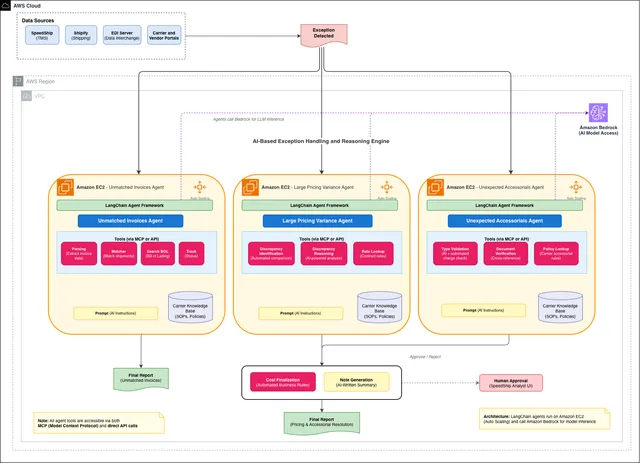
Worldwide Express built a multi-agent AI solution based on Amazon Bedrock and integrated it into its transportation management system SpeedShip. Six months after launch, active exceptions dropped by 75%, the collection cycle was shortened by 4 weeks, annual savings reached $1 million, and $10 million in free cash flow was released at once. The system dispatches invoice exceptions to three specialized agents—invoice matching, price discrepancy, and surcharge validation. Each agent first retrieves
Matched fieldsBody
Cohere has announced progress on its investment plan in Canada, expecting to invest more than CAD 4 billion in R&D and AI infrastructure by 2031 and create more than 1,500 jobs, of which about 1,000 will be technical roles in AI research, engineering, and product development. The plan began in 2024 and will also provide more than 250 paid student positions by 2029, along with research partnerships with the University of Toronto, the University of Waterloo, and others. Cohere has reached a CAD 309 million GPU cloud partnership with Bell AI Fabric to run its models on Canadian sovereign infrastructure.

Cohere has announced progress on its investment plan in Canada, expecting to invest more than CAD 4 billion in R&D and AI infrastructure by 2031 and create more than 1,500 jobs, of which about 1,000 will be technical roles in AI research, engineering, and product development. The plan began in 2024 and will also provide more than 250 paid student positions by 2029, along with research partnerships with the University of Toronto, the University of Waterloo, and others. Cohere has reached a CAD 30
Matched fieldsBody
At GitHub Universe 2026, held October 28–29, 2026, GitHub announced that Copilot Fusion, which integrates automatic model selection with multi-model collaboration, is now generally available. It can be used in VS Code, the GitHub Copilot app, the CLI, and JetBrains IDEs, and it automatically determines which model to use and which of three execution modes—Single, Cascade, or Critique—to apply, based on three processing tiers: Standard, High, and Max. The desktop GitHub Copilot app is also beginning a public beta of Projects, which centralizes materials, repositories, sessions, and artifacts in one place for management. GitHub says Fusion Max scores 60 on the Artificial Analysis Coding Agent Index, within 2 points of Claude Code using Opus 5.5 Max, while its average API cost per task is about half and its time is about 40% less.
At GitHub Universe 2026, held October 28–29, 2026, GitHub announced that Copilot Fusion, which integrates automatic model selection with multi-model collaboration, is now generally available. It can be used in VS Code, the GitHub Copilot app, the CLI, and JetBrains IDEs, and it automatically determines which model to use and which of three execution modes—Single, Cascade, or Critique—to apply, based on three processing tiers: Standard, High, and Max. The desktop GitHub Copilot app is also beginn
Matched fieldsBody
On October 30, Cognizant announced the establishment of the OpenAI Frontier Capability Group, bringing together more than 25,000 professionals dedicated to delivering OpenAI products such as Codex and ChatGPT to clients. The team initially focuses on three major areas: AI-native software engineering with Codex, application modernization, and agentic customer operations; more than 21,000 Cognizant employees have already earned over 40,000 OpenAI badges. An OpenAI enterprise assistant co-built for a global biopharmaceutical client has handled more than 5 million conversations, cutting content creation time by 60%.
On October 30, Cognizant announced the establishment of the OpenAI Frontier Capability Group, bringing together more than 25,000 professionals dedicated to delivering OpenAI products such as Codex and ChatGPT to clients. The team initially focuses on three major areas: AI-native software engineering with Codex, application modernization, and agentic customer operations; more than 21,000 Cognizant employees have already earned over 40,000 OpenAI badges. An OpenAI enterprise assistant co-built for
Matched fieldsBody
Latent Space host swyx introduces the curation approach for the annual flagship conference AIE CODE, which is single-track, invitation-only, and aimed at about 1,000 agent engineers. This year's three themes are Scaling without Slop, System One models, and Increasing Ambition, among which Jarred Sumner will share Bun's rewrite in Rust and a Bun AOT preview. The article also rounds up that day's AI news, including Mistral's open-weight release and OpenAI's frontier model monitoring.
Matched fieldsBody
Combining the latest financial reports from giants such as Amazon, Google, and Meta with surveys from multiple institutions, the article sorts out how the AI dividend is distributed among leading model companies, upstream chip and cloud vendors, enterprises adopting AI, and ordinary workers. Anthropic's prospectus shows revenue of $16.286 billion in the first half of 2026, up 1,300% year over year, but compute and infrastructure costs reached $8.945 billion, accounting for 55% of revenue. In a McKinsey survey, 80% of respondents said AI improved efficiency, while only 37% believed AI made a positive contribution to their company's EBIT.
Combining the latest financial reports from giants such as Amazon, Google, and Meta with surveys from multiple institutions, the article sorts out how the AI dividend is distributed among leading model companies, upstream chip and cloud vendors, enterprises adopting AI, and ordinary workers. Anthropic's prospectus shows revenue of $16.286 billion in the first half of 2026, up 1,300% year over year, but compute and infrastructure costs reached $8.945 billion, accounting for 55% of revenue. In a M
Matched fieldsBody
Amazon has released a guidance document for software engineers that explicitly opposes using metrics such as Token consumption and AI tool adoption rates as performance goals, arguing that this would drive up costs and increase system complexity. The document was disclosed by Vice President Terk Terkowitz and introduces the concept of the "Renaissance developer," requiring technical leaders to personally use AI in production work and explain the scenarios in which it is effective and ineffective. Previously, Microsoft Executive Vice President Jay Parikh also asked his team in August to use AI rationally and set the lower-cost GPT-5.6 as the internal default model.
Amazon has released a guidance document for software engineers that explicitly opposes using metrics such as Token consumption and AI tool adoption rates as performance goals, arguing that this would drive up costs and increase system complexity. The document was disclosed by Vice President Terk Terkowitz and introduces the concept of the "Renaissance developer," requiring technical leaders to personally use AI in production work and explain the scenarios in which it is effective and ineffective
Matched fieldsBody
Anthropic submitted a prospectus to the SEC: revenue in the first half of 2026 was $16.286 billion, up about 1,300% year over year, with a net loss of $80.748 billion, of which $72.388 billion came from fair value changes in convertible notes, derivative liabilities, and SAFE instruments. The article points out that its locked-in compute infrastructure commitments have exceeded $600 billion, with many agreements marked as payable regardless of actual usage, and terms extending to 2033 to 2034. The article also compares SpaceX, which achieved a net profit of $4.404 billion in the third quarter through its Starlink communications business, and argues that AI competition is shifting to whether unit economics can be made to work first.
Anthropic submitted a prospectus to the SEC: revenue in the first half of 2026 was $16.286 billion, up about 1,300% year over year, with a net loss of $80.748 billion, of which $72.388 billion came from fair value changes in convertible notes, derivative liabilities, and SAFE instruments. The article points out that its locked-in compute infrastructure commitments have exceeded $600 billion, with many agreements marked as payable regardless of actual usage, and terms extending to 2033 to 2034. T
Matched fieldsBody
Google DeepMind released the cybersecurity frontier model Gemini 4 Carbon on October 28, topping the Artificial Analysis Intelligence Index v5.0 with a composite score of 59, priced at $2 per million input tokens and $10 per million output tokens. Anthropic filed its S-1 prospectus with the SEC on October 26, planning to list on Nasdaq under the ticker ANT, with a target valuation of $1.5 trillion to $2 trillion and fundraising of up to $100 billion. In the same period, Microsoft disclosed for the first time that Azure quarterly revenue reached $33.2 billion, up 48% year-over-year.
Google DeepMind released the cybersecurity frontier model Gemini 4 Carbon on October 28, topping the Artificial Analysis Intelligence Index v5.0 with a composite score of 59, priced at $2 per million input tokens and $10 per million output tokens. Anthropic filed its S-1 prospectus with the SEC on October 26, planning to list on Nasdaq under the ticker ANT, with a target valuation of $1.5 trillion to $2 trillion and fundraising of up to $100 billion. In the same period, Microsoft disclosed for t
Matched fieldsBody
Intel reported third-quarter 2026 revenue of $16.5 billion and earnings per share of 52 cents, beating expectations, but its fourth-quarter revenue guidance of $15 billion to $16 billion fell short of the market's expectation of about $17.1 billion, and its gross margin guidance dropped from 43% to 38%; its stock price plunged about 21% in after-hours trading on October 29. Anthropic filed for a Nasdaq IPO on October 26 (ticker ANT), with revenue of $16.286 billion in the first half of 2026, up about 1,300% year over year, and second-quarter operating profit of $974 million. The U.S. Department of Justice has opened inquiries into whether Nvidia's acquisition of Hugging Face for about $12.93 billion affects AI competition.
Intel reported third-quarter 2026 revenue of $16.5 billion and earnings per share of 52 cents, beating expectations, but its fourth-quarter revenue guidance of $15 billion to $16 billion fell short of the market's expectation of about $17.1 billion, and its gross margin guidance dropped from 43% to 38%; its stock price plunged about 21% in after-hours trading on October 29. Anthropic filed for a Nasdaq IPO on October 26 (ticker ANT), with revenue of $16.286 billion in the first half of 2026, up
Matched fieldsBody
AMD's Jeremy Girven said at EVOLVE26 that enterprises deploying AI should rationally configure infrastructure according to business needs: if end users can accept a 30-second response, cheaper hardware can be chosen; if instant response is required, more cutting-edge hardware is needed. AMD's collaboration with Cloudera includes continuously validating the compatibility of AMD products in Cloudera deployments, and current AI solutions remain highly customized. Girven also reminded enterprises to continuously monitor utilization and adjust capacity after deployment, while watching out for hidden costs such as network egress fees.
AMD's Jeremy Girven said at EVOLVE26 that enterprises deploying AI should rationally configure infrastructure according to business needs: if end users can accept a 30-second response, cheaper hardware can be chosen; if instant response is required, more cutting-edge hardware is needed. AMD's collaboration with Cloudera includes continuously validating the compatibility of AMD products in Cloudera deployments, and current AI solutions remain highly customized. Girven also reminded enterprises to
Matched fieldsBody
Amazon Science and Booking.com combined knowledge distillation with Medusa to compress a 70B-parameter Llama-3.1 teacher model into a 1.1B TinyLlama student model, increasing inference speed by 10 to 20 times and reducing cost to less than one-third while maintaining the teacher model's quality. The approach has been used in three features—AI Trip Planner, Smart Filters, and accommodation description generation—and won the Best Paper Award in the Industry Track at ACL.
Matched fieldsBody
Anthropic filed its S-1 on October 26, planning to list on Nasdaq under the ticker ANT with a valuation of $1.5 trillion to $2 trillion; if completed, it would surpass SpaceX to become the largest IPO in history. The prospectus shows revenue of $16.286 billion in the first half of 2026, up nearly 13-fold year on year, with about 80% of revenue coming from enterprise APIs and nearly 12,000 customers each spending more than $100,000 annually. The company has signed long-term compute contracts worth more than $650 billion, about 80% of which are non-cancelable; Q3 revenue was about $16.9 billion, and the quarter-on-quarter growth rate fell from 144% to about 47%, with some investors discussing cutting the valuation to about $1.5 trillion.
Anthropic filed its S-1 on October 26, planning to list on Nasdaq under the ticker ANT with a valuation of $1.5 trillion to $2 trillion; if completed, it would surpass SpaceX to become the largest IPO in history. The prospectus shows revenue of $16.286 billion in the first half of 2026, up nearly 13-fold year on year, with about 80% of revenue coming from enterprise APIs and nearly 12,000 customers each spending more than $100,000 annually. The company has signed long-term compute contracts wort
Matched fieldsBody
The Verge's Decoder podcast invited SemiAnalysis analyst Joey Brookhart to break down the S-1 filed by Anthropic, discussing its potential Nasdaq listing at a valuation of $1.5 trillion to $2 trillion. Brookhart said Anthropic has achieved over $70 billion in ARR, with inference gross margins turning from negative 94% two years ago to positive 85%, and revenue per megawatt of inference at about $65 million, but revenue is highly concentrated in coding scenarios, and about 70% of compute is used for training and research. He also mentioned that Anthropic has $500 billion to $600 billion in compute commitments over the next 7 to 10 years, and compared OpenAI's more consumer-oriented business structure.
The Verge's Decoder podcast invited SemiAnalysis analyst Joey Brookhart to break down the S-1 filed by Anthropic, discussing its potential Nasdaq listing at a valuation of $1.5 trillion to $2 trillion. Brookhart said Anthropic has achieved over $70 billion in ARR, with inference gross margins turning from negative 94% two years ago to positive 85%, and revenue per megawatt of inference at about $65 million, but revenue is highly concentrated in coding scenarios, and about 70% of compute is used
Matched fieldsBody
The Google A2UI team and CopilotKit CEO Atai Barkai explain how to build generative UI applications using the A2UI open standard and CopilotKit. A2UI describes interfaces with declarative JSON, and the client only renders components from a trusted component catalog; the same response can be rendered to React, Angular, SwiftUI, Jetpack Compose, and Flutter. The article provides a code example for integrating CopilotKit with Google ADK, and explains the bidirectional flow, implemented via the AG-UI protocol, in which user actions are sent back and the agent regenerates the interface.
The Google A2UI team and CopilotKit CEO Atai Barkai explain how to build generative UI applications using the A2UI open standard and CopilotKit. A2UI describes interfaces with declarative JSON, and the client only renders components from a trusted component catalog; the same response can be rendered to React, Angular, SwiftUI, Jetpack Compose, and Flutter. The article provides a code example for integrating CopilotKit with Google ADK, and explains the bidirectional flow, implemented via the AG-U
Matched fieldsBody
The SemiAnalysis podcast analyzes Anthropic's S-1, pointing out its 90% incremental gross margin, 40% incremental EBIT, 85% inference gross margin, and 41% compute gross margin, and that it has been profitable for two consecutive quarters on a non-GAAP basis. On customer net revenue retention, customers who spent $1 last year now spend $9, with the Q1 figure at 500%; in addition, 250 customers pay over $10 million annually and 1,900 pay over $1 million. The episode also breaks down the $500 billion to $600 billion compute commitment, which at $100 billion per gigawatt translates to only about 5 gigawatts, and discusses the discrepancy in reporting that the top five customers account for 25% of revenue and that 48% goes through cloud vendor marketplaces.
The SemiAnalysis podcast analyzes Anthropic's S-1, pointing out its 90% incremental gross margin, 40% incremental EBIT, 85% inference gross margin, and 41% compute gross margin, and that it has been profitable for two consecutive quarters on a non-GAAP basis. On customer net revenue retention, customers who spent $1 last year now spend $9, with the Q1 figure at 500%; in addition, 250 customers pay over $10 million annually and 1,900 pay over $1 million. The episode also breaks down the $500 bill
Matched fieldsBody
The New Stack published an article discussing how to safely take over work after an AI agent crashes: before dispatching a refund, the application first writes the amount, authorization, idempotency key, and status to transactional storage, and the replacement agent inherits the original operation rather than re-reasoning. The article points out that durable execution frameworks such as LangGraph and Temporal can restore progress, but cannot determine whether the payer has already submitted the request; therefore, persistent records must be validated at the tool boundary, and the MCP services of Langfuse and ClickStack should be used to read-only investigate calls with unclear results.
The New Stack published an article discussing how to safely take over work after an AI agent crashes: before dispatching a refund, the application first writes the amount, authorization, idempotency key, and status to transactional storage, and the replacement agent inherits the original operation rather than re-reasoning. The article points out that durable execution frameworks such as LangGraph and Temporal can restore progress, but cannot determine whether the payer has already submitted the
Matched fieldsBody
At Oracle AI World 2026, Oracle released Oracle App Composer. After employees describe their requirements in a chat interface, OpenAI's Codex generates business application code, which is then deployed to Oracle Cloud after security checks and shared internally via URL. The information department can centrally manage these applications, assign owners, and take offline applications that have long been unused. The product is planned for launch in spring 2027.
Matched fieldsBody
Oracle announced that it will deploy Google TPU on OCI, along with inference chips from OpenAI, Cerebras, SambaNova, and Positron AI, giving customers more computing options beyond Nvidia GPUs. Oracle says it will become the first hyperscale cloud provider other than Google Cloud to offer TPU; TPU and the Cerebras wafer-scale engine are planned to launch in 2027, and Positron Atlas is already available. At the same time, Oracle is expanding its partnership with Nvidia, with the Vera Rubin NVL72 system and Vera CPU now generally available on OCI.
Oracle announced that it will deploy Google TPU on OCI, along with inference chips from OpenAI, Cerebras, SambaNova, and Positron AI, giving customers more computing options beyond Nvidia GPUs. Oracle says it will become the first hyperscale cloud provider other than Google Cloud to offer TPU; TPU and the Cerebras wafer-scale engine are planned to launch in 2027, and Positron Atlas is already available. At the same time, Oracle is expanding its partnership with Nvidia, with the Vera Rubin NVL72
Matched fieldsBody