←Search results

By relevance · Total 3162 results Clear search

Friday

  1. Alibaba Cloud Developer Community AI

    Development technologies for AI education and training agents: a five-layer architecture breakdown

    AI education and training agents are typically built in five layers: the perception access layer, the brain reasoning layer, the teaching action execution layer, the knowledge and storage support layer, and the security and operations assurance layer. The brain layer uses a central scheduling control unit for intent recognition and routing distribution, and schedules multiple agents such as the master control, grammar correction, and question generation and assessment agents to collaborate. The knowledge layer uses a vector database for retrieval-augmented generation, and maintains long-term memory profiles such as student error notebooks and pronunciation weak points.

    AI education and training agents are typically built in five layers: the perception access layer, the brain reasoning layer, the teaching action execution layer, the knowledge and storage support layer, and the security and operations assurance layer. The brain layer uses a central scheduling control unit for intent recognition and routing distribution, and schedules multiple agents such as the master control, grammar correction, and question generation and assessment agents to collaborate. The

    Matched fieldsSummary

  2. Ma Dongxi NLP

    The blogger claims that building Agents has become formulaic, and young people should move closer to the model layer

    The author believes that in "Agent +" scenarios, the ability to build Agents is the least important, while familiarity with specific business scenarios is instead more critical; and claims that in the current context, AI engineer has little to do with AI and is not valuable, suggesting that young people in the AI field shift toward training, quantization, inference, or AI infrastructure construction.

    Matched fieldsSummary

  3. Rohan PaulSelected

    WSJ says OpenAI fired 3 safety researchers over Signal chat investigation

    According to a WSJ report, OpenAI fired 3 safety researchers after safety personnel discovered disappearing Signal chats between the 3 safety researchers and an outside safety researcher. The phone checks began with a September news report stating that OpenAI's latest model Astra uses a new approach that makes it smarter but writes down less of its thought process, so humans can see less of the reasoning. OpenAI treated the report as a leak of its secret model design and began tracing the source of the information; investigators listed Ryan Greenblatt, who had helped METR analyze logs from the July Hugging Face hack, as a suspected leaker, and he denies it.

    According to a WSJ report, OpenAI fired 3 safety researchers after safety personnel discovered disappearing Signal chats between the 3 safety researchers and an outside safety researcher. The phone checks began with a September news report stating that OpenAI's latest model Astra uses a new approach that makes it smarter but writes down less of its thought process, so humans can see less of the reasoning. OpenAI treated the report as a leak of its secret model design and began tracing the source

    Matched fieldsSummary

  4. 36Kr · AI

    Liang Wenfeng needs his own Tibo: DeepSeek product department integration and the Agent path

    DeepSeek has integrated the Harness with the web, App, and open platform teams into a product department, led by Cui Tianyi, and the official website has posted recruitment positions in two directions: AI product manager and Agent Harness. The article uses OpenAI Codex lead Tibo Sottiaux and the Anthropic Claude Code team as examples to explain how the execution capabilities of coding tools can be extended into a general work task entry point. DeepSeek, while open-sourcing Harness and the inference framework DeepInfer, is also facing cost pressure on caching and transmission brought by long tasks.

    DeepSeek has integrated the Harness with the web, App, and open platform teams into a product department, led by Cui Tianyi, and the official website has posted recruitment positions in two directions: AI product manager and Agent Harness. The article uses OpenAI Codex lead Tibo Sottiaux and the Anthropic Claude Code team as examples to explain how the execution capabilities of coding tools can be extended into a general work task entry point. DeepSeek, while open-sourcing Harness and the infere

    Matched fieldsSummary、Body

  5. Semiconductor Industry Panorama

    Shanghai releases an action plan for AI empowering industrial services, targeting an application penetration rate of over 85% by 2028

    The Shanghai Municipal Commission of Economy and Informatization released the "Shanghai Action Plan for Accelerating the High-Quality Development of AI-Empowered Industrial Services (2027-2028)", proposing that by 2028 the penetration rate of AI applications in industrial services reach over 85%, striving to cultivate 10 digitally native unicorn enterprises. The plan provides funding support ranging from up to 5 million to 20 million yuan for stages including R&D and design, supply chain services, flexible manufacturing, embedded quality inspection, and predictive maintenance, and clearly identifies research directions such as industrial agent task planning and swarm collaboration, device-cloud collaborative inference and lightweight vertical small models, and industry high-quality corpus libraries.

    The Shanghai Municipal Commission of Economy and Informatization released the "Shanghai Action Plan for Accelerating the High-Quality Development of AI-Empowered Industrial Services (2027-2028)", proposing that by 2028 the penetration rate of AI applications in industrial services reach over 85%, striving to cultivate 10 digitally native unicorn enterprises. The plan provides funding support ranging from up to 5 million to 20 million yuan for stages including R&D and design, supply chain service

    Matched fieldsSummary、Body

  6. MediaNama

    Railway suffers cyberattack leaking customer keys, asks users to change API keys

    Cloud hosting platform Railway discovered abnormal activity on October 21 in the system storing customer environment variables, stating that an unauthorized third party may have accessed encrypted environment variables and decrypted some of them, and has advised all users to change credentials such as API keys. Railway believes the attack may be part of a recent series of attacks targeting platform companies with the aim of breaching AI inference service providers, and has notified upstream suppliers to revoke potentially leaked keys. The company also released security guidance for OpenAI, Anthropic and GitHub users, advising them to delete potentially exposed API keys, generate new keys and check usage records; on October 23 its builds and deployments had recovered, but new user registration remained suspended.

    Cloud hosting platform Railway discovered abnormal activity on October 21 in the system storing customer environment variables, stating that an unauthorized third party may have accessed encrypted environment variables and decrypted some of them, and has advised all users to change credentials such as API keys. Railway believes the attack may be part of a recent series of attacks targeting platform companies with the aim of breaching AI inference service providers, and has notified upstream supp

    Matched fieldsSummary、Body

  7. The Paper

    MiniMax open-sources the M3.1 Flash model, reducing usage cost by 70%

    MiniMax announced on October 23 the open-sourcing of the M3.1 Flash model, which processed over 100 trillion tokens within 72 hours of launch. Compared with the previous generation M3, M3.1 Flash has comprehensively improved capabilities, with usage cost reduced by 70% and online inference speed increased by nearly 3 times. MiniMax stated it will work with chip manufacturers such as Huawei Ascend, NVIDIA, and AMD, as well as inference frameworks and communities such as vLLM, SGLang, and Hugging Face, to advance day-one open-source integration.

    MiniMax announced on October 23 the open-sourcing of the M3.1 Flash model, which processed over 100 trillion tokens within 72 hours of launch. Compared with the previous generation M3, M3.1 Flash has comprehensively improved capabilities, with usage cost reduced by 70% and online inference speed increased by nearly 3 times. MiniMax stated it will work with chip manufacturers such as Huawei Ascend, NVIDIA, and AMD, as well as inference frameworks and communities such as vLLM, SGLang, and Hugging

    Matched fieldsSummary、Body

  8. Fireworks AI

    Fireworks AI Media Coverage Roundup

    Fireworks AI's media coverage roundup page lists several items: its CEO Lin Qiao said on a podcast that the company processes 40 trillion tokens per day, and claimed this scale exceeds OpenAI; another report said this Nvidia-backed company reached a valuation of $17.5B. The page also includes discussions on AI costs, agent control issues, and the difference between training and inference.

    Matched fieldsSummary、Body

  9. Codex:GitHub Releases

    OpenAI Codex Releases Version 0.164.0

    OpenAI Codex has released version 0.164.0, adding ten numbered /presets slots for saving reusable prompts and slash commands, and supporting inline /model and /permissions parameters to directly set the model, reasoning effort, speed, and permission configuration. This version also supports enterprise MCP connection authentication, credential masking for remote Bash and Zsh sessions, and enables the Amazon Bedrock setup wizard by default.

    Matched fieldsSummary、Body

  10. MiniMax

    MiniMax M3.1 Flash Gets Day-One Support from SGLang and Miles

    MiniMax announced that M3.1 Flash is ready from inference to RL, with SGLang and Miles providing support on the very first day of release. According to SGLang, the model achieves over 1K tok/s for bs1 decode on SGLang, supports NVIDIA Blackwell and Hopper (GB300/B300/B200/H200) as well as AMD Instinct MI350X and MI355X, and supports MiniMax's DSpark draft model along with HiCache and multimodal input.

    Matched fieldsSummary、Body

  11. MiniMaxSelected

    MiniMax M3.1 Flash releases open-source weights, 428B total parameters, 23B activated per token

    MiniMax M3.1 Flash weights are now public, with 428B total parameters and 23B activated per token. The company claims substantial improvements in agentic tasks, coding, and cybersecurity: BankerToolBench 76.2, DeepSWE v1.1 73.7%, OSWorld V2 61.7, Agents' Last Exam 29.6, CyberGym 82.2. The model uses MiniMax Sparse Attention and DSpark speculative decoding to improve inference efficiency; the weights are now available on Hugging Face and ModelScope, with API and MCode desktop entry points also provided.

    MiniMax M3.1 Flash weights are now public, with 428B total parameters and 23B activated per token. The company claims substantial improvements in agentic tasks, coding, and cybersecurity: BankerToolBench 76.2, DeepSWE v1.1 73.7%, OSWorld V2 61.7, Agents' Last Exam 29.6, CyberGym 82.2. The model uses MiniMax Sparse Attention and DSpark speculative decoding to improve inference efficiency; the weights are now available on Hugging Face and ModelScope, with API and MCode desktop entry points also pr

    Matched fieldsSummary、Body

  12. Phoenix Tech

    OpenAI Fully Opens the Decisions API Based on GPT-6 Luna

    OpenAI announced the full opening of the Decisions API built on GPT-6 Luna, aimed at questions with a limited set of answers, with response speeds up to 10 times faster than calling GPT-6 Luna through the Responses API. The API charges $0.10 per million input tokens, $0.01 per million cached input tokens, bills only for input tokens, and output tokens are free. Since the public beta, it has added native GPT-Live integration, prompt caching, and inference data residency support in the United States and the European Union, and up to 400 questions can be submitted per request.

    OpenAI announced the full opening of the Decisions API built on GPT-6 Luna, aimed at questions with a limited set of answers, with response speeds up to 10 times faster than calling GPT-6 Luna through the Responses API. The API charges $0.10 per million input tokens, $0.01 per million cached input tokens, bills only for input tokens, and output tokens are free. Since the public beta, it has added native GPT-Live integration, prompt caching, and inference data residency support in the United Stat

    Matched fieldsSummary、Body

  13. IT Home · Artificial IntelligenceSelected

    OpenAI fully opens its decision API, based on GPT-6 Luna, at $0.1 per million input tokens

    OpenAI announced the full opening of the Decisions API, which is built on GPT-6 Luna and is aimed at questions with bounded answers, helping applications and agents make near-real-time decisions based on text, images, and structured inputs, with response speeds up to 10 times faster than calling GPT-6 Luna through the Responses API. On pricing, input is charged at $0.1 per million tokens, cached input hits are charged at $0.01 per million tokens, and billing is based only on input tokens, with output tokens free. Since the public beta, native GPT-Live integration, Prompt caching, and inference data residency support in the United States and the European Union have been added, and up to 400 questions can be submitted per request.

    OpenAI announced the full opening of the Decisions API, which is built on GPT-6 Luna and is aimed at questions with bounded answers, helping applications and agents make near-real-time decisions based on text, images, and structured inputs, with response speeds up to 10 times faster than calling GPT-6 Luna through the Responses API. On pricing, input is charged at $0.1 per million tokens, cached input hits are charged at $0.01 per million tokens, and billing is based only on input tokens, with o

    Matched fieldsSummary、Body

  14. TechCrunch AI

    OpenAI Opens Decisions API to All, Competing with TypeSafe's Jev for the Decision Model Market

    OpenAI opened the Decisions API to all customers on Thursday; the product was announced at the September 29 Developer Day and is based on a reconfigured ChatGPT Luna to speed up inference and reduce costs. Nikunj Handa, OpenAI's head of API product, said latency has been cut from 1 to 3 seconds to 100, 120, and 180 milliseconds; the public version adds voice and vision modalities and deploys inference resources by region to reduce latency. In early trials at Box, Datadog, Ramp, and Speak, Speak cut the action interval from 1.4 seconds to 0.13 seconds; on the AIM System One Index and the Artificial Analysis Decision Index, OpenAI's decision model ranks eighth and fourteenth, respectively, trailing Liquid's D1 Ultra and Base Lab's Elephant-1.

    OpenAI opened the Decisions API to all customers on Thursday; the product was announced at the September 29 Developer Day and is based on a reconfigured ChatGPT Luna to speed up inference and reduce costs. Nikunj Handa, OpenAI's head of API product, said latency has been cut from 1 to 3 seconds to 100, 120, and 180 milliseconds; the public version adds voice and vision modalities and deploys inference resources by region to reduce latency. In early trials at Box, Datadog, Ramp, and Speak, Speak

    Matched fieldsSummary、Body

  15. Satya Nadella

    Microsoft Diagnostic Orchestrator Published in Science: Improving Accuracy and Reducing Costs

    Satya Nadella reposted Mustafa Suleyman's post, introducing the team's work published in Science: the MAI Diagnostic system achieves 1.7 times the diagnostic accuracy of physicians in emergency department settings, at lower cost and requiring fewer tests. Nadella said the diagnostic orchestrator can reason through complex cases, improving diagnostic accuracy while reducing testing costs.

    Matched fieldsSummary、Body

  16. Cerebras:Blog

    How Cerebras Deploys Trillion-Parameter Frontier Models

    Cerebras deploys the roughly 3-trillion-parameter Kimi K3 on 59 WSE-3T wafers, achieving inference speeds of 1000-2000+ tokens/second. Each wafer has 44 GB of on-chip memory, and a single layer is about 16 GB, so each of the 24 dense layers occupies one wafer, while the 69 linear attention layers are placed two per wafer; only activations are passed between layers, at about 2 microseconds per hop. The remaining space on the dense-layer wafers is used for KV cache, which determines the upper limit on concurrent requests.

    Video thumbnail

    Cerebras deploys the roughly 3-trillion-parameter Kimi K3 on 59 WSE-3T wafers, achieving inference speeds of 1000-2000+ tokens/second. Each wafer has 44 GB of on-chip memory, and a single layer is about 16 GB, so each of the 24 dense layers occupies one wafer, while the 69 linear attention layers are placed two per wafer; only activations are passed between layers, at about 2 microseconds per hop. The remaining space on the dense-layer wafers is used for KV cache, which determines the upper limi

    Matched fieldsSummary、Body

  17. The Verge AI

    Microsoft AI diagnostic tool publishes research in Science, claims accuracy up to four times that of human doctors

    Microsoft has announced the research results of its AI diagnostic tool Diagnostic Orchestrator, which uses multiple AI agents to collaboratively reason about symptoms, decide on tests, and provide diagnoses, and is based on OpenAI's GPT-5. In tests drawn from hundreds of case reports from the New England Journal of Medicine, the system's diagnostic accuracy was about 83%, compared with about 36% for general practitioners who used reference materials and about 22% for those who did not; on emergency cases from Beth Israel Deaconess Medical Center in Boston, its accuracy was 80%, compared with an average of 47% for human doctors, and the system's estimated cost for reaching a diagnosis was lower. Microsoft will open-source its self-built benchmark SDBench and plans to conduct tests with Beth Israel Deaconess Medical Center in a hospital setting in the coming months, but the system has so far been validated only on historical cases and still requires clinical validation.

    Microsoft has announced the research results of its AI diagnostic tool Diagnostic Orchestrator, which uses multiple AI agents to collaboratively reason about symptoms, decide on tests, and provide diagnoses, and is based on OpenAI's GPT-5. In tests drawn from hundreds of case reports from the New England Journal of Medicine, the system's diagnostic accuracy was about 83%, compared with about 36% for general practitioners who used reference materials and about 22% for those who did not; on emerge

    Matched fieldsSummary、Body

  18. Aditya Agarwal

    Sergey Levine discusses Physical Intelligence robot foundation models

    Aditya Agarwal shared Sergey Levine's conversation at SPC: In his early years, Levine had a roomful of robots in a converted Google conference room spend all day grasping objects, accumulating a great deal of experience yet lacking prior knowledge; this bottleneck ultimately gave rise to Physical Intelligence. The conversation covered the Pi Zero robot foundation model, the evolution of reasoning and generalization capabilities from Pi 0.5 to Pi 0.7, as well as the robot data challenge and world models.

    Aditya Agarwal shared Sergey Levine's conversation at SPC: In his early years, Levine had a roomful of robots in a converted Google conference room spend all day grasping objects, accumulating a great deal of experience yet lacking prior knowledge; this bottleneck ultimately gave rise to Physical Intelligence. The conversation covered the Pi Zero robot foundation model, the evolution of reasoning and generalization capabilities from Pi 0.5 to Pi 0.7, as well as the robot data challenge and world

    Matched fieldsSummary、Body

Thursday

  1. Modal official engineering blogSelected

    Modal releases open-source training server Spindle, compatible with the Tinker API

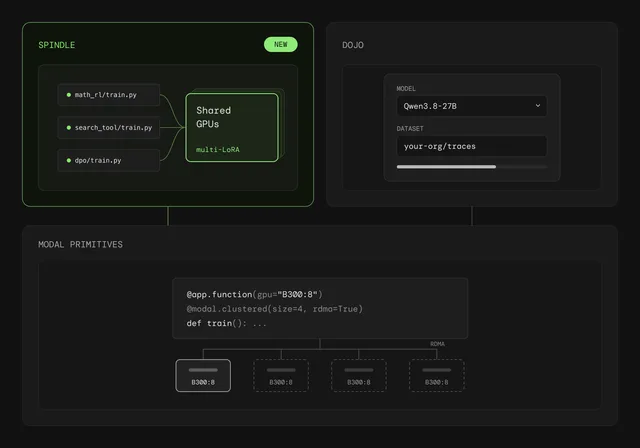
    Modal releases the open-source training server Spindle, which can run in your own Modal workspace, is compatible with the Tinker API, and bills by GPU time rather than tokens. Deployment only requires running spindle deploy, and it supports full-parameter training and multiple LoRAs, covering a variety of open-source models. In the official comparison, a single-round DAPO-math task with 8-card H200 training, 8-card H200 inference, and 8 clients sharing costs $1.99 per million output tokens, 80% lower than Tinker.

    The Modal post-training stack: Modal Dojo for hands-off training, Spindle for writing your own loop, and Modal primitives for full control

    Modal releases the open-source training server Spindle, which can run in your own Modal workspace, is compatible with the Tinker API, and bills by GPU time rather than tokens. Deployment only requires running spindle deploy, and it supports full-parameter training and multiple LoRAs, covering a variety of open-source models. In the official comparison, a single-round DAPO-math task with 8-card H200 training, 8-card H200 inference, and 8 clients sharing costs $1.99 per million output tokens, 80%

    Matched fieldsSummary、Body

  2. Tomasz Tunguz's blog

    Tomasz Tunguz: Differences in AI Application and Infrastructure Sales—Eight-Figure Deal Closed in Two Weeks

    At Fireworks AI, Bardia Shahali grew the sales team from about $3 million to about $400 million; he is now VP of Sales at Granola. He points out that at the AI infrastructure layer, individual deals can reach tens of millions of dollars and close in as little as two weeks, but all inference providers are competing for the same set of customers, making competition fiercer. Because model capabilities reach new heights every 45 days, compensation plans have shifted from annual to quarterly. At the infrastructure layer, FDEs, SEs, and AEs are paired to deliver complex products, while at the application layer, AEs and CSMs deliver software, but with higher productivity and adoption speed.

    At Fireworks AI, Bardia Shahali grew the sales team from about $3 million to about $400 million; he is now VP of Sales at Granola. He points out that at the AI infrastructure layer, individual deals can reach tens of millions of dollars and close in as little as two weeks, but all inference providers are competing for the same set of customers, making competition fiercer. Because model capabilities reach new heights every 45 days, compensation plans have shifted from annual to quarterly. At the

    Matched fieldsSummary、Body