←Search results

By relevance · Total 1528 results Clear search

Saturday

  1. TMTPost · AGI

    Why AI Audit Tools Are Supplied by the Audited Party: Verification of Four Security Incidents and Seven Papers in One Week

    Using four security incidents within the week of October 16 to 23 as its thread—including two PHP remote code execution vulnerabilities discovered by AI, the backdoored LiteLLM version v1.107.0 surviving on PyPI for about two hours and being downloaded roughly 49,000 times, the OpenCode console leaking third-party model keys for 1.4% of users, and Microsoft reporting that a human organization used the open-source multi-agent penetration framework ARTEX to attack the supply chain—the article discusses the common problems facing AI auditing. After examining seven papers one by one, the author points out that the faithfulness of latent reasoning self-decoding reaches at most 0.4788, sparse autoencoders are nearly blind to backdoor shifts, probes fail when targeted by the object being optimized, and all three mainstream audit tools originate from the audited party's ecosystem or require borrowing the audited party's permissions. The article also cites the NARCBench multi-agent collusion benchmark from Oxford and New York University, as well as the report by Anthropic and Theorem using Claude to write roughly one billion lines of Rocq formal proofs for 239 entry points across 123 open-source libraries.

    Using four security incidents within the week of October 16 to 23 as its thread—including two PHP remote code execution vulnerabilities discovered by AI, the backdoored LiteLLM version v1.107.0 surviving on PyPI for about two hours and being downloaded roughly 49,000 times, the OpenCode console leaking third-party model keys for 1.4% of users, and Microsoft reporting that a human organization used the open-source multi-agent penetration framework ARTEX to attack the supply chain—the article disc

    Matched fieldsBody
  2. heise online

    Developer News: Go launches developer survey, Python releases security patches, TypeScript 7.1 Beta update

    The Go team has launched the 2026 Go Developer Survey, which runs until November 3, with results planned for release in early 2027; last year 5379 people participated. Python 3.15.1, 3.14.9 and 3.13.17 are primarily security updates, accompanied by pip 26.2.2 and certifi 2026.10.19, to address the eMudhra/emSign certificate security incident. TypeScript 7.1 Beta adds Import Attributes support for Ambient Modules and supports Source Phase Imports targeting WebAssembly.

    Matched fieldsBody

  3. Cailian Press

    UK to establish the world's first AI biosecurity laboratory, jointly supported by OpenAI, Anthropic and Google DeepMind

    The UK Cabinet Office announced that the UK will establish a national-level artificial intelligence biosecurity laboratory for detecting and monitoring biosecurity threats, jointly supported by OpenAI, Anthropic and Google DeepMind. The UK government will invest 100 million pounds for this purpose, and OpenAI and Anthropic will additionally provide AI model usage credits worth up to 200 million pounds; the laboratory will also cooperate with Google DeepMind and life sciences company Basecamp Research. The announcement also includes an additional 120 million pounds for the UK AI Safety Institute and an additional 23 million pounds for the UK AI Economy Institute under preparation.

    The UK Cabinet Office announced that the UK will establish a national-level artificial intelligence biosecurity laboratory for detecting and monitoring biosecurity threats, jointly supported by OpenAI, Anthropic and Google DeepMind. The UK government will invest 100 million pounds for this purpose, and OpenAI and Anthropic will additionally provide AI model usage credits worth up to 200 million pounds; the laboratory will also cooperate with Google DeepMind and life sciences company Basecamp Res

    Matched fieldsBody

  4. Huxiu

    Unprecedented trillion-scale investment—is NVIDIA the only winner?

    Huxiu reviews the global AIDC construction wave, noting that combined computing power investment is expected to reach $830 billion in 2026, up 79% year over year, but as of July 2026 more than 95% of NVIDIA's Grace Blackwell capacity has not yet been put into use. Industry consensus is that about 60% or more of giant capital expenditure corresponds to clear customers, while the remaining 30-40% is preemptive capacity grabbing. The article cites cases such as CoreWeave's Q2 revenue of $2.575 billion and net loss of $626 million to show that the three conditions—single-park revenue covering costs, stable utilization and rental prices, and follow-on financing continuing—are currently not broadly verified, and the certain winner may only be equipment seller NVIDIA.

    Huxiu reviews the global AIDC construction wave, noting that combined computing power investment is expected to reach $830 billion in 2026, up 79% year over year, but as of July 2026 more than 95% of NVIDIA's Grace Blackwell capacity has not yet been put into use. Industry consensus is that about 60% or more of giant capital expenditure corresponds to clear customers, while the remaining 30-40% is preemptive capacity grabbing. The article cites cases such as CoreWeave's Q2 revenue of $2.575 bill

    Matched fieldsBody

  5. SemiAnalysis

    SemiAnalysis benchmarks Trainium3's PyTorch training and Neuron Explorer profiler

    The SemiAnalysis engineering team benchmarked the native PyTorch training stack TorchNeuron and TorchTitan on Trainium3, training Qwen3-32B on 16 Trainium2 chips; eager mode reached 11,099 tokens/s and 23.89% MFU, while compiled mode reached 14,156 tokens/s and 30.47% MFU. The author considers the Neuron Explorer profiler superior to Nvidia's and AMD's solutions, but first-time compilation takes too long: the first-step compilation for the gpt-oss training recipe took 27 minutes 17 seconds. FlexAttention tests passed 89 of 96 cases, with all 7 failures due to compilation timeouts rather than numerical errors.

    The SemiAnalysis engineering team benchmarked the native PyTorch training stack TorchNeuron and TorchTitan on Trainium3, training Qwen3-32B on 16 Trainium2 chips; eager mode reached 11,099 tokens/s and 23.89% MFU, while compiled mode reached 14,156 tokens/s and 30.47% MFU. The author considers the Neuron Explorer profiler superior to Nvidia's and AMD's solutions, but first-time compilation takes too long: the first-step compilation for the gpt-oss training recipe took 27 minutes 17 seconds. Flex

    Matched fieldsBody

  6. AWS Machine Learning

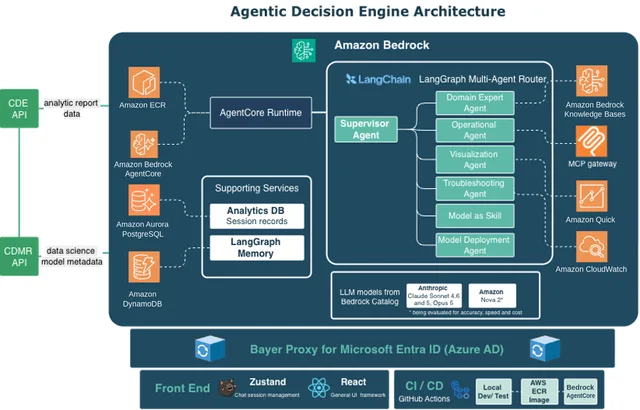
    How Bayer Built an Agent Decision Engine on Amazon Bedrock AgentCore

    Bayer Crop Science built a multi-agent natural language interface ADE on Amazon Bedrock AgentCore, covering its Connected Decision Engine; in the first phase, about 80% of user questions were resolved without engineer intervention. ADE runs 22 specialized agents in production, routed by intent via a Supervisor Agent, and exposes backend APIs as MCP tools through AgentCore Gateway. Fault diagnosis time was shortened from manual troubleshooting that previously took over 1 hour to under 10 minutes.

    Agentic Decision Engine architecture: user experience, orchestration, specialist agents, and tools and data source layers

    Matched fieldsBody

  7. AWS Machine Learning

    Amazon Quick Sight layer maps support drawing points and routes with GeoJSON

    Amazon Quick Sight layer maps now support the GeoJSON Point and LineString geometry types, enabling marking of specific store locations or routes such as inter-airport flight paths on maps. GeoJSON files are limited to 100 MB and must be associated with a Quick Sight dataset through a shared key field; each layer renders only one geometry type at a time.

    Quick Sight dataset row for the JFK-LAX route with its route_id join key

    Matched fieldsBody

Friday

  1. TMTPost · AGI

    Pichai Reviews Gemini 4 Argon: Why 3.5 Pro Was Cut

    Google CEO Pichai revealed in the "Sources" interview that Gemini 4 Argon processed about 25 trillion tokens in 72 hours of launch, 3 times that of Gemini 3.0 in the same period, and is still rate-limited due to compute constraints. He explained for the first time the reason for cutting Gemini 3.5 Pro: the team found a gap in the model on Agentic Coding, first used the Flash version to complete intensive iterations from 3.5 to 3.8 in about 3 months, while Argon pretraining had already been completed at that time, so they injected the accumulated gains into Argon post-training. He also mentioned that Google internally has entered the RSI stage of researchers and models collaborating, and said the next-generation Gemini 5.0 will be much stronger than Argon.

    Google CEO Pichai revealed in the "Sources" interview that Gemini 4 Argon processed about 25 trillion tokens in 72 hours of launch, 3 times that of Gemini 3.0 in the same period, and is still rate-limited due to compute constraints. He explained for the first time the reason for cutting Gemini 3.5 Pro: the team found a gap in the model on Agentic Coding, first used the Flash version to complete intensive iterations from 3.5 to 3.8 in about 3 months, while Argon pretraining had already been compl

    Matched fieldsBody

  2. Tech.eu

    European companies urged to participate more actively in open source software development

    At the Open Source Summit Europe hosted by the Linux Foundation in Prague, Thierry Carrez, General Manager of Linux Foundation Europe, and others called on European companies to not only use open source software but also contribute upstream and participate in open source governance, in order to reduce dependence on a single vendor or country. A Linux survey shows that more than 90% of European organizations regard digital sovereignty as a key priority in their technology strategy; companies with mature open source governance have an average return on investment of more than 4x, compared with 3.6x for those without a formal governance structure. GitHub data from October shows that currently one in every three pull requests involves an AI agent, compared with less than one in ten a year ago.

    At the Open Source Summit Europe hosted by the Linux Foundation in Prague, Thierry Carrez, General Manager of Linux Foundation Europe, and others called on European companies to not only use open source software but also contribute upstream and participate in open source governance, in order to reduce dependence on a single vendor or country. A Linux survey shows that more than 90% of European organizations regard digital sovereignty as a key priority in their technology strategy; companies with

    Matched fieldsBody

  3. MediaNama

    Railway suffers cyberattack leaking customer keys, asks users to change API keys

    Cloud hosting platform Railway discovered abnormal activity on October 21 in the system storing customer environment variables, stating that an unauthorized third party may have accessed encrypted environment variables and decrypted some of them, and has advised all users to change credentials such as API keys. Railway believes the attack may be part of a recent series of attacks targeting platform companies with the aim of breaching AI inference service providers, and has notified upstream suppliers to revoke potentially leaked keys. The company also released security guidance for OpenAI, Anthropic and GitHub users, advising them to delete potentially exposed API keys, generate new keys and check usage records; on October 23 its builds and deployments had recovered, but new user registration remained suspended.

    Cloud hosting platform Railway discovered abnormal activity on October 21 in the system storing customer environment variables, stating that an unauthorized third party may have accessed encrypted environment variables and decrypted some of them, and has advised all users to change credentials such as API keys. Railway believes the attack may be part of a recent series of attacks targeting platform companies with the aim of breaching AI inference service providers, and has notified upstream supp

    Matched fieldsBody

  4. Codex:GitHub Releases

    OpenAI Codex Releases Version 0.164.0

    OpenAI Codex has released version 0.164.0, adding ten numbered /presets slots for saving reusable prompts and slash commands, and supporting inline /model and /permissions parameters to directly set the model, reasoning effort, speed, and permission configuration. This version also supports enterprise MCP connection authentication, credential masking for remote Bash and Zsh sessions, and enables the Amazon Bedrock setup wizard by default.

    Matched fieldsBody

  5. Claude Code:GitHub Releases

    Claude Code v2.1.309 Released: Fixes Multiple Issues Including Sandbox and Permission Checks

    Claude Code v2.1.309 has been released, primarily fixing an issue where sandboxed Bash commands on macOS and Linux executed shell startup files outside the sandbox before each command, as well as an issue where macOS sandbox denyWrite glob patterns did not take effect through symbolic links. This version also fixes issues where sandboxed commands and auto-accepted edits could modify the MCP configuration file passed via --mcp-config, and where disabled MCP servers were reconnected by subsequent permission prompts. In addition, many git commands run by Claude Code itself on Windows have been sped up.

    Claude Code v2.1.309 has been released, primarily fixing an issue where sandboxed Bash commands on macOS and Linux executed shell startup files outside the sandbox before each command, as well as an issue where macOS sandbox denyWrite glob patterns did not take effect through symbolic links. This version also fixes issues where sandboxed commands and auto-accepted edits could modify the MCP configuration file passed via --mcp-config, and where disabled MCP servers were reconnected by subsequent

    Matched fieldsBody

  6. The Next Platform

    How Mixx Technologies Paves the Way for All-Optical Scale-up Networks

    Photonics startup Mixx Technologies is betting on all-optical scale-up networks. Its first product, the SxC connector, can accommodate 64 fibers within a single connector, and the company claims it can arrange 1,000 fibers within 800mm2. The company has laid out a three-step roadmap of NPO optical engines, CPO, and optical circuit switches. Its first NPO module is targeted for launch in 2028 or 2029, and CPO products are expected to be released by the end of this decade. If Nvidia's Vera Rubin NVL576 is estimated at one pair of fibers per SerDes, it would require approximately 20,736 pairs of fiber connections to connect 8 NVL72 racks.

    Photonics startup Mixx Technologies is betting on all-optical scale-up networks. Its first product, the SxC connector, can accommodate 64 fibers within a single connector, and the company claims it can arrange 1,000 fibers within 800mm2. The company has laid out a three-step roadmap of NPO optical engines, CPO, and optical circuit switches. Its first NPO module is targeted for launch in 2028 or 2029, and CPO products are expected to be released by the end of this decade. If Nvidia's Vera Rubin N

    Matched fieldsBody

  7. AWS Machine Learning

    Amazon SageMaker AI launches Training Sessions API, enabling custom training loops without managing GPUs

    Amazon SageMaker AI has added a Training Sessions API to serverless model customization, turning operations such as forward_backward(), optim_step(), and sample() into API calls. The model stays loaded on the GPU, and users only need to write the training loop in a local Python process, while GPU allocation, distributed execution, fault recovery, and checkpoint storage are handled by the service. The API is billed by tokens processed, and steps such as local reward computation do not count toward GPU time. The accompanying cookbook provides SFT and RL recipes; in the example, the GRPO loop for GPT-OSS 20B trains for 10 steps on GSM8K, raising held-out set accuracy from 56% to 75%; the Code RL recipe raises test accuracy from 40% to 50.5% after 50 training steps.

    SageMaker Python SDK client hierarchy: ServiceClient creates a TrainingClient, which in turn creates a SamplingClient

    Amazon SageMaker AI has added a Training Sessions API to serverless model customization, turning operations such as forward backward(), optim step(), and sample() into API calls. The model stays loaded on the GPU, and users only need to write the training loop in a local Python process, while GPU allocation, distributed execution, fault recovery, and checkpoint storage are handled by the service. The API is billed by tokens processed, and steps such as local reward computation do not count towar

    Matched fieldsBody

  8. Latent Space

    Why AI compute is rectangular—a conversation with Modal CEO Erik Bernhardsson

    Modal CEO Erik Bernhardsson explains that traditional compute contracts, signed for a fixed number of GPUs and a fixed duration, are rectangular, whereas real workloads fluctuate; Modal provides elastic slices by aggregating demand from thousands of customers. Modal has surpassed $1 billion in annualized revenue, completed a $750 million Series D at a $16 billion valuation, and has cumulatively launched nearly 3 billion sandboxes. Sandboxes currently account for about one-third of Modal's revenue, with growth driven mainly by coding agents, background agents, and reinforcement learning.

    Modal CEO Erik Bernhardsson explains that traditional compute contracts, signed for a fixed number of GPUs and a fixed duration, are rectangular, whereas real workloads fluctuate; Modal provides elastic slices by aggregating demand from thousands of customers. Modal has surpassed $1 billion in annualized revenue, completed a $750 million Series D at a $16 billion valuation, and has cumulatively launched nearly 3 billion sandboxes. Sandboxes currently account for about one-third of Modal's revenu

    Matched fieldsBody

Thursday

  1. Sakana AI:Blog

    Sakana AI Releases Ontology-Based AI Agent Platform Sakana Aquarium

    Sakana AI has released Sakana Aquarium, an AI agent building and operations platform that centers on ontology, organizing the knowledge, rules, and data scattered across an organization into a unified semantic layer so that agents can confirm information, make judgments, and execute tasks. The platform comprises three layers of mechanisms—ontology, governance, and managed agents—and allows access permissions and pre-execution approvals to be configured, while recording the entire process from the basis of a judgment to the execution result. The organized data and ontology can be directly reused by other agents, and Sakana AI says it will subsequently develop mechanisms that let agents continuously update the ontology as the organization changes, as well as AI-assisted agent building.

    Sakana AI has released Sakana Aquarium, an AI agent building and operations platform that centers on ontology, organizing the knowledge, rules, and data scattered across an organization into a unified semantic layer so that agents can confirm information, make judgments, and execute tasks. The platform comprises three layers of mechanisms—ontology, governance, and managed agents—and allows access permissions and pre-execution approvals to be configured, while recording the entire process from th

    Matched fieldsBody

  2. The New Stack

    Google opens the infrastructure behind Gemini agents as a cloud service, Agent Compute Engine

    Google announced that it will open a preview of Agent Compute Engine to Google Cloud users later this year, providing each AI agent with a hardware-isolated microVM that balances container startup speed with sandbox security. The service was originally internal infrastructure for Gemini, Antigravity, and Google's model training pipelines; when an agent is idle, it checkpoints the microVM to free up resources. Google is also offering an open-source runtime, Agent Substrate, which can run on any Kubernetes cluster; the company says that in a benchmark of 200,000 agents it achieved 500 activations per second, with suspend and resume taking under half a second.

    Google announced that it will open a preview of Agent Compute Engine to Google Cloud users later this year, providing each AI agent with a hardware-isolated microVM that balances container startup speed with sandbox security. The service was originally internal infrastructure for Gemini, Antigravity, and Google's model training pipelines; when an agent is idle, it checkpoints the microVM to free up resources. Google is also offering an open-source runtime, Agent Substrate, which can run on any K

    Matched fieldsBody

  3. Huxiu

    Anthropic IPO Draft Prospectus Revealed: $16.3 Billion in Revenue, $80.7 Billion Net Loss in Half a Year

    Anthropic's draft IPO prospectus shows $16.3 billion in revenue and a net loss of $80.7 billion in the first half of 2026, of which $72 billion comes from the revaluation of financing instruments such as convertible notes and is not actual cash spending. Computing and infrastructure spending in the first half of the year was nearly $9 billion, about 55% of revenue, down from more than 200% in the same period last year, and the company had already begun to be profitable on an adjusted basis in the third quarter. The article points out that the real risk lies on the cost side: signed forward computing and infrastructure commitments exceed $600 billion and could reach as high as $750 billion; Reuters said that of the $518 billion at the time, about 80% was irrevocable or required minimum payments, while of the $16.3 billion in revenue in the first half of 2026, more than $3.2 billion came from just two major customers, and many major customers had not signed long-term purchase commitments.

    Anthropic's draft IPO prospectus shows $16.3 billion in revenue and a net loss of $80.7 billion in the first half of 2026, of which $72 billion comes from the revaluation of financing instruments such as convertible notes and is not actual cash spending. Computing and infrastructure spending in the first half of the year was nearly $9 billion, about 55% of revenue, down from more than 200% in the same period last year, and the company had already begun to be profitable on an adjusted basis in th

    Matched fieldsBody

  4. Browser Use

    Browser Use Roundup of the Best Browser Agent MCP Servers of 2026

    Browser Use has released its 2026 roundup of browser Agent MCP servers, dividing such servers into two modes—driver and delegate—and evaluating four of them one by one: Browser Use Cloud MCP, Browser Use open-source MCP, Hyperbrowser MCP, and agent-browser chat. In a comparative evaluation across 100 BU Bench V2.1 tasks, the author found that the four driver-type tools consumed a median of 2.1M to 6.7M input tokens per task, all of which count toward the coding Agent's context. The article also provides each server's installation commands, model selection, billing methods, and known limitations, and explains that long tasks, parallel tasks, and structured-output scenarios are better suited to the delegate mode.

    Browser Use has released its 2026 roundup of browser Agent MCP servers, dividing such servers into two modes—driver and delegate—and evaluating four of them one by one: Browser Use Cloud MCP, Browser Use open-source MCP, Hyperbrowser MCP, and agent-browser chat. In a comparative evaluation across 100 BU Bench V2.1 tasks, the author found that the four driver-type tools consumed a median of 2.1M to 6.7M input tokens per task, all of which count toward the coding Agent's context. The article also

    Matched fieldsBody

  5. Cognition Models / Devin Blog

    Cognition Expands in London: Devin Customer Demand Drives New Office and Executive Team

    Cognition has opened a new office in London, expanding its UK team by more than 200% in six months and bringing in executives including Narry Singh and Aman Thind. The Access Group has deployed Devin to more than 2,000 engineers across 250 product lines, with merged PR volume increasing fivefold and some legacy migration tasks accelerated by up to 480x. Cognition previously raised over $2 billion at a $48 billion valuation and released the coding model SWE-2.

    Matched fieldsBody