←Search results

By relevance · Total 3162 results Clear search

Friday

  1. Cohere Product and Research Blog

    Cohere Model Vault Launches Confidential Computing Public Beta

    Cohere announced that the confidential computing feature of Model Vault has entered public beta, providing hardware-level isolation for hosted model inference based on the NVIDIA H100 GPU confidential computing capability on Microsoft Azure. This feature extends the scope of encryption from data at rest and in transit to prompts, documents, responses, and model execution during inference; after end-to-end encryption on the application workload side, decryption can only occur in a confidential environment that has passed remote attestation. Customers can cryptographically verify the hardware, firmware, and software configuration before sending sensitive data; if it does not comply with the security policy, the client will refuse to send the request. The existing Model Vault API and request format remain unchanged.

    Rerank 5 logo

    Cohere announced that the confidential computing feature of Model Vault has entered public beta, providing hardware-level isolation for hosted model inference based on the NVIDIA H100 GPU confidential computing capability on Microsoft Azure. This feature extends the scope of encryption from data at rest and in transit to prompts, documents, responses, and model execution during inference; after end-to-end encryption on the application workload side, decryption can only occur in a confidential en

    Matched fieldsSummary、Body
Thursday

  1. LMSYS Blog

    LMSYS Releases SGLang AWS Trainium Plugin Beta

    LMSYS, in collaboration with AWS, has released the SGLang Trainium plugin Beta, built on the newly released TorchNeuron, supporting LLM inference serving and RL rollout generation on Trainium2 and Trainium3. Initial coverage includes Qwen3 (dense), Qwen3-MoE-30B-A3B, DeepSeek-V2-Lite, GLM-4, and GLM-5.2/5.3, and supports data parallelism, tensor parallelism, expert parallelism, Radix Cache, BF16/FP8, and asynchronous scheduling. In the first end-to-end heterogeneous RL run, SGLang generated rollouts for Qwen3-MoE-30B-A3B on Trainium3, while Miles trained a GRPO policy with Megatron on a single H200 node. The Beta is currently limited to a small number of teams.

    LMSYS, in collaboration with AWS, has released the SGLang Trainium plugin Beta, built on the newly released TorchNeuron, supporting LLM inference serving and RL rollout generation on Trainium2 and Trainium3. Initial coverage includes Qwen3 (dense), Qwen3-MoE-30B-A3B, DeepSeek-V2-Lite, GLM-4, and GLM-5.2/5.3, and supports data parallelism, tensor parallelism, expert parallelism, Radix Cache, BF16/FP8, and asynchronous scheduling. In the first end-to-end heterogeneous RL run, SGLang generated roll

    Matched fieldsSummary

  2. Ant Ling

    Ant Ling Open-Sources Medical-Enhanced Model Ling-3.0-flash-Sante

    Ant Ling announced the official open-sourcing of Ling-3.0-flash-Sante, a medical-enhanced MoE model with 124B total parameters that activates only 5.1B parameters per token; the company claims it leads models of the same scale in performance on professional medical tasks and complex medical reasoning. Beyond medical question answering, the model has also been strengthened for deep research, multi-agent collaboration, and tool calling, and its model weights are now available for download.

    Matched fieldsSummary、Body

  3. Data Center Knowledge

    Infosys: Data Centers Can Delay but Not Avoid Power Shortages

    Infosys analysis suggests that data centers can free up near-term capacity for AI by improving energy efficiency and scheduling flexible loads, but this is more likely to delay rather than eliminate the need for new generation, transmission, and grid upgrades. Model training, retraining, and batch processing can be scheduled around grid conditions, while real-time inference and customer-facing applications typically cannot. The report recommends phased modular construction, combined with quantization, pruning, and knowledge distillation to reduce computing demand; utilities, meanwhile, need verifiable evidence such as historical performance, real-time monitoring, and contractual commitments.

    Infosys analysis suggests that data centers can free up near-term capacity for AI by improving energy efficiency and scheduling flexible loads, but this is more likely to delay rather than eliminate the need for new generation, transmission, and grid upgrades. Model training, retraining, and batch processing can be scheduled around grid conditions, while real-time inference and customer-facing applications typically cannot. The report recommends phased modular construction, combined with quantiz

    Matched fieldsSummary、Body

  4. Artificial Analysis

    DeepSeek Search ranks 17th on the Artificial Analysis Search Index

    DeepSeek Search scores 69 on the Artificial Analysis Search Index, ranking 17th among 27 search products, and is the lowest-priced paid search API on the list. It charges $0.75 per 1k searches, with a per-task cost of about $0.032, ranking 5th cheapest among 27 products. On AA-Omniscience its accuracy is 70%, ranking 10th, but on BrowseComp, which requires multi-hop reasoning, it is only 63%, ranking 25th; each search returns about 7k tokens, raising model cost to the 2nd highest on the list.

    Matched fieldsSummary

  5. MiniMax

    MiniMax M3.1 Flash is now available on Runware, with the call string minimax:m3.1@flash

    MiniMax officially stated that M3.1 Flash is now available on Runware, and the model string "minimax:m3.1@flash" is used when calling it. According to Runware, the model supports text, image, and video input, has a 1M context window and up to 524K output tokens, offers adjustable reasoning depth, scores 42 on the Artificial Analysis Intelligence Index, 72.5% on AutomationBench-AA, and 73.7% on DeepSWE, and costs less per token than MiniMax M3.

    Matched fieldsSummary

  6. OpenRouter

    Recursive's first open-source model Flint launches on OpenRouter, a 40B MoE built specifically for coding agents

    Recursive's first model Flint has launched on OpenRouter. It is an open-weight 40B MoE model (about 2.5B active parameters), built by the company's automated research system Eureka Machine, aimed at coding agents, and supports 262K context, reasoning, and tool calling. Recursive reports that it scores 54.9% on Terminal-Bench 2.1, 89.7% on SWE-bench Pro v2, and 74.2% on SWE-bench Verified, and is free to use during its launch period.

    Matched fieldsSummary、Body

  7. MiniMax

    MiniMax announces Inferact as the API launch partner for M3.1 Flash

    MiniMax announces Inferact as the API launch partner for M3.1 Flash; the latter will provide vLLM engineering capabilities and the Inferact Platform to support production inference for this model. Both parties state that they will continue to jointly build serving infrastructure for complex agent workloads. In a quoted post, Inferact stated that M3.1 Flash is aimed at multi-step automation, real-codebase engineering, and visual reasoning, scoring 29.6 on Agents' Last Exam (ALE), 72.5% on AutomationBench-AA, and 73.67% on DeepSWE.

    MiniMax announces Inferact as the API launch partner for M3.1 Flash; the latter will provide vLLM engineering capabilities and the Inferact Platform to support production inference for this model. Both parties state that they will continue to jointly build serving infrastructure for complex agent workloads. In a quoted post, Inferact stated that M3.1 Flash is aimed at multi-step automation, real-codebase engineering, and visual reasoning, scoring 29.6 on Agents' Last Exam (ALE), 72.5% on Automat

    Matched fieldsSummary

  8. SiliconANGLE

    One-Year-Old AI Research Lab Flapping Airplanes Raises $1 Billion, Reportedly Valued at $6 Billion

    AI research lab Flapping Airplanes announced it has closed a new $1 billion funding round, with Bloomberg reporting a valuation of $6 billion; the company is about a year old and has no commercial product yet. In its first year the company focused mainly on developing new GPU primitives, saying its megakernel framework can complete full training, inference and game running within a single kernel, allowing memory-bound inference and compute-bound training to overlap on the same chip. The Series A round was co-led by Index Ventures and Lux Capital, with Sequoia Capital and GV, which participated in the $180 million seed round in January, continuing to invest, and Nvidia also among the institutional investors.

    AI research lab Flapping Airplanes announced it has closed a new $1 billion funding round, with Bloomberg reporting a valuation of $6 billion; the company is about a year old and has no commercial product yet. In its first year the company focused mainly on developing new GPU primitives, saying its megakernel framework can complete full training, inference and game running within a single kernel, allowing memory-bound inference and compute-bound training to overlap on the same chip. The Series A

    Matched fieldsSummary、Body

  9. LMSYS Blog

    LMSYS uses Miles to train a SWE agent on MI355X, SWE-bench Verified…

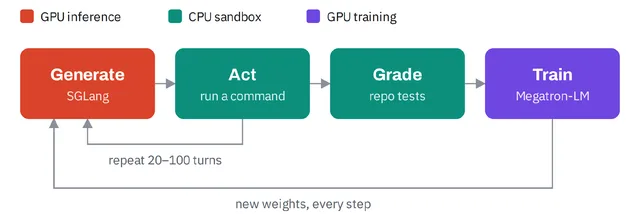
    LMSYS used Miles, SGLang, Megatron-LM, and Harbor to perform fully asynchronous agent reinforcement learning on Qwen3-30B-A3B-Instruct on AMD Instinct MI355X, raising pass@1 from 7.3% to 27.5% on a 100-task stratified subset of SWE-bench Verified. Training was conducted in two stages: first SFT on approximately 4,000 public trajectories from Open-SWE-Traces, then GRPO on approximately 1,350 SWE-smith tasks. After fixing the model and RL recipe, scaling inference from 1 node to 3 8-GPU nodes, switching to E2B cloud sandboxes, and removing the concurrency limit increased rollout throughput from approximately 860 to approximately 3,480 trajectories/hour; limiting trajectory length on the same 8-GPU node reduced single-step training time from 850 seconds to 284 seconds.

    Agentic RL loop: SGLang generates actions, a CPU sandbox executes and grades them, and Megatron-LM trains on the resulting trajectories.

    LMSYS used Miles, SGLang, Megatron-LM, and Harbor to perform fully asynchronous agent reinforcement learning on Qwen3-30B-A3B-Instruct on AMD Instinct MI355X, raising pass@1 from 7.3% to 27.5% on a 100-task stratified subset of SWE-bench Verified. Training was conducted in two stages: first SFT on approximately 4,000 public trajectories from Open-SWE-Traces, then GRPO on approximately 1,350 SWE-smith tasks. After fixing the model and RL recipe, scaling inference from 1 node to 3 8-GPU nodes, swi

    Matched fieldsSummary、Body

  10. TechCrunch AI

    One-year-old AI lab Flapping Airplanes raises $1 billion Series A at a $6 billion valuation

    One-year-old AI lab Flapping Airplanes announced it has raised a $1 billion Series A co-led by Index and Lux, reportedly at a $6 billion valuation. This comes just nine months after its $180 million seed round at a $150 million valuation, quadrupling its valuation. The founding team says its megakernel framework can complete training, inference, and game running in a single kernel, with the goal of enabling models to complete training with less data.

    Matched fieldsSummary、Body

  11. PyTorch Blog

    TorchTitan Update: Support for Multiple New SOTA Models, TitanRL, and Large-Scale Performance Improvements

    PyTorch's native training platform TorchTitan has released an update that adds full training-stack support for Muse Spark Open, Muse Glimmer, Qwen3-VL, Qwen3.5, Kimi K2.7, Kimi K3, and DeepSeek-V4, and introduces the reinforcement learning component TitanRL. TitanRL lets pretraining, post-training, and vLLM inference share the same model code, and supports asynchronous rollout as well as agent-task training such as long-context and code execution. On performance, FlexShard on 256 H100 GPUs reduces DeepSeekV3 optimizer time by up to 79%, and reduces end-to-end training step time on Llama3 405B by up to 20%.

    PyTorch's native training platform TorchTitan has released an update that adds full training-stack support for Muse Spark Open, Muse Glimmer, Qwen3-VL, Qwen3.5, Kimi K2.7, Kimi K3, and DeepSeek-V4, and introduces the reinforcement learning component TitanRL. TitanRL lets pretraining, post-training, and vLLM inference share the same model code, and supports asynchronous rollout as well as agent-task training such as long-context and code execution. On performance, FlexShard on 256 H100 GPUs reduc

    Matched fieldsSummary

Wednesday

  1. Jiwei.com

    Xidian University Wins 9 Awards at the 3rd China Graduate Operating System Open Source Innovation Competition and Will Host the 4th

    Nine teams from Xidian University won 1 first prize, 5 second prizes, and 3 third prizes in the national finals of the 3rd China Graduate Operating System Open Source Innovation Competition, tying for first nationwide in the number of awards. One team built a containerized PD-disaggregated inference system based on vLLM; in recovery tests, first-token latency dropped by about 36% and total recovery time was shortened by about 25%, while under mixed-load concurrency testing, throughput increased by 6.1% and P99 first-token latency decreased by 15.7%. The 4th competition will be hosted by Xidian University.

    Nine teams from Xidian University won 1 first prize, 5 second prizes, and 3 third prizes in the national finals of the 3rd China Graduate Operating System Open Source Innovation Competition, tying for first nationwide in the number of awards. One team built a containerized PD-disaggregated inference system based on vLLM; in recovery tests, first-token latency dropped by about 36% and total recovery time was shortened by about 25%, while under mixed-load concurrency testing, throughput increased

    Matched fieldsSummary、Body

  2. Databricks Blog

    Databricks AI Runtime is now GA: Fine-tune open models on serverless NVIDIA GPUs

    Databricks AI Runtime (AIR) is now generally available. Developers can train and fine-tune open models on serverless NVIDIA GPUs without managing GPU infrastructure themselves. AIR supports NVIDIA NeMo, NGC containers, and Nemotron cookbooks, and supports multi-node distributed training, with clusters and networking managed by Databricks. Trained models can be deployed for real-time inference through Databricks Model Serving, and access to training data is governed by Unity Catalog.

    Matched fieldsSummary、Body