English translation is being prepared.
Matched fieldsBody
Matched fieldsBody
For customers such as those in financial services, OpenAI explains the production routing and failover design for critical AI workloads between the direct OpenAI API (1P) and third-party cloud providers (3P). The direct API allows early access to preview models and features, and failover is enabled only when a request can be safely retried and the fallback route meets the requirements—for example, in a payment flow, a timed-out Responses API call for a read-only fraud assessment can be retried before the transaction deadline. In-progress sessions in the Agents API cannot be recovered by switching providers; multi-provider support is a platform capability, while failover is a workflow decision.
For customers such as those in financial services, OpenAI explains the production routing and failover design for critical AI workloads between the direct OpenAI API (1P) and third-party cloud providers (3P). The direct API allows early access to preview models and features, and failover is enabled only when a request can be safely retried and the fallback route meets the requirements—for example, in a payment flow, a timed-out Responses API call for a read-only fraud assessment can be retried b
Matched fieldsBody
Since November 2025, Databricks has been collecting malicious npm samples. Among the 11,413 package-versions scanned and verified, 96.2% hid their payloads in source code or on external servers, and only 3.8% (432) bundled binaries; however, the proportion of such packages for which no clear malicious conclusion could be reached was more than twice that of pure source-code packages (14.4% vs 6.2%). The team evaluated 9 models (including Claude Haiku 4.5, Gemini 3.5 Flash, GPT-5.4-nano, Qwen3-Next 80B, etc.) and injected precomputed static evidence as capability profiles during inference to improve detection quality for both budget-tier and frontier models.
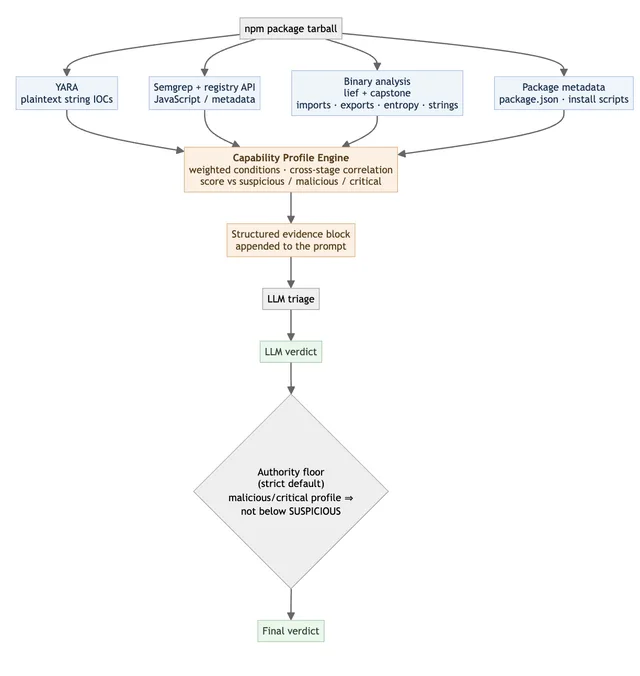
Since November 2025, Databricks has been collecting malicious npm samples. Among the 11,413 package-versions scanned and verified, 96.2% hid their payloads in source code or on external servers, and only 3.8% (432) bundled binaries; however, the proportion of such packages for which no clear malicious conclusion could be reached was more than twice that of pure source-code packages (14.4% vs 6.2%). The team evaluated 9 models (including Claude Haiku 4.5, Gemini 3.5 Flash, GPT-5.4-nano, Qwen3-Nex
Matched fieldsBody
On October 16, Reflection released its first open-weight model Beam on Hugging Face under the Apache 2.0 license, and Baseten provided day-0 support the same day through Model APIs and Dedicated Inference. Beam is a 501B total-parameter MoE autoregressive Transformer with 23B activated per token, a context window of up to 1 million tokens, pretraining on 23.8 trillion tokens, and weights released in BF16, FP8, and NVFP4 precisions. The evaluation results given by Reflection are GPQA Diamond 90.5%, SWE-bench Verified 80.9%, AIME 2026 97.8%, Terminal-Bench 2.1 80.1%, and MCP Atlas 78.7%, and it also open-sourced the terminal agent tool Mirror CLI.
On October 16, Reflection released its first open-weight model Beam on Hugging Face under the Apache 2.0 license, and Baseten provided day-0 support the same day through Model APIs and Dedicated Inference. Beam is a 501B total-parameter MoE autoregressive Transformer with 23B activated per token, a context window of up to 1 million tokens, pretraining on 23.8 trillion tokens, and weights released in BF16, FP8, and NVFP4 precisions. The evaluation results given by Reflection are GPQA Diamond 90.5
Matched fieldsBody
Matched fieldsBody

Matched fieldsBody
Matched fieldsBody
Matched fieldsBody
Matched fieldsBody
Matched fieldsBody
Matched fieldsBody
Matched fieldsBody
Matched fieldsBody
Matched fieldsBody
Matched fieldsBody
Matched fieldsBody
Matched fieldsBody
Matched fieldsBody
Matched fieldsBody
Matched fieldsBody