←Search results

By relevance · Total 1629 results Clear search

Thursday

  1. LMSYS Blog

    LMSYS uses Miles to train a SWE agent on MI355X, SWE-bench Verified…

    LMSYS used Miles, SGLang, Megatron-LM, and Harbor to perform fully asynchronous agent reinforcement learning on Qwen3-30B-A3B-Instruct on AMD Instinct MI355X, raising pass@1 from 7.3% to 27.5% on a 100-task stratified subset of SWE-bench Verified. Training was conducted in two stages: first SFT on approximately 4,000 public trajectories from Open-SWE-Traces, then GRPO on approximately 1,350 SWE-smith tasks. After fixing the model and RL recipe, scaling inference from 1 node to 3 8-GPU nodes, switching to E2B cloud sandboxes, and removing the concurrency limit increased rollout throughput from approximately 860 to approximately 3,480 trajectories/hour; limiting trajectory length on the same 8-GPU node reduced single-step training time from 850 seconds to 284 seconds.
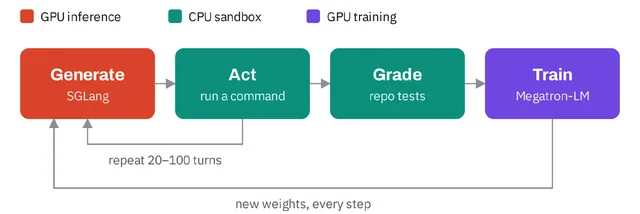
    Agentic RL loop: SGLang generates actions, a CPU sandbox executes and grades them, and Megatron-LM trains on the resulting trajectories.

    LMSYS used Miles, SGLang, Megatron-LM, and Harbor to perform fully asynchronous agent reinforcement learning on Qwen3-30B-A3B-Instruct on AMD Instinct MI355X, raising pass@1 from 7.3% to 27.5% on a 100-task stratified subset of SWE-bench Verified. Training was conducted in two stages: first SFT on approximately 4,000 public trajectories from Open-SWE-Traces, then GRPO on approximately 1,350 SWE-smith tasks. After fixing the model and RL recipe, scaling inference from 1 node to 3 8-GPU nodes, swi

    Matched fieldsBody
  2. AWS Machine Learning

    AWS team open-sources multi-agent system Deep Insight, breaking down five major challenges in production environments

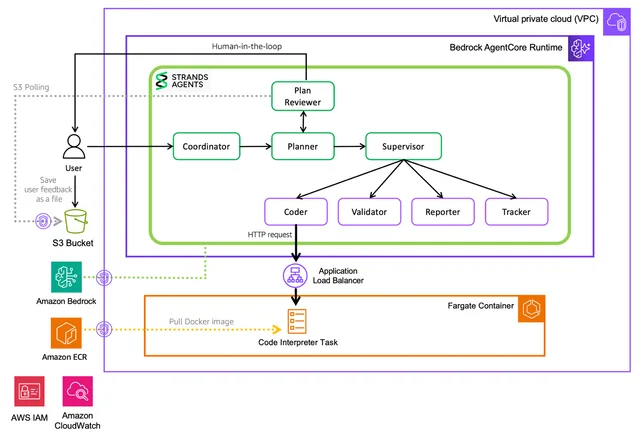
    The AWS Solutions Architecture team built and open-sourced the multi-agent system Deep Insight, which can transform CSV data and natural language prompts into cited .docx analysis reports. The system consists of eight agents—Coordinator, Planner, Supervisor, Coder, Validator, Reporter, Tracker, and others—collaborating in layers, controlling execution flow based on the Graph and Agents-as-Tools patterns of the Strands Agents SDK, and selecting Claude Haiku, Opus, and Sonnet by role. Production deployment relies on the Amazon Bedrock AgentCore runtime; LLM-generated code is executed in isolation within per-session ephemeral containers on AWS Fargate, accompanied by a Web UI and an Ops dashboard.

    Deep Insight architecture: the Strands Agents multi-agent layer on Amazon Bedrock AgentCore, with an Application Load Balancer routing code execution to AWS Fargate containers in a private VPC

    The AWS Solutions Architecture team built and open-sourced the multi-agent system Deep Insight, which can transform CSV data and natural language prompts into cited .docx analysis reports. The system consists of eight agents—Coordinator, Planner, Supervisor, Coder, Validator, Reporter, Tracker, and others—collaborating in layers, controlling execution flow based on the Graph and Agents-as-Tools patterns of the Strands Agents SDK, and selecting Claude Haiku, Opus, and Sonnet by role. Production d

    Matched fieldsBody

  3. Claude Code:GitHub Releases

    Claude Code v2.1.307 released

    Claude Code v2.1.307 adds the `/claude-api api-version` command, which can migrate Claude API code to API version `2026-10-21`, and adds a `claude_code.safety_event` OpenTelemetry event for each tool call that is blocked, prompted, or returned by permission rules, auto mode, safety checks, hooks, or the sandbox. This version also fixes the issue where alias models such as `opus[1m]` reported model-not-found when `CLAUDE_CODE_DISABLE_1M_CONTEXT` was set, as well as the issue where MCP servers in `claude -p` falsely reported "authentication required" when the macOS keychain was locked.

    Claude Code v2.1.307 adds the /claude-api api-version command, which can migrate Claude API code to API version 2026-10-21 , and adds a claude code.safety event OpenTelemetry event for each tool call that is blocked, prompted, or returned by permission rules, auto mode, safety checks, hooks, or the sandbox. This version also fixes the issue where alias models such as opus[1m] reported model-not-found when CLAUDE CODE DISABLE 1M CONTEXT was set, as well as the issue where MCP servers in claude -p

    Matched fieldsBody

  4. AWS Machine Learning

    Training Qwen3 on AWS Trainium with torchtitan

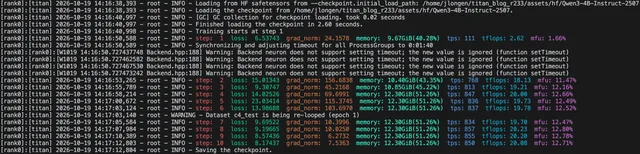
    AWS has published a tutorial demonstrating three ways to train Qwen3-4B-Instruct-2507 with torchtitan on a single trn2.48xlarge (16 Trainium2 chips, 128 physical NeuronCores): Transformers v5 as the modeling backend, torchtitan's native Qwen3, and integration with the NKI MoE kernel. All three configurations share the same torchrun launch method and run on 64 logical NeuronCores; when loading from the released weights, the first-step loss is 6.54, while with random initialization it is 12.43.

    Training output showing a step 1 loss of 6.54 and the exported checkpoint loading with no missing or unexpected keys

    Matched fieldsBody

  5. PyTorch Blog

    TorchTitan Update: Support for Multiple New SOTA Models, TitanRL, and Large-Scale Performance Improvements

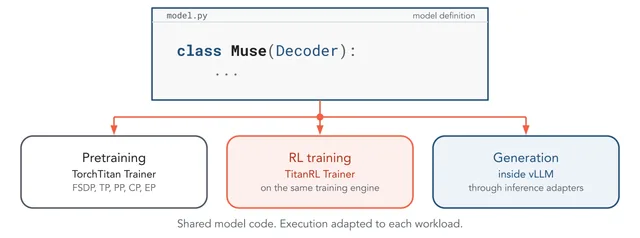
    PyTorch's native training platform TorchTitan has released an update that adds full training-stack support for Muse Spark Open, Muse Glimmer, Qwen3-VL, Qwen3.5, Kimi K2.7, Kimi K3, and DeepSeek-V4, and introduces the reinforcement learning component TitanRL. TitanRL lets pretraining, post-training, and vLLM inference share the same model code, and supports asynchronous rollout as well as agent-task training such as long-context and code execution. On performance, FlexShard on 256 H100 GPUs reduces DeepSeekV3 optimizer time by up to 79%, and reduces end-to-end training step time on Llama3 405B by up to 20%.

    PyTorch's native training platform TorchTitan has released an update that adds full training-stack support for Muse Spark Open, Muse Glimmer, Qwen3-VL, Qwen3.5, Kimi K2.7, Kimi K3, and DeepSeek-V4, and introduces the reinforcement learning component TitanRL. TitanRL lets pretraining, post-training, and vLLM inference share the same model code, and supports asynchronous rollout as well as agent-task training such as long-context and code execution. On performance, FlexShard on 256 H100 GPUs reduc

    Matched fieldsBody

  6. Pydantic AI official articleSelected

    Pydantic AI integrates E2B sandbox as a native capability

    Pydantic AI integrates E2B as a native sandbox provider. After adding E2BSandbox() to the agent's capability list, all shell commands and file operations are executed in an isolated E2B microVM, and environment variables and SSH keys do not enter the sandbox. The sandbox can be paused after a run ends and resumed on the next run, with the filesystem and memory remaining unchanged, and can be reused across processes via a credential-free reference identifier. The article gives two examples: one is a two-round run of diagnose, pause, then fix; the other is killing a worker in a Temporal workflow and having a new worker continue and complete the fix in the same sandbox.

    Laís Carvalho avatar

    Pydantic AI integrates E2B as a native sandbox provider. After adding E2BSandbox() to the agent's capability list, all shell commands and file operations are executed in an isolated E2B microVM, and environment variables and SSH keys do not enter the sandbox. The sandbox can be paused after a run ends and resumed on the next run, with the filesystem and memory remaining unchanged, and can be reused across processes via a credential-free reference identifier. The article gives two examples: one i

    Matched fieldsBody

  7. Pragmatic Engineer

    Will Larson on the revised rules of engineering management: How AI is changing engineering management and the engineer-to-CTO path

    Imprint CTO Will Larson discussed on a podcast how AI and shifting industry expectations are reshaping engineering management, the career ladder, and the growth path from engineer to CTO, and advised middle managers to return to frontline management and relearn technical skills. Drawing on his experience at Digg, Yahoo, Stripe, Uber, Carta, and Calm, he discussed cases such as the Digg v4 rewrite and how Yahoo's server approval process spawned a "black market," as well as how AI is bringing technical decision-making power back to management.

    Imprint CTO Will Larson discussed on a podcast how AI and shifting industry expectations are reshaping engineering management, the career ladder, and the growth path from engineer to CTO, and advised middle managers to return to frontline management and relearn technical skills. Drawing on his experience at Digg, Yahoo, Stripe, Uber, Carta, and Calm, he discussed cases such as the Digg v4 rewrite and how Yahoo's server approval process spawned a "black market," as well as how AI is bringing tech

    Matched fieldsBody

Wednesday

  1. Google Developers Blog

    Google Agents CLI Launches Extension System: From ADK to LangChain, All Can Plug In

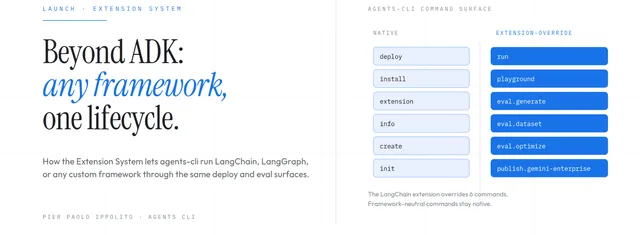
    Starting with version 1.5.0, Google Cloud's Agents CLI introduces an Extension System that allows developers to override or add commands without forking the tool; version 1.8.0 debuts the first LangChain extension, replacing ADK-bound commands with equivalent LangChain implementations. Extensions are declared via agents-cli-extension.yaml in a Git repository and can override built-in commands such as playground, deploy, and eval generate, or add new commands; enterprise platform teams can use this to enforce policies such as SBOM scanning in deployment pipelines.

    1 (2)

    Starting with version 1.5.0, Google Cloud's Agents CLI introduces an Extension System that allows developers to override or add commands without forking the tool; version 1.8.0 debuts the first LangChain extension, replacing ADK-bound commands with equivalent LangChain implementations. Extensions are declared via agents-cli-extension.yaml in a Git repository and can override built-in commands such as playground, deploy, and eval generate, or add new commands; enterprise platform teams can use th

    Matched fieldsBody

  2. Mastra Blog

    Mastra Launches Mastra Observability Managed Platform

    Mastra has released the Mastra Observability managed platform, which can connect directly to Mastra framework projects, automatically trace agent runs, and view the latency, tokens, and cost of model and tool calls. The platform supports online scorers to monitor correctness, team annotation of traces to build evaluation datasets, and running evaluations in CI via Gates and Verdicts to catch regressions. It offers 100k observability events per month free with 15-day retention; beyond that, it costs $10 per 100k events.

    Alex Booker

    Mastra has released the Mastra Observability managed platform, which can connect directly to Mastra framework projects, automatically trace agent runs, and view the latency, tokens, and cost of model and tool calls. The platform supports online scorers to monitor correctness, team annotation of traces to build evaluation datasets, and running evaluations in CI via Gates and Verdicts to catch regressions. It offers 100k observability events per month free with 15-day retention; beyond that, it co

    Matched fieldsBody

  3. Fortune AI

    AI code testing startup Blacksmith reaches $1 billion valuation as AI-generated code surges

    AI code testing infrastructure startup Blacksmith has reached a $1 billion valuation following a $66 million Series C funding round led by Sequoia Capital, just about two months after its $45 million Series B round. More than 10,000 companies currently use Blacksmith's platform, which runs 90 million verification checks per week, up from 5 million at the start of the year, while annual recurring revenue grew 17-fold over the same period. CEO Aditya Jayaprakash said most of the new funding will go toward purchasing more compute, and the company plans to grow its staff from about 40 to about 75 by the end of the year.

    AI code testing infrastructure startup Blacksmith has reached a $1 billion valuation following a $66 million Series C funding round led by Sequoia Capital, just about two months after its $45 million Series B round. More than 10,000 companies currently use Blacksmith's platform, which runs 90 million verification checks per week, up from 5 million at the start of the year, while annual recurring revenue grew 17-fold over the same period. CEO Aditya Jayaprakash said most of the new funding will g

    Matched fieldsBody

  4. Unite.AI

    NVIDIA Releases Nemotron 3.5 Series of Open Models, Covering Embedding, Reranking, and Document Parsing

    On October 21, 2026, NVIDIA expanded the Nemotron Retriever series, launching Nemotron 3.5 Embed (8B BF16, 1B BF16, 1B NVFP4), Nemotron 3.5 Rerank 8B BF16, and the 631-million-parameter Nemotron 3.5 Parse, aimed at multimodal retrieval and document processing for enterprise agent workflows. NVIDIA says that adding Rerank to the agent retrieval pipeline reduces the token cost per query by about 14% (with the 8B embedding model) and 13% (with the 1B model), respectively, while also improving retrieval accuracy. Parse scores 75.20 on ParseBench and processes 10.5 pages per second on a single H100; the open weights, data, and training recipes have been released on Hugging Face and can be deployed via NVIDIA NIM as well as Baseten, DeepInfra, and FriendliAI.

    On October 21, 2026, NVIDIA expanded the Nemotron Retriever series, launching Nemotron 3.5 Embed (8B BF16, 1B BF16, 1B NVFP4), Nemotron 3.5 Rerank 8B BF16, and the 631-million-parameter Nemotron 3.5 Parse, aimed at multimodal retrieval and document processing for enterprise agent workflows. NVIDIA says that adding Rerank to the agent retrieval pipeline reduces the token cost per query by about 14% (with the 8B embedding model) and 13% (with the 1B model), respectively, while also improving retri

    Matched fieldsBody

  5. Analytics India Magazine

    NVIDIA GTC Berlin 2026 announces 12 releases, covering AI factories, telecommunications, and enterprise agents

    At GTC 2026 in Berlin, NVIDIA announced 12 releases, covering AI factory deployment, semiconductor manufacturing expansion, telecom AI-RAN, enterprise agents, robotics and autonomous driving, as well as new open models for enterprise data, protein design, and quantum computing. On the infrastructure side, the DSX POD modular AI factory reference design is said to shorten deployment time from six months to as little as 14 days, and DSX MaxLPS is said to deliver equivalent AI compute using up to 30% less power, with partners planning to deliver in early 2027. On the telecom side, T-Mobile completed what it calls the world's first AI-RAN call on a commercial network in Bellevue, Washington, with NVIDIA and Nokia, and Elisa completed Europe's first AI-RAN field trial; on the enterprise side, it expanded the open-source Agent Toolkit and introduced the OpenShell reference architecture for monitoring and restricting agent behavior.

    At GTC 2026 in Berlin, NVIDIA announced 12 releases, covering AI factory deployment, semiconductor manufacturing expansion, telecom AI-RAN, enterprise agents, robotics and autonomous driving, as well as new open models for enterprise data, protein design, and quantum computing. On the infrastructure side, the DSX POD modular AI factory reference design is said to shorten deployment time from six months to as little as 14 days, and DSX MaxLPS is said to deliver equivalent AI compute using up to 3

    Matched fieldsBody

  6. Hugging Face

    NVIDIA Releases SimReady Central, an Open Library of Simulation-Ready 3D Assets, on Hugging Face

    NVIDIA has launched SimReady Central on Hugging Face, an open 3D asset library for robot and AI factory simulation. The assets are in OpenUSD format with simulation attributes such as mass, collision geometry, and friction. OEMs can use the SimReady Central submission skill to validate and submit CAD equipment models according to the SimReady configuration, while developers and AI agents can use NVIDIA USD Search to retrieve assets in natural language and assemble them into Isaac Sim scenes. The article uses a pick-and-place scenario with a FANUC robotic arm equipped with a Robotiq gripper and an AI factory layout comparison as examples to demonstrate the workflow of generating scene assembly and validation code with GPT-6 Astra.

    NVIDIA has launched SimReady Central on Hugging Face, an open 3D asset library for robot and AI factory simulation. The assets are in OpenUSD format with simulation attributes such as mass, collision geometry, and friction. OEMs can use the SimReady Central submission skill to validate and submit CAD equipment models according to the SimReady configuration, while developers and AI agents can use NVIDIA USD Search to retrieve assets in natural language and assemble them into Isaac Sim scenes. The

    Matched fieldsBody

  7. NVIDIA Developer · Generative AI

    NVIDIA Releases OpenShell Reference Architecture to Provide Security and Governance for Large-Scale AI Agent Workloads

    NVIDIA has released the OpenShell reference architecture, using an open-source runtime to treat agent workloads as untrusted objects and grant access on demand. The architecture consists of four components: Gateway, Supervisor, Sandbox, and Policy Prover, which are responsible for sandbox lifecycle and policy management, credential access brokering, workload isolation, and formal verification of policy permissions, respectively. CoreWeave's measurements show that on Vera CPUs, sandbox startup is more than 3 times faster than on x86, agent loops complete 1.8 times faster, and a single rack can support more than 11,000 concurrent agent environments.

    A comparison of NVIDIA Vera (green) against x86 (gray). Left chart shows sandbox startup speed in sandboxes per second, with Vera more than 3x higher than x86. Right chart shows per-task relative performance across 20 agentic loop tasks, with Vera bars consistently above the x86 baseline of 1.0, reaching up to 2x on tasks such as cobol-modernization, fix-git, db-wal-recovery, and openssl-selfsigned-cert. Geometric mean advantage: 1.8x.

    NVIDIA has released the OpenShell reference architecture, using an open-source runtime to treat agent workloads as untrusted objects and grant access on demand. The architecture consists of four components: Gateway, Supervisor, Sandbox, and Policy Prover, which are responsible for sandbox lifecycle and policy management, credential access brokering, workload isolation, and formal verification of policy permissions, respectively. CoreWeave's measurements show that on Vera CPUs, sandbox startup is

    Matched fieldsBody