←Search results

By relevance · Total 1166 results Clear search

Wednesday

  1. AWS Machine Learning

    From Data to Decisions: Building Conversational Supply Chain Intelligence with Amazon Quick and Amazon Bedrock AgentCore

    The combination of Amazon Quick and Amazon Bedrock AgentCore turns supply chain data from systems such as ERP, monitoring, and procurement into a conversational MCP tool layer, so users can get cross-system answers in natural language. In the example, a TechComp production stoppage event is assessed via assess_disruption_impact, which finds a $750K risk, 23 orders, and three days of inventory, and recommend_mitigation then chains together governance and quoting tools to generate an emergency RFQ. All changes require approval from designated personnel, and the same workflow can also be triggered to run automatically on a schedule or by email.
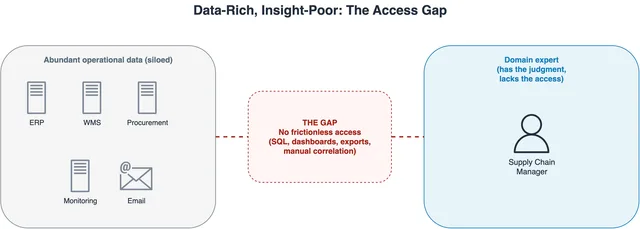
    Diagram showing domain expertise with business users while operational data is split across ERP, monitoring, procurement, and email systems

    The combination of Amazon Quick and Amazon Bedrock AgentCore turns supply chain data from systems such as ERP, monitoring, and procurement into a conversational MCP tool layer, so users can get cross-system answers in natural language. In the example, a TechComp production stoppage event is assessed via assess disruption impact, which finds a $750K risk, 23 orders, and three days of inventory, and recommend mitigation then chains together governance and quoting tools to generate an emergency RFQ

    Matched fieldsBody

  2. t3n

    AI agents: Developer builds Geneva digital twin with Claude

    Since July 2026, Swiss developer Arnaud Ricci has used models such as Claude to drive up to 15 AI agents and, in about three months, built Genève 3D, a digital twin application for the canton of Geneva. He believes that without AI agents, the project would have taken two to three years. The browser application is based on a self-developed Three.js engine and integrates data from more than 15 organizations, including SITG, OpenStreetMap, MeteoSwiss, Swisstopo, EUMETSAT, and NASA. It can render buildings, roads, and trees in 3D, as well as running buses, trains, and aircraft and real-time weather. Because vehicle positions are estimated only from official timetables and delay information, with no real-time GPS positioning, the map is not suitable for actual travel planning.

    Since July 2026, Swiss developer Arnaud Ricci has used models such as Claude to drive up to 15 AI agents and, in about three months, built Genève 3D, a digital twin application for the canton of Geneva. He believes that without AI agents, the project would have taken two to three years. The browser application is based on a self-developed Three.js engine and integrates data from more than 15 organizations, including SITG, OpenStreetMap, MeteoSwiss, Swisstopo, EUMETSAT, and NASA. It can render bu

    Matched fieldsBody

  3. 36Kr · AISelected

    OpenAI advances roughly $30 billion funding round, aiming to lock in investors ahead of Anthropic's IPO

    According to Reuters, OpenAI is accelerating a roughly $30 billion funding round, targeting a valuation above $1.4 trillion, seeking to lock in investors before Anthropic's expected mid-November IPO; existing investors including SoftBank and Abu Dhabi's MGX are in talks to participate. OpenAI told investors that growth accelerated after the release of GPT-6 Astra, with annualized revenue already at $50 billion and expected to rise to $70 billion by year-end; Anthropic said its third-quarter revenue rose from $11.6 billion to $16.8 billion, but slowing month-over-month growth has raised valuation concerns. The two also differ on revenue recognition: OpenAI recognizes revenue on a net basis and has accused Anthropic of recognizing revenue on a gross basis under third-party cloud vendor contracts.

    According to Reuters, OpenAI is accelerating a roughly $30 billion funding round, targeting a valuation above $1.4 trillion, seeking to lock in investors before Anthropic's expected mid-November IPO; existing investors including SoftBank and Abu Dhabi's MGX are in talks to participate. OpenAI told investors that growth accelerated after the release of GPT-6 Astra, with annualized revenue already at $50 billion and expected to rise to $70 billion by year-end; Anthropic said its third-quarter reve

    Matched fieldsBody

  4. Fortune AI

    Idealab founder Bill Gross opens free access to 1.2 million AI-generated business ideas

    Idealab founder and CEO Bill Gross has launched idealab.ai, offering free access to 1.2 million AI-generated business ideas. These ideas were generated by combining 31 ideation methodologies with roughly 17 million source documents, including news articles, research reports, expired patents, public company filings, and community discussions. Users can search by industry, skill, interest, and region, and can also upload a résumé or LinkedIn profile to receive personalized ideas. Gross believes the surge in entrepreneurship brought about by AI can partially offset its impact on employment.

    Idealab founder and CEO Bill Gross has launched idealab.ai, offering free access to 1.2 million AI-generated business ideas. These ideas were generated by combining 31 ideation methodologies with roughly 17 million source documents, including news articles, research reports, expired patents, public company filings, and community discussions. Users can search by industry, skill, interest, and region, and can also upload a résumé or LinkedIn profile to receive personalized ideas. Gross believes th

    Matched fieldsBody

  5. Thurrott

    Gemini Personal Intelligence comes to Android Auto and built-in Google cars

    Gemini's Personal Intelligence feature is beginning to roll out to Android Auto; once enabled, it can connect to user data in Gmail, Google Calendar, Google Photos and Google Search to provide more personalized answers. The feature is entirely opt-in in Gemini settings, and in the coming months it will also arrive on built-in Google cars that run Google's in-car system directly. Karan Daryanani, a senior Google product manager, said the feature's two core capabilities are extracting specific details from emails, photos or saved places in Google Maps, and reasoning across complex sources.

    Gemini's Personal Intelligence feature is beginning to roll out to Android Auto; once enabled, it can connect to user data in Gmail, Google Calendar, Google Photos and Google Search to provide more personalized answers. The feature is entirely opt-in in Gemini settings, and in the coming months it will also arrive on built-in Google cars that run Google's in-car system directly. Karan Daryanani, a senior Google product manager, said the feature's two core capabilities are extracting specific det

    Matched fieldsBody

  6. SiliconANGLE

    Otter.ai Raises $320 Million to Fund Its AI Meeting Assistant

    Otter.ai announced it has raised $320 million, with all funding coming from General Catalyst's Customer Value Fund, which takes no equity and instead shares in the revenue it helps generate. Its AI meeting assistant supports speaker-identified transcription, one-page summaries and action items, and can provide files to chatbots such as ChatGPT through an MCP server. The platform has more than 40 million users worldwide and reaches employees at over 86% of Fortune 500 companies.

    Matched fieldsBody

  7. Claude Code:GitHub Releases

    Claude Code v2.1.305 Released

    Claude Code v2.1.305 fixes a regression introduced in 2.1.304: when providers or gateways such as Vertex and Bedrock reject tool search, all requests would fail; it now automatically retries and skips that feature. Added the sandbox.allowNestedUserNamespaces option, which allows Linux sandbox commands to create user namespaces, and improved the /usage warning into a one-line fix prompt that can be applied by pressing f.

    Matched fieldsBody

  8. PyTorch Blog

    From KTIR to SpyreCode: IBM Spyre's MLIR Dataflow Backend

    torch-spyre's backend compiler uses KTIR (Kernel Tile IR) to take over the parallel partitioning already determined by Inductor, and then the open-source Dataflow Scheduler breaks each tile's work into programs, progressively expanding from a load → compute → store pipeline into nested, double-buffered, multi-instance scheduling, outputting DataflowIR and generating SpyreCode. KTIR targets Spyre hardware with 32 cores and 2 MB of scratchpad per core, moving data in 128-byte sticks; the scheduler and its dialects are open-sourced under Apache-2.0.

    torch-spyre's backend compiler uses KTIR (Kernel Tile IR) to take over the parallel partitioning already determined by Inductor, and then the open-source Dataflow Scheduler breaks each tile's work into programs, progressively expanding from a load → compute → store pipeline into nested, double-buffered, multi-instance scheduling, outputting DataflowIR and generating SpyreCode. KTIR targets Spyre hardware with 32 cores and 2 MB of scratchpad per core, moving data in 128-byte sticks; the scheduler

    Matched fieldsBody

  9. PyTorch BlogSelected

    Google and Meta jointly launch TorchTPU, enabling PyTorch to run natively on TPUs

    Google and Meta's PyTorch teams have collaborated to launch the open-source project TorchTPU, providing a native PyTorch backend for Google TPUs; migration only requires changing model.to("cuda") to model.to("tpu"). The project supports both eager and torch.compile modes, adds a new DeferAndFuse eager mode, covers about 450 Aten operators, and has been verified to run out of the box on 4,917 Hugging Face models, with a Tier 1 pass rate of 98% and Tier 2 numerical consistency relative to GPUs of 97%. According to the official announcement, it has already been used in the inference and training production workloads of some major Google Cloud customers, and is integrated with vLLM, SGLang, TorchTitan, Ray, and TorchRec.

    Google and Meta's PyTorch teams have collaborated to launch the open-source project TorchTPU, providing a native PyTorch backend for Google TPUs; migration only requires changing model.to("cuda") to model.to("tpu"). The project supports both eager and torch.compile modes, adds a new DeferAndFuse eager mode, covers about 450 Aten operators, and has been verified to run out of the box on 4,917 Hugging Face models, with a Tier 1 pass rate of 98% and Tier 2 numerical consistency relative to GPUs of

    Matched fieldsBody

Tuesday

  1. ElevenLabs Blog

    How to Transcribe Podcasts with AI: A Step-by-Step Guide

    ElevenLabs has released a guide introducing a five-step process for transcribing podcasts with AI: export the audio, choose a method, upload and configure, review the output, and export the file. Its Scribe v2 supports more than 90 languages and up to 32 speakers per file; the web version has a 3GB per-file limit, and standard mode can process recordings up to 10 hours long. SRT and VTT are suited to podcast apps and subtitles, while plain text or HTML is better for websites and blogs.

    Four benefits of podcast transcripts: accessibility, search, repurposing, and archives.

    Matched fieldsBody

  2. Google BlogSelected

    Google Brings Gemini and Personal Intelligence to Global In-Car Scenarios

    Google announced that Gemini is now available globally on Android Auto and in cars with Google built in, and has begun rolling out Personal Intelligence, which, with authorization, can connect to Workspace (including Gmail and Google Calendar), Google Photos, Google Maps, YouTube, and Search to answer questions such as flight gate numbers, restaurants along the route, and locations in photos. Personal Intelligence begins rolling out on Android Auto today, with cars with Google built in to follow over the coming months. It is currently available to eligible personal Google accounts for users aged 18 and over, excludes Workspace business, enterprise, and education users, and is not available in the European Economic Area, Switzerland, the United Kingdom, or Nigeria.

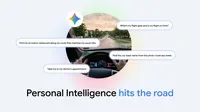
    Center of image is a photo of a 1st-person point of view of driving a car. On the circumference of the circle are the Gemini logo and various prompts. The bottom of the image has the text "Personal Intelligence hits the road".

    Google announced that Gemini is now available globally on Android Auto and in cars with Google built in, and has begun rolling out Personal Intelligence, which, with authorization, can connect to Workspace (including Gmail and Google Calendar), Google Photos, Google Maps, YouTube, and Search to answer questions such as flight gate numbers, restaurants along the route, and locations in photos. Personal Intelligence begins rolling out on Android Auto today, with cars with Google built in to follow

    Matched fieldsBody

  3. The New StackSelected

    DeepSeek open-sources DeepInfer, the inference engine behind its API, with support for both Nvidia and Huawei Ascend

    DeepSeek has open-sourced DeepInfer, its in-house inference framework used to serve its models in production. Released under the Apache 2.0 license, it lets developers run DeepSeek-V4.1-Flash on their own infrastructure, with support for subsequent models planned. The framework includes optimized compute kernels and communication libraries such as FlashMLA, DeepGEMM, and DeepEP, supports speculative decoding, asynchronous scheduling, and structured output, and also open-sources the deepseek-recipe library (available in Rust and Python versions) for handling request and response transformations. On the hardware side, it supports Nvidia SM100 (Blackwell) architecture and the Huawei Ascend 950 NPU series from day one; older architectures such as Hopper are not listed. Batch-invariant inference and deterministic sampling are available only on Nvidia hardware, and the published performance data is also based on Nvidia GPUs. The current version supports offline inference but lacks complete production serving components such as KV cache management, cross-machine inference stage separation, and replica load balancing.

    DeepSeek has open-sourced DeepInfer, its in-house inference framework used to serve its models in production. Released under the Apache 2.0 license, it lets developers run DeepSeek-V4.1-Flash on their own infrastructure, with support for subsequent models planned. The framework includes optimized compute kernels and communication libraries such as FlashMLA, DeepGEMM, and DeepEP, supports speculative decoding, asynchronous scheduling, and structured output, and also open-sources the deepseek-reci

    Matched fieldsBody

  4. OpenAI: Alignment Research Blog

    OpenAI proposes complementary monitorability metrics beyond g-mean²

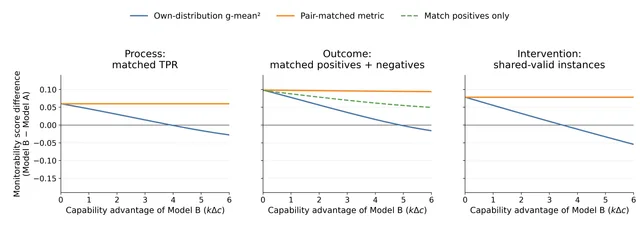
    OpenAI proposes two complementary metrics beyond g-mean²: the pair-matched metric compares monitorability only on instances jointly supported by multiple models, while the post-control risk metric simulates the probability that the system still produces harmful outputs after the monitor rejects outputs. g-mean² was previously used to measure a monitor's ability to distinguish positive from negative samples, but because different models have different subsets of valid positive tasks, scores may reflect different task mixtures. The article notes that if the monitor is used as a deployment control measure, the model can retry after being rejected, and the risk depends on the frequency of harmful behavior, which outputs the monitor accepts, and the number of allowed attempts.

    Pair matching isolates monitorability from capability-driven instance selection

    OpenAI proposes two complementary metrics beyond g-mean²: the pair-matched metric compares monitorability only on instances jointly supported by multiple models, while the post-control risk metric simulates the probability that the system still produces harmful outputs after the monitor rejects outputs. g-mean² was previously used to measure a monitor's ability to distinguish positive from negative samples, but because different models have different subsets of valid positive tasks, scores may r

    Matched fieldsBody

  5. Google Blog

    Google launches a small business hub and brand and finance tools for Gemini

    Google has launched a business landing page for Gemini aimed at small business owners, where they can manage branding, finances, and customer insights, and connect Google Business Profile, Google Ads, Google Workspace, as well as third-party apps such as Adobe, Canva, Dropbox, Shopify, Wix, Zoho, and Xero. Users can define their brand style by uploading their website, brand kit, fonts, or color palettes, and with Nano Banana 2.1 generate marketing visuals with a consistent style; Gemini can also turn spreadsheets, receipts, and purchase records into financial charts and interactive models. These features will roll out gradually worldwide to all Gemini app users over the coming days.

    "Your brand, your tools, all in one place" banner featuring three feature highlights: "Create image styles for your brand," "Customize Gemini with apps and skills," and "Create content with templates."

    Google has launched a business landing page for Gemini aimed at small business owners, where they can manage branding, finances, and customer insights, and connect Google Business Profile, Google Ads, Google Workspace, as well as third-party apps such as Adobe, Canva, Dropbox, Shopify, Wix, Zoho, and Xero. Users can define their brand style by uploading their website, brand kit, fonts, or color palettes, and with Nano Banana 2.1 generate marketing visuals with a consistent style; Gemini can also

    Matched fieldsBody

  6. METR BlogSelected

    METR reviews the misalignment risk chapter of Anthropic's August 2026 risk report

    METR conducted an external review of the "Misalignment in high-risk scenarios" chapter in the August 2026 edition of Anthropic's risk report. It agreed that the catastrophic misalignment risk of the covered models (including Mythos 5 and the internal model Model 2) is low, but held that this is mainly due to limited model capabilities rather than safeguards and alignment training. METR pointed out that the covert capability benchmark in the report cannot represent a model's ability to evade Anthropic's internal monitoring systems, and stated that recent events weaken the report's argument that unknown severe situational misalignment is "unlikely." METR also recommended disclosing four redacted pieces of information and conducting end-to-end red-team testing of the monitoring system.

    METR conducted an external review of the "Misalignment in high-risk scenarios" chapter in the August 2026 edition of Anthropic's risk report. It agreed that the catastrophic misalignment risk of the covered models (including Mythos 5 and the internal model Model 2) is low, but held that this is mainly due to limited model capabilities rather than safeguards and alignment training. METR pointed out that the covert capability benchmark in the report cannot represent a model's ability to evade Anth

    Matched fieldsBody