←Search results

By relevance · Total 1579 results Clear search

Friday

  1. OpenAI: Deployment Safety and System Card

    GPT-6 Luna October 29 Update: System Card Supplementary Notes

    OpenAI released the GPT-6 Luna (October 29) update, which responds more concisely and reduces overly sycophantic phrasing; under the Preparedness Framework it is still rated High for both cybersecurity and biochemical capabilities, and it uses the same set of safeguards as GPT-6 Luna (October 7). This version improves over the previous version on the gore evaluation in Production Benchmarks, achieving a Pareto improvement between safely handling harmful requests and helpfulness; in the U18 evaluation it improves on sexual content, eating disorders, emotional dependence, and gore, and in the instruction hierarchy evaluation it reaches 99.91% robustness.

    Figure 1. Safety and non-overrefusal on challenging prompts. Higher is better
on both axes

    OpenAI released the GPT-6 Luna (October 29) update, which responds more concisely and reduces overly sycophantic phrasing; under the Preparedness Framework it is still rated High for both cybersecurity and biochemical capabilities, and it uses the same set of safeguards as GPT-6 Luna (October 7). This version improves over the previous version on the gore evaluation in Production Benchmarks, achieving a Pareto improvement between safely handling harmful requests and helpfulness; in the U18 evalu

    Matched fieldsBody
  2. English text is being prepared.

    Google AI coding assistant Jules will gradually be discontinued, with its experience merged into Antigravity

    Google has announced that it will gradually discontinue Jules, the AI coding assistant launched in December 2024, and apply the experience gained from the tool to Antigravity, its agent-first development platform. Jules's official X account said that Jules was originally an experiment to understand how asynchronous coding agents can help developers ship faster, and that in the future it will merge remote background task execution with an agent-centric development environment into a unified experience. Antigravity was launched by Google DeepMind on November 18, 2025, and is a standalone IDE distributed as a VS Code fork, supporting Windows, macOS, and Linux.

    Google has announced that it will gradually discontinue Jules, the AI coding assistant launched in December 2024, and apply the experience gained from the tool to Antigravity, its agent-first development platform. Jules's official X account said that Jules was originally an experiment to understand how asynchronous coding agents can help developers ship faster, and that in the future it will merge remote background task execution with an agent-centric development environment into a unified exper

    Matched fieldsBody

  3. Ant inclusionAI: New GitHub repository

    Ant inclusionAI Open-Sources the ZwZ Model Family and the ZoomBench Fine-Grained Perception Benchmark (ICML 2026)

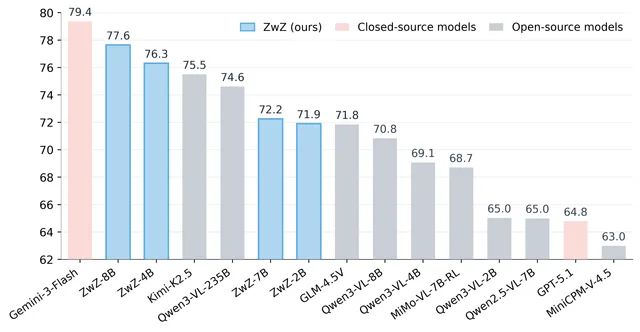
    Ant inclusionAI has released the ZwZ model family (4/7/8B) accompanying its ICML 2026 paper, achieving SOTA on multimodal perception benchmarks among open-source models, while requiring only a single forward inference pass and no tool calls at inference time. The method is Region-to-Image Distillation (R2I), which distills high-quality VQA supervision generated from enlarged local regions back into the full image, with 37K training samples. It also introduces ZoomBench, containing 845 VQA items covering 6 fine-grained perception dimensions, on which Qwen2.5-VL-7B achieves only 42.5% average accuracy.

    gp_avg_comparison

    Ant inclusionAI has released the ZwZ model family (4/7/8B) accompanying its ICML 2026 paper, achieving SOTA on multimodal perception benchmarks among open-source models, while requiring only a single forward inference pass and no tool calls at inference time. The method is Region-to-Image Distillation (R2I), which distills high-quality VQA supervision generated from enlarged local regions back into the full image, with 37K training samples. It also introduces ZoomBench, containing 845 VQA items

    Matched fieldsBody

  4. Ant Group inclusionAI: New GitHub Repository

    Ant Group's inclusionAI Open-Sources 2B Visual Forensics Model DefakerOne2

    Ant Group's GuangJian team has open-sourced DefakerOne2 on GitHub, a 2B-parameter unified visual forensics model built on the Qwen3.5-2B multimodal backbone, covering AI-generated content, DeepFake faces, document tampering, natural image tampering, face and ID anti-counterfeiting, and AI-generated video detection. The model was trained on approximately 50 million samples, employs a three-stage Tide-Style Tuning process from LoRA to full parameters and back to LoRA, and uses entropy-based test-time routing to select between the video and frame pathways. The team claims that it achieves SOTA on 40 of 53 detection benchmarks and on 11 of 14 localization benchmarks, and that the weights and the RRVBench benchmark have been released on ModelScope.

    GitHub

    Ant Group's GuangJian team has open-sourced DefakerOne2 on GitHub, a 2B-parameter unified visual forensics model built on the Qwen3.5-2B multimodal backbone, covering AI-generated content, DeepFake faces, document tampering, natural image tampering, face and ID anti-counterfeiting, and AI-generated video detection. The model was trained on approximately 50 million samples, employs a three-stage Tide-Style Tuning process from LoRA to full parameters and back to LoRA, and uses entropy-based test-t

    Matched fieldsBody

  5. AWS Machine Learning

    How MoEngage Used AgentCore Gateway to Turn Over 400 APIs into Agent Tools

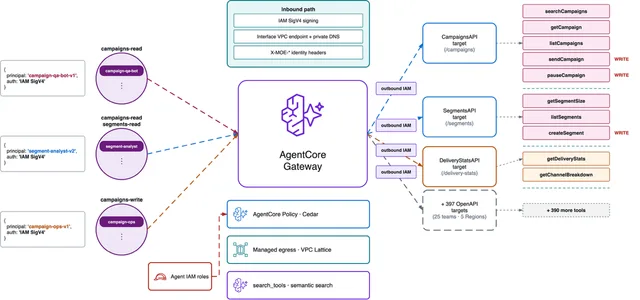
    Using Amazon Bedrock AgentCore Gateway, MoEngage converted approximately 400 internal REST APIs distributed across private VPCs in 7 AWS Regions into permission-controlled agent tools, saving about 6 months of platform engineering effort and reducing new API onboarding from several days to a few hours. The solution requires no MCP server code from product teams, no per-integration network configuration, and involves no public endpoints anywhere in the path. MoEngage also established a principle: engineering teams only maintain OpenAPI specs, while the AI platform team is solely responsible for the MCP layer.

    AgentCore Gateway architecture: agent services reach the gateway through a private VPC interface endpoint, which evaluates Cedar policies and routes calls over Amazon VPC Lattice to internal APIs

    Using Amazon Bedrock AgentCore Gateway, MoEngage converted approximately 400 internal REST APIs distributed across private VPCs in 7 AWS Regions into permission-controlled agent tools, saving about 6 months of platform engineering effort and reducing new API onboarding from several days to a few hours. The solution requires no MCP server code from product teams, no per-integration network configuration, and involves no public endpoints anywhere in the path. MoEngage also established a principle:

    Matched fieldsBody

  6. AWS Machine Learning

    Building a Repeatable PHP-to-Java Migration Engine with Kiro

    AWS describes building a repeatable PHP-to-Java migration engine with Kiro: the migration methodology and discovery scanner are encapsulated as skill files, using an eight-phase process and a parity harness to verify that the Java port behaves consistently with the original PHP application. The same set of skill files can be used for interactive, application-by-application migration in Kiro, or handed to AWS Transform to run as parallel tasks at portfolio scale. Running requires PHP 8.0 or later, and the generated Spring Boot project requires Java 21 and Maven.

    Workspace architecture: one shared brain, many projects. Diagram of the workspace layout. At the top is the Kiro workspace root, PHP-Java-Migration. Below it, a shared, global layer under .kiro/ holds the skills (the methodology) and the steering file (the governing workflow), and applies to every project. Beneath that, three per-project folders each hold their own spec sub-folder, and the diagram notes that improving the shared layer once benefits every project.

    AWS describes building a repeatable PHP-to-Java migration engine with Kiro: the migration methodology and discovery scanner are encapsulated as skill files, using an eight-phase process and a parity harness to verify that the Java port behaves consistently with the original PHP application. The same set of skill files can be used for interactive, application-by-application migration in Kiro, or handed to AWS Transform to run as parallel tasks at portfolio scale. Running requires PHP 8.0 or later

    Matched fieldsBody

  7. Shanghai Observer

    Changxin Fund Deploys Tencent WorkBuddy: A Team of Under 300 Achieves 80% Monthly Active Usage, Building an Organization-Level AI Model for Public Funds

    Since deploying Tencent WorkBuddy in June 2026, Changxin Fund has achieved coverage across all business lines within a team of fewer than 300 people, with internal monthly active usage reaching 80%. The product supports VPC and private deployment, permissions refined down to individuals and data sources, full-link audit logs, and mandatory invocation of local models in sensitive scenarios. The turnaround for segregated account operation reports has been compressed from five or six hours to one or two hours, and factor reproduction for a single research report has been shortened from several days to several hours. Shen Wei, Chief Information Officer of Changxin Fund, proposed that AI tools themselves account for only 30%, with the remaining 70% lying in data governance, institutional development, knowledge management, and organizational mobilization.

    Since deploying Tencent WorkBuddy in June 2026, Changxin Fund has achieved coverage across all business lines within a team of fewer than 300 people, with internal monthly active usage reaching 80%. The product supports VPC and private deployment, permissions refined down to individuals and data sources, full-link audit logs, and mandatory invocation of local models in sensitive scenarios. The turnaround for segregated account operation reports has been compressed from five or six hours to one o

    Matched fieldsBody

  8. MarkTechPost

    Baseten Releases 2B Decision Model joey-1, Priced at $0.01 per Million Tokens

    Baseten's Base Labs has released a 2B decision model, joey-1, post-trained on Qwen3.5-2B, which directly returns labels and calibrated probabilities instead of generating text, targeting high-concurrency routing, classification, and guardrail checks. The model scores 63.30 on the public Jev Decision Index 0.4 set, the highest among models under 4B, but 8.94 points lower than the 9B elephant-1. Model APIs are priced at $0.01 per million input tokens, with a P50 latency of 20 ms for an average 2000-token request; the weights are open-sourced under the MIT license on Hugging Face and can be self-hosted on a single CUDA GPU.

    Baseten's Base Labs has released a 2B decision model, joey-1, post-trained on Qwen3.5-2B, which directly returns labels and calibrated probabilities instead of generating text, targeting high-concurrency routing, classification, and guardrail checks. The model scores 63.30 on the public Jev Decision Index 0.4 set, the highest among models under 4B, but 8.94 points lower than the 9B elephant-1. Model APIs are priced at $0.01 per million input tokens, with a P50 latency of 20 ms for an average 200

    Matched fieldsBody

Wednesday

  1. Official Pydantic AI articleSelected

    Pydantic compares code mode and tool calling across 5,276 runs

    Michael Pfaffenberger of Pydantic used 5 small Pydantic AI applications and 8 models to conduct 5,276 scored runs, comparing code mode with direct tool calling. On long tasks, code mode reduced average cost by 58%, latency by 51%, and increased success rate by 16 percentage points; however, for short tasks with 5 items, 3 out of 5 tasks were instead 21% to 38% more expensive. The author argues that models are better at writing loops than at acting as the loop, and the gap widens as tasks get longer.

    Michael Pfaffenberger avatar

    Michael Pfaffenberger of Pydantic used 5 small Pydantic AI applications and 8 models to conduct 5,276 scored runs, comparing code mode with direct tool calling. On long tasks, code mode reduced average cost by 58%, latency by 51%, and increased success rate by 16 percentage points; however, for short tasks with 5 items, 3 out of 5 tasks were instead 21% to 38% more expensive. The author argues that models are better at writing loops than at acting as the loop, and the gap widens as tasks get lon

    Matched fieldsBody

  2. Hugging FaceSelected

    NVIDIA Releases Nemotron 3.5 Transcribe and Granary v2 Data Pipeline

    NVIDIA has released the open-weight model Nemotron 3.5 Transcribe on Hugging Face and ModelScope, integrating transcription, speaker diarization, translation, and audio question answering into a single checkpoint. It supports transcription in 40 languages, translation between 31 languages and English, and speaker labeling in 13 languages, can process recordings up to 1 hour long, and can label up to 8 speakers. The model ranks first among open-weight models on the English leaderboard of the Hugging Face Open ASR Leaderboard with an average WER of 5.33%, and achieves 2.8% AA-WER on Artificial Analysis with approximately 4B activated parameters. The simultaneously released Granary v2 covers 48 languages and 463,062 hours of speech data, and the accompanying NeMo Speech fine-tuning recipe reduced WER on held-out speakers from 22.44% to 12.17% in a medical case.

    NVIDIA has released the open-weight model Nemotron 3.5 Transcribe on Hugging Face and ModelScope, integrating transcription, speaker diarization, translation, and audio question answering into a single checkpoint. It supports transcription in 40 languages, translation between 31 languages and English, and speaker labeling in 13 languages, can process recordings up to 1 hour long, and can label up to 8 speakers. The model ranks first among open-weight models on the English leaderboard of the Hugg

    Matched fieldsBody

  3. MIT Tech Review

    The Download: Data from failed startups is being sold to AI labs, and cross-species communication

    MIT Tech Review's The Download notes that firms that help shut down startups are selling the codebases and workspace data of failed companies to AI labs, with Keelan Miskell using this to sell companies' digital archives for tens of thousands of dollars. As training labs hit the limits of public and synthetic datasets, buyers are turning to real-world records to train AI agents, and such deals are also sparking legal and ethical controversy. This issue also looks at AI-assisted cross-species communication research, and the US and China racing to build lunar bases.

    MIT Tech Review's The Download notes that firms that help shut down startups are selling the codebases and workspace data of failed companies to AI labs, with Keelan Miskell using this to sell companies' digital archives for tens of thousands of dollars. As training labs hit the limits of public and synthetic datasets, buyers are turning to real-world records to train AI agents, and such deals are also sparking legal and ethical controversy. This issue also looks at AI-assisted cross-species com

    Matched fieldsBody

  4. Simon Willison

    Simon Willison: October 2026 is the inflection point for vibe coding game development

    Simon Willison believes that October 2026 is the inflection point for vibe coding game development. Claude Opus 5.5 has made notable improvements in 3D modeling, music generation, and game design. After having the model make games more fun, he spent a few weeks building four browser games he genuinely wants to play. Each of these projects took no more than four hours of investment, and all were built with HTML and JavaScript and run in the browser; he suggests starting with prompts like "Build a mobile-friendly three.js game where..." and switching to Claude Code or Codex once a project gets past the prototype stage.

    Simon Willison believes that October 2026 is the inflection point for vibe coding game development. Claude Opus 5.5 has made notable improvements in 3D modeling, music generation, and game design. After having the model make games more fun, he spent a few weeks building four browser games he genuinely wants to play. Each of these projects took no more than four hours of investment, and all were built with HTML and JavaScript and run in the browser; he suggests starting with prompts like "Build a

    Matched fieldsBody

Thursday

  1. Latent SpaceSelected

    Google DeepMind releases Gemini 4 Carbon, topping Artificial…

    Google DeepMind has released Gemini 4 Carbon, which ranks first on the Artificial Analysis Intelligence Index v5 with a score of 59 and leads in 4 of 9 evaluations including HLE-Diamond and TB-Science. The model focuses on cybersecurity and long-horizon tasks, claiming 88.2% on SEC-bench Pro, 54.8% on ExploitGym, and 71.0% on CWE-bench, and is initially available only to trusted cybersecurity personnel through the Fairwind Program. In terms of specifications, it supports a 1M token context and 1M maximum output, with input covering text, images, video, and speech, and output in text; Artificial Analysis lists a standard price of $4/$20 per million input/output tokens, plus a 50% launch discount.

    Google DeepMind has released Gemini 4 Carbon, which ranks first on the Artificial Analysis Intelligence Index v5 with a score of 59 and leads in 4 of 9 evaluations including HLE-Diamond and TB-Science. The model focuses on cybersecurity and long-horizon tasks, claiming 88.2% on SEC-bench Pro, 54.8% on ExploitGym, and 71.0% on CWE-bench, and is initially available only to trusted cybersecurity personnel through the Fairwind Program. In terms of specifications, it supports a 1M token context and 1

    Matched fieldsBody

  2. Hugging Face

    AnySpeechRecognizer and AnyDecisionModel: Open-source speech and decision models for the Apple platform

    AnySpeechRecognizer supports engine switching on top of the Apple SpeechAnalyzer API, with options including NVIDIA Parakeet TDT 0.6B v3 (supporting 25 European languages), Moondream post-trained Parakeet Ultra, the English version Parakeet Unified, and Alibaba Qwen3-ASR (0.6B/1.7B, covering 30 languages and 22 Chinese dialects). These models have been converted to Core ML and published on the Hugging Face Hub; Parakeet takes about 20–40 seconds to transcribe 1 hour of audio, while Qwen3-ASR is slower and requires several GB of memory. The package also adds a speaker diarization module, SpeakerDiarizer, which the Apple framework lacks; it is based on NVIDIA Streaming Sortformer and can track up to 4 speakers.

    AnySpeechRecognizer supports engine switching on top of the Apple SpeechAnalyzer API, with options including NVIDIA Parakeet TDT 0.6B v3 (supporting 25 European languages), Moondream post-trained Parakeet Ultra, the English version Parakeet Unified, and Alibaba Qwen3-ASR (0.6B/1.7B, covering 30 languages and 22 Chinese dialects). These models have been converted to Core ML and published on the Hugging Face Hub; Parakeet takes about 20–40 seconds to transcribe 1 hour of audio, while Qwen3-ASR is

    Matched fieldsBody

  3. Baseten Engineering Blog

    Baseten Optimizes Qwen3-ASR Batch Transcription, Boosting Single-GPU Throughput by 7x

    The Baseten engineering team, through native audio decoding, KV cache FP8 quantization, and reduced host-device synchronization, increased batch transcription throughput for Qwen3-ASR 1.7B on a single RTX PRO 6000 by 7x and reduced latency by 6.9x. After optimization, the transcription cost for one hour of audio is approximately $0.0013, i.e., 1/10 of a cent per audio hour, with no significant change in word error rate. The optimized version has been made the default deployment in the Baseten Model Library and can be called through an OpenAI-compatible transcription client.

    How Baseten gets 7x throughput on Qwen3-ASR batch transcription

    The Baseten engineering team, through native audio decoding, KV cache FP8 quantization, and reduced host-device synchronization, increased batch transcription throughput for Qwen3-ASR 1.7B on a single RTX PRO 6000 by 7x and reduced latency by 6.9x. After optimization, the transcription cost for one hour of audio is approximately $0.0013, i.e., 1/10 of a cent per audio hour, with no significant change in word error rate. The optimized version has been made the default deployment in the Baseten Mo

    Matched fieldsBody

  4. Ben's Bites

    Ben's Bites author reflects: AI is overwhelming, and I've been using it the wrong way

    Ben's Bites author Ben Tossell published a post reflecting on his struggle of being overwhelmed by AI tools and multiple agents and repeatedly overturning his direction, and announced that for the next 30 days he will only use agents for things he finds interesting, will not introduce new tools that don't solve real pain points, will not summarize long articles, and will not do things for the sake of making money. He also mentioned that Google released Gemini 4 Carbon and the world model Genie 4, as well as a test in which experts followed an agent's random choices 86% of the time.

    Ben's Bites author Ben Tossell published a post reflecting on his struggle of being overwhelmed by AI tools and multiple agents and repeatedly overturning his direction, and announced that for the next 30 days he will only use agents for things he finds interesting, will not introduce new tools that don't solve real pain points, will not summarize long articles, and will not do things for the sake of making money. He also mentioned that Google released Gemini 4 Carbon and the world model Genie 4

    Matched fieldsBody

  5. The PaperSelected

    Google Releases Gemini 4 Carbon, Strengthening Cybersecurity and Long-Running Agent Workflows

    Two weeks after the debut of Gemini 4 Argon, Google released a new-generation frontier model, Gemini 4 Carbon, saying it achieves the current highest level in cybersecurity and long-horizon tasks, with enhancements for coding, Agent workflows, and cyber defense. The model scored 88.2% on the vulnerability discovery benchmark SEC-bench Pro, 54.8% on the exploit benchmark Exploit Gym, and 71.0% on the patch application benchmark CWE-bench. Carbon will first be made available this week to some cybersecurity defenders, then expanded to more trusted partners, and only afterward released to developers, enterprises, and consumers; during the trial period it follows Argon pricing at $2 per million input tokens and $10 per million output tokens, adjusted to $4 and $20 after the trial period.

    Two weeks after the debut of Gemini 4 Argon, Google released a new-generation frontier model, Gemini 4 Carbon, saying it achieves the current highest level in cybersecurity and long-horizon tasks, with enhancements for coding, Agent workflows, and cyber defense. The model scored 88.2% on the vulnerability discovery benchmark SEC-bench Pro, 54.8% on the exploit benchmark Exploit Gym, and 71.0% on the patch application benchmark CWE-bench. Carbon will first be made available this week to some cybe

    Matched fieldsBody

  6. TechSpot

    Valve Refuses to Ban AI Games on Steam, Says It Only Requires Disclosure and Will Continue Investigating

    Speaking at a developer Q&A at the 2026 Busan Indie Connect Festival, Valve said that although Steam users are increasingly complaining about AI-generated assets and vibe-coded games, the company still will not ban AI games and only requires developers to disclose their use of generative AI. Valve's Tom Giardino said he had heard for the first time that a developer received an extortion email threatening to publish AI clone games, and promised to investigate and advised those affected to contact law enforcement. Valve also explained that Next Fest's homepage displays games almost randomly during the first two days, so more low-quality content surfaces, but stressed that this keeps things fair and that the company is still thinking about solutions.

    Speaking at a developer Q&A at the 2026 Busan Indie Connect Festival, Valve said that although Steam users are increasingly complaining about AI-generated assets and vibe-coded games, the company still will not ban AI games and only requires developers to disclose their use of generative AI. Valve's Tom Giardino said he had heard for the first time that a developer received an extortion email threatening to publish AI clone games, and promised to investigate and advised those affected to contact

    Matched fieldsBody

  7. MarkTechPost

    MiniMax Open-Sources MCode Stack: 17 Agent Skills and 5 Checklists

    On October 28, MiniMax open-sourced MCode Stack under the MIT license, including the 17 SKILL.md skills and 5 checklists its team used to build MiniMax Code, but not the MiniMax Code source code. The skills are grouped into planning and decomposition, context and tools, long sessions and commands, review, and experiments and hotfixes, among which independent-review provides reviewers only with the diff, requirements, and test results. It can be installed into MiniMax Code by copying the skill directories, via a local plugin, or through the plugin marketplace, and can also be installed in Claude Code with /plugin marketplace add MiniMax-AI/mcode-stack; the original article did not publish evaluation results.

    On October 28, MiniMax open-sourced MCode Stack under the MIT license, including the 17 SKILL.md skills and 5 checklists its team used to build MiniMax Code, but not the MiniMax Code source code. The skills are grouped into planning and decomposition, context and tools, long sessions and commands, review, and experiments and hotfixes, among which independent-review provides reviewers only with the diff, requirements, and test results. It can be installed into MiniMax Code by copying the skill di

    Matched fieldsBody

  8. MarkTechPost

    NVIDIA Releases Nemotron 3.5 Transcribe: An Open-Source 30B MoE Speech Model…

    NVIDIA has released Nemotron 3.5 Transcribe, an open-weight large speech model that supports 40 languages and up to 1 hour of audio per pass, and can select output formats such as verbatim, written, speaker-labeled, contextual, and translation via text instructions. The model has approximately 34B total parameters and about 4.3B activated parameters, adopts a hybrid Mamba-Transformer MoE architecture, can run in BF16 on a single H100 80GB, and the NVFP4 version at about 21GB can run on an RTX 5090. NVIDIA self-reports an average WER of 4.71% across 9 public English Open ASR test sets, the best result among open-weight models, though commercial APIs still lead; its shortcomings are that it only supports offline operation, and the Chinese far-field meeting cpCER is 34.95%.

    NVIDIA has released Nemotron 3.5 Transcribe, an open-weight large speech model that supports 40 languages and up to 1 hour of audio per pass, and can select output formats such as verbatim, written, speaker-labeled, contextual, and translation via text instructions. The model has approximately 34B total parameters and about 4.3B activated parameters, adopts a hybrid Mamba-Transformer MoE architecture, can run in BF16 on a single H100 80GB, and the NVFP4 version at about 21GB can run on an RTX 50

    Matched fieldsBody