English translation is being prepared.
Matched fieldsBody
Matched fieldsBody
Matched fieldsBody
Matched fieldsBody
Matched fieldsBody
Matched fieldsBody
Matched fieldsBody
Anthropic has released an internal research report analyzing AI's impact on the company's hiring and work organization, based on data including hiring, AI usage, output metrics, employee surveys, calendars, and recruiting records, as well as interviews with 17 employees. The report says the share of junior employees in technical departments fell from 21% in early 2025 to 14%, and the share of junior technical roles in hiring dropped from 27% to 9%; by August, interactive AI Agents were working six times as many hours as employees, and per-engineer code commits reached five times the level of six months earlier. Human attention has become the bottleneck on Agent output, employees are shifting toward meta-work of building monitoring and orchestration Agents, and hiring now places more value on autonomy and judgment.
nical departments fell from 21% in early 2025 to 14%, and the share of junior technical roles in hiring dropped from 27% to 9%; by August, interactive AI Agents were working six times as many hours as employees, and per-engineer code commits reached five times the level of six months earlier. Human attention has become the bottleneck on Agent output, employees are shifting toward meta-work of building monitoring and orchestration Agents, and hiring now places more value on autonomy and judgment.
Matched fieldsBody
Matched fieldsBody
Trendos is an AI search visibility platform that helps brands monitor and optimize their presence in AI search engines such as ChatGPT, Gemini, Claude, and Perplexity by scraping LLM conversations at scale. CEO Gintare Rimolaityte says that under AI search, the key to brands being mentioned lies in five major sources: the official website, PR, review platforms such as Trustpilot and G2, affiliates, and social media, and that content needs to answer directly in an FAQ style rather than stuffing keywords.
Trendos is an AI search visibility platform that helps brands monitor and optimize their presence in AI search engines such as ChatGPT, Gemini, Claude, and Perplexity by scraping LLM conversations at scale. CEO Gintare Rimolaityte says that under AI search, the key to brands being mentioned lies in five major sources: the official website, PR, review platforms such as Trustpilot and G2, affiliates, and social media, and that content needs to answer directly in an FAQ style rather than stuffing k
Matched fieldsBody
Matched fieldsBody
Matched fieldsBody
Matched fieldsBody

Matched fieldsBody
LiveKit has released a guide sharing the experience of its solutions architects and forward-deployed engineers in helping customers move voice agent POCs into production systems, centered on three questions: whether the agent is smart and natural enough, whether production performance can be observed, and whether it can scale reliably and at low cost. The guide offers 7 methods, including measuring first-turn response latency separately, splitting context into the part needed for the greeting and the part loaded in the background, and enabling turn_detection=inference.TurnDetector() and adaptive interruption handling by default.

LiveKit has released a guide sharing the experience of its solutions architects and forward-deployed engineers in helping customers move voice agent POCs into production systems, centered on three questions: whether the agent is smart and natural enough, whether production performance can be observed, and whether it can scale reliably and at low cost. The guide offers 7 methods, including measuring first-turn response latency separately, splitting context into the part needed for the greeting an
Matched fieldsBody
Since November 2025, Databricks has been collecting malicious npm samples. Among the 11,413 package-versions scanned and verified, 96.2% hid their payloads in source code or on external servers, and only 3.8% (432) bundled binaries; however, the proportion of such packages for which no clear malicious conclusion could be reached was more than twice that of pure source-code packages (14.4% vs 6.2%). The team evaluated 9 models (including Claude Haiku 4.5, Gemini 3.5 Flash, GPT-5.4-nano, Qwen3-Next 80B, etc.) and injected precomputed static evidence as capability profiles during inference to improve detection quality for both budget-tier and frontier models.
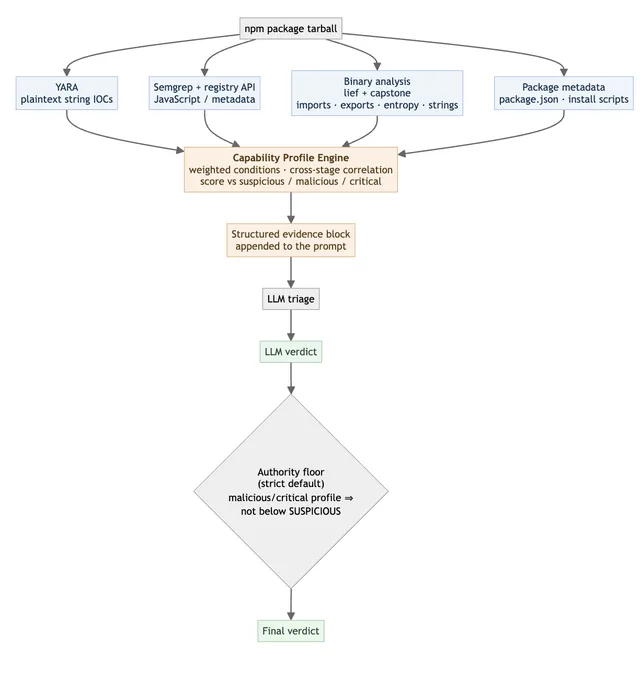
Since November 2025, Databricks has been collecting malicious npm samples. Among the 11,413 package-versions scanned and verified, 96.2% hid their payloads in source code or on external servers, and only 3.8% (432) bundled binaries; however, the proportion of such packages for which no clear malicious conclusion could be reached was more than twice that of pure source-code packages (14.4% vs 6.2%). The team evaluated 9 models (including Claude Haiku 4.5, Gemini 3.5 Flash, GPT-5.4-nano, Qwen3-Nex
Matched fieldsBody
Three authors from Imperial College London have published the paper "Retrieved but Not Read: Understanding Why Search-Augmented LLMs Fail to Use Available Evidence," examining why search-augmented LLMs frequently cite web pages they never actually open. The study tested GPT-5.6 Luna and six open-weight configurations including GLM-5.3-Flash, gpt-oss-120b, gpt-oss-20b, gemma-4-31b, and qwen3-8b using 225 facts that changed after February 16, 2026, finding that models often answer based solely on search snippets without opening the source pages; under the same set of search results, the proportion of cases where no page was opened ranged from 2.6% to 76%, and when Luna used its built-in search, 53.6% of turns relied only on snippets. When answering from snippets alone, outdated answers accounted for 6.4% and misleading citations for 6.4%, whereas when pages were opened and cited, these fell to 1.3% and 2.3% respectively; placing the correct page directly into the prompt significantly reduced errors, but some models still favored old information even when shown the new facts.
Three authors from Imperial College London have published the paper "Retrieved but Not Read: Understanding Why Search-Augmented LLMs Fail to Use Available Evidence," examining why search-augmented LLMs frequently cite web pages they never actually open. The study tested GPT-5.6 Luna and six open-weight configurations including GLM-5.3-Flash, gpt-oss-120b, gpt-oss-20b, gemma-4-31b, and qwen3-8b using 225 facts that changed after February 16, 2026, finding that models often answer based solely on
Matched fieldsBody
Collective[i] co-founder Stephen Messer wrote an article rebutting AI doomsday theories, pointing out that the AI revolution has been underway for thirteen years and large language models have been widely adopted for three years, yet the U.S. unemployment rate remained in the 4.3% to 4.5% range from 2025 through the first three quarters of 2026. He cited a March 2026 paper by Anthropic economists and Danish data covering 25,000 employees and 7,000 enterprises, saying no rise in unemployment was found in jobs highly exposed to AI. He believes doomsayers shifted from job threats to AGI existential risks because dangerous narratives make them appear important.
Collective[i] co-founder Stephen Messer wrote an article rebutting AI doomsday theories, pointing out that the AI revolution has been underway for thirteen years and large language models have been widely adopted for three years, yet the U.S. unemployment rate remained in the 4.3% to 4.5% range from 2025 through the first three quarters of 2026. He cited a March 2026 paper by Anthropic economists and Danish data covering 25,000 employees and 7,000 enterprises, saying no rise in unemployment was
Matched fieldsBody
Matched fieldsBody
Matched fieldsBody
Matched fieldsBody