←Search results

By relevance · Total 1578 results Clear search

Wednesday

  1. AWS Machine Learning

    From Data to Decisions: Building Conversational Supply Chain Intelligence with Amazon Quick and Amazon Bedrock AgentCore

    The combination of Amazon Quick and Amazon Bedrock AgentCore turns supply chain data from systems such as ERP, monitoring, and procurement into a conversational MCP tool layer, so users can get cross-system answers in natural language. In the example, a TechComp production stoppage event is assessed via assess_disruption_impact, which finds a $750K risk, 23 orders, and three days of inventory, and recommend_mitigation then chains together governance and quoting tools to generate an emergency RFQ. All changes require approval from designated personnel, and the same workflow can also be triggered to run automatically on a schedule or by email.
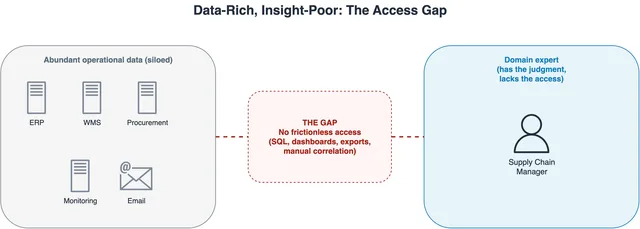
    Diagram showing domain expertise with business users while operational data is split across ERP, monitoring, procurement, and email systems

    The combination of Amazon Quick and Amazon Bedrock AgentCore turns supply chain data from systems such as ERP, monitoring, and procurement into a conversational MCP tool layer, so users can get cross-system answers in natural language. In the example, a TechComp production stoppage event is assessed via assess disruption impact, which finds a $750K risk, 23 orders, and three days of inventory, and recommend mitigation then chains together governance and quoting tools to generate an emergency RFQ

    Matched fieldsBody
  2. Simon Willison

    Simon Willison built Battle Drones, an audio-networked RTS game, with Claude Code

    Simon Willison released Battle Drones, a real-time strategy game developed entirely through vibe coding with Claude Code. It went through 12 major versions and 321 commits and runs in mobile and desktop browsers. The game includes 9 building types, 7 ground vehicles, 6 air vehicles and 3 infantry units, and supports fog of war, random map generation, AI versus AI, and an Agent battle mode in which two LLMs fight each other. He also implemented a multiplayer method in which two devices synchronize game state via microphone audio, and because the audio caused headaches, he added online multiplayer based on a WebSockets relay server.

    Simon Willison released Battle Drones, a real-time strategy game developed entirely through vibe coding with Claude Code. It went through 12 major versions and 321 commits and runs in mobile and desktop browsers. The game includes 9 building types, 7 ground vehicles, 6 air vehicles and 3 infantry units, and supports fog of war, random map generation, AI versus AI, and an Agent battle mode in which two LLMs fight each other. He also implemented a multiplayer method in which two devices synchroniz

    Matched fieldsBody

  3. Fortune Tech

    How non-gamer Xbox CEO Asha Sharma plans to save Microsoft's gaming business

    Microsoft CEO Satya Nadella appointed Asha Sharma, who has zero gaming industry experience, to succeed Phil Spencer as Xbox CEO in February of this year. She has already laid off thousands of employees, consolidated studios and reorganized the technology stack, seeking to reverse the financial troubles and market share decline of this $21 billion business. Observers are also questioning whether Nadella is preparing Xbox for a sale or spin-off at a time when Microsoft is fully committing to the AI race.

    Microsoft CEO Satya Nadella appointed Asha Sharma, who has zero gaming industry experience, to succeed Phil Spencer as Xbox CEO in February of this year. She has already laid off thousands of employees, consolidated studios and reorganized the technology stack, seeking to reverse the financial troubles and market share decline of this $21 billion business. Observers are also questioning whether Nadella is preparing Xbox for a sale or spin-off at a time when Microsoft is fully committing to the A

    Matched fieldsBody

  4. Unite.AI

    GEPI report "How AI Fails Women" examines how algorithms amplify gender bias

    The Gender Equality Policy Institute (GEPI) has published a report authored by Myriam Shiran titled "How AI Fails Women: When Bias Becomes Amplified," reviewing how automated systems replicate and even amplify gender discrimination. The report cites a 2024 hiring audit involving more than 3 million simulated résumé comparisons: screening models showed a significant preference for male-associated names in 51.9% of comparisons, and for female-associated names in only 11.1%. The report also notes that simply removing gender fields is insufficient to eliminate bias, as information such as names, education, and work history still carries gender signals.

    The Gender Equality Policy Institute (GEPI) has published a report authored by Myriam Shiran titled "How AI Fails Women: When Bias Becomes Amplified," reviewing how automated systems replicate and even amplify gender discrimination. The report cites a 2024 hiring audit involving more than 3 million simulated résumé comparisons: screening models showed a significant preference for male-associated names in 51.9% of comparisons, and for female-associated names in only 11.1%. The report also notes t

    Matched fieldsBody

  5. Unite.AI

    Perplexity Releases AI Gateway Guide: Explaining Routing, Cost Control, and Governance for LLM and Agent Traffic

    On October 20, Perplexity released the guide "What Is an AI Gateway?", explaining how an AI gateway uniformly handles routing, cost control, security, and usage monitoring between applications and LLMs. The guide states that its request flow includes authentication, policy enforcement (token limits, budgets, PII redaction), routing and failover based on cost/latency/availability, and logging token counts and latency. The guide cites a Broadcom VMware benchmark from June 2026 stating that a tuned Envoy AI Gateway adds about 2 milliseconds per request at 224 concurrent users, but guardrails and semantic caching may add tens to hundreds of milliseconds.

    On October 20, Perplexity released the guide "What Is an AI Gateway?", explaining how an AI gateway uniformly handles routing, cost control, security, and usage monitoring between applications and LLMs. The guide states that its request flow includes authentication, policy enforcement (token limits, budgets, PII redaction), routing and failover based on cost/latency/availability, and logging token counts and latency. The guide cites a Broadcom VMware benchmark from June 2026 stating that a tuned

    Matched fieldsBody

  6. AWS Machine Learning

    AWS Publishes Agent Registry Runtime Tool Discovery Practice

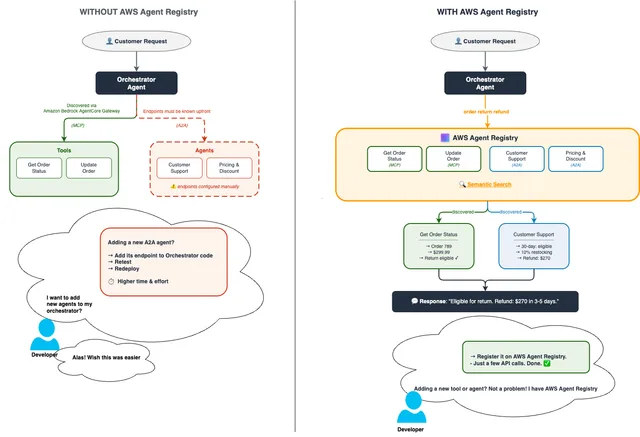
    AWS introduces the Agent Registry runtime tool discovery approach: agents use hybrid semantic and keyword search to find approved MCP servers and A2A agents, then instantly build clients from descriptors to execute requests. The sample code is based on Amazon Bedrock AgentCore Gateway and runtime, integrates an order management MCP server and two A2A agents for pricing and customer service, and demonstrates a return and refund scenario using pure semantic matching. The registry returns only connection metadata; invocation credentials must be obtained separately through Cognito OAuth or IAM, and new capabilities require no changes to orchestrator code.

    Comparison of hardcoded tool endpoints versus runtime discovery with AWS Agent Registry

    AWS introduces the Agent Registry runtime tool discovery approach: agents use hybrid semantic and keyword search to find approved MCP servers and A2A agents, then instantly build clients from descriptors to execute requests. The sample code is based on Amazon Bedrock AgentCore Gateway and runtime, integrates an order management MCP server and two A2A agents for pricing and customer service, and demonstrates a return and refund scenario using pure semantic matching. The registry returns only conn

    Matched fieldsBody

  7. PyTorch Blog

    From KTIR to SpyreCode: IBM Spyre's MLIR Dataflow Backend

    torch-spyre's backend compiler uses KTIR (Kernel Tile IR) to take over the parallel partitioning already determined by Inductor, and then the open-source Dataflow Scheduler breaks each tile's work into programs, progressively expanding from a load → compute → store pipeline into nested, double-buffered, multi-instance scheduling, outputting DataflowIR and generating SpyreCode. KTIR targets Spyre hardware with 32 cores and 2 MB of scratchpad per core, moving data in 128-byte sticks; the scheduler and its dialects are open-sourced under Apache-2.0.

    torch-spyre's backend compiler uses KTIR (Kernel Tile IR) to take over the parallel partitioning already determined by Inductor, and then the open-source Dataflow Scheduler breaks each tile's work into programs, progressively expanding from a load → compute → store pipeline into nested, double-buffered, multi-instance scheduling, outputting DataflowIR and generating SpyreCode. KTIR targets Spyre hardware with 32 cores and 2 MB of scratchpad per core, moving data in 128-byte sticks; the scheduler

    Matched fieldsBody

  8. PyTorch BlogSelected

    Google and Meta jointly launch TorchTPU, enabling PyTorch to run natively on TPUs

    Google and Meta's PyTorch teams have collaborated to launch the open-source project TorchTPU, providing a native PyTorch backend for Google TPUs; migration only requires changing model.to("cuda") to model.to("tpu"). The project supports both eager and torch.compile modes, adds a new DeferAndFuse eager mode, covers about 450 Aten operators, and has been verified to run out of the box on 4,917 Hugging Face models, with a Tier 1 pass rate of 98% and Tier 2 numerical consistency relative to GPUs of 97%. According to the official announcement, it has already been used in the inference and training production workloads of some major Google Cloud customers, and is integrated with vLLM, SGLang, TorchTitan, Ray, and TorchRec.

    Google and Meta's PyTorch teams have collaborated to launch the open-source project TorchTPU, providing a native PyTorch backend for Google TPUs; migration only requires changing model.to("cuda") to model.to("tpu"). The project supports both eager and torch.compile modes, adds a new DeferAndFuse eager mode, covers about 450 Aten operators, and has been verified to run out of the box on 4,917 Hugging Face models, with a Tier 1 pass rate of 98% and Tier 2 numerical consistency relative to GPUs of

    Matched fieldsBody

Tuesday

  1. ZhidongxiSelected

    DeepSeek open-sources inference framework DeepInfer and token codec component deepseek-recipe

    DeepSeek has open-sourced its internal large-scale cloud service inference framework DeepInfer and the production-grade token codec component deepseek-recipe. The former supports distributed inference, speculative decoding, SWA Bounded Replay, and structured output, and can run on NVIDIA and Huawei Ascend platforms. DeepSeek says the high-throughput, low-latency inference service of DeepSeek V4.1 Flash is based on this framework, with a single cluster serving 155 trillion Tokens/day in throughput, at 38 US dollars per card per hour calculated at off-peak prices. The processing logic of deepseek-recipe is fully aligned with the official DeepSeek API. The team also explained that the KVCache management and load balancing components are deeply coupled with internal infrastructure, so the relevant code has not yet been fully open-sourced.

    DeepSeek has open-sourced its internal large-scale cloud service inference framework DeepInfer and the production-grade token codec component deepseek-recipe. The former supports distributed inference, speculative decoding, SWA Bounded Replay, and structured output, and can run on NVIDIA and Huawei Ascend platforms. DeepSeek says the high-throughput, low-latency inference service of DeepSeek V4.1 Flash is based on this framework, with a single cluster serving 155 trillion Tokens/day in throughpu

    Matched fieldsBody

  2. The New StackSelected

    DeepSeek open-sources DeepInfer, the inference engine behind its API, with support for both Nvidia and Huawei Ascend

    DeepSeek has open-sourced DeepInfer, its in-house inference framework used to serve its models in production. Released under the Apache 2.0 license, it lets developers run DeepSeek-V4.1-Flash on their own infrastructure, with support for subsequent models planned. The framework includes optimized compute kernels and communication libraries such as FlashMLA, DeepGEMM, and DeepEP, supports speculative decoding, asynchronous scheduling, and structured output, and also open-sources the deepseek-recipe library (available in Rust and Python versions) for handling request and response transformations. On the hardware side, it supports Nvidia SM100 (Blackwell) architecture and the Huawei Ascend 950 NPU series from day one; older architectures such as Hopper are not listed. Batch-invariant inference and deterministic sampling are available only on Nvidia hardware, and the published performance data is also based on Nvidia GPUs. The current version supports offline inference but lacks complete production serving components such as KV cache management, cross-machine inference stage separation, and replica load balancing.

    DeepSeek has open-sourced DeepInfer, its in-house inference framework used to serve its models in production. Released under the Apache 2.0 license, it lets developers run DeepSeek-V4.1-Flash on their own infrastructure, with support for subsequent models planned. The framework includes optimized compute kernels and communication libraries such as FlashMLA, DeepGEMM, and DeepEP, supports speculative decoding, asynchronous scheduling, and structured output, and also open-sources the deepseek-reci

    Matched fieldsBody

  3. OpenAI: Alignment Research Blog

    OpenAI proposes complementary monitorability metrics beyond g-mean²

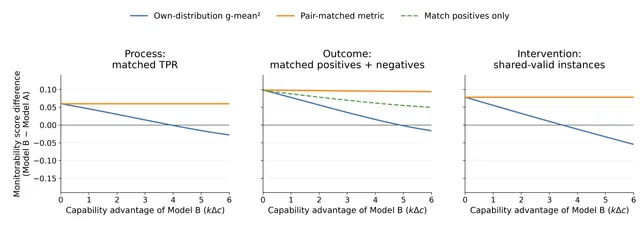
    OpenAI proposes two complementary metrics beyond g-mean²: the pair-matched metric compares monitorability only on instances jointly supported by multiple models, while the post-control risk metric simulates the probability that the system still produces harmful outputs after the monitor rejects outputs. g-mean² was previously used to measure a monitor's ability to distinguish positive from negative samples, but because different models have different subsets of valid positive tasks, scores may reflect different task mixtures. The article notes that if the monitor is used as a deployment control measure, the model can retry after being rejected, and the risk depends on the frequency of harmful behavior, which outputs the monitor accepts, and the number of allowed attempts.

    Pair matching isolates monitorability from capability-driven instance selection

    OpenAI proposes two complementary metrics beyond g-mean²: the pair-matched metric compares monitorability only on instances jointly supported by multiple models, while the post-control risk metric simulates the probability that the system still produces harmful outputs after the monitor rejects outputs. g-mean² was previously used to measure a monitor's ability to distinguish positive from negative samples, but because different models have different subsets of valid positive tasks, scores may r

    Matched fieldsBody

  4. Zyphra Research

    Zyphra Inference Wave 2: Accelerating MoE and Long-Context Inference Serving on MI355X

    Zyphra has released ZOE, its second-generation inference optimization, which on AMD Instinct MI355X reduces GLM-5.3's time to first token (TTFT) at 512K context from 178.8 seconds to 64.6 seconds (2.8x), and from 42.3 seconds to 11.8 seconds (3.6x) at 90% prefix cache hit rate. Its CSA top-K selection HIP kernel raises DeepSeek-V4-Pro's single-user decode throughput at 1M context from 43.5 to 61.1 tokens/s (1.40x). AMD MXFP4 quantization of GLM-5.3 shrinks the model from 756 GB to 410 GB, with benchmark scores such as AIME25 within 3 points of FP8.

    Zyphra has released ZOE, its second-generation inference optimization, which on AMD Instinct MI355X reduces GLM-5.3's time to first token (TTFT) at 512K context from 178.8 seconds to 64.6 seconds (2.8x), and from 42.3 seconds to 11.8 seconds (3.6x) at 90% prefix cache hit rate. Its CSA top-K selection HIP kernel raises DeepSeek-V4-Pro's single-user decode throughput at 1M context from 43.5 to 61.1 tokens/s (1.40x). AMD MXFP4 quantization of GLM-5.3 shrinks the model from 756 GB to 410 GB, with b

    Matched fieldsBody

  5. Tessl: Product and Engineering Blog

    Aviator CEO shares how to replace line-by-line code review with intent verification

    Ankit Jain, founder and CEO of Aviator, explains that as the share of AI-generated code rose and PR volume reached four times the level of a year earlier, his team abandoned reading diffs line by line. Instead, they review acceptance criteria, constraints, and edge cases before code generation, and give a deterministic conclusion with evidence for each criterion. The team also turned recurring review comments from historical PRs into reusable invariant rules, enforced by machines on every change—for example, always use the Money type for anything involving currency, and never write directly to the users table. The author says this transition took about three months, after which code review was no longer a delivery bottleneck.

    Ankit Jain

    Ankit Jain, founder and CEO of Aviator, explains that as the share of AI-generated code rose and PR volume reached four times the level of a year earlier, his team abandoned reading diffs line by line. Instead, they review acceptance criteria, constraints, and edge cases before code generation, and give a deterministic conclusion with evidence for each criterion. The team also turned recurring review comments from historical PRs into reusable invariant rules, enforced by machines on every change

    Matched fieldsBody

  6. Hugging FaceSelected

    ALTK-Evolve Uses Learned Memory to Put GPT-4.1 Customer-Service Agent Atop the τ²-bench Retail Leaderboard

    IBM Research has released ALTK-Evolve on Hugging Face. It uses GPT-4.1 to distill behavioral guidelines from the agent's own training trajectories and append them to the system prompt, achieving 67.5% Pass^4 on the τ²-bench retail task and surpassing all retail entries in its October 12, 2026 leaderboard snapshot. The method requires no weight updates or human annotation. Retail average accuracy rises from 78.1% to 82.5%, and Pass^4 rises from 57.5% to 67.5%; in the airline domain, Pass^4 rises from 35.0% to 45.0% with GPT-4.1 and to 82.0% with GPT-5.5. The authors say the gains come from more accurate decisions rather than longer conversations; the guidelines slightly reduce the number of dialogue turns, and the added cost is mainly in input tokens.

    IBM Research has released ALTK-Evolve on Hugging Face. It uses GPT-4.1 to distill behavioral guidelines from the agent's own training trajectories and append them to the system prompt, achieving 67.5% Pass^4 on the τ²-bench retail task and surpassing all retail entries in its October 12, 2026 leaderboard snapshot. The method requires no weight updates or human annotation. Retail average accuracy rises from 78.1% to 82.5%, and Pass^4 rises from 57.5% to 67.5%; in the airline domain, Pass^4 rises

    Matched fieldsBody

  7. 36Kr · AISelected

    DeepSeek open-sources inference framework DeepInfer and Token codec component deepseek-recipe

    DeepSeek open-sources its self-developed inference framework DeepInfer (Apache 2.0) and the production-grade Token codec component deepseek-recipe (MIT), supporting DeepSeek V4.1 Flash in serving 155 trillion Tokens per day on a single cluster. Official online statistics show an average of 77K Tokens input per request, a time to first token of about 400 milliseconds, 230 Tokens output per second during the generation phase, and an average of 96% of input hitting the cache. DeepInfer currently supports V4.1 Flash; the open-source version provides only offline inference, and the KV cache management and load balancing code has not yet been fully open-sourced because it is tied to internal infrastructure.

    DeepSeek open-sources its self-developed inference framework DeepInfer (Apache 2.0) and the production-grade Token codec component deepseek-recipe (MIT), supporting DeepSeek V4.1 Flash in serving 155 trillion Tokens per day on a single cluster. Official online statistics show an average of 77K Tokens input per request, a time to first token of about 400 milliseconds, 230 Tokens output per second during the generation phase, and an average of 96% of input hitting the cache. DeepInfer currently su

    Matched fieldsBody

  8. China.com Technology

    OpenAI plans to raise $30 billion, targeting a $1.4 trillion valuation

    According to Reuters citing people familiar with the matter, OpenAI is accelerating its fundraising and plans to raise about $30 billion from investors, with its valuation expected to exceed $1.4 trillion, with SoftBank Group and MGX participating. OpenAI is pitching investors on $50 billion in annualized revenue and expects annualized revenue to reach $70 billion by year-end as the GPT-6 Astra model launches. The fundraising process is intended to lock in subscription commitments before Anthropic's expected mid-November IPO; OpenAI's valuation reached $852 billion after raising $122 billion in March this year.

    According to Reuters citing people familiar with the matter, OpenAI is accelerating its fundraising and plans to raise about $30 billion from investors, with its valuation expected to exceed $1.4 trillion, with SoftBank Group and MGX participating. OpenAI is pitching investors on $50 billion in annualized revenue and expects annualized revenue to reach $70 billion by year-end as the GPT-6 Astra model launches. The fundraising process is intended to lock in subscription commitments before Anthrop

    Matched fieldsBody

  9. SiliconANGLE

    SmartBear's BearQ adds Sources to find coverage gaps, Workflows to automate test runs

    SmartBear has added two capabilities, Sources and Workflows, to its BearQ agentic quality assurance system: Sources pulls requirements and bug reports from Jira and, combined with existing tests in Reflect and Zephyr, identifies coverage gaps to reduce duplicate testing; Workflows supports chaining tasks under a single trigger, for example automatically creating a test environment and running regression tests once a build enters CI/CD. SmartBear said that in a September 30 survey of 1,436 respondents in the US and UK, 23% cited trust as the top barrier to adopting autonomous testing.

    SmartBear has added two capabilities, Sources and Workflows, to its BearQ agentic quality assurance system: Sources pulls requirements and bug reports from Jira and, combined with existing tests in Reflect and Zephyr, identifies coverage gaps to reduce duplicate testing; Workflows supports chaining tasks under a single trigger, for example automatically creating a test environment and running regression tests once a build enters CI/CD. SmartBear said that in a September 30 survey of 1,436 respon

    Matched fieldsBody