←Search results

By relevance · Total 1578 results Clear search

Monday

  1. CTech

    Shashua's new company doubleAI releases Maxwell code execution model

    Amnon Shashua's new company doubleAI has released its first product, Maxwell, which it says belongs to a new category called Code Execution Models (CEM), optimizing software execution efficiency between code and chips without modifying source code. doubleAI says Maxwell continuously analyzes running programs, hardware, and data to optimize underlying machine instructions, while using formal mathematical verification to ensure each optimization does not change the program's original behavior, with support for CPUs and GPUs. The company says Maxwell speeds up data pipelines by more than 38x and AI inference kernels by more than 4.5x on real workloads; these figures have not been independently verified. Maxwell is now available for early access through the official website, and doubleAI plans to charge customers based on the compute costs saved.

    Amnon Shashua's new company doubleAI has released its first product, Maxwell, which it says belongs to a new category called Code Execution Models (CEM), optimizing software execution efficiency between code and chips without modifying source code. doubleAI says Maxwell continuously analyzes running programs, hardware, and data to optimize underlying machine instructions, while using formal mathematical verification to ensure each optimization does not change the program's original behavior, wit

    Matched fieldsBody

  2. Ayi AI Notes

    MiniMax Claims Blind-Test Model Space Bunny, Confirms It as MiniMax-M3.1-Flash

    MiniMax officially tweeted to claim the mysterious model Space Bunny on an overseas blind-test platform, confirming it as the upcoming MiniMax-M3.1-Flash. The model had previously drawn developer attention in blind tests with a speed of about 100 words per second and a one-million-token context window; community tests measured generation speed steady at 85 to 112 words per second, and it can run through complex 3D scenes and code builds in a single pass within three minutes, and respond quickly in multi-file project repairs.

    MiniMax officially tweeted to claim the mysterious model Space Bunny on an overseas blind-test platform, confirming it as the upcoming MiniMax-M3.1-Flash. The model had previously drawn developer attention in blind tests with a speed of about 100 words per second and a one-million-token context window; community tests measured generation speed steady at 85 to 112 words per second, and it can run through complex 3D scenes and code builds in a single pass within three minutes, and respond quickly

    Matched fieldsBody

  3. Tessl: Product and Engineering Blog

    How to add Tessl agent code review to a repository in 5 minutes

    Tessl has published a tutorial on how to set up Tessl Code Review agent review for a GitHub repository in about 5 minutes: it reads the full pull request rather than an isolated diff, scores it against the standards the team defines in the repository, and posts a single review result. Reviews can be set to run only when a PR is opened or requested, or after every update; the handling mode can be comment-only, or approve/request changes, and it supports automatic approval once all Tessl threads are resolved. Changes only take effect for new review runs.

    Simon Maple

    Tessl has published a tutorial on how to set up Tessl Code Review agent review for a GitHub repository in about 5 minutes: it reads the full pull request rather than an isolated diff, scores it against the standards the team defines in the repository, and posts a single review result. Reviews can be set to run only when a PR is opened or requested, or after every update; the handling mode can be comment-only, or approve/request changes, and it supports automatic approval once all Tessl threads a

    Matched fieldsBody

Sunday

  1. Shao Meng

    Stripe Chief Design Officer Katie Dill on How to Use AI to Scale Intent, Quality, and Artistry

    In her talk at Lenny's Summit, Stripe Chief Design Officer Katie Dill argued that using AI only to do existing things faster misses the most interesting part, and that we should raise the ceiling across four dimensions: point of view, standards, editing, and creativity. She identified three warning signals—LLMs naturally gravitate toward the mean, a sense of completion is seductive, and work becomes disposable—which, when combined, produce monotonous, hollow zombie UI. Stripe's practice evolved from using MCP to let AI read design docs to building a CLI on top of the design system, injecting docs at the right moment to avoid context rot, and upgrading content from atomic components to full templates and flows.

    In her talk at Lenny's Summit, Stripe Chief Design Officer Katie Dill argued that using AI only to do existing things faster misses the most interesting part, and that we should raise the ceiling across four dimensions: point of view, standards, editing, and creativity. She identified three warning signals—LLMs naturally gravitate toward the mean, a sense of completion is seductive, and work becomes disposable—which, when combined, produce monotonous, hollow zombie UI. Stripe's practice evolved

    Matched fieldsBody

  2. TechCrunch AI

    Anthropic report: share of junior employees declines, employee meeting time increases 20%

    A report released by Anthropic shows that the share of junior employees in its technical department fell from 21% in early 2025 to 14%, and the share of junior technical positions in hiring dropped from 27% to 9%. The technical team's share of overall employees fell from 61% to 56%, per-employee meeting time increased 20% year over year, and technical contributors increased 16%. The report says human attention and judgment are becoming productivity bottlenecks, and 27% of employees said Claude has improved their efficiency.

    A report released by Anthropic shows that the share of junior employees in its technical department fell from 21% in early 2025 to 14%, and the share of junior technical positions in hiring dropped from 27% to 9%. The technical team's share of overall employees fell from 61% to 56%, per-employee meeting time increased 20% year over year, and technical contributors increased 16%. The report says human attention and judgment are becoming productivity bottlenecks, and 27% of employees said Claude h

    Matched fieldsBody

Saturday

  1. ChinaTalk

    Why DUV Controls Hold Up: Saif Khan on the U.S.-China AI Chip Rivalry

    Saif Khan, a former U.S. National Security Council and Commerce Department official, predicts in a new DUV report from the new think tank CTS that if exports of the relevant equipment stopped now, by the mid-2030s China could produce roughly 100 times fewer AI chips than the United States, making DUV controls the most critical lever for the United States to shape the AI balance of power. In a ChinaTalk interview, he also discussed how robotics will become the next frontier in U.S.-China AI competition, and how AI is changing policy research itself.

    Saif Khan, a former U.S. National Security Council and Commerce Department official, predicts in a new DUV report from the new think tank CTS that if exports of the relevant equipment stopped now, by the mid-2030s China could produce roughly 100 times fewer AI chips than the United States, making DUV controls the most critical lever for the United States to shape the AI balance of power. In a ChinaTalk interview, he also discussed how robotics will become the next frontier in U.S.-China AI compe

    Matched fieldsBody

  2. Unite.AI

    What Is a Native Audio Model? How Speech-to-Speech AI Skips the Transcription Step

    Native audio models process or generate acoustic representations directly, preserving information such as timing, intonation, and speaker cues that text transcription would discard. They are fundamentally different from the "transcribe to text first, then synthesize speech" pipeline: the latter changes the causal chain, and the evidence of success, the sources of cost, and the approach to risk control all differ. The article breaks down its workflow into five stages: converting waveforms into audio tokens, modeling speech and non-speech context, inferring semantics and dialogue state, generating audio tokens, and decoding natural speech.

    Native audio models process or generate acoustic representations directly, preserving information such as timing, intonation, and speaker cues that text transcription would discard. They are fundamentally different from the "transcribe to text first, then synthesize speech" pipeline: the latter changes the causal chain, and the evidence of success, the sources of cost, and the approach to risk control all differ. The article breaks down its workflow into five stages: converting waveforms into au

    Matched fieldsBody

  3. Anthropic ResearchSelected

    Anthropic Research: How AI Is Changing Its Internal Hiring and Ways of Working

    Anthropic has released an internal research report analyzing AI's impact on the company's hiring and work organization, based on data including hiring, AI usage, output metrics, employee surveys, calendars, and recruiting records, as well as interviews with 17 employees. The report says the share of junior employees in technical departments fell from 21% in early 2025 to 14%, and the share of junior technical roles in hiring dropped from 27% to 9%; by August, interactive AI Agents were working six times as many hours as employees, and per-engineer code commits reached five times the level of six months earlier. Human attention has become the bottleneck on Agent output, employees are shifting toward meta-work of building monitoring and orchestration Agents, and hiring now places more value on autonomy and judgment.

    Anthropic has released an internal research report analyzing AI's impact on the company's hiring and work organization, based on data including hiring, AI usage, output metrics, employee surveys, calendars, and recruiting records, as well as interviews with 17 employees. The report says the share of junior employees in technical departments fell from 21% in early 2025 to 14%, and the share of junior technical roles in hiring dropped from 27% to 9%; by August, interactive AI Agents were working s

    Matched fieldsBody

  4. Anthropic Research

    Anthropic study: the gap between the public's and its own employees' expectations for AI

    Anthropic released a study based on an August 2026 survey comparing the AI expectations of U.S. adults and Anthropic employees: 91% of employees believe AI will be able to make Nobel Prize-level discoveries by 2030, compared with 39% of U.S. adults. On average, employees expect AI to be able to do 75% of their current work by 2030, compared with 28% for employed Americans; according to the study's economic model, the median U.S. adult's response corresponds to 5.4% GDP growth in 2030, while the median employee's corresponds to 17.1%. The two groups differ markedly on the share of their own jobs that will be replaced by AI, but both believe that the more replacement there is, the higher the unemployment rate.

    Anthropic released a study based on an August 2026 survey comparing the AI expectations of U.S. adults and Anthropic employees: 91% of employees believe AI will be able to make Nobel Prize-level discoveries by 2030, compared with 39% of U.S. adults. On average, employees expect AI to be able to do 75% of their current work by 2030, compared with 28% for employed Americans; according to the study's economic model, the median U.S. adult's response corresponds to 5.4% GDP growth in 2030, while the

    Matched fieldsBody

  5. MacRumors Apple Intelligence

    Didn't pre-order Apple HomeView? Here's how long the wait is now

    Apple's all-new smart home hub HomeView opened for pre-order on Tuesday, with the first orders shipping on November 13; users who haven't pre-ordered will have to wait until early December for some colorways. Delivery times vary by ZIP code across the U.S.: the silver desktop version is November 23 to December 1 in New York, and November 30 to December 7 elsewhere. The wall-mounted HomeView has no delays for now, and all five colorways of the HomePod mini 2 can still arrive on the October 30 launch day.

    Apple's all-new smart home hub HomeView opened for pre-order on Tuesday, with the first orders shipping on November 13; users who haven't pre-ordered will have to wait until early December for some colorways. Delivery times vary by ZIP code across the U.S.: the silver desktop version is November 23 to December 1 in New York, and November 30 to December 7 elsewhere. The wall-mounted HomeView has no delays for now, and all five colorways of the HomePod mini 2 can still arrive on the October 30 lau

    Matched fieldsBody

  6. SiliconANGLE

    Vinci Uses Physical AI to Accelerate Chip Design

    Vinci4D showcased its physical AI solution at SEMICON West, combining physics foundation models with GPU-native physics kernels in what it calls Continuous Physics Reasoning, enabling engineers to obtain both accuracy and fast physics simulation at design speed. The model is trained on Vinci's proprietary data, deployed within customers' firewalls, and can directly read existing design files. Its $250 million Series B funding will support expansion into electromagnetics, fluid dynamics, and the automotive and aerospace sectors.

    Vinci4D showcased its physical AI solution at SEMICON West, combining physics foundation models with GPU-native physics kernels in what it calls Continuous Physics Reasoning, enabling engineers to obtain both accuracy and fast physics simulation at design speed. The model is trained on Vinci's proprietary data, deployed within customers' firewalls, and can directly read existing design files. Its $250 million Series B funding will support expansion into electromagnetics, fluid dynamics, and the

    Matched fieldsBody

  7. Anthropic Research

    Anthropic has Claude autonomously design quantum circuits, with some results outperforming published approaches

    Anthropic gave Claude plain-language specifications for eight quantum circuits along with an automated evaluator; in a closed loop with essentially no human intervention, Claude repeatedly submitted designs and improved them based on scores, finding solutions that use fewer qubits and gates than the best published circuits, with some improvements reaching an order of magnitude. The elliptic-curve modular inversion design came from a single 53-hour continuous run, in which Claude derived a reversible divsteps implementation that requires no storage of branch information and formally verified it with Lean; another effort reduced the gate count of the most expensive Reed-Solomon decoding step in DQI to about 1/12 of Google's previous construction. Anthropic also noted that Claude was initially conservative and tended to stick with known methods, which had to be mitigated by requiring parallel exploration of multiple approaches and occasionally prompting it to broaden its search.

    Anthropic gave Claude plain-language specifications for eight quantum circuits along with an automated evaluator; in a closed loop with essentially no human intervention, Claude repeatedly submitted designs and improved them based on scores, finding solutions that use fewer qubits and gates than the best published circuits, with some improvements reaching an order of magnitude. The elliptic-curve modular inversion design came from a single 53-hour continuous run, in which Claude derived a revers

    Matched fieldsBody

Friday

  1. heise online

    RTX Spark laptop tested: How does Nvidia's first local AI laptop chip perform?

    heise online's c't 3003 tested the Asus ProArt P14, which is equipped with Nvidia's first laptop chip, the N1X (brand name RTX Spark). The machine supports up to 128 GB of unified memory; the test unit had 32 GB of memory plus a 1 TB SSD and cost 3,300 euros. In llama-bench tests with Qwen 3.8-27B, generation speed was about 14.5 tokens/s, slightly faster than Apple M6 and Strix Halo but slower than M5 Pro; with the MoE model Qwen 3.6-35B-A3B, it reached nearly 61 tokens/s. Prompt processing speed was better than Strix Halo and the M5 Pro and M6, but fan noise under full load reached up to 2.7 sone, and the fans also spin up when idle. The author also tried installing Ubuntu; after manually adding the drivers, both models ran 14% and 9% faster under Linux than under Windows.

    heise online's c't 3003 tested the Asus ProArt P14, which is equipped with Nvidia's first laptop chip, the N1X (brand name RTX Spark). The machine supports up to 128 GB of unified memory; the test unit had 32 GB of memory plus a 1 TB SSD and cost 3,300 euros. In llama-bench tests with Qwen 3.8-27B, generation speed was about 14.5 tokens/s, slightly faster than Apple M6 and Strix Halo but slower than M5 Pro; with the MoE model Qwen 3.6-35B-A3B, it reached nearly 61 tokens/s. Prompt processing spe

    Matched fieldsBody

  2. Databricks Blog

    Databricks uses domain knowledge injection to improve LLMs' ability to detect malicious npm binary packages

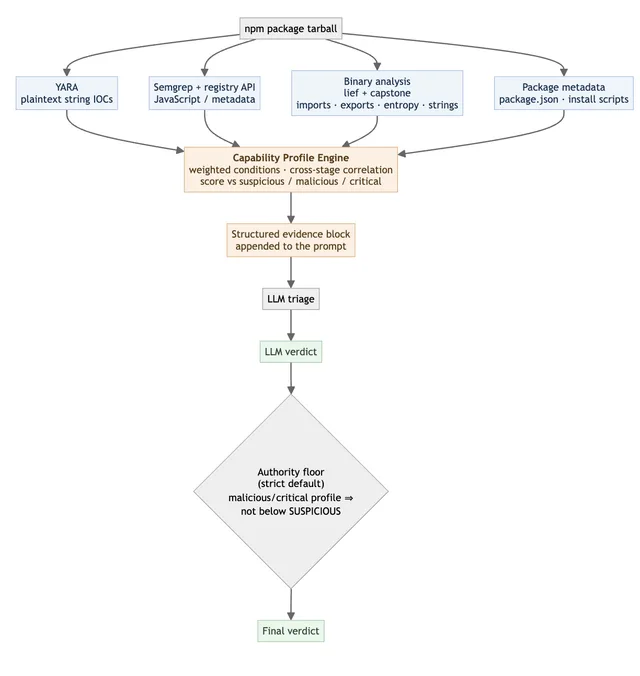
    Since November 2025, Databricks has been collecting malicious npm samples. Among the 11,413 package-versions scanned and verified, 96.2% hid their payloads in source code or on external servers, and only 3.8% (432) bundled binaries; however, the proportion of such packages for which no clear malicious conclusion could be reached was more than twice that of pure source-code packages (14.4% vs 6.2%). The team evaluated 9 models (including Claude Haiku 4.5, Gemini 3.5 Flash, GPT-5.4-nano, Qwen3-Next 80B, etc.) and injected precomputed static evidence as capability profiles during inference to improve detection quality for both budget-tier and frontier models.

    image1.png

    Since November 2025, Databricks has been collecting malicious npm samples. Among the 11,413 package-versions scanned and verified, 96.2% hid their payloads in source code or on external servers, and only 3.8% (432) bundled binaries; however, the proportion of such packages for which no clear malicious conclusion could be reached was more than twice that of pure source-code packages (14.4% vs 6.2%). The team evaluated 9 models (including Claude Haiku 4.5, Gemini 3.5 Flash, GPT-5.4-nano, Qwen3-Nex

    Matched fieldsBody

  3. The New Stack

    Running local AI models on the Microsoft Surface Laptop Ultra: hands-on findings

    The New Stack tested running local AI models on the Microsoft Surface Laptop Ultra (Nvidia N1X platform, Blackwell RTX GPU, 64GB of memory, $4,300 configuration): Nemotron 3.5 Bolt reached 56-60 tokens/s, while 8-bit Qwen 3.8 27B managed only 8-9 tokens/s, recovering to 25-28 tokens/s after dropping to 4-bit. On battery, AI workload performance dropped by about 20%-25%, inconsistent with Microsoft's claim of retaining 99.6%.

    Matched fieldsBody