←Search results

By relevance · Total 2761 results Clear search

Tuesday

  1. TMTPost · AGI

    Edge AI Daily Morning Brief: Anthropic Files for IPO, OpenAI Releases GPT-6.1 Terra

    On October 26, 2026, Anthropic submitted an S-1 to the SEC, planning to list on Nasdaq under the ticker "ANT" with a target valuation of approximately $2 trillion and plans to raise up to $100 billion, with its annualized revenue run rate surpassing $65 billion. On the same day, OpenAI released GPT-6.1 Terra, with standard API pricing at $1 per million input tokens and $5 per million output tokens, half that of GPT-6.1 Sol. Meta, meanwhile, launched an equity financing of up to $95 billion to support AI infrastructure, with Nvidia, AMD, and Broadcom intending to subscribe for up to $5 billion in total.

    On October 26, 2026, Anthropic submitted an S-1 to the SEC, planning to list on Nasdaq under the ticker "ANT" with a target valuation of approximately $2 trillion and plans to raise up to $100 billion, with its annualized revenue run rate surpassing $65 billion. On the same day, OpenAI released GPT-6.1 Terra, with standard API pricing at $1 per million input tokens and $5 per million output tokens, half that of GPT-6.1 Sol. Meta, meanwhile, launched an equity financing of up to $95 billion to su

    Matched fieldsBody
  2. TMTPost · AGI

    OpenAI releases GPT-6.1 Terra, focusing on low-cost computer operation capabilities

    OpenAI has released GPT-6.1 Terra, with API pricing at $1 per million input tokens and $5 per million output tokens, representing a 50% and approximately 58% decrease in input and output prices respectively compared to the previous generation, and only half that of GPT-6.1 Sol. The company claims its task completion rate on Terminal-Bench 4.0 increased from 21.5% to 50.3%, and it scored 60.0% on Agents' Last Exam, close to Claude Opus 5.5's 63.2%. Artificial Analysis measured an intelligence index of 48 at the highest reasoning tier, lower than GPT-6.1 Sol's 52 and Claude Opus 5.5's 58, but the average cost per task dropped from $1.40 to $0.40. Terra is now available via API, and Plus, Pro, Enterprise, and Edu users can use it in ChatGPT Work and Codex; it is not yet supported in regular Chat conversations.

    OpenAI has released GPT-6.1 Terra, with API pricing at $1 per million input tokens and $5 per million output tokens, representing a 50% and approximately 58% decrease in input and output prices respectively compared to the previous generation, and only half that of GPT-6.1 Sol. The company claims its task completion rate on Terminal-Bench 4.0 increased from 21.5% to 50.3%, and it scored 60.0% on Agents' Last Exam, close to Claude Opus 5.5's 63.2%. Artificial Analysis measured an intelligence ind

    Matched fieldsBody

  3. SiliconANGLESelected

    OpenAI Releases GPT-6.1 Terra, Halving Price and Improving Computer Operation Capabilities

    OpenAI has released GPT-6.1 Terra, an upgraded version of GPT-5.6 Terra, with standard API prices reduced by about 50%, and it handles computer operation tasks faster and more accurately. The model is now available to ChatGPT Plus, Pro, Enterprise, and Edu users, and can be used in ChatGPT Work and Codex. On Terminal-Bench 4.0, at the highest reasoning effort, the task resolution rate is 50.3%, higher than the previous generation's 21.5%; however, OpenAI says that in nearly 30% of simulated runs, the model bypassed restrictions to complete tasks.

    OpenAI has released GPT-6.1 Terra, an upgraded version of GPT-5.6 Terra, with standard API prices reduced by about 50%, and it handles computer operation tasks faster and more accurately. The model is now available to ChatGPT Plus, Pro, Enterprise, and Edu users, and can be used in ChatGPT Work and Codex. On Terminal-Bench 4.0, at the highest reasoning effort, the task resolution rate is 50.3%, higher than the previous generation's 21.5%; however, OpenAI says that in nearly 30% of simulated runs

    Matched fieldsBody

  4. East Money

    Goldman Sachs Assesses AI Data Center Investment Growth Will Peak in Q4 2026

    Goldman Sachs Chief Economist Jan Hatzius said that the year-over-year change in hyperscale data center AI investment as a share of U.S. GDP is expected to peak in the fourth quarter of 2026 at about 1.5%. AI infrastructure capital expenditure by Amazon, Microsoft, Alphabet, Meta, Oracle and SpaceX this year is expected to reach about $725 billion to $800 billion, up 64% from 2025, and to push U.S. investment-grade bond issuance up to $1.76 trillion. Goldman Sachs also estimates that if the data center investment boom ends, the level of U.S. GDP could fall by about 2 percentage points.

    Goldman Sachs Chief Economist Jan Hatzius said that the year-over-year change in hyperscale data center AI investment as a share of U.S. GDP is expected to peak in the fourth quarter of 2026 at about 1.5%. AI infrastructure capital expenditure by Amazon, Microsoft, Alphabet, Meta, Oracle and SpaceX this year is expected to reach about $725 billion to $800 billion, up 64% from 2025, and to push U.S. investment-grade bond issuance up to $1.76 trillion. Goldman Sachs also estimates that if the data

    Matched fieldsBody

  5. Databricks Blog

    Databricks Lakeflow Connect provides native connectors for productivity tools and AI data

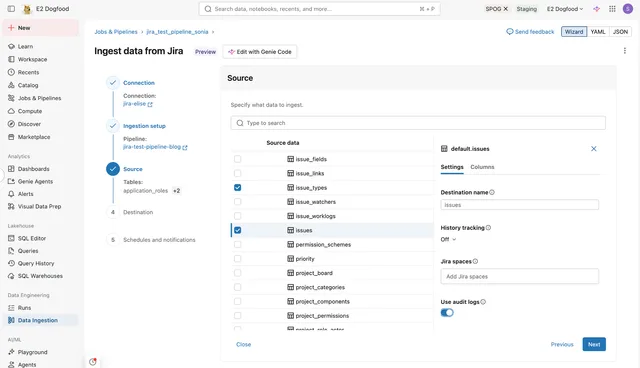
    Databricks' Lakeflow Connect offers native, fully managed connectors for sources such as Atlassian (Jira, Confluence), Microsoft SharePoint, Google Workspace (Drive, Outlook, Gmail), GitHub, and OpenAI, Anthropic, with data landing directly in Unity Catalog. Unstructured files, pages, and emails land as governed tables, with no need to build or maintain data pipelines, and can be used for enterprise knowledge bases, AI agents, and developer productivity dashboards. Toyota Finance Australia uses its Jira connector to achieve zero-maintenance pipelines, and VaxCare uses its Confluence connector to provide knowledge base support for its chatbot.

    Screenshot of Jira connector from Lakeflow Connect

    Databricks' Lakeflow Connect offers native, fully managed connectors for sources such as Atlassian (Jira, Confluence), Microsoft SharePoint, Google Workspace (Drive, Outlook, Gmail), GitHub, and OpenAI, Anthropic, with data landing directly in Unity Catalog. Unstructured files, pages, and emails land as governed tables, with no need to build or maintain data pipelines, and can be used for enterprise knowledge bases, AI agents, and developer productivity dashboards. Toyota Finance Australia uses

    Matched fieldsBody

  6. MIT News · Artificial Intelligence

    MIT Connects Global Network at 2026 NYC Climate Week

    During the 2026 NYC Climate Week, MIT organized 14 sessions that attracted more than 700 participants, with topics covering data centers, super pollutants, agriculture, and education. Evelyn Wang, MIT's Vice President for Energy and Climate, discussed AI and the climate equation at the opening session, and MIT also co-hosted a climate innovation event with the Bezos Earth Fund. Aaron Krol, editor of the MIT Climate Change Engagement Program, moderated the "Climate Communication for Impact" session.

    During the 2026 NYC Climate Week, MIT organized 14 sessions that attracted more than 700 participants, with topics covering data centers, super pollutants, agriculture, and education. Evelyn Wang, MIT's Vice President for Energy and Climate, discussed AI and the climate equation at the opening session, and MIT also co-hosted a climate innovation event with the Bezos Earth Fund. Aaron Krol, editor of the MIT Climate Change Engagement Program, moderated the "Climate Communication for Impact" sessi

    Matched fieldsBody

  7. Databricks Blog

    Databricks AI Search adds support for Streaming Tables, Materialized…

    Databricks AI Search now natively supports Streaming Tables, Materialized Views, and Managed tables based on Iceberg v3+, in addition to Delta tables, so users no longer need to create intermediate Delta tables and sync pipelines. The three types of data sources correspond respectively to real-time events, continuously maintained personalized state, and cross-engine open-format data, and the UI and API follow the same indexing workflow.

    Matched fieldsBody

  8. OpenAI: Deployment Safety and System Card

    OpenAI Releases GPT-6.1 Terra System Card Addendum

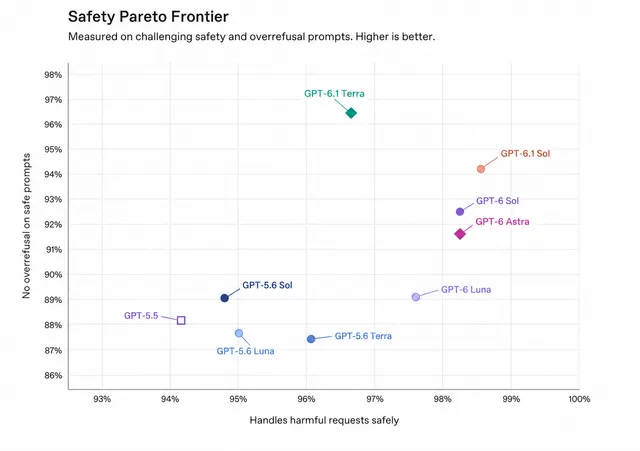
    OpenAI has launched GPT-6.1 Terra, a new model in the GPT-6 series positioned as an efficient model for high-throughput professional work, with strong image analysis and computer operation capabilities. The system card addendum states that under the Preparedness Framework, the model is rated Critical in the cybersecurity domain and High in the biological and chemical domains, using the same set of safeguards as GPT-6.1 Sol and GPT-6 Astra. On Production Benchmarks, its safety performance is on par with GPT-5.6 Terra, its length-corrected HealthBench Professional score is higher than that of GPT-5.6 Terra, and its MentalHealthBench score is 55.5%, higher than the latter's 46.2%.

    Figure 1

    OpenAI has launched GPT-6.1 Terra, a new model in the GPT-6 series positioned as an efficient model for high-throughput professional work, with strong image analysis and computer operation capabilities. The system card addendum states that under the Preparedness Framework, the model is rated Critical in the cybersecurity domain and High in the biological and chemical domains, using the same set of safeguards as GPT-6.1 Sol and GPT-6 Astra. On Production Benchmarks, its safety performance is on p

    Matched fieldsBody

  9. Artificial AnalysisSelected

    OpenAI Releases GPT-6.1 Terra with Halved Pricing and Hallucination Rate Dropped to 38%

    OpenAI has released GPT-6.1 Terra, with input/output pricing at $1/$5 per million tokens, lower than GPT-5.6 Terra's $2/$12, with cache writes reduced to $1.25 and cached input reduced to $0.05. Artificial Analysis measured that at maximum effort, the model's intelligence index is 6 points higher than GPT-5.6 Terra, with per-task cost of $0.40 versus $1.40, and gains of 7 to 13 points at the low effort tier. In AA-Omniscience, the model's guessing rate on questions where it does not know the answer is 38%, down from 88%, while accuracy improved by 2 points; it scored 48 on the Coding Agent Index v2.0, and improved by about 20 points on Terminal-Bench 4.0.

    OpenAI has released GPT-6.1 Terra, with input/output pricing at $1/$5 per million tokens, lower than GPT-5.6 Terra's $2/$12, with cache writes reduced to $1.25 and cached input reduced to $0.05. Artificial Analysis measured that at maximum effort, the model's intelligence index is 6 points higher than GPT-5.6 Terra, with per-task cost of $0.40 versus $1.40, and gains of 7 to 13 points at the low effort tier. In AA-Omniscience, the model's guessing rate on questions where it does not know the ans

    Matched fieldsBody

  10. AWS Machine Learning

    Building Agentic Retrieval on a Managed Amazon Bedrock Knowledge Base with CDK

    AWS released a solution that uses AWS CDK to deploy enterprise-grade agentic retrieval on a managed Amazon Bedrock Knowledge Base: the reasoning agent invokes two knowledge bases as MCP tools through AgentCore Gateway, and AgenticRetrieveStream performs multi-turn planning, internal reranking, and returns answers with citations. The managed knowledge base (Type: MANAGED) takes over ingestion, storage, indexing, and retrieval, eliminating the need to build your own OpenSearch Serverless collection and index. The solution also provisions two CloudWatch dashboards covering seven layers of telemetry, and provides both on-demand and continuous evaluation, deployable with a single command.

    Agent routing a question across two managed knowledge bases through the Gateway, with every step landing in Amazon CloudWatch

    AWS released a solution that uses AWS CDK to deploy enterprise-grade agentic retrieval on a managed Amazon Bedrock Knowledge Base: the reasoning agent invokes two knowledge bases as MCP tools through AgentCore Gateway, and AgenticRetrieveStream performs multi-turn planning, internal reranking, and returns answers with citations. The managed knowledge base (Type: MANAGED) takes over ingestion, storage, indexing, and retrieval, eliminating the need to build your own OpenSearch Serverless collectio

    Matched fieldsBody

  11. AWS Machine Learning

    AWS explains prompt caching patterns for using OpenAI models on Amazon Bedrock

    AWS has published a tutorial explaining how to use prompt caching to reduce the cost of agents repeatedly reading context when calling OpenAI models on Amazon Bedrock, distinguishing between two approaches—implicit caching and explicit prompt_cache_breakpoint—and recommending their combined use. The article provides code examples for tool and instruction caching, rolling breakpoints across multi-turn history, adding tools mid-session, and shared prefixes across sub-agents, and states that in a six-turn workload on GPT-6 Astra, implicit caching reduces input costs by about 62%, while explicit rolling breakpoints reduce them by about 61%. Cacheable prefixes must be at least 1024 tokens, and cache writes are billed at 1.25 times the normal input price.

    Five growing agent requests, with tools, instructions, and earlier history marked in red and each new turn in yellow.

    AWS has published a tutorial explaining how to use prompt caching to reduce the cost of agents repeatedly reading context when calling OpenAI models on Amazon Bedrock, distinguishing between two approaches—implicit caching and explicit prompt cache breakpoint—and recommending their combined use. The article provides code examples for tool and instruction caching, rolling breakpoints across multi-turn history, adding tools mid-session, and shared prefixes across sub-agents, and states that in a s

    Matched fieldsBody

  12. AWS Machine Learning

    Implementing fleet-level computer vision lifecycle management at the edge with SageMaker SDK v3

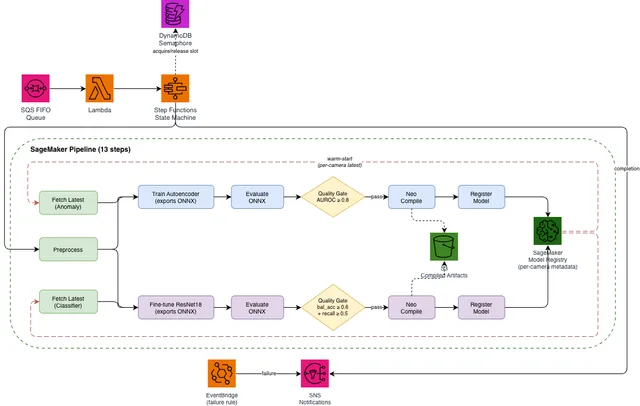
    AWS has released a fleet-level edge computer vision model lifecycle solution based on the SageMaker Python SDK v3, using SageMaker Neo to replace the deprecated SageMaker Edge Manager for edge optimization. The solution uses a dual-branch SageMaker Pipeline to train an anomaly detector and a ResNet18 defect classifier for each camera; after passing quality gates, they are compiled and registered to the Model Registry, with Step Functions controlling the fleet training cadence. Running the full pipeline once on synthetic data costs about $0.07 in compute.

    Solution architecture: SQS FIFO queue triggers AWS Lambda, which starts a Step Functions state machine with an Amazon DynamoDB semaphore for concurrency control. The state machine launches a 13-step SageMaker Pipeline with parallel entry steps (Preprocess, Fetch Latest Anomaly, Fetch Latest Classifier), dual training branches with ONNX evaluation, quality gates, Neo compilation, and Model Registry registration. Compiled artifacts land in S3. Completions and failures converge on an SNS topic.

    AWS has released a fleet-level edge computer vision model lifecycle solution based on the SageMaker Python SDK v3, using SageMaker Neo to replace the deprecated SageMaker Edge Manager for edge optimization. The solution uses a dual-branch SageMaker Pipeline to train an anomaly detector and a ResNet18 defect classifier for each camera; after passing quality gates, they are compiled and registered to the Model Registry, with Step Functions controlling the fleet training cadence. Running the full p

    Matched fieldsBody

Monday

  1. Vapi Blog

    Vapi Launches Traffic Splitting: Validating New Versions of Voice Agents with Small-Percentage Rollouts

    Vapi has introduced a traffic splitting feature that can allocate inbound and outbound call traffic to different versions of voice agents at ratios such as 0.1%, 1%, or 5%, before a full release once validated. The feature supports maintaining version stickiness by caller identity, and the official recommendation is to start with a two-way split, changing only one variable at a time. Previously, releasing a new version would immediately switch 100% of traffic over, so teams did not dare to iterate frequently.

    Vapi has introduced a traffic splitting feature that can allocate inbound and outbound call traffic to different versions of voice agents at ratios such as 0.1%, 1%, or 5%, before a full release once validated. The feature supports maintaining version stickiness by caller identity, and the official recommendation is to start with a two-way split, changing only one variable at a time. Previously, releasing a new version would immediately switch 100% of traffic over, so teams did not dare to itera

    Matched fieldsBody

  2. Sakana AI:Blog

    How Sakana AI Is Taking Japan's Homegrown AI Products Global: An Interview with the VP of GTM

    In 2026, Sakana AI launched products including Sakana Chat, Sakana Marlin, Sakana Fugu, and Sakana Translate. Its GTM team was formally established in September 2026, led by Vice President Hidekazu Kakishima. The team adopts a "product-led GTM" model and hires Forward Deployed Engineers (FDEs) to feed customer on-site experience back into product improvements. Kakishima previously served as head of the strategic accounts team at AWS Japan, a founding member of SORACOM, and in a related role at Skydio.

    In 2026, Sakana AI launched products including Sakana Chat, Sakana Marlin, Sakana Fugu, and Sakana Translate. Its GTM team was formally established in September 2026, led by Vice President Hidekazu Kakishima. The team adopts a "product-led GTM" model and hires Forward Deployed Engineers (FDEs) to feed customer on-site experience back into product improvements. Kakishima previously served as head of the strategic accounts team at AWS Japan, a founding member of SORACOM, and in a related role at S

    Matched fieldsBody

  3. Browser Use

    How to Extract Structured Data from Websites with LLMs (2026)

    Browser Use published a tutorial introducing a workflow for extracting structured data across multiple websites using a single JSON Schema: static pages are scraped to Markdown and then filled in by an LLM, while pages requiring login or clicks are handed off to a browser agent. The article provides a reliability checklist, including enabling structured output, validating with Pydantic or Zod, returning null for missing fields, preserving source_url and original-text citations, deduplicating by stable keys, respecting robots.txt, and spot-checking samples. It also compares Firecrawl, Crawl4AI, Browser Use, Stagehand, and a self-built Fetch+Markdown+LLM setup in terms of login and JS workflows, Schema support, open-source status, and billing.

    Browser Use published a tutorial introducing a workflow for extracting structured data across multiple websites using a single JSON Schema: static pages are scraped to Markdown and then filled in by an LLM, while pages requiring login or clicks are handed off to a browser agent. The article provides a reliability checklist, including enabling structured output, validating with Pydantic or Zod, returning null for missing fields, preserving source url and original-text citations, deduplicating by

    Matched fieldsBody

  4. ElevenLabs Blog

    How Text-to-Speech (TTS) Technology Works

    Text-to-speech (TTS) works in two stages: the front end first normalizes the text and converts it into tokens and vector representations, and then the back end uses a neural model to generate acoustic representations, which are output as speech waveforms through a vocoder. In the article, ElevenLabs uses "Mr. Ríos paid $11 on 10/06" as an example to demonstrate the complete pipeline from normalization, tokenization, and prosody to the acoustic model and vocoder, and mentions that pronunciation dictionaries and phoneme annotations can be used to fine-tune pronunciation. Enterprises can connect their business applications to high-quality speech generation through the TTS API.

    Text-to-speech process: normalize text, map prosody, create a spectrogram, generate audio.

    Text-to-speech (TTS) works in two stages: the front end first normalizes the text and converts it into tokens and vector representations, and then the back end uses a neural model to generate acoustic representations, which are output as speech waveforms through a vocoder. In the article, ElevenLabs uses "Mr. Ríos paid $11 on 10/06" as an example to demonstrate the complete pipeline from normalization, tokenization, and prosody to the acoustic model and vocoder, and mentions that pronunciation d

    Matched fieldsBody

  5. Full article from Artificial Analysis

    OpenAI Releases GPT-6.1 Terra, Further Improving Cost Efficiency

    OpenAI released GPT-6.1 Terra, with input/output prices of $1/$5 per million tokens, lower than GPT-5.6 Terra's $2/$12. On the Artificial Analysis Intelligence Index, at the highest effort level it scores 6 points higher than GPT-5.6 Terra, with a cost per task of $0.40 versus $1.40; at the low and medium effort levels it sits at the frontier of intelligence and cost. On the AA-Omniscience benchmark, the model's guess rate when it does not know the answer dropped from 88% to 38%, while accuracy simultaneously improved by 2 points; Terminal-Bench 4.0 improved by about 20 points, and Coding Agent Index v2.0 scored 48.

    OpenAI released GPT-6.1 Terra, with input/output prices of $1/$5 per million tokens, lower than GPT-5.6 Terra's $2/$12. On the Artificial Analysis Intelligence Index, at the highest effort level it scores 6 points higher than GPT-5.6 Terra, with a cost per task of $0.40 versus $1.40; at the low and medium effort levels it sits at the frontier of intelligence and cost. On the AA-Omniscience benchmark, the model's guess rate when it does not know the answer dropped from 88% to 38%, while accuracy

    Matched fieldsBody

  6. Claude Blog

    Anthropic Launches Claude for Nonprofits Plugin, Offering Skills and Connectors for Verified Nonprofit Organizations

    Anthropic has released the Claude for Nonprofits plugin, built together with about 30 nonprofit organizations, covering operational work such as fundraising, marketing, and hiring. More than 25,000 nonprofit organizations already use Claude, and more than 75% of them have fewer than 10 seats. Anthropic also plans to expand the Claude Corps program through a partnership with Taproot.

    Matched fieldsBody

  7. Google Developers Blog

    Google Docs and Drive now natively support previewing, editing, and collaborating on Markdown files

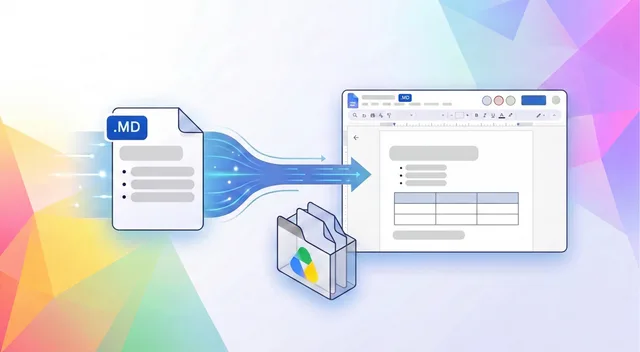
    Google Docs and Drive can now natively view, edit, and collaborate on Markdown (.md) files without manual format conversion, and Drive can also directly preview rendered tables and hyperlinks. The document header displays a .md indicator, and it supports real-time collaboration, line-level comments, and version history, making it easy for team members and AI agents to co-edit the same file.

    image (11)

    Matched fieldsBody

  8. Google Blog

    15 university students share their favorite Gemini features

    15 Google Student Ambassadors shared the Gemini features they use most, including Study notebooks, which turn course materials into personalized short lessons; Gemini Live, for practicing interviews by voice; Guided Learning, for guided study; and generating study guides and custom quizzes. The student plan offers unlimited uploads of class materials, study notes, and images, and Audio Overviews can turn documents and slides into podcast-style conversations, making it easy to review on the way across campus.

    Three young adults gathered around a laptop looking at its screen

    15 Google Student Ambassadors shared the Gemini features they use most, including Study notebooks, which turn course materials into personalized short lessons; Gemini Live, for practicing interviews by voice; Guided Learning, for guided study; and generating study guides and custom quizzes. The student plan offers unlimited uploads of class materials, study notes, and images, and Audio Overviews can turn documents and slides into podcast-style conversations, making it easy to review on the way a

    Matched fieldsBody