 Nov 16, 2026
By Farshad Ghodsian and Sukru Burc Eryilmaz
Discuss (0)
AI-Generated Summary
- NVIDIA Vera Rubin NVL72 debuted in MLPerf Training v6.1 and delivered the fastest time to train on six of seven benchmarks, achieving up to 2x more performance per GPU than an optimized GB300 NVL72 baseline.
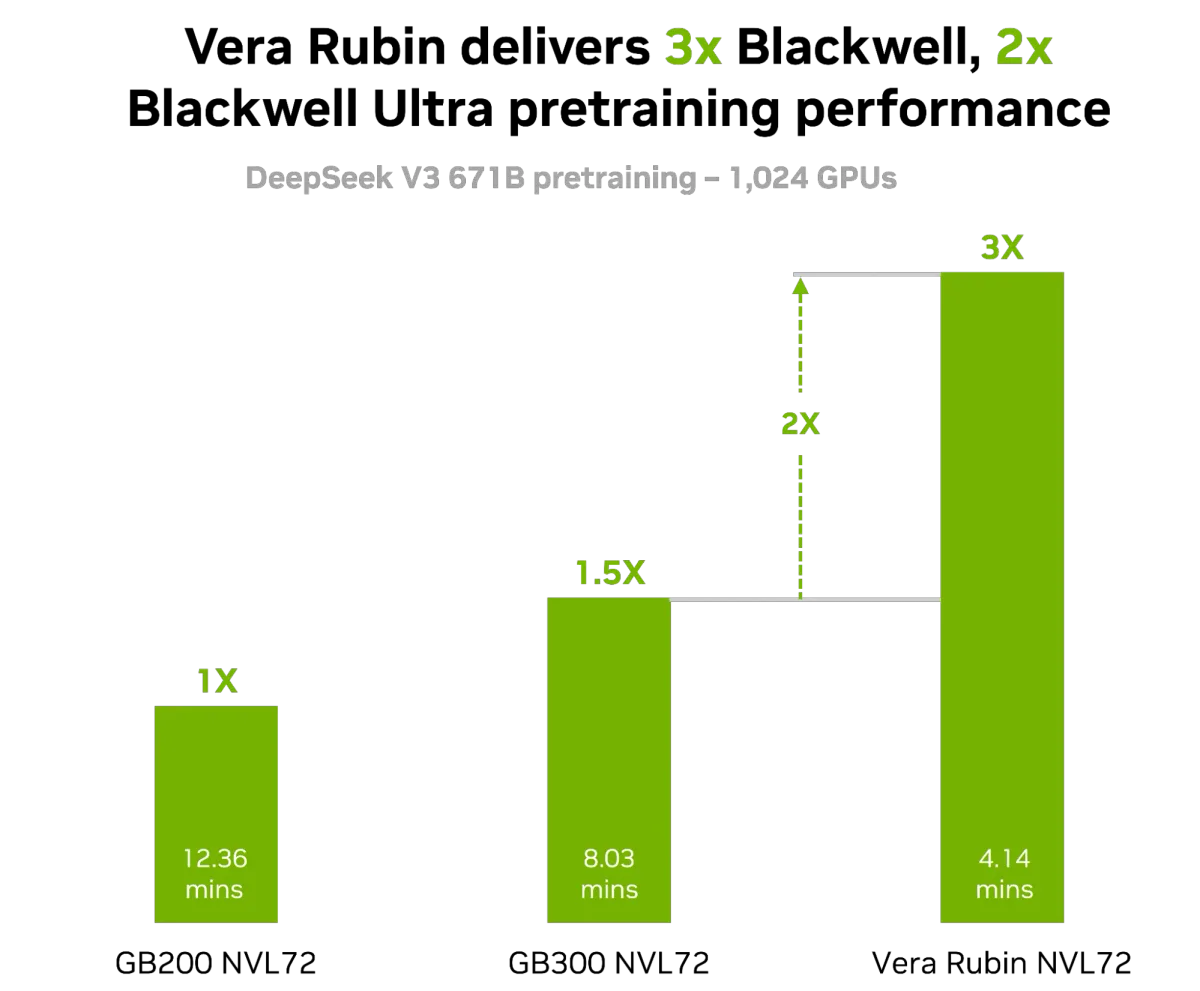
- On the DeepSeek-V3 671B Mixture-of-Experts benchmark, Vera Rubin NVL72 trained the model in 4.14 minutes using 1,024 GPUs, halving the 8.03-minute time of GB300 NVL72 at the same scale.
- Vera Rubin NVL72 also led the new Qwen 3.5 397B GRPO reinforcement learning post-training benchmark with a 10.44-minute result at 1,024 GPUs, and demonstrated software maturity by submitting with both TensorRT-LLM and vLLM inference backends.
- The platform maintained above 97% scaling efficiency when expanding from 256 to 1,024 GPUs on DeepSeek-V3, enabled by a copper NVLink 6 spine delivering 3.6 TB/s per GPU and ConnectX-9 SuperNICs over Quantum-X800 InfiniBand or Spectrum-X Ethernet.
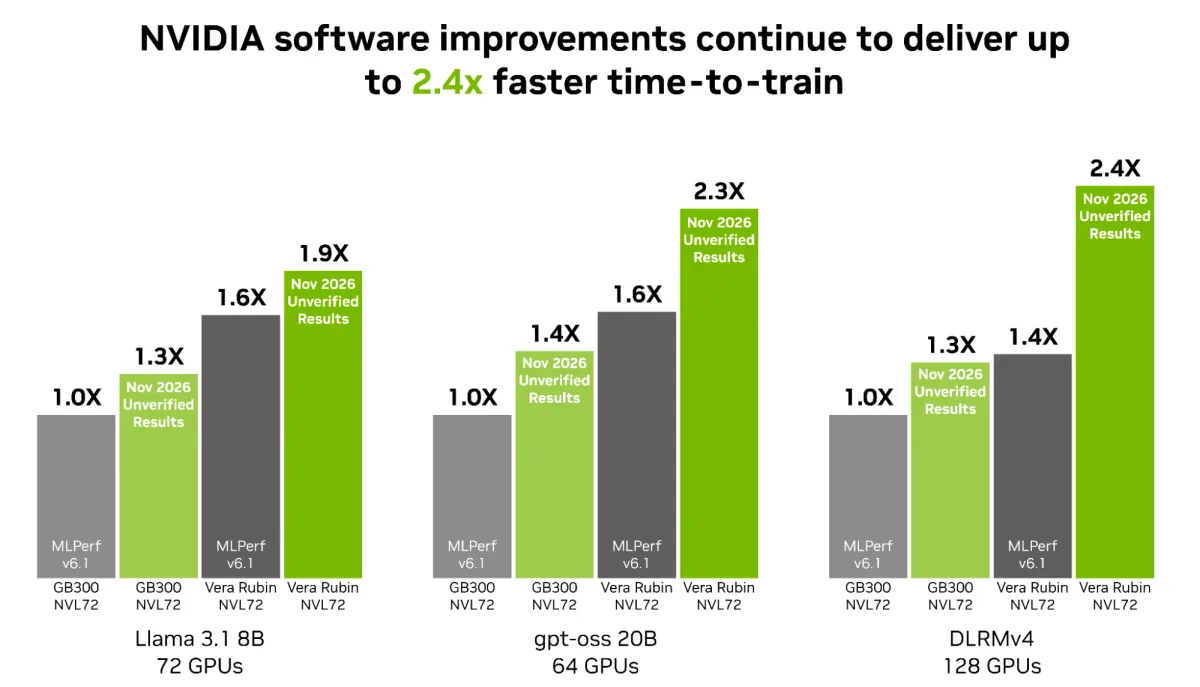
- Unverified reruns with a newer software stack further reduced Vera Rubin NVL72 time to train on Llama 3.1 8B, gpt-oss 20B, and DLRMv4, demonstrating continuous optimization after hardware ships.
- Eighty percent of closed-division submissions ran on NVIDIA platforms across 20 partner organizations, and Vera Rubin NVL72 systems are generally available through cloud infrastructure partners worldwide.
Next Steps
- Learn more about the NVIDIA Vera Rubin NVL72 platform for AI training and inference.
- See the full MLPerf Training v6.1 results for detailed benchmark data.
- Read the MLPerf Endpoints v1.0 blog to see how Vera Rubin leads in agentic inference.
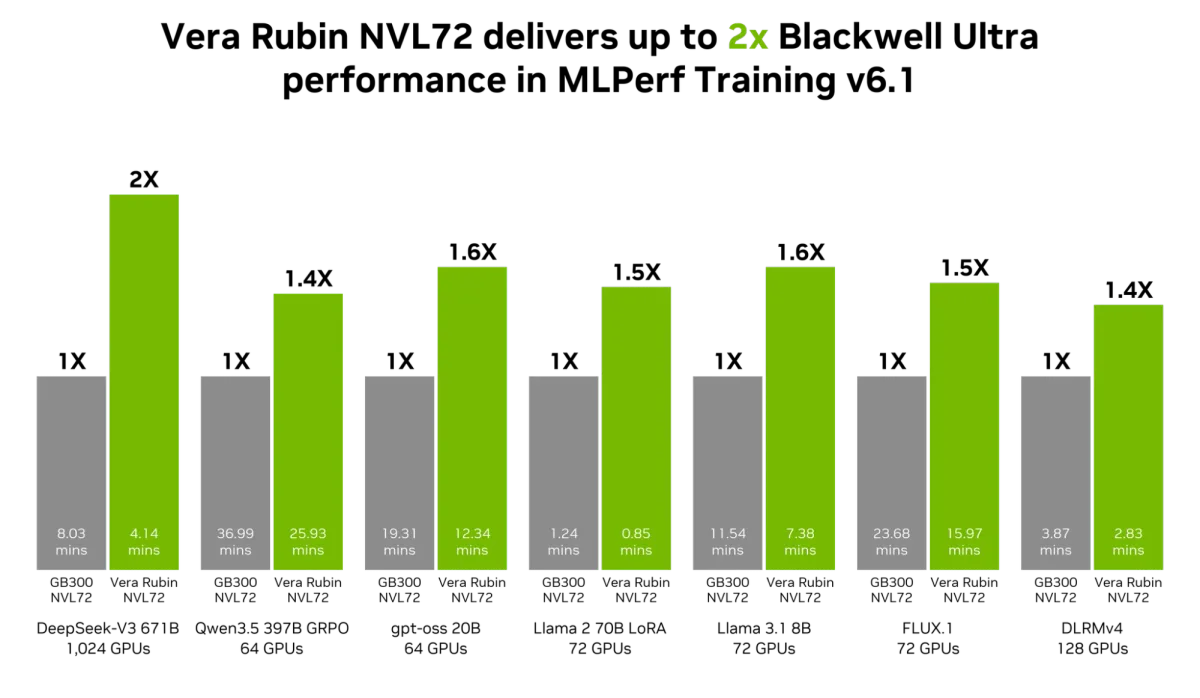
As AI agents tackle increasingly complex workflows, reducing time-to-train is critical for rapidly iterating on both models and the agents they power. MLPerf Training v6.1 marks the debut of the NVIDIA Vera Rubin architecture, and these early results demonstrate that its CUDA software stack is already highly mature. In its first appearance, the Vera Rubin NVL72 platform delivered the fastest time to train on six of the seven benchmarks, achieving up to 2x more performance than a highly optimized NVIDIA GB300 NVL72 baseline.
For the seventh benchmark, DeepSeek-V3 671B, NVIDIA captured the absolute fastest time of the round by demonstrating massive scale on a 10,240-GPU GB300 NVL72 cluster. This dual-platform approach deliberately showcases the strengths of both systems. While the GB300 results highlight the massive, reliable cluster scale NVIDIA is deploying today, Vera Rubin demonstrated its own exceptional scaling architecture by maintaining above 97% overall efficiency when scaling from 256 to 1,024 GPUs. Together, NVIDIA platforms hold the fastest time to train on every benchmark in v6.1.
NVIDIA platforms were also the only ones to submit results across all seven benchmarks, with Vera Rubin successfully completing the entire suite in its inaugural run. For developers, this breadth matters as much as any single top-line number. It proves that the performance gains inherited on day one span the entire modeling pipeline, comprehensively supporting everything from large-scale pretraining to the reinforcement learning post-training required for modern AI agents.
Comprehensive AI performance across all MLPerf training benchmarks
The simplest way to read this round is per benchmark: How much more performance does the new platform deliver per GPU on the same model?
| Model type | Benchmark | GPU Count | Vera Rubin NVL72 vs. optimized GB300 NVL72 | Submission ID (Vera Rubin / GB300) |
|---|---|---|---|---|
| Mixture-of-Experts | DeepSeek-V3 671B | 1,024 | 2x | 6.1-0116 / 6.1-0030 |
| Mixture-of-Experts | Qwen3.5 397B GRPO (RL) | 64 | 1.4x | 6.1-0135 / 6.1-0020 |
| Mixture-of-Experts | gpt-oss 20B | 64 | 1.6x | 6.1-0135 / 6.1-0049 |
| Dense | Llama 2 70B LoRA | 72 | 1.5x | 6.1-0123 / 6.1-0138 |
| Dense | Llama 3.1 8B | 72 | 1.6x | 6.1-0073 / 6.1-0138 |
| Diffusion | FLUX.1 | 72 | 1.5x | 6.1-0124 / 6.1-0138 |
| Recommender | DLRMv4 | 128 | 1.4x | 6.1-0129 / 6.1-0038 |
MLPerfTraining v6.1 results retrieved from www.mlcommons.org on Nov 16, 2026, from the following entries: 6.1-0116 , 6.1-0030, 6.1-0135, 6.1-0020, 6.1-0049, 6.1-0123, 6.1-0138, 6.1-0073, 6.1-0124, 6.1-0129 and 6.1-0038. The MLPerf name and logo are trademarks of MLCommons Association in the United States and other countries. All rights reserved. Unauthorized use is strictly prohibited. See www.mlcommons.org for more information.
MLPerfTraining v6.1 results retrieved from www.mlcommons.org on Nov 16, 2026, from the following entries: 6.1-0116 , 6.1-0030, 6.1-0135, 6.1-0020, 6.1-0049, 6.1-0123, 6.1-0138, 6.1-0073, 6.1-0124, 6.1-0129 and 6.1-0038. The MLPerf name and logo are trademarks of MLCommons Association in the United States and other countries. All rights reserved. Unauthorized use is strictly prohibited. See www.mlcommons.org for more information.
The pattern is clear. The largest gain lands on the largest, most communication-heavy model. While the platform is consistently 1.4x to 1.6x faster across the rest of the suite, the generational advantage widens even further for the massive DeepSeek-V3 benchmark.
The suite covers natural language, image generation, recommendation, and reinforcement learning, so the gains hold across multiple modalities as well as across different model shapes and architectures.
DeepSeek-V3 671B: 2x per GPU on the hardest workload
DeepSeek-V3 671B is a 671-billion-parameter token-dropless Mixture-of-Experts (MoE) model and the most demanding workload in the suite. Expert parallelism turns every iteration into a burst of all-to-all communication, so fabric efficiency shows up directly in time to train.
Vera Rubin NVL72 trained the benchmark in 4.14 minutes using 1,024 GPUs across 16 racks. GB300 NVL72 ran the identical 1,024-GPU configuration in 8.03 minutes, close to 2x per GPU, and the largest generational improvement in this round. Halving time to train roughly doubles how many experiments a team can run in a quarter, and experiment throughput is what moves model quality.
At a larger scale, GB300 NVL72 produced the fastest absolute result of the round: 1.38 minutes across 10,240 GPUs. That is one training job spread across 160 racks, each its own NVLink domain, and it shows the platform’s scale-out fabric holding up long after the job outgrows a single rack.
Post-training arrives, and Vera Rubin leads it
MLPerf Training v6.1 adds its first agentic LLM reinforcement learning post-training benchmark, Qwen 3.5 397B GRPO, reflecting a fundamental shift in AI development. Post-training has emerged as the critical differentiator for agentic accuracy, making the GRPO workload uniquely demanding. The continuous cycle of generating rollouts, scoring them, and updating weights pushes system architectures to their limits by forcing constant, massive weight migrations between inference and training engines.
Vera Rubin NVL72 achieved the fastest time for this new benchmark with a time of 10.44 minutes at 1,024 GPUs (6.1-0117), compared with 13.78 minutes for GB300 NVL72 (6.1-0031) at the same scale. The Vera Rubin platform also proved its flexibility by submitting on two different inference backends: NVIDIA NeMo RL with TensorRT-LLM at 10.44 minutes and with vLLM at 10.94 minutes (6.1-0118). Shipping two viable inference backends on a benchmark this new says as much about software maturity as it does about silicon.
Teaching these models to observe, reason, and act requires running each rollout in a simulated environment and executing tool calls, code, or API validations. Because driving these simulations is intensely CPU-bound, the NVIDIA Vera CPU is integral to the architecture, sustaining more than 22,500 concurrent RL environments across 256 CPUs in a single Vera CPU rack.
While the GPUs handle massive token generation and rapid weight updates, the Vera CPUs work in lockstep to simulate the environments, ensuring the accelerators are continuously fed with the rich feedback required to perfect agentic workflows.
NVLink, Quantum-X and Spectrum-X: Co-designed networking for high-efficiency AI scaling
Every result above is also a networking result. Modern AI training requires thousands of processors to act as one, a challenge NVIDIA solves by co-designing the internal rack domain and the external cluster fabric.
Inside the rack, Vera Rubin NVL72 connects 72 GPUs and 36 CPUs through a copper NVLink 6 spine. Delivering 3.6 TB/s per GPU and 260 TB/s per rack, this all-to-all domain keeps MoE expert dispatch off the critical path. Beyond the rack, the platform scales out via ConnectX-9 SuperNICs over Quantum-X800 InfiniBand or Spectrum-X Ethernet. To manage bursty MoE traffic, both fabrics use adaptive routing and congestion control to keep all-to-all communications hidden behind the compute layer.
This cohesive design translates directly to efficiency. On the DeepSeek-V3 benchmark, Vera Rubin NVL72 achieved above 97% scaling efficiency as it scaled from 256 to 1,024 GPUs (4 to 16 racks). GB300 NVL72 showcased the platform’s large-scale capabilities , extending to 10,240 GPUs to capture the fastest absolute result of the round.
Because the NVL72 architecture provides a consistent 72-GPU domain, developers see predictable performance jumps every generation without altering their operating model. Each cycle simply delivers more compute and bandwidth across the same consistent fabric.
MLPerfTraining v6.1 results retrieved from www.mlcommons.org on Nov 16, 2026, from the following entries: 6.1-0045, 6.1-0030 and 6.1-0116. Ratios are rounded. The MLPerf name and logo are trademarks of MLCommons Association in the United States and other countries. All rights reserved. Unauthorized use is strictly prohibited. See www.mlcommons.org for more information.
Continuous software optimization: Unlocking faster pretraining without hardware upgrades
Vera Rubin’s results came from the NVIDIA AI software stack that customers receive: NVIDIA NeMo Framework 26.09 for the pretraining benchmarks, NVIDIA NeMo RL for the reinforcement learning benchmark, and NVIDIA PyTorch releases for FLUX.1 and DLRMv4. The optimizations are the ones described in our MLPerf Training v6.0 round.
The stack also keeps moving after a round closes. Since v6.1 submissions were finalized, we have re-run several of the benchmarks on the same hardware and configuration with a newer software build. These are unverified results rather than MLCommons submissions, and we are sharing them because they show how continuous optimizations make NVIDIA infrastructure highly productive, durable, and fungible.
| Benchmark | GPU Count | GB300 NVL72 MLPerf v6.1 Run (MLPerf ID) | Vera Rubin NVL72 MLPerf v6.1 Run (MLPerf ID) | Nov 2026 Unverified Results GB300 NVL72* | Nov 2026 Unverified Results Vera Rubin NVL72* |
|---|---|---|---|---|---|
| Llama 3.1 8B | 72 | 11.541 mins (6.1-0138) |
7.162 min (6.1-0073) |
9.211 mins | 6.140 min |
| gpt-oss 20B | 64 | 18.24 mins (6.1-0049) |
11.213 mins (6.1-0135) |
13.151 mins | 8.080 mins |
| DLRMv4 | 128 | 3.871 mins (6.1-0038) |
2.829 mins (6.1-0129) |
2.940 mins | 1.628 mins |
MLPerfTraining v6.1 results retrieved from www.mlcommons.org on Nov 16, 2026, from the following entries: 6.1-0138, 6.1-0073, 6.1-0049, 6.1-0135, 6.1-0038 and 6.1-0129. Ratios are rounded. Unverified results have not been verified by MLCommons Association. Unverified results have not been through an MLPerf review and may use measurement methodologies and/or workload implementations that are inconsistent with the MLPerf specification for verified results. The MLPerf name and logo are registered and unregistered trademarks of MLCommons Association in the United States and other countries. All rights reserved. Unauthorized use strictly prohibited. See www.mlcommons.org for more information.
That is what a mature software stack means for customers. The infrastructure gets faster after it ships, and the improvements continue to arrive, extending the platform’s productive lifetime and revenue generating potential.
Because the CUDA platform is highly programmable, customers can unlock even more performance on their own. For example, Thinking Machines Lab developed an NVFP4 training recipe and custom kernels for its Inkling 2 Small model on GB300 NVL72, using NVFP4 for forward-pass MoE GEMMs and MXFP8 for gradients. Compared with full MXFP8 training, it sped up pretraining and fine-tuning by 8% and reinforcement learning by 20%, with minimal accuracy impact.
An ecosystem that shipped on day one
Vera Rubin’s debut in MLPerf Training v6.1 proves the architecture is built for immediate global deployment. With 80 percent of all closed-division submissions running on NVIDIA platforms across 20 partner organizations, these benchmarks represent reproducible performance across clouds and OEMs rather than isolated laboratory peaks.
Systems are already generally available across various cloud infrastructure partners, complementing a multitude of AI Factory deployments around the globe. Today, Vera Rubin leads on performance per GPU across all seven workloads, while Blackwell and Blackwell Ultra maintain the scale record. Azure’s 2,560-node, 10,240-GPU GB200 NVL72 submission tied the NVIDIA 10,240-GPU GB300 NVL72 run to claim this round’s largest clusters.
Partners are also pushing the limits of the architecture at the node level: Firmus used AI-driven kernel generation, with automated performance testing and mathematical validation, to post the fastest GB300 8-GPU result of the round, training GPT-OSS 20B in 52.90 minutes (6.1-0091) and Llama 3.1 8B in 52.40 minutes (6.1-0094). Because these platforms share a continuously optimizing CUDA software stack, developers can expect these inaugural metrics to climb steadily higher before the next MLPerf round even begins.
As the Vera Rubin software stack matures the way the Blackwell stack did, expect these initial performance advantages to continue to unlock even greater value throughout the platform’s lifecycle.
Learn more about the NVIDIA Vera Rubin NVL72 platform and see the full MLPerf Training v6.1 results or read our MLPerf Endpoints v1.0 blog to see how Vera Rubin leads the industry in agentic inference.
Discuss (0)Tags
Agentic AI / Generative AI | Data Center / Cloud | Hardware / Semiconductor | Blackwell | ConnectX | GB200 | Grace CPU | NVLink | Spectrum-X Ethernet | Intermediate Technical | Benchmark | Blackwell Ultra | Cloud Services | featured | LLM Benchmarking | MLPerf | Software-Defined Data Center | Training | Vera RubinAbout the Authors
 About Farshad Ghodsian
Farshad Ghodsian is a senior technical marketing engineer at NVIDIA, where he focuses on AI training and inference at scale, performance optimization insights, new model releases, and AI engineering enablement. He brings a wealth of experience at the intersection of AI infrastructure, distributed training, GPU-accelerated computing, and agentic workloads. With this background, he translates cutting-edge research into practical insights for developers, enterprise teams, and business leaders. Prior to NVIDIA, Farshad held technical roles at leading semiconductor and consulting companies, where he helped build and manage large-scale generative AI and MLOps platforms for top technology customers. View all posts by Farshad Ghodsian
 About Sukru Burc Eryilmaz
S. Burc Eryilmaz is a senior manager of GPU architecture at NVIDIA. His team focuses on optimizing the end-to-end performance and energy efficiency of AI training both at single-node scale and supercomputer scale through hardware and software innovations. He received his PhD from Stanford University, and BS from Bilkent University. View all posts by Sukru Burc Eryilmaz