English translation is being prepared.
Matched fieldsTitle
Matched fieldsTitle
Matched fieldsTitle
Matched fieldsTitle

Matched fieldsTitle
Matched fieldsTitle

Matched fieldsTitle
Matched fieldsTitle

Matched fieldsTitle

Matched fieldsTitle
Matched fieldsTitle
Matched fieldsTitle
Matched fieldsTitle
Matched fieldsTitle
The Berkeley AI Research (BAIR) blog reviewed recent advances in the field of parallel reasoning, focusing on the paradigm of Adaptive Parallel Reasoning (APR): letting the model decide at inference time when to parallelize, how many threads to generate, and how to coordinate them. Compared with Tree-of-Thoughts, it requires no domain-specific heuristic decomposition; compared with BoN, it avoids redundant computation; and compared with non-adaptive methods, it can choose not to parallelize. The post mentions ThreadWeaver (Lian et al., 2025) and the APR method proposed by Pan et al. (2025).
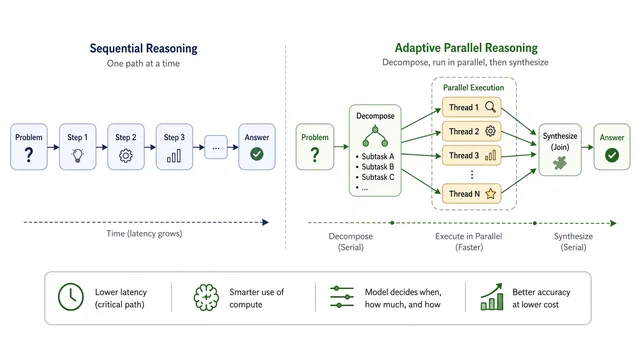
The Berkeley AI Research (BAIR) blog reviewed recent advances in the field of parallel reasoning, focusing on the paradigm of Adaptive Parallel Reasoning (APR): letting the model decide at inference time when to parallelize, how many threads to generate, and how to coordinate them. Compared with Tree-of-Thoughts, it requires no domain-specific heuristic decomposition; compared with BoN, it avoids redundant computation; and compared with non-adaptive methods, it can choose not to parallelize. The
Matched fieldsTitle

Matched fieldsTitle

Matched fieldsTitle
Matched fieldsTitle

Matched fieldsTitle

Matched fieldsTitle
Matched fieldsTitle