English translation is being prepared.
Matched fieldsTitle、Summary
Matched fieldsTitle、Summary

Matched fieldsTitle、Summary
Matched fieldsTitle、Summary
Matched fieldsTitle、Summary
Matched fieldsTitle
Matched fieldsTitle、Summary
Matched fieldsTitle、Summary
Matched fieldsTitle

Matched fieldsTitle、Summary
Matched fieldsTitle、Summary
The Gradient published an article exploring neural algorithmic reasoning, that is, using deep neural networks to capture the computations of classical algorithms such as shortest paths and sorting. The article points out that MIT's "What Can Neural Networks Reason About?" demonstrates that the better the algorithmic alignment, the better the generalization; GNNs are naturally aligned with dynamic programming and outperform architectures with weaker inductive biases on DP execution benchmarks. The author also cautions that algorithmic alignment does not mean one can arbitrarily apply any highly expressive GNN, and out-of-distribution performance remains a key challenge.
The Gradient published an article exploring neural algorithmic reasoning, that is, using deep neural networks to capture the computations of classical algorithms such as shortest paths and sorting. The article points out that MIT's "What Can Neural Networks Reason About?" demonstrates that the better the algorithmic alignment, the better the generalization; GNNs are naturally aligned with dynamic programming and outperform architectures with weaker inductive biases on DP execution benchmarks. Th
Matched fieldsTitle、Summary、Body
Matched fieldsTitle、Summary
Matched fieldsTitle、Summary
Browser Use has opened its fastest browser agent, BU Ultrafast, from the waitlist to all Cloud plans in the US, including the free tier. Official data shows a median task time of 22 seconds and a cost of $0.0064 per task, compared with 79 seconds and $0.0098 for the default agent on GPT-6 Luna. To use it, simply set model to bu-ultrafast; if you need more step-by-step reasoning, you can switch to bu-fast from the same agent, which is billed at standard rates.

Matched fieldsSummary、Body
Krea announced that its research lead @sleenyre will speak at the SGLang Summit, covering reinforcement learning and inference scaling for Krea 3. The summit takes place November 12–13 at Fort Mason in San Francisco.
Matched fieldsSummary、Body
AWS presents a five-step closed loop for managing Amazon Bedrock costs: attribute by IAM principal, record request observability, control spending with budget alerts and hard blocks, optimize platform defaults such as model routing and caching, and review on a regular cadence. Amazon Bedrock now supports automatically attributing inference costs to the IAM principal that initiated the call, with the caller ARN written to the line_item_iam_principal column in CUR 2.0, covering IAM users, roles, federated identities, and API keys. In shared gateway scenarios, role session names and session tags can be set per user, credentials are cached for up to 1 hour, and attribution by user and tenant is restored.
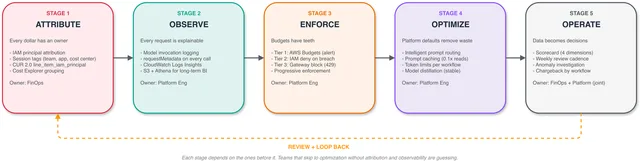
AWS presents a five-step closed loop for managing Amazon Bedrock costs: attribute by IAM principal, record request observability, control spending with budget alerts and hard blocks, optimize platform defaults such as model routing and caching, and review on a regular cadence. Amazon Bedrock now supports automatically attributing inference costs to the IAM principal that initiated the call, with the caller ARN written to the line item iam principal column in CUR 2.0, covering IAM users, roles, f
Matched fieldsSummary、Body
OpenAI releases the GPT-Rosalind-6 system card addendum. This model uses the same set of weights as GPT-6 Astra, with no new training data or post-training added, and is provided only through trusted access to vetted research institutions, enterprises, and government partners. At the highest reasoning budget, MedChemBench v7 averages 49.6% (GPT-Rosalind-5.5: 28.9%), GeneBench Pro v13 single-attempt success rate is 37.7% (previous generation: 16.7%), and LifeSciBench Gold average score is 61.3% (previous generation: 44.0%). Under the Preparedness Framework, this release is rated High capability in the biological and chemical domains, below the Critical threshold; rated Critical in the cybersecurity domain; and below High in AI self-improvement.
OpenAI releases the GPT-Rosalind-6 system card addendum. This model uses the same set of weights as GPT-6 Astra, with no new training data or post-training added, and is provided only through trusted access to vetted research institutions, enterprises, and government partners. At the highest reasoning budget, MedChemBench v7 averages 49.6% (GPT-Rosalind-5.5: 28.9%), GeneBench Pro v13 single-attempt success rate is 37.7% (previous generation: 16.7%), and LifeSciBench Gold average score is 61.3% (
Matched fieldsSummary、Body
UCSD Hao AI Lab has open-sourced JetSpec++, which pipelines the draft stage and verification through causal parallel drafting, a hidden-state predictor, and an anchor-token decoder, achieving 1,361 TPS on Qwen3-8B, up to 1.54x end-to-end speedup over DSpark, and 7.45x speedup over autoregressive decoding while remaining lossless. Combined with NVFP4 and kernel optimizations, Qwen3-8B exceeds 4,000 TPS and Qwen3.8-27B exceeds 900 TPS (on two GB200 GPUs). The model, code, and inference engine have all been open-sourced.
UCSD Hao AI Lab has open-sourced JetSpec++, which pipelines the draft stage and verification through causal parallel drafting, a hidden-state predictor, and an anchor-token decoder, achieving 1,361 TPS on Qwen3-8B, up to 1.54x end-to-end speedup over DSpark, and 7.45x speedup over autoregressive decoding while remaining lossless. Combined with NVFP4 and kernel optimizations, Qwen3-8B exceeds 4,000 TPS and Qwen3.8-27B exceeds 900 TPS (on two GB200 GPUs). The model, code, and inference engine have
Matched fieldsSummary
UCSD Hao AI Lab has launched JetSpec++, which, through causal parallel drafting and pipelined verification, achieves lossless end-to-end speedups of 1.54× over DSpark and 7.45× over autoregressive decoding on Qwen3-8B, reaching 1,361 TPS in BF16. On GSM8K, Qwen3-8B's per-round latency drops from 9.92 ms with DSpark to 6.84 ms, with drafting time compressed from 3.76 ms to 0.61 ms. The model, code, and inference engine have all been open-sourced.
Matched fieldsSummary
Hao AI Lab proposes JetSpec++, which pipelines draft generation and verification through causal parallel drafting, a hidden-state predictor, and an anchor-token decoder, achieving lossless speedup on Qwen3-8B and Qwen3.8-27B. Compared with DSpark, it achieves up to 1.54x end-to-end speedup, and 7.45x speedup over autoregressive decoding, reaching 1,361 TPS and 367 TPS respectively under BF16; with NVFP4 and kernel optimizations, it exceeds 4,000 TPS and 900 TPS on two GB200s. Across 7 benchmarks, it accepts 8.94 tokens per round, compared with 6.89 for DSpark; the model, code, and inference engine have all been open-sourced.
Hao AI Lab proposes JetSpec++, which pipelines draft generation and verification through causal parallel drafting, a hidden-state predictor, and an anchor-token decoder, achieving lossless speedup on Qwen3-8B and Qwen3.8-27B. Compared with DSpark, it achieves up to 1.54x end-to-end speedup, and 7.45x speedup over autoregressive decoding, reaching 1,361 TPS and 367 TPS respectively under BF16; with NVFP4 and kernel optimizations, it exceeds 4,000 TPS and 900 TPS on two GB200s. Across 7 benchmarks
Matched fieldsSummary