←Search results

By relevance · Total 1628 results Clear search

Thursday

  1. Zhidongxi

    Chaoyan Intelligence Open-Sources 35B Model Apex-35B-V1.0, with AI Participating in Its Own R&D

    Beijing-based large model startup Chaoyan Intelligence has released and open-sourced its first large model, Apex-35B-V1.0, with 35 billion total parameters, approximately 3 billion parameters activated per token, and support for a 262,000-token context window, optimized through mid-training and post-training based on Qwen3.6-35B-A3B. The model scored 60.9 and 40.0 on the paper reproduction test PaperBench and the scientific research challenge test FrontierScience, respectively, higher than GLM-5.3's 42.5 and 30.7; it scored 84.0 on the tool-calling test BFCL V4, higher than DeepSeek-V4.1-Flash-1017's 75.0. The model has been released with open weights under the Apache 2.0 license, and the official release provides approximately 72GB of BF16 weights and GGUF quantized versions at various precisions.

    Beijing-based large model startup Chaoyan Intelligence has released and open-sourced its first large model, Apex-35B-V1.0, with 35 billion total parameters, approximately 3 billion parameters activated per token, and support for a 262,000-token context window, optimized through mid-training and post-training based on Qwen3.6-35B-A3B. The model scored 60.9 and 40.0 on the paper reproduction test PaperBench and the scientific research challenge test FrontierScience, respectively, higher than GLM-5

    Matched fieldsBody

  2. heise online

    Austrian court confirms 30-year statute of limitations for Volkswagen dieselgate compensation; Apple releases touchscreen MacBook Pro

    Austria's Supreme Court (OGH) has confirmed in a final ruling that the statute of limitations for dieselgate victims' claims against Volkswagen is 30 years rather than 3 years, and Austrian car owners can still sue Volkswagen. Apple has released its first touchscreen MacBook Pro, with the 14-inch model starting at nearly 3,300 euros and the 16-inch model starting at 3,900 euros, featuring Tandem-OLED and Dynamic Island for the first time. Microsoft's quarterly revenue and profit exceeded expectations, with cloud business growing 30% and Copilot usage in Microsoft 365 growing 50%.

    Austria's Supreme Court (OGH) has confirmed in a final ruling that the statute of limitations for dieselgate victims' claims against Volkswagen is 30 years rather than 3 years, and Austrian car owners can still sue Volkswagen. Apple has released its first touchscreen MacBook Pro, with the 14-inch model starting at nearly 3,300 euros and the 16-inch model starting at 3,900 euros, featuring Tandem-OLED and Dynamic Island for the first time. Microsoft's quarterly revenue and profit exceeded expecta

    Matched fieldsBody

  3. Shaoshupai

    Minority Editorial Team's New Gadgets: Cuktech Power Bank Card, HomePod mini 2, Sonos Beam Ultra, and Guyán Prepared Dishes

    In issue 254 of "New Gadgets," the Shaoshupai editorial team shared four products they recently purchased or received for testing. The HomePod mini 2's chip has been upgraded from the S5 to the S10, and Wi-Fi has been upgraded to Wi-Fi 6, but the difference in everyday listening is extremely small compared with the previous generation; under the 27.2 system, AirPlay latency is greatly improved. The Sonos Beam Ultra achieves 7.1.2 Dolby Atmos on its own, and the Sonos 27 system provides a native cloud MCP service that lets commonly used AI directly control speaker playback.

    In issue 254 of "New Gadgets," the Shaoshupai editorial team shared four products they recently purchased or received for testing. The HomePod mini 2's chip has been upgraded from the S5 to the S10, and Wi-Fi has been upgraded to Wi-Fi 6, but the difference in everyday listening is extremely small compared with the previous generation; under the 27.2 system, AirPlay latency is greatly improved. The Sonos Beam Ultra achieves 7.1.2 Dolby Atmos on its own, and the Sonos 27 system provides a native

    Matched fieldsBody

  4. Replit Blog

    Replit releases ViBench 2.0: a benchmark for long-horizon software building

    Replit releases ViBench 2.0 to evaluate AI agents' ability to build a complete product feature by feature starting from an empty project, comprising 17 products, 241 feature requests, and 544 test plans. GPT-6.1 Sol leads with a 65% pass@1, GPT-6 Astra is at 60%, and Opus 5.5 is at 49%, with all three passing over 90% of test plans. Opus 5.5 completes a build in about 70 minutes on average, roughly 2.5 times faster than Sol; DeepSeek V4.1 Flash passes 77% of test plans at about $2.50 per build, but no open-weight model can pass a complete build.

    ViBench 2.0: A Benchmark for Long-Horizon Software Building — cover image

    Replit releases ViBench 2.0 to evaluate AI agents' ability to build a complete product feature by feature starting from an empty project, comprising 17 products, 241 feature requests, and 544 test plans. GPT-6.1 Sol leads with a 65% pass@1, GPT-6 Astra is at 60%, and Opus 5.5 is at 49%, with all three passing over 90% of test plans. Opus 5.5 completes a build in about 70 minutes on average, roughly 2.5 times faster than Sol; DeepSeek V4.1 Flash passes 77% of test plans at about $2.50 per build,

    Matched fieldsBody

  5. Pragmatic Engineer

    Google-Scale Software Engineering and CS Education: A Conversation with Titus Winters

    On The Pragmatic Engineer podcast, Titus Winters looked back at Google's 2010 large-scale refactoring of 250M+ lines of C++ code, which was maintained by 10,000 engineers at the time; the team completed it in seven steps—parsing, matching, code generation, coexistence of old and new APIs, sharding, banning old patterns, and deleting old APIs—all well before the LLM era. He also discussed how Google, because Search could not be released monthly, mandated that every change come with tests, and how he took part in updating the ACM/IEEE undergraduate computer science curriculum guidelines, believing that almost all existing curricula should be torn down and rebuilt.

    On The Pragmatic Engineer podcast, Titus Winters looked back at Google's 2010 large-scale refactoring of 250M+ lines of C++ code, which was maintained by 10,000 engineers at the time; the team completed it in seven steps—parsing, matching, code generation, coexistence of old and new APIs, sharding, banning old patterns, and deleting old APIs—all well before the LLM era. He also discussed how Google, because Search could not be released monthly, mandated that every change come with tests, and how

    Matched fieldsBody

  6. Latent SpaceSelected

    Google DeepMind releases Gemini 4 Carbon, topping Artificial…

    Google DeepMind has released Gemini 4 Carbon, which ranks first on the Artificial Analysis Intelligence Index v5 with a score of 59 and leads in 4 of 9 evaluations including HLE-Diamond and TB-Science. The model focuses on cybersecurity and long-horizon tasks, claiming 88.2% on SEC-bench Pro, 54.8% on ExploitGym, and 71.0% on CWE-bench, and is initially available only to trusted cybersecurity personnel through the Fairwind Program. In terms of specifications, it supports a 1M token context and 1M maximum output, with input covering text, images, video, and speech, and output in text; Artificial Analysis lists a standard price of $4/$20 per million input/output tokens, plus a 50% launch discount.

    Google DeepMind has released Gemini 4 Carbon, which ranks first on the Artificial Analysis Intelligence Index v5 with a score of 59 and leads in 4 of 9 evaluations including HLE-Diamond and TB-Science. The model focuses on cybersecurity and long-horizon tasks, claiming 88.2% on SEC-bench Pro, 54.8% on ExploitGym, and 71.0% on CWE-bench, and is initially available only to trusted cybersecurity personnel through the Fairwind Program. In terms of specifications, it supports a 1M token context and 1

    Matched fieldsBody

  7. Hugging Face

    AnySpeechRecognizer and AnyDecisionModel: Open-source speech and decision models for the Apple platform

    AnySpeechRecognizer supports engine switching on top of the Apple SpeechAnalyzer API, with options including NVIDIA Parakeet TDT 0.6B v3 (supporting 25 European languages), Moondream post-trained Parakeet Ultra, the English version Parakeet Unified, and Alibaba Qwen3-ASR (0.6B/1.7B, covering 30 languages and 22 Chinese dialects). These models have been converted to Core ML and published on the Hugging Face Hub; Parakeet takes about 20–40 seconds to transcribe 1 hour of audio, while Qwen3-ASR is slower and requires several GB of memory. The package also adds a speaker diarization module, SpeakerDiarizer, which the Apple framework lacks; it is based on NVIDIA Streaming Sortformer and can track up to 4 speakers.

    AnySpeechRecognizer supports engine switching on top of the Apple SpeechAnalyzer API, with options including NVIDIA Parakeet TDT 0.6B v3 (supporting 25 European languages), Moondream post-trained Parakeet Ultra, the English version Parakeet Unified, and Alibaba Qwen3-ASR (0.6B/1.7B, covering 30 languages and 22 Chinese dialects). These models have been converted to Core ML and published on the Hugging Face Hub; Parakeet takes about 20–40 seconds to transcribe 1 hour of audio, while Qwen3-ASR is

    Matched fieldsBody

  8. The Rundown AI

    Google releases Gemini 4 Carbon, topping 15 of 17 benchmarks

    Google has released Gemini 4 Carbon, a frontier model aimed at cybersecurity and long-horizon coding tasks, topping 15 of Google's own 17 benchmarks, but it has not yet been made public and is available only to some cybersecurity defenders. It scores 59 on Artificial Analysis' Intelligence Index, surpassing Claude Opus 5.5 and up 9 points from Argon four weeks ago; on long-input reasoning it leads OpenAI Astra and Opus by 24 points. The introductory API price is $2 per million input tokens and $10 per million output tokens, half that of Opus 5.5, doubling after the discount period to Opus's rates. Google has not announced when it will broaden access.

    Google has released Gemini 4 Carbon, a frontier model aimed at cybersecurity and long-horizon coding tasks, topping 15 of Google's own 17 benchmarks, but it has not yet been made public and is available only to some cybersecurity defenders. It scores 59 on Artificial Analysis' Intelligence Index, surpassing Claude Opus 5.5 and up 9 points from Argon four weeks ago; on long-input reasoning it leads OpenAI Astra and Opus by 24 points. The introductory API price is $2 per million input tokens and $

    Matched fieldsBody

  9. Mistral AISelected

    Mistral Releases Open Weights for Mistral Large 4 (Le Chonk)

    Mistral has released the open weights for Mistral Large 4 (Le Chonk), a 1-trillion-parameter natively multimodal model that continues reinforcement learning on top of the preview version, with improved coding and defensive cybersecurity capabilities. It scores 19.7% on FrontierCode 2.0 and 48% on the Artificial Analysis Coding Agent Index, roughly on par with GLM-5.3, but uses an average of 47% fewer tokens per task; on Terminal-Bench 4.0 it improves by 13 percentage points to 41%. The model supports three reasoning modes, uses a modified MIT-based Mistral Ecosystem Open-Weight license, and is priced via API at $0.70 per million input tokens, $0.07 for cached input, and $2.10 for output.

    Le Chonk signal

    Mistral has released the open weights for Mistral Large 4 (Le Chonk), a 1-trillion-parameter natively multimodal model that continues reinforcement learning on top of the preview version, with improved coding and defensive cybersecurity capabilities. It scores 19.7% on FrontierCode 2.0 and 48% on the Artificial Analysis Coding Agent Index, roughly on par with GLM-5.3, but uses an average of 47% fewer tokens per task; on Terminal-Bench 4.0 it improves by 13 percentage points to 41%. The model sup

    Matched fieldsBody

  10. AWS Machine Learning

    Implementing agentic QA automation with Amazon Nova Act to accelerate software delivery (Part 3)

    The AWS blog introduces two new capabilities added to QA Studio based on Amazon Nova Act: applications organize test cases and test suites into application containers with owners, record CloudWatch metrics by application and environment, and provide a 0–100 health score (starting from the pass rate and deducting points for flaky tests), supporting two trend windows of 7 days/hourly and 30 days/daily. Team-based user management defines five cumulative roles: Admin, Team Lead, Editor, Executor, and Viewer; each application belongs to only one team, and permissions are managed by application rather than by individual test.

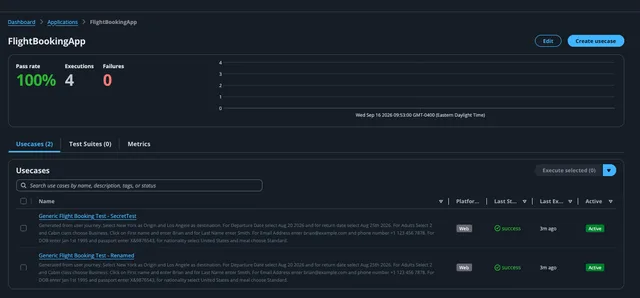
    QA Studio application detail page showing pass rate, executions, and failures above the use cases and test suites tabs

    The AWS blog introduces two new capabilities added to QA Studio based on Amazon Nova Act: applications organize test cases and test suites into application containers with owners, record CloudWatch metrics by application and environment, and provide a 0–100 health score (starting from the pass rate and deducting points for flaky tests), supporting two trend windows of 7 days/hourly and 30 days/daily. Team-based user management defines five cumulative roles: Admin, Team Lead, Editor, Executor, an

    Matched fieldsBody

  11. AWS Machine Learning

    Building an Enterprise-Grade Agentic AI Platform on Amazon Bedrock AgentCore

    AWS has released an enterprise-grade Agentic AI platform blueprint based on Amazon Bedrock and AgentCore, adopting a federated operating model in which a central Platform team provides governed shared services while each Workstream team retains ownership of its own agents, tools, and data. The platform enforces model admission, regional restrictions, rate and token quotas, and budget controls through an independent inference gateway and an MCP tool gateway, and uses an evaluation pipeline to perform gate checks before agents go live.

    Operating model linking the governance foundation, Platform control plane, and team-owned Workstream cells

    AWS has released an enterprise-grade Agentic AI platform blueprint based on Amazon Bedrock and AgentCore, adopting a federated operating model in which a central Platform team provides governed shared services while each Workstream team retains ownership of its own agents, tools, and data. The platform enforces model admission, regional restrictions, rate and token quotas, and budget controls through an independent inference gateway and an MCP tool gateway, and uses an evaluation pipeline to per

    Matched fieldsBody

Friday

  1. 36Kr · AI

    Coursera 2026 Q3 Earnings: Revenue $376.7 Million, Project Helix Planned to Open in the First Half of 2027

    Coursera reported third-quarter 2026 revenue of $376.7 million, up 94% year over year, mainly from Udemy, which was merged in May; on an organic basis, revenue fell about 3% year over year, and the stock dropped about 8% after hours. The company expects to achieve more than $150 million in annualized total cost savings by the end of the year, and has listed Project Helix, an AI-native adaptive skills platform, as its "number one priority," with plans to open it broadly to enterprise customers in the first half of 2027. The platform's GenAI course enrollment rate rose from 25 per minute in 2025 to more than 40 per minute in 2026.

    Coursera reported third-quarter 2026 revenue of $376.7 million, up 94% year over year, mainly from Udemy, which was merged in May; on an organic basis, revenue fell about 3% year over year, and the stock dropped about 8% after hours. The company expects to achieve more than $150 million in annualized total cost savings by the end of the year, and has listed Project Helix, an AI-native adaptive skills platform, as its "number one priority," with plans to open it broadly to enterprise customers in

    Matched fieldsBody

  2. 36Kr · AI

    OpenAI Doubles Pro Plan Quotas; Article Reviews Backend Token Consumption of AI Coding Tools

    OpenAI product lead Tibo announced that usage limits for the Pro 100, Pro 200, Pro 500, and Business Premium plans have all been doubled, and that the quota reduction for Pro 200 has been withdrawn; Pro 500 can get usage equivalent to 50 times that of Plus. The article notes that this falls on day 25 of OpenAI's 28-day improvement plan, and some Pro 200 users believe it merely cancels a planned reduction rather than adding new benefits. The article also reviews the hidden token consumption caused by backend sub-agent status summaries in Codex and Claude Code; an Anthropic engineer said that agent_summary, at API list prices, accounts for about 2% of total cost, and that the issue of missed prompt caching has been fixed in Claude Code 2.1.311 and later versions.

    OpenAI product lead Tibo announced that usage limits for the Pro 100, Pro 200, Pro 500, and Business Premium plans have all been doubled, and that the quota reduction for Pro 200 has been withdrawn; Pro 500 can get usage equivalent to 50 times that of Plus. The article notes that this falls on day 25 of OpenAI's 28-day improvement plan, and some Pro 200 users believe it merely cancels a planned reduction rather than adding new benefits. The article also reviews the hidden token consumption cause

    Matched fieldsBody

  3. Unite.AI

    OpenAI expands its misalignment monitoring system to cover training, evaluation, and external deployment

    On October 29, 2026, OpenAI announced an expanded multi-layer misalignment behavior monitoring system covering training, evaluation, and internal use, and, after modifications, extended to external deployment. The system monitors every reinforcement learning run and evaluation for models at least as capable as GPT-6 Astra, with a four-layer architecture that escalates step by step from activation probes to safety and alignment investigation agents. In independent red team testing conducted by METR and Redwood Research from July 21 to August 11, two client-controllable request headers that could disable the new agent monitoring were found, along with a compression event gap from May to July 2026 in which approximately 10% of eligible internal Codex traffic was not monitored.

    On October 29, 2026, OpenAI announced an expanded multi-layer misalignment behavior monitoring system covering training, evaluation, and internal use, and, after modifications, extended to external deployment. The system monitors every reinforcement learning run and evaluation for models at least as capable as GPT-6 Astra, with a four-layer architecture that escalates step by step from activation probes to safety and alignment investigation agents. In independent red team testing conducted by ME

    Matched fieldsBody

  4. Unite.AI

    Baseten Releases 2B Open-Weight Decision Model joey-1

    On October 29, Baseten released joey-1, a 2B-parameter decision model, priced at $0.01 per million tokens. It is now available on Baseten Model APIs and has open weights on Hugging Face. The model was post-trained by the in-house lab Base Labs based on Qwen3.5-2B, and shares the same data recipe and API with mammoth-1 (27B) and elephant-1 (9B), so switching requires only a one-line change. The model card shows that joey-1 scored 63.30 on the public Jev Decision Index 0.4 leaderboard, ranking 37th among 230 models and the highest score among models with fewer than 4B parameters; Baseten says its P50 end-to-end latency for 2000-token requests in production is 20 ms.

    On October 29, Baseten released joey-1, a 2B-parameter decision model, priced at $0.01 per million tokens. It is now available on Baseten Model APIs and has open weights on Hugging Face. The model was post-trained by the in-house lab Base Labs based on Qwen3.5-2B, and shares the same data recipe and API with mammoth-1 (27B) and elephant-1 (9B), so switching requires only a one-line change. The model card shows that joey-1 scored 63.30 on the public Jev Decision Index 0.4 leaderboard, ranking 37t

    Matched fieldsBody

  5. Microsoft Research

    Microsoft Research Focus Issue 97: ForkPilot, CABRA, and…

    Microsoft Research Focus Issue 97 presents several research advances: the self-improving agent framework ForkPilot achieves state-of-the-art performance on six benchmarks and mainstream AI models while reducing AI processing overhead by up to 59%. The CABRA framework finds that coding agents, although able to solve coding problems with the help of tools, still struggle when understanding unfamiliar codebases. An analysis of Copilot Chat activity shows that document editing accounts for more than 20% of classified activity, and after excluding the 20 most common activities, differences between different customer categories are significantly amplified.

    Portrait of Sowbhagya Suresh

    Microsoft Research Focus Issue 97 presents several research advances: the self-improving agent framework ForkPilot achieves state-of-the-art performance on six benchmarks and mainstream AI models while reducing AI processing overhead by up to 59%. The CABRA framework finds that coding agents, although able to solve coding problems with the help of tools, still struggle when understanding unfamiliar codebases. An analysis of Copilot Chat activity shows that document editing accounts for more than

    Matched fieldsBody

  6. Ant inclusionAI: New GitHub repository

    Ant inclusionAI Open-Sources the ZwZ Model Family and the ZoomBench Fine-Grained Perception Benchmark (ICML 2026)

    Ant inclusionAI has released the ZwZ model family (4/7/8B) accompanying its ICML 2026 paper, achieving SOTA on multimodal perception benchmarks among open-source models, while requiring only a single forward inference pass and no tool calls at inference time. The method is Region-to-Image Distillation (R2I), which distills high-quality VQA supervision generated from enlarged local regions back into the full image, with 37K training samples. It also introduces ZoomBench, containing 845 VQA items covering 6 fine-grained perception dimensions, on which Qwen2.5-VL-7B achieves only 42.5% average accuracy.

    gp_avg_comparison

    Ant inclusionAI has released the ZwZ model family (4/7/8B) accompanying its ICML 2026 paper, achieving SOTA on multimodal perception benchmarks among open-source models, while requiring only a single forward inference pass and no tool calls at inference time. The method is Region-to-Image Distillation (R2I), which distills high-quality VQA supervision generated from enlarged local regions back into the full image, with 37K training samples. It also introduces ZoomBench, containing 845 VQA items

    Matched fieldsBody

Wednesday

  1. gihyo.jp

    Google open-sources the Elephant-Goldfish Model plugin, letting AI separately handle the writing and verification of design documents

    On October 22, 2026, Google announced the open-sourcing of the Elephant-Goldfish Model (EGM) plugin, which pairs Elephant, responsible for conversing with users and writing design documents, with Goldfish, which independently verifies the documents without inheriting the conversation history, to identify ambiguities and omissions in specifications. The plugin was first developed internally at Google for software engineers, and it is said that thousands of employees already use it daily to develop production code; the repository uses the Apache 2.0 license. The first tagged version, v0.1.0, was released on October 27, containing a total of 7 skills. The README provides installation methods for Antigravity, Claude Code, and Codex, but the release notes state that verification across runtime environments has not yet been completed, so it cannot yet be called a stable version.

    On October 22, 2026, Google announced the open-sourcing of the Elephant-Goldfish Model (EGM) plugin, which pairs Elephant, responsible for conversing with users and writing design documents, with Goldfish, which independently verifies the documents without inheriting the conversation history, to identify ambiguities and omissions in specifications. The plugin was first developed internally at Google for software engineers, and it is said that thousands of employees already use it daily to develo

    Matched fieldsBody

  2. Publickey

    Oracle Releases Oracle App Composer: Employees Use AI to Automatically Generate Business Applications and, on Oracle...

    At Oracle AI World 2026, Oracle released Oracle App Composer. After employees describe their requirements in a chat interface, OpenAI's Codex generates business application code, which is then deployed to Oracle Cloud after security checks and shared internally via URL. The information department can centrally manage these applications, assign owners, and take offline applications that have long been unused. The product is planned for launch in spring 2027.

    Matched fieldsBody

  3. Latent Space

    Anthropic Abolishes Coding Interviews: Felix Reiseberg Says "Hunger beats tenure"

    Anthropic hiring manager Felix Reiseberg announced that the company will no longer use traditional coding interviews to evaluate candidates, citing the fact that Claude is already stronger than humans at both React challenges and assembly problems, and that truly impactful builders do not win through such tests. He advises junior engineers to pick an idea that can drive business impact, build a working prototype over the weekend, focus on just one good idea, and leverage their fresh perspective on users. On the same day, Google DeepMind released the Genie 4 world model, and Claude Opus 5.5 (58 points) topped the Artificial Analysis Intelligence Index v5.

    Anthropic hiring manager Felix Reiseberg announced that the company will no longer use traditional coding interviews to evaluate candidates, citing the fact that Claude is already stronger than humans at both React challenges and assembly problems, and that truly impactful builders do not win through such tests. He advises junior engineers to pick an idea that can drive business impact, build a working prototype over the weekend, focus on just one good idea, and leverage their fresh perspective

    Matched fieldsBody