←Search results

By relevance · Total 1351 results Clear search

Saturday

  1. Moonshot AI · Kimi BlogSelected

    Moonshot AI releases Kimi K3.1 Pro: a 3T-class open-weight model with a 1 million token context

    Moonshot AI releases Kimi K3.1 Pro, the first model in the K3.1 series and its strongest 3T-class open-weight model to date, with a 1 million token context window, alongside Kimi K3.1 Pro Highspeed, which is 2-3 times faster. The model is now available on Kimi.com, Kimi Work, Kimi Code and the Kimi API, with full model weights to be released on November 4. On Terminal-Bench 4.0, K3.1 Pro scores 65.7%, higher than GPT-6 Astra's 58.2% and slightly below Claude Opus 5.5's 66.4%; on the internal benchmark Kimi Code Bench 3.0 Long-horizon it scores 61.2%, higher than K3's 55.95%.
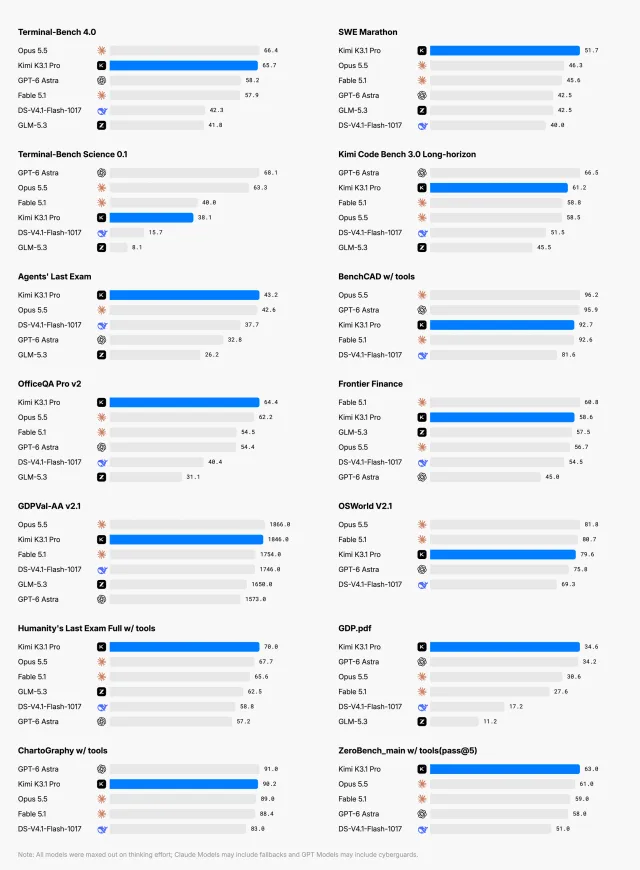
    Benchmark results for Kimi K3.1 Pro and peer models across 14 coding, science, and knowledge-work evaluations

    Moonshot AI releases Kimi K3.1 Pro, the first model in the K3.1 series and its strongest 3T-class open-weight model to date, with a 1 million token context window, alongside Kimi K3.1 Pro Highspeed, which is 2-3 times faster. The model is now available on Kimi.com, Kimi Work, Kimi Code and the Kimi API, with full model weights to be released on November 4. On Terminal-Bench 4.0, K3.1 Pro scores 65.7%, higher than GPT-6 Astra's 58.2% and slightly below Claude Opus 5.5's 66.4%; on the internal ben

    Matched fieldsBody

Friday

  1. Shao Meng

    Coding Agent Leaderboard Upgrade v2.0: Claude Opus 5.5 Leads at 61.7

    Artificial Analysis released Coding Agent Index v2.0, replacing DeepSWE with Cognition's FrontierCode v1.1 and tightening repository Q&A scoring; the leaderboard evaluates model-plus-harness combinations. Currently first is Claude Code + Claude Opus 5.5 (max) at 61.7, followed by Claude Code + Sonnet 5.5 at 59.3 and Muse Code + Muse Wonder Full at 58.9; the first OpenAI combination, Codex + GPT-6 Astra, is at 54.7. For the same 21 configurations, the mean across the old and new leaderboards fell from 54.8 to 47.4, with 20 declining, mainly because FrontierCode's mean is about 45.1%, far below DeepSWE's 65.6%.

    Artificial Analysis released Coding Agent Index v2.0, replacing DeepSWE with Cognition's FrontierCode v1.1 and tightening repository Q&A scoring; the leaderboard evaluates model-plus-harness combinations. Currently first is Claude Code + Claude Opus 5.5 (max) at 61.7, followed by Claude Code + Sonnet 5.5 at 59.3 and Muse Code + Muse Wonder Full at 58.9; the first OpenAI combination, Codex + GPT-6 Astra, is at 54.7. For the same 21 configurations, the mean across the old and new leaderboards fell

    Matched fieldsBody

  2. Shao Meng

    SkyRL extends GLM-5.3-Flash training context to 1 million tokens

    Through four types of system optimizations, SkyRL achieves a single-sequence training length of 1 million tokens for GLM-5.3-Flash on B200, with a peak of about 144.5 GiB, roughly 64 times that of the out-of-the-box Megatron baseline. The optimizations include running DSA on sparse kernels, chunking by query and sharding the indexer by TP, recomputing full-layer activations and CPU offloading layer inputs, and removing redundant fp32 upcasting. On real book data, the 512k peak is about 122 GiB, and 1M (CP=4) is about 109 GiB; the mean absolute difference in logprob between the trainer and vLLM is about 0.04–0.07.

    Through four types of system optimizations, SkyRL achieves a single-sequence training length of 1 million tokens for GLM-5.3-Flash on B200, with a peak of about 144.5 GiB, roughly 64 times that of the out-of-the-box Megatron baseline. The optimizations include running DSA on sparse kernels, chunking by query and sharding the indexer by TP, recomputing full-layer activations and CPU offloading layer inputs, and removing redundant fp32 upcasting. On real book data, the 512k peak is about 122 GiB,

    Matched fieldsBody

  3. TMTPost · AGI

    San Francisco AI venture capital data packaging: buying GitHub stars for 6 cents, annualizing two-week orders into full-year ARR

    TMTPost AGI sorts through the data packaging tactics in the San Francisco AI venture capital circle, including multiplying a $3 million order from two weeks by 26 to claim externally about $80 million in ARR, startups mutually signing $5 million letters of intent, and buying GitHub stars at 6 cents each. The article also mentions that such practices likewise exist in the circles of large model labs and computing power centers, and cites industry insiders saying that the previous company that inflated $220 million in revenue by swapping invoices has already gone bankrupt.

    TMTPost AGI sorts through the data packaging tactics in the San Francisco AI venture capital circle, including multiplying a $3 million order from two weeks by 26 to claim externally about $80 million in ARR, startups mutually signing $5 million letters of intent, and buying GitHub stars at 6 cents each. The article also mentions that such practices likewise exist in the circles of large model labs and computing power centers, and cites industry insiders saying that the previous company that inf

    Matched fieldsBody

  4. The Paper

    MiniMax open-sources the M3.1 Flash model, reducing usage cost by 70%

    MiniMax announced on October 23 the open-sourcing of the M3.1 Flash model, which processed over 100 trillion tokens within 72 hours of launch. Compared with the previous generation M3, M3.1 Flash has comprehensively improved capabilities, with usage cost reduced by 70% and online inference speed increased by nearly 3 times. MiniMax stated it will work with chip manufacturers such as Huawei Ascend, NVIDIA, and AMD, as well as inference frameworks and communities such as vLLM, SGLang, and Hugging Face, to advance day-one open-source integration.

    MiniMax announced on October 23 the open-sourcing of the M3.1 Flash model, which processed over 100 trillion tokens within 72 hours of launch. Compared with the previous generation M3, M3.1 Flash has comprehensively improved capabilities, with usage cost reduced by 70% and online inference speed increased by nearly 3 times. MiniMax stated it will work with chip manufacturers such as Huawei Ascend, NVIDIA, and AMD, as well as inference frameworks and communities such as vLLM, SGLang, and Hugging

    Matched fieldsBody

  5. English text is being prepared.

    CAICT Report: In 2026, Average Prices of Domestic Large Models Doubled, and Per-Second Throughput Also Doubled

    The "Large Model Token Service Performance Monitoring Report (2026)," jointly released by the China Academy of Information and Communications Technology (CAICT) and other institutions, shows that in August 2026, the average TPS of domestic models reached 78.23, double the 2025 average of 38.25; however, typical foreign models stood at 112.82 in the same period, still higher than domestic models. The normalized average price of domestic token services rose from 6.8 yuan in the second half of 2025 to 13.46 yuan, an increase of nearly 1x; in June 2026, average daily domestic token consumption was about 500 trillion, nearly 4 times that of December 2025. Among the monitored models, those with a context length of 1M accounted for 47.8%, and those with 200K and above totaled 95.7%.

    The "Large Model Token Service Performance Monitoring Report (2026)," jointly released by the China Academy of Information and Communications Technology (CAICT) and other institutions, shows that in August 2026, the average TPS of domestic models reached 78.23, double the 2025 average of 38.25; however, typical foreign models stood at 112.82 in the same period, still higher than domestic models. The normalized average price of domestic token services rose from 6.8 yuan in the second half of 2025

    Matched fieldsBody

  6. Phoenix Technology

    Microsoft Launches AI Diagnostic System MAI-DxO, Achieving 83% Accuracy on Complex Cases

    Microsoft announced the launch of its AI diagnostic system, Microsoft AI Diagnostic Orchestrator (MAI-DxO), which simulates a multidisciplinary expert consultation by orchestrating multiple AI agents. In an evaluation based on common cases from U.S. emergency departments using the MIMIC-IV-ED dataset, its diagnostic accuracy was 1.7 times that of human physicians; in a simulated evaluation based on complex cases from The New England Journal of Medicine, it achieved 83% accuracy, compared with 36% for primary care general practitioners and general internists who could independently consult reference materials, while specialists were not included in the comparison. Officials said the system's cost is only half or even one-third that of physicians, and the research findings have been published in the journal Science.

    Microsoft announced the launch of its AI diagnostic system, Microsoft AI Diagnostic Orchestrator (MAI-DxO), which simulates a multidisciplinary expert consultation by orchestrating multiple AI agents. In an evaluation based on common cases from U.S. emergency departments using the MIMIC-IV-ED dataset, its diagnostic accuracy was 1.7 times that of human physicians; in a simulated evaluation based on complex cases from The New England Journal of Medicine, it achieved 83% accuracy, compared with 36

    Matched fieldsBody

  7. IT Home · Artificial Intelligence

    Microsoft launches AI medical diagnostic system MAI-DxO, achieving 83% accuracy on complex cases

    Microsoft announced the launch of the AI diagnostic system MAI-DxO (Microsoft AI Diagnostic Orchestrator), which simulates a multidisciplinary expert consultation of physicians by uniformly orchestrating multiple AI agents. In a simulated evaluation based on complex NEJM cases, its diagnostic accuracy reached 83%, compared with 36% for primary care general practitioners and general internists who could independently consult reference materials; in an evaluation of common U.S. emergency department visit cases based on the MIMIC-IV-ED dataset, its accuracy was 1.7 times that of human physicians. Officials said the system costs only half or even one-third of what physicians cost, and the research results have been published in the journal Science.

    Microsoft announced the launch of the AI diagnostic system MAI-DxO (Microsoft AI Diagnostic Orchestrator), which simulates a multidisciplinary expert consultation of physicians by uniformly orchestrating multiple AI agents. In a simulated evaluation based on complex NEJM cases, its diagnostic accuracy reached 83%, compared with 36% for primary care general practitioners and general internists who could independently consult reference materials; in an evaluation of common U.S. emergency departmen

    Matched fieldsBody

  8. PyTorch Blog

    PyTorch Conference 2026 held in San Jose, announces progress on TorchTPU and TorchNeuron

    PyTorch Conference North America 2026 was held on October 20–21 in San Jose, attracting more than 3,500 attendees and focusing on accelerating open intelligence and projects including PyTorch, vLLM, DeepSpeed, Ray, Helion, and Safetensors. The event announced TorchTPU, a native PyTorch TPU backend developed in collaboration between Google and Meta, as well as TorchNeuron, a native backend for AWS Trainium, which entered public testing under Apache 2.0 on October 20. Shopify shared a case study of building a continuous learning loop with PyTorch and vLLM, saying it compresses production failures into model weights every day and has reduced serving costs by 96%.

    PyTorchCon community expo

    PyTorch Conference North America 2026 was held on October 20–21 in San Jose, attracting more than 3,500 attendees and focusing on accelerating open intelligence and projects including PyTorch, vLLM, DeepSpeed, Ray, Helion, and Safetensors. The event announced TorchTPU, a native PyTorch TPU backend developed in collaboration between Google and Meta, as well as TorchNeuron, a native backend for AWS Trainium, which entered public testing under Apache 2.0 on October 20. Shopify shared a case study o

    Matched fieldsBody

Thursday

  1. Shao Meng

    Stanford CS 329Z Lecture 9 Outlines the Selection of Agent System Optimization Methods

    Lecture 9 of Stanford's CS 329Z course presents a selection diagram for Agent system optimization: the prerequisite for optimization is having data, a system, and evaluation metrics all in place; generally, context optimization (prompts and few-shots) is done first because it is cheap, fast, and sample-efficient; when context optimization is insufficient, or when you want to distill capabilities into a small model, or when prompts grow longer and longer, then you move on to changing the weights. The lecture notes also review reflective prompt optimization methods such as OPRO, MIPROv2, TextGrad, and GEPA; weight optimization paths such as SFT, RL (PPO vs. GRPO), and on-policy distillation; and approaches that let agents self-optimize, such as the Darwin Gödel Machine, Meta-Harness, and karpathy's autoresearch. They also point out that agents are already decent optimizers, making evaluation metrics the link that most needs to be controlled.

    Lecture 9 of Stanford's CS 329Z course presents a selection diagram for Agent system optimization: the prerequisite for optimization is having data, a system, and evaluation metrics all in place; generally, context optimization (prompts and few-shots) is done first because it is cheap, fast, and sample-efficient; when context optimization is insufficient, or when you want to distill capabilities into a small model, or when prompts grow longer and longer, then you move on to changing the weights.

    Matched fieldsBody

  2. LMSYS Blog

    LMSYS uses Miles to train a SWE agent on MI355X, SWE-bench Verified…

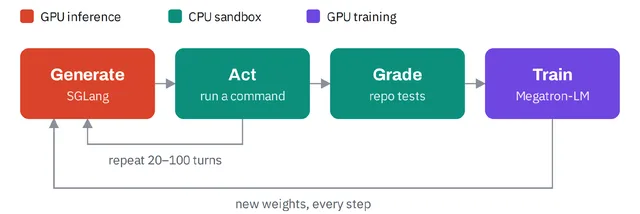
    LMSYS used Miles, SGLang, Megatron-LM, and Harbor to perform fully asynchronous agent reinforcement learning on Qwen3-30B-A3B-Instruct on AMD Instinct MI355X, raising pass@1 from 7.3% to 27.5% on a 100-task stratified subset of SWE-bench Verified. Training was conducted in two stages: first SFT on approximately 4,000 public trajectories from Open-SWE-Traces, then GRPO on approximately 1,350 SWE-smith tasks. After fixing the model and RL recipe, scaling inference from 1 node to 3 8-GPU nodes, switching to E2B cloud sandboxes, and removing the concurrency limit increased rollout throughput from approximately 860 to approximately 3,480 trajectories/hour; limiting trajectory length on the same 8-GPU node reduced single-step training time from 850 seconds to 284 seconds.

    Agentic RL loop: SGLang generates actions, a CPU sandbox executes and grades them, and Megatron-LM trains on the resulting trajectories.

    LMSYS used Miles, SGLang, Megatron-LM, and Harbor to perform fully asynchronous agent reinforcement learning on Qwen3-30B-A3B-Instruct on AMD Instinct MI355X, raising pass@1 from 7.3% to 27.5% on a 100-task stratified subset of SWE-bench Verified. Training was conducted in two stages: first SFT on approximately 4,000 public trajectories from Open-SWE-Traces, then GRPO on approximately 1,350 SWE-smith tasks. After fixing the model and RL recipe, scaling inference from 1 node to 3 8-GPU nodes, swi

    Matched fieldsBody

Wednesday

  1. Baseten Base Labs: Model ResearchSelected

    Baseten Base Labs releases decision models mammoth-1 and elephant-1

    Baseten's Base Labs releases two decision models, elephant-1 (9B) and mammoth-1 (27B), both fully fine-tuned from Qwen3.5, with model weights publicly released. mammoth-1 ranks first among 208 models on the Jev Decision Index 0.4 with a score of 71.24, leading the second-place Perplexity Decider v1.2 by 1.8 points; elephant-1 scores 62.65 on that leaderboard and ties for first with d1-ultra on the Artificial Analysis Decision Index with a score of 65. Training used the eighth version of the data mixture with 6.21M samples, and replaced the full-attention layers with a block bidirectional attention mask; under fixed data, this change raised the public 10k-sample score from 44.8 to 48.6.

    Max Kirkby

    Baseten's Base Labs releases two decision models, elephant-1 (9B) and mammoth-1 (27B), both fully fine-tuned from Qwen3.5, with model weights publicly released. mammoth-1 ranks first among 208 models on the Jev Decision Index 0.4 with a score of 71.24, leading the second-place Perplexity Decider v1.2 by 1.8 points; elephant-1 scores 62.65 on that leaderboard and ties for first with d1-ultra on the Artificial Analysis Decision Index with a score of 65. Training used the eighth version of the data

    Matched fieldsBody

  2. ChinaTalkSelected

    China's Ministry of Commerce plans to include AI models in the export control catalog

    China's Ministry of Commerce and Ministry of Science and Technology issued Announcement No. 48 of 2026 on October 16, proposing to add 40 items to the Catalogue of Technologies Prohibited or Restricted from Export in China, of which 14 are prohibited from export and 26 are restricted from export, and to implement pre-export registration for all newly added technologies effective immediately. The draft sets three thresholds for frontier models: ≥10^26 FLOP, ≥2T parameters, or reaching a globally leading level, and also covers AI chip design, memory chips, ten-thousand-card-level clusters, agents, AIGC detection tools, training data, and cyber offense and defense capabilities; scenarios such as open source, self-built overseas data centers, and overseas tape-out may use the report-and-export channel. The public comment period runs until November 15.

    China's Ministry of Commerce and Ministry of Science and Technology issued Announcement No. 48 of 2026 on October 16, proposing to add 40 items to the Catalogue of Technologies Prohibited or Restricted from Export in China, of which 14 are prohibited from export and 26 are restricted from export, and to implement pre-export registration for all newly added technologies effective immediately. The draft sets three thresholds for frontier models: ≥10^26 FLOP, ≥2T parameters, or reaching a globally

    Matched fieldsBody

  3. Semiconductor Industry Observer

    Dongfang Suanxin's 128-card 3D chip cluster goes live, sprinting toward thousand-card delivery by year-end

    At the Guoxin Exhibition, Dongfang Suanxin announced that its 128-card DF1000 training cluster is running stably and that it has achieved large-scale training cluster delivery, with plans to achieve thousand-card-level cluster delivery by the end of the year. The cluster trained continuously for 72 hours without interruption and has carried training tasks for models such as Llama2-70B and Step 130B; the hundred-billion-parameter-level Step 130B completed training adaptation in only 7 days. The DF1000 adopts 3D-stacked near-memory computing, with per-chip memory access bandwidth of 6.4TB/s, and has completed a closed loop across the domestic industrial chain from chip design and 14nm wafer manufacturing to 3D hybrid bonding packaging.

    At the Guoxin Exhibition, Dongfang Suanxin announced that its 128-card DF1000 training cluster is running stably and that it has achieved large-scale training cluster delivery, with plans to achieve thousand-card-level cluster delivery by the end of the year. The cluster trained continuously for 72 hours without interruption and has carried training tasks for models such as Llama2-70B and Step 130B; the hundred-billion-parameter-level Step 130B completed training adaptation in only 7 days. The D

    Matched fieldsBody